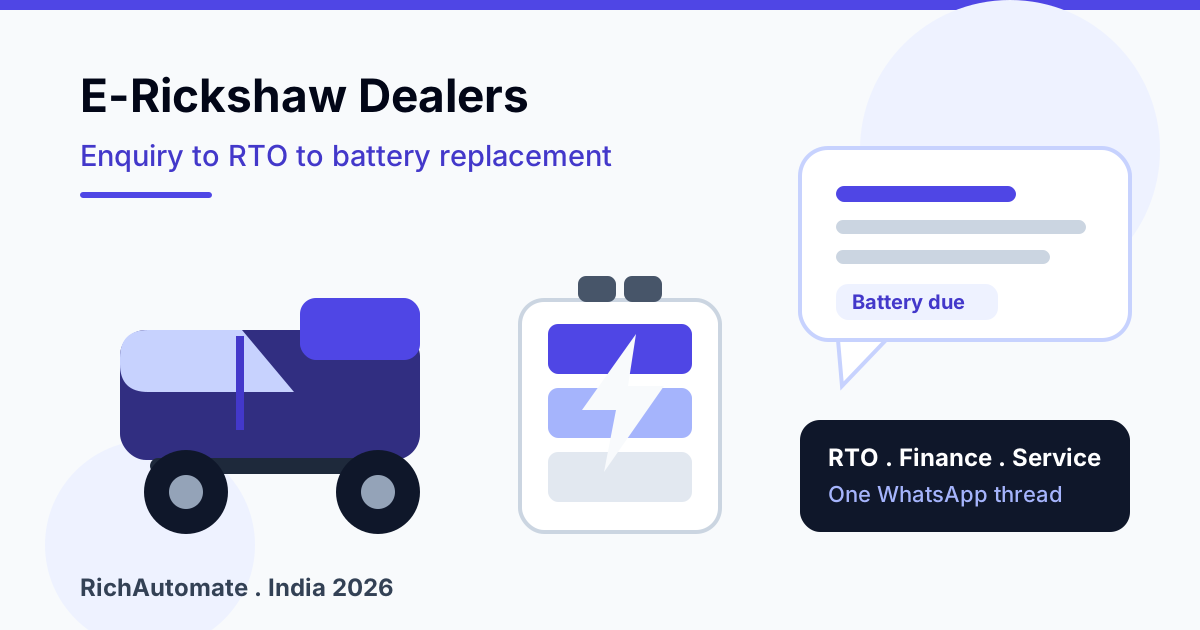
E-rickshaw dealers in India use WhatsApp as the single thread that carries one buyer from walk-in enquiry through finance paperwork, RTO registration, delivery handover and service reminders to the battery-replacement sale. Because a battery pack has a known replacement clock from the day of delivery, the dealer who keeps that thread alive owns the second sale, the third sale and the driver's referrals — and the dealer who lost the phone number does not.
This is a dealer-side operational playbook, not a policy note. Rules for battery-operated vehicle registration, permits, type approval, subsidies, battery waste handling, GST and digital lending all shift, and they vary by state RTO. Treat every rule mentioned here as a prompt to check the current notification on the relevant official portal before you print it on a delivery checklist.
Why an e-rickshaw dealership is a WhatsApp-shaped business
Three things make this category unusually well suited to a structured WhatsApp workflow. First, the buyer is almost always a driver-owner or a small fleet owner who does not use email — the phone number is the account. Second, the sale is paperwork-heavy: identity and address proof, a financier's document set, an invoice, a registration file and often a permit, most of which arrive as photographs from a phone camera. Third, and most importantly, the product has a consumable inside it. The vehicle keeps running for years; the battery does not.
India registers on the order of six to seven lakh electric three-wheelers a year across e-rickshaw and e-cart categories, and electric three-wheelers have accounted for something close to half of all electric vehicle registrations in the country in recent years (both figures directional — verify current numbers on the official VAHAN dashboard). A large share of retail buyers finance the vehicle, commonly quoted somewhere between half and two-thirds of retail sales (directional — verify against your own financier mix). Whatever the exact split, the operational shape is the same: high unit volume, modest ticket size, heavy documentation, and a near-guaranteed repeat purchase on a predictable clock.
The seven-stage dealer lifecycle, mapped to message types
The useful way to design this is stage by stage, being explicit about what each message prevents. On WhatsApp Business Platform terms, a template you send outside an open conversation is either utility — transactional, tied to something the customer did or bought — or marketing, which is promotional and needs opt-in. Getting that classification right is what keeps cost sane and quality ratings healthy.
If you would rather start from something proven, the WhatsApp template library has formats you can adapt.
| Lifecycle stage | Message type | What it prevents |
|---|---|---|
| Walk-in or call enquiry | Service conversation: model list, price range, showroom location | The enquiry dying inside a salesman's personal phone |
| Finance document collection | Utility checklist plus per-document acknowledgement | Half-complete files, three re-visits, deal drift |
| RTO registration and permit | Utility status update at each milestone | Daily "what happened to my papers" calls tying up counter staff |
| Delivery and charging handover | Utility handover pack: invoice, warranty, charging do and don't | Wrong-charging warranty disputes in month three |
| Service and battery-health follow-up | Utility service-due and post-job reminders | Silent churn to the roadside mechanic |
| Battery replacement window | Utility reminder first, then a marketing offer on opt-in | Losing the highest-margin repeat sale you had already scheduled |
| Fleet and driver-referral repeat orders | Marketing broadcast to opted-in owners | Treating a twelve-vehicle fleet owner like a one-time buyer |
Enquiry and finance documents: the two stages that leak most
Capture the enquiry into a thread, not a diary
Most dealerships already receive enquiries on WhatsApp — they just receive them on four different salesmen's personal numbers, where nothing is searchable and nothing survives a resignation. Moving to a single business number with a shared inbox changes the unit of work from a person to a thread. A simple automated first reply carrying model options, on-road price ranges, showroom timings and one qualifying question — buying for yourself or for a fleet? — does more for conversion than any brochure, because it answers within seconds and it tags the lead while intent is hot.
Collect the financier's document set as a checklist
Loan files fail on missing pages, not on missing customers. Sending a numbered checklist and acknowledging each document as it arrives — "received: address proof, 2 of 6" — converts a vague chase into a visible progress bar, and it gives the showroom a defensible record of what was asked for and when. Two guardrails matter here. The dealer is not the lender: the bot must never quote an interest rate, never say a loan is approved, and never predict eligibility. And documents belong to the customer, so you ask for explicit consent in the thread before forwarding anything to a financier, and you name that financier. RBI's digital lending and fair-practice expectations sit primarily on the regulated lender, but a dealer acting as a collection point should behave as though they applied and keep its own role narrow and documented (verify the current circulars). If you also retail used or exchange vehicles, the same discipline is worked through in our guide to WhatsApp workflows for refurbished-vehicle finance.
RTO registration and permits: turn status calls into status messages
Registration of battery-operated three-wheelers sits under the Motor Vehicles Act and the Central Motor Vehicles Rules, and the practical experience differs sharply by state: documentation, whether a permit is required for the passenger variant, fitness formalities and local municipal or police clearances are all state-textured. Only models carrying valid type approval and certification from a notified testing agency such as ARAI or ICAT should be retailed at all (verify the current AIS and CMVR requirements plus the approved-model position in your state before you commit a delivery date to a customer).
The dealer's job at this stage is not legal interpretation, it is expectation management. Four utility messages — file submitted, application number generated, registration granted, RC and permit ready for collection — remove almost all of the inbound status traffic. Each message carries a date and the exact document list needed at collection. When a state office adds a step, you edit one template instead of re-explaining it fifty times at the counter.
Delivery handover and the battery-care thread
Delivery is where dealers quietly create their own warranty problems. A driver who charges a fresh pack on a loose extension board, drains it flat every night and tops it up in forty-degree afternoon heat will produce a range complaint within months, and that complaint will arrive as an accusation. The fix is boring and effective: send the handover pack in the thread as a permanent record — invoice, warranty terms, the charger's rating, a short do-and-don't list, and the service schedule. It costs one utility message and it is exactly the evidence you will want in month four.
Then keep a light touch on battery health. A short check-in at fixed intervals asking about range and charging time gives you a usable early-warning signal: a driver reporting a sharp range drop is either a warranty claim you want to catch early or a replacement sale you want to catch early. Dealers who also run swap or charging infrastructure will recognise the same telemetry-to-message pattern used in battery-swap network operations on WhatsApp, and the workshop mechanics of job cards, estimate approvals and service-due reminders are laid out in our two-wheeler service workshop playbook.
The money message: the replacement clock and the pack you take back
The clock you already know at the point of sale
This is the argument for the whole system. On the day you deliver an e-rickshaw, you can already estimate when its battery will need replacing. Hard commercial duty on lead-acid packs is commonly described as roughly twelve to eighteen months before usable capacity falls away, while lithium packs are usually described in years rather than months (both directional and heavily duty-cycle dependent — verify against the specific pack, chemistry and warranty terms you actually sell). Either way you are holding a dated, per-customer future purchase order that most dealerships never write down anywhere.
Get the India 2026 WhatsApp BSP price comparison
Wati vs AiSensy vs Interakt vs RichAutomate: Meta rates, platform fees and hidden costs, side by side. We send it to your WhatsApp in a minute.
| Ownership factor (illustrative — verify locally) | Lead-acid pack | Lithium pack |
|---|---|---|
| Upfront cost to the driver-owner | Lower; keeps the on-road price entry-level | Higher; more often needs finance to clear |
| Typical replacement interval under hard duty | Months rather than years — frequent repeat sale | Years — fewer but larger repeat sales |
| Sensitivity to charging discipline | High: deep discharge and heat punish pack life | Partly managed by the BMS, still heat sensitive |
| Reminder cadence that works for the dealer | Periodic health check-ins, then a replacement-window nudge | Annual health check plus a warranty-milestone nudge |
| Old-pack handling at replacement | Take-back and channelisation duty applies | Take-back and channelisation duty applies |
Operationally this is three fields and three templates. At delivery, store pack type, capacity and delivery date against the contact. Schedule a health check-in ahead of the expected window, a replacement reminder inside it, and then — only for customers who opted in to promotional messages — an exchange offer stating the buyback value of the old pack. The reminder is utility in character; the offer is marketing. Keep them as separate templates so the classification stays defensible and so a customer who wants service messages but no offers can have exactly that.
Battery Waste Management Rules: the obligation that makes buyback easy
A used e-rickshaw battery is regulated waste, not scrap. The Battery Waste Management Rules, 2022 place extended producer responsibility on producers and place collection and channelisation duties along the chain that includes dealers, covering lead-acid and lithium-ion batteries alike, with the clear intent that end-of-life packs reach registered recyclers rather than informal smelters (verify your exact obligations, registration requirements and record-keeping formats under the current version of the rules and any state pollution control board guidance).
The commercial reading is the interesting one. You are already expected to take the old pack back, so make take-back the hook of the replacement sale instead of an afterthought. A reminder that says "bring your old pack, we handle channelisation to a registered recycler, and the buyback value comes off your new pack" is compliance and conversion in a single message. Log the returned pack against the customer in the thread so your books and your chat history tell the same story if anyone audits the trail. Dealers who also move spares and packs downstream through sub-dealers can run the same channelisation record on the same number.
Subsidy and scheme broadcasts without over-promising
Subsidy questions arrive constantly, and answering them loosely is the fastest way for a dealership to acquire a reputation for misleading buyers. Central support for electric vehicles has moved through successive schemes, and the current central programme plus each state's EV policy has its own eligibility conditions, caps, portal and end date — all of which change with notifications mid-year. The rule for your templates is therefore simple: never state an amount as certain, always name the official portal, and always frame it as subject to scheme status and eligibility at the time of registration. A broadcast can legitimately say a window may be closing and invite an enquiry; it must not tell a specific buyer that a specific rupee amount is guaranteed.
The same restraint applies to tax framing. Vehicle, spare parts and labour are not one line item, and e-invoicing applies above a turnover threshold that has been revised more than once (verify the current rate structure and e-invoicing threshold with your chartered accountant). Send invoices as documents in the thread; do not let an automated reply answer tax questions.
Manual dealer ops versus an automated thread, and what it costs
Where the two models diverge
| Task | Manual follow-up today | WhatsApp-automated |
|---|---|---|
| Enquiry response | Whenever the salesman is free; often the next day | Auto-reply in seconds, tagged and assigned |
| Loan document chase | Repeat phone calls, no record of what is pending | Checklist with per-item acknowledgement in one thread |
| Registration status | Inbound calls to the counter all day | Four milestone messages, near-zero inbound |
| Battery replacement | Customer walks into whoever is nearest that week | Reminder scheduled from the delivery date |
| Fleet and referral orders | Depends on one relationship manager's memory | Segmented, opted-in broadcast list |
| Audit trail for documents | Photos scattered across personal phones | One business number with a retention and deletion policy |
What a dealership actually pays
RichAutomate is ₹0 setup and ₹0 monthly platform fee — you pay for usage only. There are two ways to run it, and the trade-off is explained fully in our note on Client Pay versus SaaS Pay WhatsApp billing: Client Pay is ₹0.10 per message to us with the dealer paying Meta directly for conversations, while SaaS Pay is ₹1.50 per marketing message and ₹0.50 per utility message with nothing else to settle.
Take a dealer doing 120 deliveries and around 400 service threads a month. Say roughly 800 utility messages — document checklists, registration milestones, handover packs, service and battery-health reminders — plus around 200 marketing messages for subsidy-window and exchange-offer broadcasts to opted-in owners. On SaaS Pay that is about ₹400 for the utility traffic and about ₹300 for the marketing traffic: roughly ₹700 a month, or about ₹6 per delivery. On Client Pay the platform side is about ₹100 a month plus whatever Meta bills for those conversations directly. One recovered battery replacement covers a year of it, which is why this is an operations decision rather than a software decision.
One note on expectations, because this category attracts bad advice: opt-in is not optional. Marketing templates go only to owners who agreed to receive them, quality ratings respond to how recipients react to your messages, and nobody can promise guaranteed delivery or immunity from restrictions on unsolicited bulk sending. Build the list from real customers — buyers, service visitors, fleet owners you actually supply — and the channel stays healthy on its own.
DPDP: loan documents and KYC inside a chat thread
A dealership thread ends up holding identity documents, address proof, financier paperwork and sometimes Aadhaar-based KYC images. Under the Digital Personal Data Protection Act, 2023 that is personal data collected for a stated purpose, and the practical obligations are purpose limitation, collecting no more than you need, keeping it only as long as you need it, and not disclosing it onward without consent (verify the current rules and notified timelines before finalising your policy). Concretely: state at collection why each document is needed, take explicit in-thread consent before forwarding anything to a financier and name that financier, restrict which showroom staff can open document attachments, delete what a closed deal no longer justifies keeping, and never let an automated reply make or imply a credit decision. Our DPDP Act compliance checklist for WhatsApp Business covers the consent, retention and grievance mechanics in detail.
Start with the battery clock
If you do only one thing from this playbook, do this: record pack type and delivery date for every vehicle you hand over, and schedule the replacement reminder on day one. That single habit turns a one-off vehicle sale into a customer with a calendar. Everything else here — enquiry capture, document checklists, registration milestones, take-back offers, fleet broadcasts — hangs off the same thread you already opened at the showroom door.
RichAutomate runs the whole dealer lifecycle on one WhatsApp Business number: ₹0 setup, ₹0 monthly platform fee, usage-only pricing, and a 14-day trial with 100 free credits so you can test a real registration-status template and a real battery reminder before you spend anything. Create your free RichAutomate account and set up your first delivery-to-battery flow today, or read more at richautomate.in.