All articles
Vertical

WhatsApp for Optical + Eyewear Retail India 2026: The 8-Stage Rx-to-Refill Lifecycle from Eye-Test to Contact-Lens Subscription

India organised eyewear retail crossed an estimated 13,000 crore rupees in FY26 (directional, verify), but most opticals still run the highest-margin recurring moments on phone calls and paper Rx cards. The money is not the first pair of glasses; it is the annual Rx-renewal recall, the contact-lens refill subscription, and the second and third pair per household. This guide maps the full eight-stage optical lifecycle onto a compliant WhatsApp Business stack for India 2026: eye-test booking, prescription capture, frame and lens recommendation with an AR try-on link, quote and fitting, order and UPI, ready-for-collection or dispatch, the D-330 annual Rx-renewal recall, and the contact-lens subscription refill. It treats the two hardest constraints head-on: a contact lens is a regulated medical device under the CDSCO Medical Device Rules 2017, and a prescription is sensitive health data under the DPDP Act 2023. Players from Lenskart, Titan Eyeplus and Specsmakers to single-store chains; comparison tables, an illustrative optical-chain cohort, six anti-patterns and a 12-week rollout. Regulatory specifics marked to verify; cohort numbers illustrative.

RichAutomate Editorial
14 min read 0 views
WhatsApp for Optical + Eyewear Retail India 2026: The 8-Stage Rx-to-Refill Lifecycle from Eye-Test to Contact-Lens Subscription

India's organised eyewear retail crossed an estimated ₹13,000 crore in FY26 (directional — verify against latest IBEF + brand annual reports), riding on roughly 50 crore Indians who need vision correction, a refractive-error prevalence that keeps climbing with screen time, and a smartphone base deep enough that a frame try-on link or a prescription-renewal nudge now lands in the same WhatsApp thread a customer already uses for everything else. Yet most opticals — from Lenskart, Titan Eyeplus and Specsmakers down to the single-store neighbourhood chain — still run the highest-margin recurring moments of the eyewear lifecycle on phone calls, walk-in memory and paper prescription cards. The money in optical retail is not the first pair of glasses; it is the annual Rx-renewal recall, the contact-lens refill subscription, the second and third pair per household. This guide maps the full eight-stage optical + eyewear lifecycle — eye-test booking, prescription (Rx) capture, frame and lens recommendation with an AR try-on link, quote and fitting, order and UPI payment, ready-for-collection or dispatch, the D-330 annual Rx-renewal recall, and the contact-lens subscription refill — onto a compliant WhatsApp Business stack for India 2026. It treats the two hardest constraints head-on: a contact lens is a regulated medical device under the CDSCO Medical Device Rules 2017 (commonly classed as a low-moderate-risk device), and a prescription is sensitive health data under the DPDP Act 2023. Regulatory specifics below are flagged to verify against the current rule text; cohort numbers are illustrative and marked as such.

Why WhatsApp Fits Optical Retail in India Now

Optical retail has a structure that rewards a messaging channel more than almost any other vertical:

  1. The lifecycle is inherently recurring. A spectacle prescription in India is conventionally treated as valid for about a year before a fresh eye test is advised (clinical guidance, not a hard legal expiry — verify). That gives every optical a natural annual recall event per customer, plus contact-lens wearers who reorder every 1-3 months. Recurring revenue needs a recurring channel.
  2. Prescriptions are structured, shareable data. Sphere, cylinder, axis, add and pupillary distance fit neatly into a captured digital record that powers re-orders, lens recommendation and recall — if you store it as sensitive health data correctly.
  3. High-consideration purchase, low-friction reorder. The first pair needs a try-on and a fitting; the refill or the renewal should be one tap. WhatsApp covers both ends.
  4. Family accounts. One household number often books eye tests for parents, kids and grandparents. A single thread can hold multiple linked prescriptions with consent.
  5. Lenskart and Titan Eyeplus set the expectation. Customers of large chains already expect order tracking, try-on links and reminders. A neighbourhood optical that goes silent after the sale loses the renewal to a chain that does not.

WhatsApp vs Walk-In, Phone Call and App

CapabilityWalk-in / paper cardPhone callBrand appWhatsApp Business
Eye-test bookingIn person onlyManual, office hoursApp install neededIn-thread Flow, 24x7 self-serve
Rx capture + storagePaper card, often lostNot captured digitallyStrong, but low install rateStructured record, consent-gated
Frame / lens recommendationStaff memoryHard to conveyCatalogue browseCatalogue + AR try-on link inline
Annual Rx-renewal recallRarely happensCostly, low pickupPush notification, often muted~70-90% open on a personal channel
Contact-lens refillRepeat walk-inPhone reorderApp reorderOne-tap reorder + UPI
PaymentCounter onlyNot supportedIn-app gatewayUPI deep-link / payment link in chat
Setup cost for a small opticalHigh build + low adoption₹0 platform fee, pay per message

The app column is the trap that catches mid-size chains: a beautifully built app that customers install once and never open. WhatsApp wins because it sits where attention already is, and because the optical does not have to fight for an install before it can send a renewal reminder.

The Eight-Stage Optical Lifecycle on WhatsApp

Each stage maps to a specific automation surface, a KPI to watch, and a compliance note. None of the steps below should make an efficacy or medical claim about vision outcomes — copy must stay descriptive and route clinical questions to a qualified professional.

#StageWhatsApp automation surfacePrimary KPICompliance note
1Eye-test bookingBooking Flow: store, date, slot, family memberBooked-slot fill rateConsent capture at first contact (DPDP)
2Prescription (Rx) capturePost-test Rx record + PDF, stored as sensitive data% tests with digital Rx storedRx = sensitive health data, Sec 8 duties (verify)
3Frame / lens recommendation + AR try-onCatalogue cards + AR try-on deep-linkTry-on link click-throughNo vision-correction efficacy claims
4Quote + fitting appointmentItemised quote + fitting slot bookingQuote-to-fitting conversionLegal Metrology: declare lens pack details (verify)
5Order + UPIOrder summary + UPI deep-link / payment linkQuote-to-paid conversionRBI payment-aggregator rules via gateway (verify)
6Ready-for-collection / dispatchStatus update + tracking + collection slotTime-to-collect, dispatch SLAOrder-status messages within service window
7Rx-renewal recall (D-330)Annual eye-test nudge timed to last testRecall-to-rebook conversionMarketing template + opt-in honoured
8Contact-lens subscription refillRefill reminder + one-tap reorder + UPI mandateRefill uptake, subscription churnContact lens = CDSCO medical device (verify class)

Stage 1-3: Booking, Rx Capture and AR Try-On

The front half of the lifecycle is where you earn the right to the recurring back half. A WhatsApp booking Flow asks the customer which store, which date, which slot and which family member the test is for, and writes the result straight into the optical's calendar. After the optometrist completes the eye test, the optical sends a clean digital prescription — sphere, cylinder, axis, add, pupillary distance — as a structured record plus a downloadable PDF. This single act replaces the paper Rx card that customers lose within weeks, and it becomes the seed data for every later recommendation, recall and refill.

For frame and lens selection, send catalogue cards filtered to face-shape and budget, each with a deep-link into an AR try-on experience hosted on the brand's site or a partner SDK. The try-on link is the bridge between an in-store-feeling decision and a remote purchase: the customer sees the frame on their own face, then replies in-thread to lock a choice. Keep the copy descriptive — frame material, lens coating options, weight — and never imply a clinical vision outcome.

Prescriptions are sensitive health data. Under the DPDP Act 2023, a person's eye prescription is health information and likely falls within the more careful handling expectations for sensitive personal data (verify the exact treatment under the current Act and DPDP Rules). Practically: capture explicit consent before storing an Rx, state the purpose (re-orders, recall, lens fulfilment), let the customer withdraw consent and request erasure, restrict internal access, and never share the Rx with a third party without a fresh basis. Treat a child's prescription with extra care and verifiable parental consent where required. Build this in from day one — retrofitting consent onto an existing prescription database is painful.

Stage 4-6: Quote, Fitting, Order, UPI and Fulfilment

Once a frame and lens are chosen, send an itemised quote: frame, lens type, coatings, any tint, and the all-in price with taxes. Pair it with a fitting-appointment slot picker so the customer locks both the purchase intent and the in-store fitting in one exchange. On confirmation, present an order summary and a UPI deep-link or payment link generated through your payment gateway — the customer pays from the same thread, and the order moves to fulfilment.

Fulfilment messaging is where optical retail differs from fast fashion: lenses are often ground to prescription, so there is a genuine production lag of a few days between order and ready-for-collection. Use that honestly. A status thread that says "lenses in grinding", then "quality check passed", then "ready for collection at MG Road, anytime till 8pm" converts a waiting period into a trust-building sequence. For dispatched orders, attach courier tracking. For collection, offer a slot so the store is not crowded.

Contact lenses carry device rules; lens packaging carries metrology rules. A contact lens in India is regulated as a medical device under the CDSCO Medical Device Rules 2017 and is commonly placed in a low-moderate risk class (verify the exact classification and any import-licence or labelling duties for your SKUs). That means the seller must respect device labelling, expiry, batch traceability and any sale conditions that apply — and must not make therapeutic claims the licence does not support. Separately, Legal Metrology packaging rules govern declarations on the pack (quantity, MRP, expiry, importer / manufacturer details where applicable — verify what applies to your products). Keep WhatsApp copy aligned with what is on the compliant pack; do not invent claims in chat that the label does not carry.

Stop overpaying on WhatsApp

Get a 1-minute BSP audit on WhatsApp

Drop your WhatsApp number — we line-item your current invoice against Meta India rates in under 60 seconds. India-hosted, DPDP-compliant.

DPDP-compliant · India-hosted · 1-min reply

Stage 7: The D-330 Rx-Renewal Recall — The Profit Engine

This is the stage most opticals skip and the one that pays for the whole stack. A spectacle prescription is conventionally treated as advisable to refresh roughly annually (clinical guidance — verify; not a fixed legal expiry). So roughly 330 days after a customer's last eye test, you have a near-perfect reason to reach out: time for an annual check, your prescription may have changed, here is a one-tap slot to re-book. Because the message is timed to the individual's own test date and framed as a health-conscious reminder rather than a discount blast, pickup is dramatically higher than a generic promo.

The recall is a marketing-category template, so it must go only to opted-in customers and honour withdrawal. Keep it caring, not pushy: lead with the eye-health reason, offer the booking, and let the frame upsell follow naturally once the new prescription is in hand. The renewal recall does double duty — it drives the eye-test revisit and it re-opens the recommendation funnel for a second or third pair.

Recall channelTypical reach / openCost per contactPersonalisation to last test dateCompliance load
SMSDelivered, low openLow-mediumPossible but rarely doneDLT registration for SMS (verify)
Outbound callLow connect rateHigh (staff time)ManualDND / telecom rules (verify)
EmailLow open in this segmentVery lowPossibleLight
Brand-app pushGated by install + muteLowStrongApp-store + consent
WhatsApp templateHigh open on personal channelPer-message, lowNative — timed to D-330Opt-in + marketing template approval

Stage 8: Contact-Lens Subscription Refill

Contact-lens wearers are the highest-frequency optical customers: daily disposables, fortnightly or monthly lenses all run out on a predictable cadence. A refill reminder timed to expected run-out, with a one-tap reorder and an optional UPI auto-pay mandate, turns a leaky manual reorder into a subscription. Because the lens is a medical device, the refill flow should confirm the prescription on file is current (and prompt an eye-test re-book if it has aged past the renewal window), respect any sale conditions on the SKU, and surface expiry and batch where relevant.

Done well, the contact-lens subscription is the stickiest relationship in optical retail: the customer never runs out, the optical owns a recurring UPI mandate, and the annual Rx-renewal recall keeps the underlying prescription fresh so refills stay compliant. The two recurring engines — renewal recall and lens subscription — reinforce each other.

Illustrative Optical-Chain Cohort (Illustrative — Not a Guarantee)

The numbers below are an illustrative model for a mid-size regional optical chain (roughly 12 stores, a few tens of thousands of customer records) that moved the eight-stage lifecycle onto a compliant WhatsApp stack. They are directional, marked illustrative, and not a promise of results.

MetricBefore (manual)After (WhatsApp lifecycle)Delta
Tests with a digital Rx stored~30%~88%+58pp
AR try-on link click-through~34%new surface
Quote-to-paid conversion~41%~58%+17pp
Annual Rx-renewal recall conversion~6% (ad-hoc calls)~29%+23pp
Repeat-purchase rate (12-month)~22%~46%+24pp
Contact-lens subscription uptake~9%~31%+22pp
"Is my order ready" inbound callsBaseline-61%deflected to status thread

The single biggest swing is the Rx-renewal recall: lifting renewal conversion from an ad-hoc few percent to a structured high-twenties percentage is what compounds repeat-purchase rate and feeds the subscription engine.

Six Anti-Patterns to Avoid

  1. Storing prescriptions without consent. An Rx is sensitive health data. Capturing it into a CRM without explicit, purpose-stated consent is a DPDP exposure (verify duties). Consent first, always.
  2. Making clinical claims in chat. Do not imply vision-correction outcomes or therapeutic benefits in WhatsApp copy. Stay descriptive; route clinical questions to a qualified optometrist.
  3. Ignoring contact-lens device rules. Treating lenses like ordinary merchandise — no expiry, batch or sale-condition handling — ignores their CDSCO medical-device status (verify class and duties).
  4. Generic blast instead of D-330 timing. A "20% off frames" broadcast to everyone wastes the channel. The renewal recall must be timed to each customer's own last test date to earn its high pickup.
  5. Letting the paper Rx card survive. If the prescription still lives on a card the customer loses, you have no recall trigger, no refill base and no recommendation seed. Digitise at capture.
  6. No fulfilment honesty. Hiding the lens-grinding lag breeds "is it ready" calls. A transparent status thread converts the wait into trust.

A 12-Week Rollout

  1. Weeks 1-2: Consent + data foundation. Add DPDP consent capture at first contact, define the Rx as sensitive data with restricted access, retention and erasure paths. Verify CDSCO + Legal Metrology duties for your lens SKUs.
  2. Weeks 3-4: Booking + Rx capture Flows. Eye-test booking Flow into the store calendar; post-test digital Rx record + PDF.
  3. Weeks 5-6: Recommendation + AR try-on. Catalogue cards, AR try-on deep-link, in-thread frame selection.
  4. Weeks 7-8: Quote, fitting, order, UPI. Itemised quote, fitting slot, UPI payment link, order confirmation.
  5. Weeks 9-10: Fulfilment status + collection. Grinding-to-ready status thread, courier tracking, collection slots.
  6. Weeks 11-12: Recurring engines live. D-330 renewal recall timed to last test; contact-lens refill reminders + one-tap reorder + optional UPI mandate. Dashboard the eight KPIs.

Compliance Stack Summary

  • DPDP Act 2023: Prescription = sensitive health data; explicit consent, purpose limitation, withdrawal, erasure, access control, extra care for minors (verify exact sensitive-data treatment under the Act + DPDP Rules).
  • CDSCO Medical Device Rules 2017: Contact lens is a regulated medical device, commonly low-moderate risk class; respect labelling, expiry, batch traceability, sale conditions, no unsupported claims (verify class + licence duties).
  • Legal Metrology packaging rules: Declarations on lens / packaged-goods packs — quantity, MRP, expiry, importer/manufacturer where applicable (verify scope).
  • Opticians / paramedical council norms: Eye tests and dispensing should be performed by appropriately qualified persons per applicable state / council rules (verify).
  • Advertising norms (ASCI + sector rules): No misleading or unsubstantiated claims about vision correction or device benefits (verify).
  • RBI payment-aggregator rules: UPI / payment links flow through a compliant gateway (verify).

Run the full optical lifecycle on RichAutomate.

Eye-test booking Flows, consent-gated digital Rx capture, AR try-on deep-links, itemised quotes with UPI payment links, grinding-to-ready fulfilment threads, the D-330 annual Rx-renewal recall timed to each customer's last test, and contact-lens subscription refills with one-tap reorder — all on a compliant WhatsApp Business stack. Built for India 2026: prescriptions handled as sensitive health data, contact-lens device and Legal Metrology constraints respected, no clinical claims. ₹0 platform fee. Client Pay: ₹0.10 per message plus Meta's per-conversation charge billed direct, or SaaS Pay at ₹1.20 marketing / ₹0.30 utility-auth all-in. 14-day free trial with 100 credits. Regulatory specifics should be verified against current rule text.

Start your 14-day trial →

Ready to ship this?

Get the full migration playbook on WhatsApp

A founder-led 1-minute reply with the migration steps, template approval timeline, and a 14-day pilot offer. DPDP-compliant. India-hosted. No spam.

DPDP-compliant · India-hosted · 1-min reply
Tagged
Optical RetailEyewearContact LensPrescriptionCDSCODPDPWhatsAppD2CIndia2026
Written by
RichAutomate Editorial
Editorial team at RichAutomate. We build the WhatsApp Business automation platform Indian D2C brands, fintechs, and agencies use to ship campaigns and flows on the official Meta Cloud API.
FAQ

Frequently asked questions

Is a customer eye prescription sensitive data under the DPDP Act 2023?
Treat it as such. An eye prescription is health information about an identifiable person, and health data is generally handled with greater care under Indian data-protection expectations (verify the exact sensitive-data treatment under the current DPDP Act 2023 and DPDP Rules). In practice an optical should capture explicit consent before storing an Rx, state the purpose such as re-orders, recall and lens fulfilment, allow withdrawal of consent and erasure on request, restrict internal access, and apply extra care with verifiable parental consent for a minor. Build consent in at capture rather than retrofitting it onto an existing prescription database.
Are contact lenses regulated as medical devices in India?
Yes. A contact lens is regulated as a medical device under the CDSCO Medical Device Rules 2017 and is commonly placed in a low-to-moderate risk class (verify the exact classification, and any import-licence or labelling duties for your specific SKUs). The practical effect is that a seller should respect device labelling, expiry, batch traceability and any conditions of sale, and must avoid making therapeutic or vision-correction claims the product licence does not support. WhatsApp refill copy should stay aligned with what the compliant pack actually declares.
What is the D-330 Rx-renewal recall and why does it matter?
A spectacle prescription is conventionally treated as advisable to refresh roughly once a year (clinical guidance, not a fixed legal expiry, so verify). The D-330 recall is a WhatsApp message sent about 330 days after a customer last had an eye test, framed as a caring annual-check reminder with a one-tap slot to re-book. Because it is timed to the individual customer rather than blasted to everyone, pickup is much higher than a generic discount promo. It is the profit engine of optical retail because it revives the eye-test revisit and re-opens the second-pair recommendation funnel. It is a marketing-category template, so send only to opted-in customers.
How does the contact-lens subscription refill work on WhatsApp?
Lens wearers run out on a predictable cadence, so the optical sends a refill reminder timed to expected run-out, with a one-tap reorder and an optional UPI auto-pay mandate so the customer never goes without lenses. Because the lens is a medical device, the refill flow should confirm the prescription on file is still current, prompt an eye-test re-book if it has aged past the renewal window, respect SKU sale conditions, and surface expiry and batch where relevant. Done well it becomes the stickiest relationship in optical retail and reinforces the annual Rx-renewal recall.
What does it cost to run this on RichAutomate?
There is a zero-rupee platform fee. On Client Pay you pay 0.10 rupees per message plus Meta per-conversation charges billed to you directly. On SaaS Pay you pay an all-in 1.20 rupees for marketing and 0.30 rupees for utility and authentication conversations. A 14-day free trial includes 100 credits so an optical can wire up the eye-test booking Flow, digital Rx capture, AR try-on links, quote and UPI payment, fulfilment status, the annual renewal recall and the contact-lens refill before committing. Regulatory specifics around DPDP, CDSCO and Legal Metrology should be verified against the current rule text.
RichAutomate · WhatsApp BSP for India 2026

Ship WhatsApp campaigns + flows on a transparent, compliance-ready BSP.

₹0 platform fee. DPDP audit log included. Visual flow builder. Multi-tenant from day one.

Start free trial
Want this for your brand?

Get a free 24-hour BSP audit

Send us your last invoice. We line-item it against Meta's published rates and benchmark against three alternatives.

Limited Spots Available

Get a Free
Automation Audit

Stop leaving revenue on the table. Get a custom roadmap to automate your growth.

Secure & Confidential

Continue reading

All articles
Retail

WhatsApp for Eyewear & Optical Retail India 2026: Eye-Test Booking + Prescription Capture + Refraction-Cycle Reorder Engine

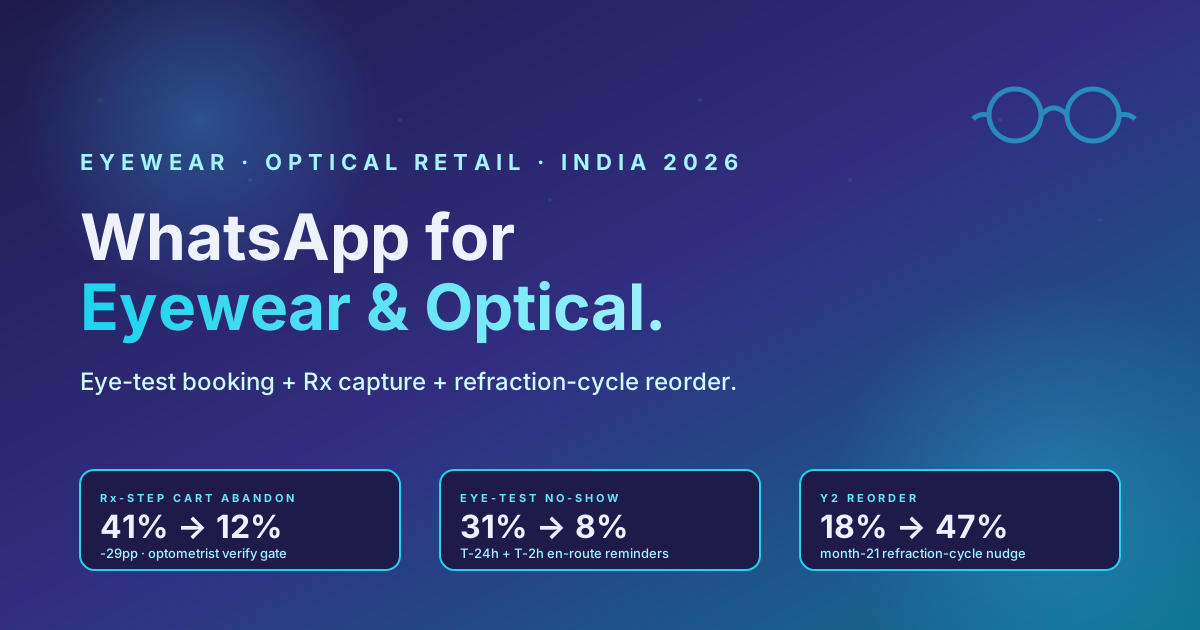
India organised eyewear crossed ₹14,800 cr in FY26 (₹52,000 cr total category, still 67% unorganised), growing 14% YoY on Lenskart, Titan Eyeplus, Specsmakers and GKB. The lifecycle is broken in uniquely Indian ways: 41% of online carts die at the prescription-entry step, home eye-test no-shows hit 31%, lens-fulfilment delays drive 22% of support tickets, and Y2 reorder — the biggest margin lever in a 2.4-year refraction-change category — sits at just 18%. This is the 2026 WhatsApp Business Platform playbook for Indian eyewear D2C + optical chains: a 10-stage lifecycle from click-to-WhatsApp face-shape quiz to month-21 refraction-cycle reorder, AI-OCR prescription capture behind a registered-optometrist verify gate, phlebotomy-style eye-test no-show reduction, AR virtual try-on hand-off, WhatsApp Pay/UPI/123Pay checkout, per-stage lab-fulfilment tracking, and contact-lens UPI auto-refill. Real Indian cohort numbers from an 84-store chain + a 40-store Tier-2 network: prescription-step cart abandonment 41% → 12%, eye-test no-show 31% → 8%, AR try-on to purchase 14% → 38%, Y2 reorder 18% → 47%, lens-remake 9.4% → 3.1%, NPS +34 → +62. NCAHP Act 2021 + DPDP Section 8 Sensitive Personal Data + Consumer Protection + GST + RBI e-Mandate compliant. Usage-only pricing, 12-week migration.

Read article
Vertical

WhatsApp for Hyperlocal Services India 2026: Sub-30-Min Delivery + Dynamic Pricing + Driver Coordination

India's hyperlocal economy hit ₹2.1 lakh crore GMV in FY25 — quick commerce ₹84K cr (Zepto, BlinkIt, Instamart, BB Now), ride-hailing ₹62K cr, home services ₹38K cr (Urban Company, NoBroker), hyperlocal courier ₹28K cr (Dunzo, Borzo, Porter). App-only architectures leak 60% of first-orders at install + onboarding and burn 14-hour dispute SLAs. The brands compounding hyperlocal in 2026 run WhatsApp as the operations spine: order intake via CTWA + catalog (48s placement), dynamic surge pricing inline with countdown, driver dispatch via utility template with 1-tap accept, real-time ETA push + arrival photo + hand-over confirm, AI Pathway-routed dispute resolution in < 90 sec. Real Indian quick-commerce + hyperlocal-courier + home-services cohort numbers: first-order completion 22% → 68%, Tier 2/3 repeat 14% → 52%, dispute SLA 14h → 78s, CAC -41%. 2026 playbook: 8-layer architecture, four-tier dynamic pricing UX, six driver coordination patterns with privacy bridge, four anti-patterns, DPDP + RBI + Motor Vehicles Act + Shops & Establishments compliance.

Read article
Integration

Razorpay WhatsApp Integration India 2026: Complete Setup Guide

Wire Razorpay payment links to WhatsApp Business API in 30 minutes. Real pricing math (DIY Meta Cloud vs Wati vs RichAutomate at 25k convs/month), webhook signature verification, idempotent handling, DPDP-compliant opt-in. Cohort: SMS 71% to WhatsApp 96% on-time collection, abandoned-cart 11% to 28%, refund cycle 4.2d to 11hr, support tickets 38 to 9 per 1,000 orders. ROI ₹7-22 per ₹1 message spend, payback 14 days. RichAutomate ships native Razorpay node + pre-built templates + DPDP defaults + ₹0 setup + ₹0.10/msg Client Pay OR ₹1.20 mkt + ₹0.30 util SaaS Pay.

Read article
Vertical

WhatsApp for Restaurant Chains India 2026: FSSAI + Ops

Full-stack restaurant WhatsApp lifecycle for Indian chains — 10 stages from discovery and reservation to FSSAI supplier audit. India restaurant industry ₹5.69 lakh crore FY26, 80k+ organised outlets + 6L FSSAI-licensed long tail. 32-outlet casual-dine cohort (₹140 cr revenue, 4.2L monthly diners, 16 cities): reservation show-up 67% to 91% (+24pp = 1.01L extra show-ups/year), repeat-visit 60d 22% to 41%, average bill +₹240, NPS 4.1 to 4.7, supplier-order cycle 6d to 1.5d, FSSAI audit prep 14d to 2d, support tickets per 10k covers 22 to 4, ROI ₹6.40 per ₹1 message spend, ₹18.6 cr annual revenue lift. 7-flow JSON library lead-magnet. FSSAI Cat 1/2/3 + GST CGST 5% + Shops Act + State Excise + State PCB + DPDP Sec 6/8/11 + Consumer Protection 2019 + ISO 22000 + TRAI DLT comparator compliant.

Read article
Integration

WooCommerce WhatsApp Integration India 2026 Setup Guide

WooCommerce powers ~38% of Indian e-com SMBs. Wire WC hooks (thankyou, payment_complete, status_changed, status_completed, subscription_renewal_payment_complete, order_refunded) to WhatsApp Cloud API in one day. Six approved templates cover cart-recovery (6h/24h/72h), COD-confirm with 1-tap UPI switch, prepaid thank-you with GST invoice, payment-link retry, order_shipped_tracking with AWB, delivery OTP, return-RTO notice, review request. Real pricing at 25k convs/mo: DIY ₹11-14k, Wati ₹19.5-27.7k, RichAutomate Client Pay ₹13.5-16.5k, SaaS Pay ₹6.9k. Cohort (₹3-15 cr GMV, 800-3,500 orders): cart-recovery 11% to 28%, COD-confirm 71% to 89%, RTO 18% to 7%, repeat 60d 22% to 41%, support tickets 38 to 9, ROI ₹7-22 per ₹1, payback 14d. DPDP-default + Razorpay UPI link + 9-flow JSON library lead-magnet.

Read article
Comparison

Wati vs RichAutomate India 2026 Pricing Decoded · Save ₹2.5 Lakh Per Year

Wati charges ₹2,499 to ₹7,999 per month platform fee plus Meta conversation costs in India 2026 — and the hidden charges (per-conversation markup, agent seat fees, setup fee, AI add-on, template language tax, auto-renewal lock) push the average 25,000 conversation per month bill to ₹27,698. RichAutomate ships at ₹0 platform fee with two transparent usage models: Client Pay at ₹0.10 per message (Meta billed direct to you) or SaaS Pay at ₹1.20 per marketing conversation and ₹0.30 per utility or authentication conversation (all-in). At the same 25,000 conversation per month load RichAutomate bills ₹6,900 — annual saving ₹2,49,576. 14-day free trial with 100 free credits. Free migration from Wati in 3 working days · we file the Meta paperwork · zero downtime · WABA + green tick + phone number all preserved. Built for Indian D2C ₹1-50 cr revenue, EdTech coaching <50 employees, healthcare clinics 3-15 branches, NBFCs <₹100 cr AUM, RERA-registered real-estate brokers, B2B SaaS ₹1-10 cr ARR. GST invoice via Razorpay · DPDP Act 2023 compliant · India-hosted Mumbai region · all 22 official Indian languages supported · founder-direct WhatsApp line for first 90 days · no annual contract lock-in.

Read article