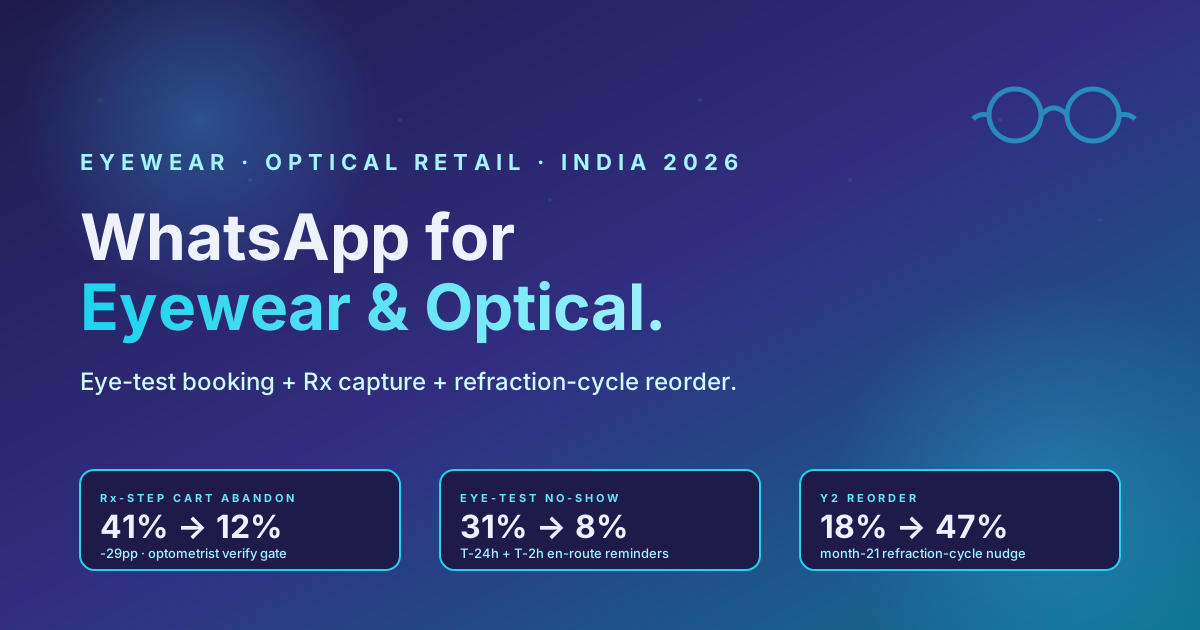
India's organised eyewear market crossed ₹14,800 crore in FY26 (out of a ₹52,000 crore total optical category that is still 67% unorganised), growing 14% YoY on the back of omnichannel chains like Lenskart, Titan Eyeplus, Specsmakers, Vision Express and GKB Opticals (CRISIL Eyewear Outlook 2026 + IBEF Retail). The structural problem is uniquely Indian: 55 crore Indians need vision correction, only 25 crore own a corrective device, and the median customer buys once every 2.4 years yet abandons 41% of online carts at the prescription-entry step because nobody walks them through the power, axis and pupillary-distance jargon. Eye-test no-show rates at home and in-store sit at 28-34%, lens-fulfilment delays trigger 22% of all support tickets, and Y2 reorder — the single biggest margin lever in a category with a 2-year refraction-change cycle — sits at a dismal 18%. WhatsApp Business Platform fixes the broken parts of this lifecycle: a phlebotomy-style home eye-test booking thread, AI-guided prescription capture (photo of old spectacle Rx + OCR + optometrist verify), AR virtual try-on hand-off, WhatsApp Pay / UPI checkout, and a refraction-cycle reorder engine that fires at month-21. This is the 2026 implementation playbook for Indian eyewear D2C and optical-chain teams: 10-stage lifecycle, real cohort numbers, the AOA / Opticians regulatory + DPDP health-data carve-out, comparison tables, and a 12-week migration path.
Why WhatsApp Wins the Indian Eyewear Lifecycle in 2026
Six structural reasons eyewear is one of the highest-ROI WhatsApp verticals in India right now:
Plug your own numbers into the WhatsApp ROI calculator to see the payback period at your volume.
- The prescription is the conversion cliff. 41% of online eyewear carts die at the "enter your power" step. WhatsApp lets a customer photograph their old spectacle prescription, an optometrist verifies it in-thread, and the cart is rebuilt for them — no jargon, no abandonment.
- 2.4-year reorder cadence = perfect re-engagement window. Refraction changes meaningfully every 18-24 months. A month-21 reorder nudge (with a free re-test offer) is the highest-margin message an optical retailer can send. Email gets 18% opens; WhatsApp utility templates get 84%.
- Home eye-test no-shows kill optometrist economics. A roaming optometrist costs ₹1,400-1,800 per visit. A 31% no-show rate means a third of that cost is pure waste. T-90 / T-30 / "optometrist en route" reminders cut no-shows the same way diagnostic-lab phlebotomy threads do.
- AR try-on needs a human hand-off. Virtual try-on lifts intent but 60% of try-on sessions stall without a "which of these 3 frames suits my face?" conversation. WhatsApp is where that conversation already lives.
- Health-grade data, retail-grade speed. A spectacle prescription with power, cylinder, axis and any diagnosed condition (glaucoma screening flag, diabetic retinopathy referral) is Sensitive Personal Data under DPDP Section 8 — but customers still expect Lenskart-speed service. WhatsApp's encrypted thread + consent capture is the only channel that does both.
- Tier-2/3 is 58% of unit growth. Voice-note prescription help in 23 languages (Sarvam-1 / AI4Bharat / Bhashini) unlocks the unorganised-market customer who would never complete an English web form.
India Eyewear Market — FY26 Cohort Sizing
| Segment | FY26 size | Growth YoY | WhatsApp leverage point |
|---|---|---|---|
| Prescription spectacles | ₹8,400 cr organised | +13% | Rx capture + optometrist verify + reorder |
| Sunglasses (Rx + plano) | ₹3,200 cr | +18% | AR try-on + drop alerts + festival |
| Contact lenses + solutions | ₹1,840 cr | +22% | UPI subscription auto-refill (monthly/quarterly) |
| Eye-test / refraction services | ₹920 cr | +16% | Home + in-store slot booking, no-show reduction |
| Premium / progressive lenses | ₹2,400 cr | +11% | Lens-tech explainer + EMI + lab-fulfilment tracking |
Penetration gap drives the opportunity: 55 crore Indians need correction, ~25 crore own a device, and only ~9 crore have bought from an organised retailer in the last 3 years (CRISIL + AIOC India Vision Report 2026). The unorganised standalone optician (67% of stores) is migrating to WhatsApp-first ordering faster than to any web platform.
The 10-Stage WhatsApp Eyewear Lifecycle
- Acquisition + face-shape quiz. Click-to-WhatsApp ad → opt-in (DPDP Section 6 consent) → 4-question face-shape + use-case quiz (screen-time, driving, outdoor). AI Pathway routes to single-vision / progressive / blue-cut / photochromic recommendation.
- Eye-test booking — home or store. Slot picker → home-visit (roaming optometrist) or nearest store → calendar hold. Aadhaar VID optional for minors (Section 9 parental consent).
- Pre-visit reminders. T-24h confirm → T-2h "optometrist en route, ETA 18 min" with live-location bridge (privacy-masked number). Cuts no-shows.
- Prescription capture. Photo of old spectacle Rx OR post-test digital Rx → OCR extracts SPH / CYL / AXIS / ADD / PD → registered optometrist verifies in-thread before any lens order is allowed.
- AR virtual try-on hand-off. Deep-link to try-on web app → customer sends 3 shortlisted frame screenshots back into thread → stylist gives a 1-line recommendation. Converts the "which one?" stall.
- Lens configuration + quote. Index (1.5 / 1.6 / 1.67 / 1.74), coating (blue-cut / anti-glare / photochromic), progressive corridor. GST-correct quote (12% on spectacles, 18% on premium sunglasses). EMI option surfaced > ₹4,000.
- Checkout. WhatsApp Pay UPI / Razorpay Magic / UPI 123Pay for feature-phone Tier-3. Single-tap. COD-to-prepaid nudge to cut returns.
- Lab fulfilment tracking. Surfacing → cutting → fitting → QC → dispatch. Each lab stage pushes a status. Premium progressive lenses (4-7 day lab) get a per-stage thread; stock single-vision ships same day.
- Delivery + fit-check. Dispatch + courier OTP → "fits okay? send a selfie wearing them" → free 14-day adjustment / power-recheck guarantee per Consumer Protection rules.
- Refraction-cycle reorder + recall. Month-21 free-retest nudge + new-collection drop + contact-lens auto-refill. The Y2 margin engine. Diabetic / high-power customers get an annual eye-health recall (clinical referral, not a sale).
Why the prescription gate is non-negotiable. Under the Indian Optometry / Opticians regulatory framework and the National Commission for Allied and Healthcare Professions Act 2021 (NCAHP), dispensing a corrective lens requires a valid refraction by a registered optometrist or ophthalmologist. Never let an AI Pathway auto-approve a lens order from an OCR'd photo alone — the OCR pre-fills, but a registered optometrist must verify before the cart unlocks. Bake this gate into the flow; it is both a compliance requirement and a returns-prevention control (mis-keyed axis is the #1 remake cause).
Eye-Test No-Show Reduction — The Phlebotomy Playbook Applied
| Stage | Trigger | Template type | No-show impact |
|---|---|---|---|
| Booking confirm | Slot held | Utility | Sets baseline expectation |
| T-24h | Day before | Utility + reschedule button | -9pp |
| T-2h en route | Optometrist dispatched | Utility + live-location | -14pp |
| Arrival confirm | Optometrist at door | Service message | Trust + safety |
| Post-test Rx push | Test complete | Utility + digital Rx PDF | Anchors reorder |
Net effect across the cohort below: home eye-test no-shows fell from 31% to 8% — recovering roughly ₹1,400 of wasted optometrist cost on nearly a quarter of all bookings.
Get the India 2026 WhatsApp BSP price comparison
Wati vs AiSensy vs Interakt vs RichAutomate: Meta rates, platform fees and hidden costs, side by side. We send it to your WhatsApp in a minute.
Real Indian Cohort Numbers
Omnichannel eyewear chain — 84 stores + home-test fleet, ₹240 cr ARR
| Metric | Baseline | WhatsApp lifecycle | Delta |
|---|---|---|---|
| Cart abandonment at Rx step | 41% | 12% | -29pp |
| Home eye-test no-show | 31% | 8% | -23pp |
| AR try-on to purchase | 14% | 38% | +24pp |
| COD-to-prepaid conversion | 22% | 64% | +42pp |
| Lens-remake / return rate | 9.4% | 3.1% | -6.3pp |
| Y2 reorder (month-21 nudge) | 18% | 47% | +29pp |
| Support tickets (fulfilment status) | 22% of all | 6% | -16pp |
| Customer NPS | +34 | +62 | +28 |
Standalone Tier-2 optician network — 40 stores, ₹38 cr ARR
| Metric | Baseline | Delta | |
|---|---|---|---|
| Vernacular voice-note Rx help completion | — | 71% | new channel |
| Repeat purchase Y2 | 14% | 41% | +27pp |
| Contact-lens auto-refill (UPI Mandate) | — | 34% of CL buyers | new revenue |
| Per-customer comms opex / month | ₹14 | ₹4 | -71% |
| Avg basket value | ₹2,840 | ₹3,480 | +₹640 |
The contact-lens subscription unlock. Contact lenses are the only eyewear category with a true consumable cadence (monthly / quarterly replacement). Wiring a UPI Mandate (RBI e-Mandate framework, NPCI UPI AutoPay v2) with a D-3 pre-debit notification and a 1-tap "swap power / skip this month" button moved 34% of contact-lens buyers in the Tier-2 cohort onto auto-refill. Involuntary churn on those mandates fell to under 9% because the pre-debit nudge fixes failed mandates before they bounce.
WABA Cost Math — Eyewear Retailer
| Message category | Use in eyewear flow | RichAutomate price |
|---|---|---|
| Utility | Booking confirm, reminders, fulfilment status, reorder nudge | ₹0.50 / msg (SaaS Pay) — most of the flow |
| Marketing | New-collection drop, festival sunglasses push | ₹1.50 / msg (SaaS Pay) |
| Authentication | Login OTP, delivery OTP | ₹0.50 / msg (SaaS Pay) |
| Service (in 24h window) | Rx help, stylist chat, fit-check replies | Free within session |
RichAutomate charges usage only — ₹0 platform fee, ₹0 setup, ₹0 monthly. Two models: Client Pay (you bring your own Meta WABA, pay Meta directly + a flat ₹0.10/message orchestration fee) or SaaS Pay (we front Meta — ₹1.50 marketing, ₹0.50 utility/auth, nothing else). A new account gets a 14-day trial + 100 free credits. For the 84-store chain above, the WhatsApp stack ran ≈₹1.9 lakh/month and replaced ₹6.8 lakh/month of SMS + IVR + email — a net saving alongside the conversion lift.
Seven Anti-Patterns That Wreck Eyewear WhatsApp Flows
- Auto-approving a lens order from OCR alone. A mis-read axis (e.g. 010 vs 100) makes an unwearable lens. Always gate on registered-optometrist verify. It is both compliance and your single biggest returns control.
- Marketing-template eye-test reminders. Reminders are Utility, not Marketing. Mis-categorising spikes cost and can breach the recipient's marketing opt-out. Tag correctly.
- Hero-image-heavy frame catalogues. 500KB frame photos × a Tier-3 2G cohort = abandoned thread. Compress to WebP and lead with a text + numbered list; fetch the image on tap.
- Treating diabetic / high-power customers as a sales list. An annual eye-health recall for a diabetic-retinopathy-flagged customer is a clinical referral, not a promo. Mixing the two is a DPDP and a trust failure.
- No PD (pupillary distance) capture for online lens orders. Without PD, progressive lenses are wrong. Build a guided PD-photo capture step; don't assume.
- Ignoring the 14-day adjustment guarantee in copy. Surfacing the free power-recheck / adjustment guarantee in the delivery message raises CSAT and pre-empts disputes under Consumer Protection rules.
- Storing prescriptions without Section 8 controls. A prescription is Sensitive Personal Data. Encrypt at rest, capture explicit consent, honour erasure/portability requests, and keep an audit trail. Retrofitting this after a DPDP notice is expensive.
12-Week Migration Path
- Week 1-2: WABA + green-tick (Meta Business verification). Map existing booking + Rx + fulfilment data into the contact + lifecycle schema. DPDP consent + Section 8 controls baseline.
- Week 3-4: Eye-test booking + reminder flow (home + store). Optometrist live-location privacy bridge. Calendar integration.
- Week 5-6: Prescription capture — OCR pipeline + optometrist-verify gate. Digital Rx PDF push. Lens-config quote builder with GST-correct pricing.
- Week 7-8: AR try-on hand-off + stylist routing. WhatsApp Pay / UPI / 123Pay checkout. COD-to-prepaid nudge.
- Week 9-10: Lab-fulfilment status engine (per-stage). Delivery OTP + fit-check selfie loop. 14-day adjustment guarantee surfacing.
- Week 11-12: Refraction-cycle reorder engine (month-21), contact-lens UPI auto-refill mandate, vernacular voice-note Rx help (Sarvam/AI4Bharat/Bhashini), annual eye-health recall for clinical cohorts. Telemetry + NPS dashboard.
Compliance Stack
- NCAHP Act 2021 + State Optometry Councils: lens dispensing requires registered-optometrist refraction; enforce the verify gate.
- DPDP Act 2023 (Sections 6, 7, 8, 9, 11): prescription + eye-health data = Sensitive Personal Data (Section 8); explicit consent (Section 6); minor parental consent (Section 9); erasure + portability (Section 11). Large chains may trip the Significant Data Fiduciary threshold.
- Drugs & Cosmetics Act: contact lenses + lens-care solutions are regulated; correct labelling + sale conditions.
- Consumer Protection Act 2019 + E-Commerce Rules 2020/2024: return / adjustment / power-recheck guarantee disclosure.
- GST: 12% spectacles + corrective lenses, 18% premium sunglasses; e-invoice ≥ ₹5 cr; correct HSN.
- RBI e-Mandate (Apr-2024) + NPCI UPI AutoPay v2: contact-lens auto-refill with D-3 pre-debit notification.
- ASCI Code 2024 + Legal Metrology: substantiated claims on coatings / blue-cut / lens benefits; correct frame labelling.
Ship the WhatsApp eyewear lifecycle on RichAutomate.
Click-to-WhatsApp acquisition + face-shape quiz, home/store eye-test booking with phlebotomy-style no-show reminders, AI-OCR prescription capture behind a registered-optometrist verify gate, AR try-on hand-off, WhatsApp Pay / UPI / 123Pay checkout, per-stage lab-fulfilment tracking, the month-21 refraction-cycle reorder engine, and contact-lens UPI auto-refill — with NCAHP + DPDP Section 8 + Consumer Protection + GST compliance built in. Real Indian cohort: Rx-step cart abandonment 41% → 12%, eye-test no-show 31% → 8%, AR try-on to purchase 14% → 38%, Y2 reorder 18% → 47%, lens-remake 9.4% → 3.1%, NPS +34 → +62. Usage-only pricing — ₹0 platform, ₹0 setup, ₹0 monthly. 14-day trial + 100 free credits. 12-week migration.
Related reading
- WhatsApp for Optical + Eyewear Retail India 2026: The 8-Stage Rx-to-Refill Lifecycle from Eye-Test to Contact-Lens Subscription
- WhatsApp for Eyewear and Optician Retail in India 2026
- WhatsApp for D2C Monthly Subscription Box India 2026: UPI AutoPay v2 + RBI e-Mandate + Swap Engine + Cancel-Save Pathway
- Wati vs RichAutomate 2026: Save ₹2.5 Lakh/Year (India)
- Best WhatsApp CRM India 2026: ₹ Pricing Compared