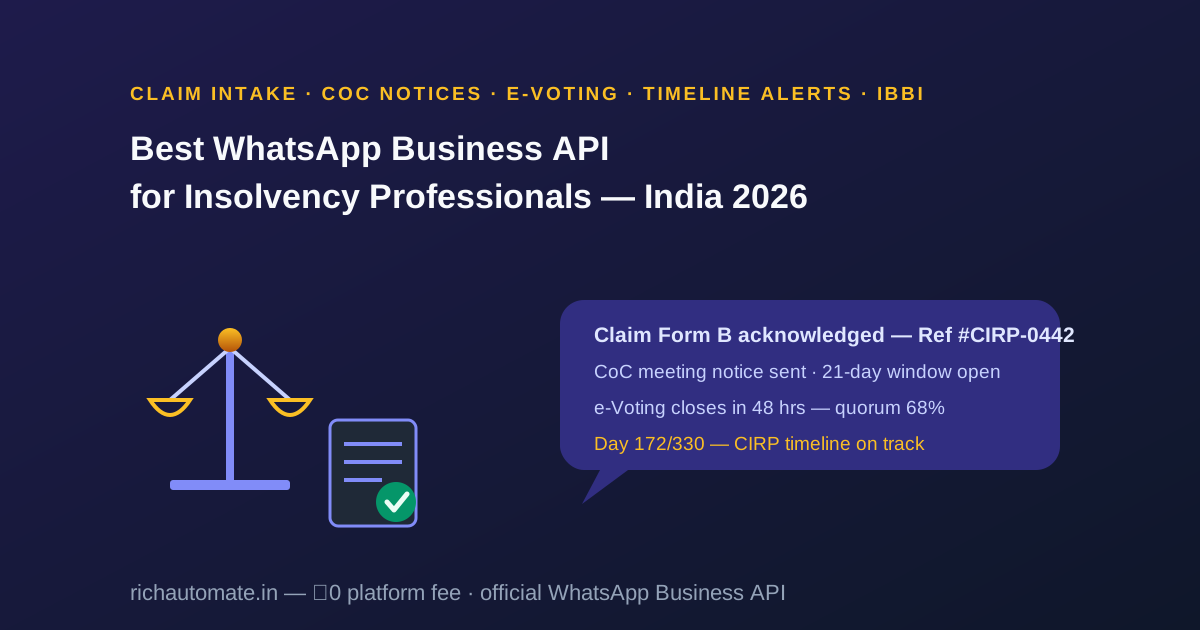
An IBBI-registered Insolvency Professional (IP) running multiple concurrent CIRP mandates lives inside a compliance clock: statutory claim windows, Committee of Creditors (CoC) meeting notices, e-voting deadlines, and a 330-day outer CIRP timeline that courts enforce strictly. Most of that clock is still run over email threads and phone calls to hundreds of creditors per matter. This page is an honest comparison of what to look for in a WhatsApp Business API partner if you run an insolvency-professional practice or IP entity handling Corporate Insolvency Resolution Process (CIRP) work in India.
What an insolvency-professional practice actually needs from a WhatsApp partner
A CIRP mandate is not one audience — it's several: operational creditors, financial creditors on the CoC, the suspended board, prospective resolution applicants, and the IP's own case team, all needing different information at different statutory checkpoints. A WhatsApp partner built for a generic "law firm client updates" use case won't naturally handle claim-form intake at scale (Form B/C/D submissions from hundreds of creditors), CoC voting-share tracking, or the kind of audit-trail logging that stands up if an NCLT bench asks how and when a stakeholder was notified.
Criteria for choosing a WhatsApp partner as an insolvency professional
| Criterion | Why it matters for IBC/CIRP work |
|---|---|
| Flow builder for claim-form intake | Public announcement (Form A) triggers claim submissions from potentially hundreds of creditors — a structured Flow with document upload beats chasing PDF attachments over email |
| Broadcast + read-receipt logging for CoC notices | Meeting notices and e-voting windows have statutory notice periods — you need proof of delivery, not just a sent email that may bounce |
| Timeline/SLA-triggered reminders | CIRP runs on hard deadlines (180+90 days, 330-day outer limit including litigated time) — automated reminders ahead of each internal checkpoint reduce the single biggest CIRP risk: missing a filing window |
| Segmented, permissioned messaging | Operational creditors, financial creditors/CoC members, and the suspended board need different information — accidental cross-broadcast of confidential resolution-plan terms is a real risk |
| DPDP-aware data handling + retention control | Creditor KYC and the corporate debtor's confidential financials both move through the same channel — needs purpose limitation and a defined retention/deletion policy, not permanent open threads |
The lifecycle a good WhatsApp setup should cover
- Public announcement + claim intake: Form A broadcast to known creditor classes, Flow-based Form B/C/D submission with supporting-document upload and an acknowledgement receipt.
- CoC formation and meetings: voting-share confirmation to financial creditors, meeting-notice broadcasts with the statutory notice period tracked, agenda and minutes circulation.
- Resolution process: Request for Resolution Plan (RFRP) dissemination to registered resolution applicants, query-window reminders, and plan-submission deadline nudges.
- CoC e-voting: voting-window open/close reminders, quorum and threshold (66%/51%) tracking nudges to the case team — never automated vote-casting or vote-tallying itself.
- Outcome + implementation: approval/rejection/liquidation status update to all stakeholder classes, monitoring-committee update cadence once a resolution plan is approved.
What NOT to automate
WhatsApp should move information and reminders, not exercise the IP's statutory judgment. Claim admission/rejection decisions, voting-share computation, resolution-plan evaluation, and any communication that could be read as legal advice to a creditor or resolution applicant must stay with the IP and case team — a bot should never draft or send anything that looks like an eligibility ruling or a recommendation on how to vote. Confidential resolution-plan commercial terms should never go into a broadcast list; keep those on a permissioned, need-to-know thread only.
Get a 1-minute BSP audit on WhatsApp
Drop your WhatsApp number — we line-item your current invoice against Meta India rates in under 60 seconds. India-hosted, DPDP-compliant.
Worth knowing the scale of the risk, and the DPDP penalty calculator estimates it from your own numbers.
Regulatory notes (hedged — verify current rules)
Insolvency professionals are registered and regulated by the Insolvency and Bankruptcy Board of India (IBBI) under the IBC, 2016, and its CIRP Regulations — public-announcement format, claim-submission timelines, CoC-meeting notice periods, and the 330-day outer CIRP limit (including admitted litigation time) are all set by regulation and case law that evolves; verify current IBBI circulars and the latest NCLT/NCLAT/Supreme Court position before relying on any specific deadline. DPDP Act 2023 governs both creditor personal data and the corporate debtor's financial information moving through the same WhatsApp channel — these should be handled with purpose limitation and a defined retention window, not commingled or kept indefinitely. None of this is legal advice; confirm current IBC/IBBI requirements with your compliance counsel.
Illustrative cost model
An IP practice running roughly 10 concurrent CIRP mandates, each with an average of 150-200 creditors, sending claim acknowledgements, CoC-meeting notices, and periodic status updates (illustratively 3-4 touches/month per creditor) totals roughly 5,000-8,000 messages/month. On Client Pay (₹0 platform fee + ₹0.10/message + Meta's rate billed direct), that's illustratively ₹500-800/month — verify current Meta conversation rates. On SaaS Pay, most of this traffic is utility-category (claim acknowledgements, status updates) at ₹0.50/utility conversation, with occasional marketing-category outreach (e.g. empanelment updates) at ₹1.50/conversation — a similar 2,000-3,000 utility-conversation month lands near ₹600-900/month, all-in.
One-week rollout
- Day 1-2: Connect the WhatsApp Business number, import the known-creditor list for the active mandate(s).
- Day 3: Build the claim-intake Flow (Form B/C/D fields + document upload + acknowledgement message).
- Day 4: Template CoC meeting-notice and e-voting-window messages with the statutory notice period built into the send schedule.
- Day 5: Set up timeline-triggered internal reminders for the case team ahead of each CIRP statutory checkpoint.
- Day 6: Segment stakeholder lists (operational creditors / financial creditors-CoC / suspended board) with permissioned sends.
- Day 7: Pilot on one active mandate, confirm delivery/read-receipt logging is adequate for your own audit-trail needs before rolling to the full caseload.
Who fits which platform
A solo IP handling one or two small mandates with a handful of creditors each can usually manage on email and phone without much friction. Once a practice is running several concurrent CIRP mandates — with hundreds of creditors per matter, CoC-meeting notice obligations, and statutory timelines that don't forgive a missed reminder — a WhatsApp Business API setup with Flow-based claim intake and timeline-triggered alerts becomes a genuine risk-reduction tool, not just a convenience. Large insolvency-professional entities (IPEs) already running dedicated case-management or CIRP-tracking software should look for API integration into that system of record rather than a standalone WhatsApp tool — the case-management system stays authoritative, WhatsApp is the notification and intake layer on top of it.
RichAutomate runs on the official WhatsApp Business API — ₹0 platform fee, ₹0 setup, ₹0 monthly minimum. Client Pay is ₹0.10/message plus Meta's rate billed direct; SaaS Pay is ₹1.50/marketing and ₹0.50/utility conversation, all-in. 14-day trial, 100 free credits, no card required to start. Any competitor pricing mentioned elsewhere should be verified on that vendor's own site — rates change. There is never a promise of "no ban" for bulk or unsolicited sends; proper opt-in, permissioned lists, and the official API are what keep a WABA in good standing.