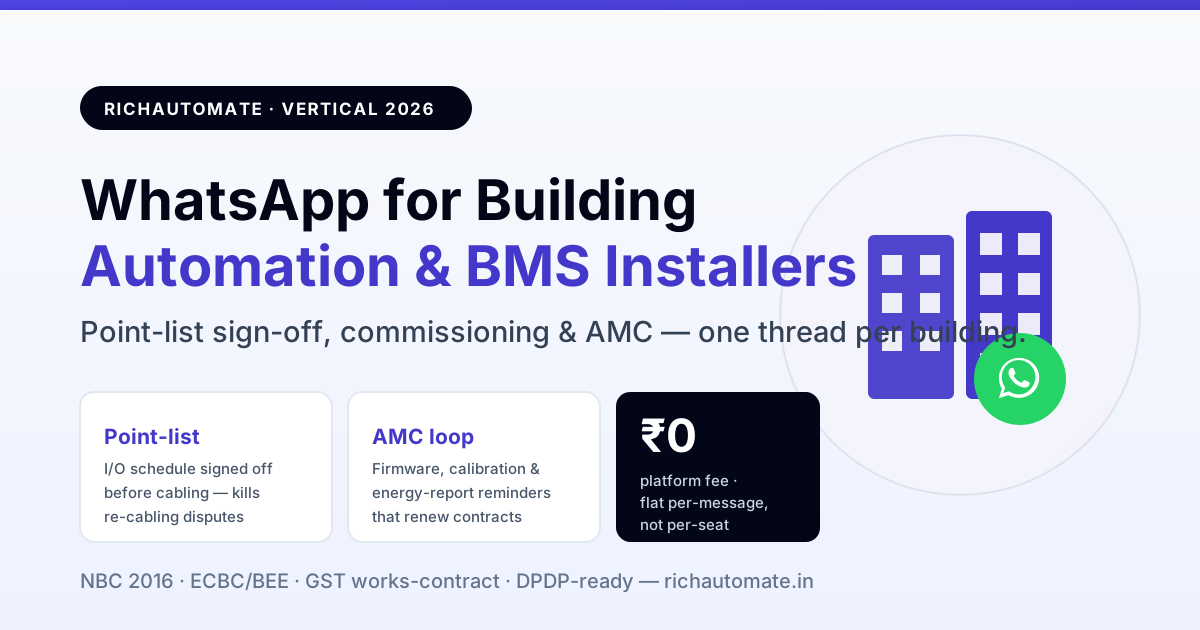
Yes — WhatsApp is the right operating layer for a building-automation and BMS integration business in India: it carries the enquiry and scope in, the site survey and the all-important point-list approval, the multi-trade installation coordination, the commissioning and handover sign-off, and the recurring AMC and energy-report loop that keeps a serviced building on your books for years. A BMS integrator's margin is made or lost on one thing — whether every I/O point was agreed in writing before the cabling went in — and that agreement lives cleanest as a timestamped WhatsApp thread, not a buried email.
This 2026 guide covers the regulatory spine (NBC 2016, ECBC/BEE energy code, BIS and CEA electrical safety, fire-alarm interlock, GST works-contract treatment), the six-stage enquiry-to-AMC lifecycle on WhatsApp, the automation stack that keeps installs on schedule and AMC renewals timely, and the DPDP carve-outs that matter when your controllers log who entered which door and when. All figures are directional — verify current rules for your projects and state.
Why a BMS integrator's real bottleneck is the point-list sign-off, not the wiring
A building-management-system integrator ties a building's HVAC, electrical, lighting, fire, access-control and energy metering into one control layer through DDC controllers and a head-end. The technical work is well understood. The money is lost somewhere else: at the I/O point schedule. Every sensor, valve, actuator, damper and meter maps to a controller point, and if that list is wrong or was never formally agreed, the mismatch surfaces at commissioning — the most expensive moment to find it — and the re-cabling, re-programming and repeat site visits come out of the integrator's pocket.
The trap is verbal and email-buried approvals: a consultant "confirms" a point count on a call, the client adds three AHUs nobody logged, the fire-panel interlock scope was assumed, and at commissioning everyone remembers it differently. A structured WhatsApp Business API workflow captures the enquiry as data, puts the point list and I/O schedule in the thread for a dated, explicit approval before procurement, and then keeps installation status, commissioning results and every AMC visit in one record per building — so a dispute is settled by scrolling up, not by argument.
The regulatory spine (verify for your projects)
- NBC 2016 — National Building Code. Building services, integration and safety systems are governed by the NBC and the local building bye-laws that adopt it; BMS scope routinely touches Part 4 (fire & life safety) interlocks and services coordination. There is no single "BMS regulator" — you work to the NBC, the consultant's spec and the local authority (verify current adoption in your city).
- ECBC / Energy Conservation Building Code (BEE). For large commercial buildings, a BMS is often central to demonstrating energy-monitoring and efficiency compliance under ECBC. Your energy-metering points and reports may feed the building's compliance case — get the metering scope right and keep the data trail (verify state adoption and current thresholds).
- BIS and CEA electrical safety. Panels, controllers and field devices should meet applicable BIS standards, and installation work must respect CEA electrical-safety regulations. Fire-detection integration ties to the fire-alarm system's own approvals under state Fire Acts (verify).
- GST — works contract vs supply. A supply-plus-installation BMS project is typically a works contract / composite supply, taxed differently from a pure equipment sale; the split affects your quoting and e-invoicing. Take professional advice for your contract structure (verify current position).
- Site and labour compliance. Site work carries the usual labour, safety and (on notified premises) Factories Act obligations for your install crew (verify).
The one that protects the project and you
Get the point list and I/O schedule approved in writing before you procure and cable. A dated, explicit client/consultant approval of exactly which points are in scope is the single document that decides who pays when a building adds equipment mid-project — and an in-thread WhatsApp approval, with the schedule attached, is the cheapest dispute-proof record a small integrator can keep.
The six-stage BMS lifecycle on WhatsApp
1. Enquiry and scope capture
A builder, facility manager or MEP consultant messages after a tender or a referral. A WhatsApp Flow captures the building type, the systems to integrate (HVAC, electrical, lighting, fire, access, metering), the approximate point count and the timeline — so you scope a real quote instead of chasing a spec by phone. First contact runs on a Meta-approved template; the rest stays in the 24-hour service window.
Get a 1-minute BSP audit on WhatsApp
Drop your WhatsApp number — we line-item your current invoice against Meta India rates in under 60 seconds. India-hosted, DPDP-compliant.
2. Site survey, design and point-list approval
After the survey you share the design intent, the panel layout and — critically — the I/O point schedule for explicit approval in the thread. This is the money stage: a mismatch here caught now costs a message; caught at commissioning it costs a re-visit. The dated approval, with the schedule attached, becomes the contract baseline that governs every later "can you also add…".
3. Procurement and installation coordination
BMS install is a multi-trade sequence — you depend on the HVAC, electrical and civil contractors finishing their bits first. Delivery updates, cable-tray and containment readiness checks, and photo-proof of field-device mounting all run in-thread, so a slipping dependency is visible early instead of discovered on a wasted mobilisation.
4. Commissioning, point-to-point testing and handover
At commissioning you verify every point end to end, share the test results and snag list, and get the handover documentation and the O&M/training acknowledgement signed off in the thread. A building handed over with an in-thread commissioning record and point-list closure is a building that will not argue about scope six months later.
5. AMC, preventive service and firmware health-checks
A BMS is not fit-and-forget: controllers need firmware and battery checks, sensors drift and need recalibration, and graphics/schedules need periodic review. Automated AMC reminders, preventive-visit scheduling and calibration-due nudges keep the building healthy and keep you on contract — the recurring AMC is where a one-off install becomes a multi-year account.
6. Breakdown SLA, energy reports and expansion
When a controller or integration drops, a down BMS leaves the building blind on comfort and energy — a fault-photo, an auto-logged ticket and a dispatch ETA in-thread keep the SLA and the account. Periodic energy-saving reports and upgrade/expansion proposals (new blocks, added meters, analytics) go out on the same thread, turning a serviced building into repeat capital work.
What "best" means for a BMS integrator
| Integrator need | What to look for |
|---|---|
| Kill scope disputes | Point-list & I/O schedule approved in-thread with a dated record before procurement |
| Fast, real quoting | Structured scope-capture Flow (building type, systems, point count) not phone tag |
| On-time multi-trade installs | Dependency-readiness checks + photo-proof of mounting in one project thread |
| Clean handover | Commissioning results, snag list and O&M sign-off logged in-thread |
| Recurring AMC revenue | Preventive-visit + firmware/calibration reminders that renew contracts on time |
| Predictable cost | Flat per-message pricing, not per-seat SaaS that taxes every engineer you add |
RichAutomate fits this shape: a shared inbox, native Flows, and flat pricing — see the full pricing. The same install-and-AMC discipline that commercial HVAC & central-AC contractors and CCTV & electronic-security installers use applies directly to building automation — the BMS usually integrates both.
The automation stack
- Click-to-WhatsApp ads and a QR on tender documents and business cards feeding consultant and builder enquiries into a tagged thread.
- Scope-capture Flow — building type, systems to integrate, point count and timeline as structured data for a real quote.
- Point-list approval — the I/O schedule shared for a dated, explicit in-thread sign-off before procurement.
- Shared inbox across sales, project engineers and service techs, one thread per building.
- AMC reminders — preventive-visit, firmware and calibration-due nudges on the contract clock.
- CRM sync so each building's point list, commissioning record, AMC schedule and energy history stay in one place.
The same recurring-service model that keeps an elevator & lift installer's AMC book renewing keeps a BMS integrator's serviced buildings from drifting to a cheaper competitor at renewal.
DPDP Act 2023: your controllers log real people
A modern BMS often ties into access-control and CCTV, which means your integration and its logs can record who entered which door and when — personal data under the DPDP Act 2023. The building owner is usually the data fiduciary, but as the integrator you are the processor who touches it. Practical musts:
- Treat access-control and occupancy logs as personal data — collect and retain only what the system needs (purpose limitation).
- Restrict who on your team can view a live building's data — role-based shared-inbox access, not everyone-sees-everything.
- Never forward a client's building drawings, network details or occupancy logs outside the project team; keep them in the controlled thread.
- Treat drawings, network diagrams and control logic as client IP — hand them back at closure and hold nothing longer than the contract allows.
- Agree data handling with the building owner in writing, so the fiduciary/processor split and retention are clear.
Bottom line
A building-automation integrator wins on disputes that never happen and AMC contracts that keep renewing, and a WhatsApp Business API workflow attacks both: a dated point-list approval before procurement that kills the scope fight on one side, and preventive-service, calibration and energy-report reminders that keep serviced buildings on contract on the other — one record per building from enquiry to expansion. Start with a scope-capture Flow and in-thread point-list sign-off; layer AMC reminders and energy reports next. RichAutomate runs it on flat per-message pricing with no platform fee, so cost scales with projects and buildings served, not with the number of engineers on your team.
Related reading: WhatsApp for Rooftop Solar EPC Installers 2026 walks through the same WhatsApp setup for a neighbouring use case.