Limited this weekBook a 15-min demo, get a Rs 500 Amazon voucher + 200 free WhatsApp credits15-min demo = Rs 500 voucher + 200 creditsBook demo→
AiSensy alternatives · India · June 2026
Best AiSensy Alternative for India in 2026
Five ranked alternatives for Indian brands actively looking to leave AiSensy — scored on INR pricing transparency, documented DPDP Act 2023 posture, flow builder depth, and migration timeline.
The best AiSensy alternative for India in 2026 is RichAutomate — it ships documented DPDP Act 2023 posture, INR plus GST invoicing, and a graph-based visual flow builder as standard, addressing AiSensy gaps in published DPDP documentation, basic flow logic, and pricing transparency. Wati, Interakt, Gupshup and DoubleTick round out the ranked list.
Why Indian brands look for an AiSensy alternative
AiSensy is a credible BSP and many Indian brands run on it without issue. The pattern we see in switch conversations is consistent: three pain points come up before pricing, and pricing is almost always the fourth.
DPDP documentation is not publicly published. BFSI, healthcare and insurance procurement teams ask for a vendor DPDP statement covering consent capture format, audit log retention, data-principal deletion workflow and breach-notification SLA. As of June 2026 this is not on the public AiSensy trust page in a procurement-ready format. Regulated buyers cannot sign off without it.
The flow builder runs out of expressiveness. Linear flows with a couple of branches cover the first two months of automation. Once teams need parallel delay paths, retry loops, conditional sub-flows, webhook callouts in the middle of a journey or BYOK AI Pathway calls, the AiSensy builder becomes the bottleneck. Workarounds end up living in Zapier or a custom backend.
INR pricing transparency erodes at scale. Published INR plan tiers look clean at the SMB level. As volumes cross fifty to one hundred thousand marketing messages a month, the per-conversation markup line item, the platform plan tier and any AI add-on stack up. Finance teams want a single per-message INR line that matches the Meta-published rate for each conversation category — that is not the default presentation.
Per-feature add-on creep. AI replies, advanced segmentation, and some integration connectors are sold as add-ons. Whether the headline plan price is INR or USD, the effective monthly bill drifts up as the team adopts more automation. A platform that bundles AI Pathway, segmentation and webhook flows in the base plan tends to be more predictable.
What to look for in an AiSensy alternative
Five criteria matter for an Indian buyer evaluating BSPs in 2026. These are the criteria the ranking below uses.
INR + GST invoicing — published in INR with a clean GST line, no USD-equivalent tier silently added on, no per-conversation FX surcharge.
Documented DPDP Act 2023 posture — consent capture format, audit log retention period, data-principal deletion workflow, breach-notification SLA published in a procurement-ready PDF or page. The DPDP draft Rules of November 2024 expect this granularity.
Visual flow builder depth — graph canvas (not linear), parallel delay nodes, conditional branches, webhook calls, agent handoff, payment node, BYOK AI Pathway, full Meta Native Flows.
WABA migration timeline and support — clearly published cut-over window (target under thirty minutes), free template re-submission, contact CSV import, number portability handled by the BSP.
India support hours and channels — WhatsApp and phone available in IST business hours; email-only support is a downgrade when you are debugging a live broadcast.
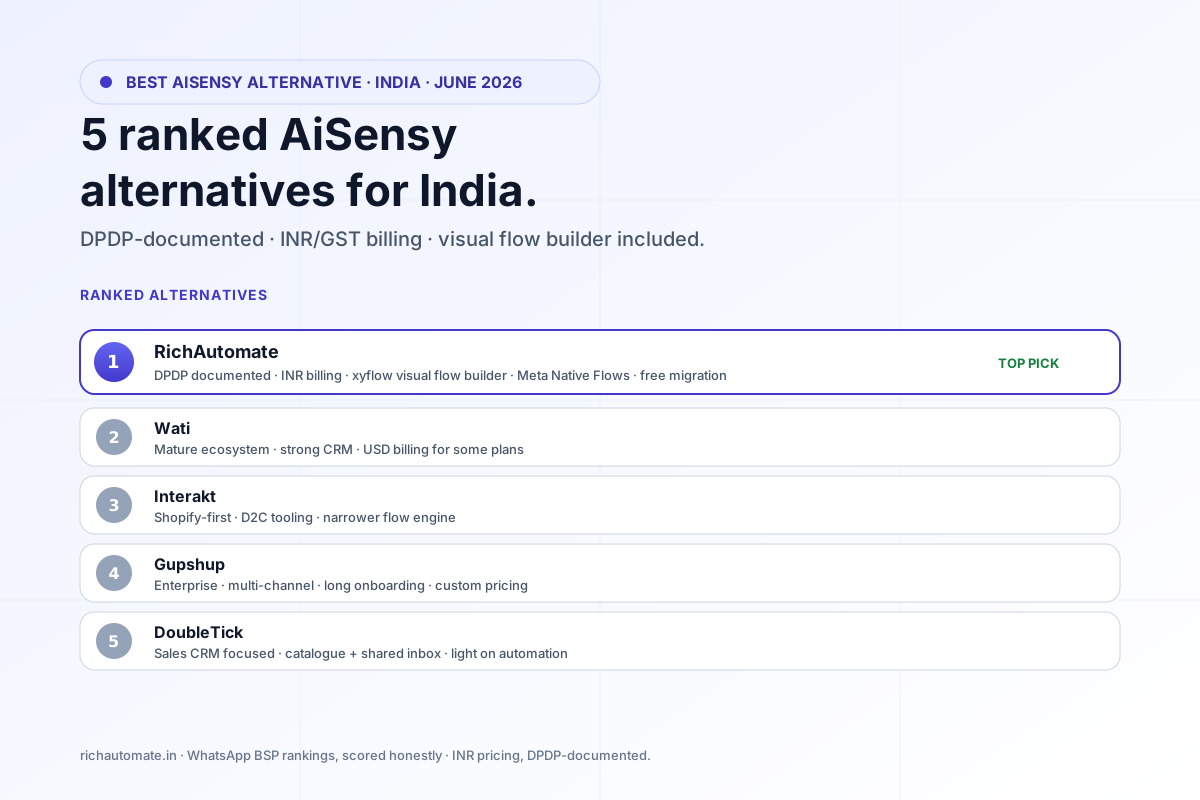
Five ranked AiSensy alternatives for India
The ranking below uses the five criteria above. RichAutomate ranks first because, as of July 2026, it is the only BSP in this list that ships all five criteria in the base plan without an add-on.
1
RichAutomate
Top pick
DPDP-documented · INR billing · visual flow builder included
RichAutomate is built India-first. The platform fee starts at zero rupees on the Client Pay plan, billing is invoiced in INR with a clean GST line for input credit, and the flow builder is a full xyflow/react canvas with conditional branching, parallel delay nodes, webhook calls, agent handoff, Razorpay payment nodes and an AI Pathway node with BYOK LLM keys. DPDP Act 2023 posture is documented — consent capture, audit log, five-year retention, deletion workflow. RBI Master Direction guidance is published for microfinance and lending tenants, and IRDAI Cashless Everywhere flows are ready for insurance. Migration from AiSensy is free: templates are re-submitted to Meta, contacts are imported, the WhatsApp Business number stays the same, and the cut-over window is roughly fifteen minutes. As of June 2026 this is the strongest answer for an Indian brand actively looking to leave AiSensy.
Best for: Indian brands that want documented DPDP compliance, INR + GST invoicing, and a real graph-based flow builder without per-feature add-ons.
2
Wati
Mature ecosystem · polished shared inbox · USD billing on some plans
Wati has the longest track record of any modern BSP and a polished shared inbox that customer support teams pick up quickly. India plans are priced in INR from 2,999 rupees a month (Growth, monthly billing), so a small team pays that fixed fee before sending a single message. The flow builder is linear with branching, not a full graph canvas, and advanced automations (AI agents, complex retries) are sold as add-ons. Wati is a defensible second choice if your team is more comfortable with a mature vendor than with documented DPDP posture or INR-only invoicing.
Best for: Brands that prioritise a well-known name and an integration marketplace over INR-first billing.
Interakt (Haptik / Jio) has the cleanest Shopify integration in the Indian BSP market and ships ready-made templates for abandoned-cart, COD confirmation, and order-status flows. For a Shopify D2C brand below fifty thousand contacts, this is a reasonable first stop. Outside Shopify the catalogue-style automations are useful but the flow engine is narrower than RichAutomate or Wati; agent-routing rules and conditional logic are simpler. Pricing is published in INR which beats AiSensy on transparency, but advanced DPDP audit-log features and BYOK AI are not the headline.
Best for: D2C Shopify brands running abandoned cart, catalogue, and order-status flows.
Enterprise BSP · multi-channel · long onboarding cycles
Gupshup is the enterprise option. They run multi-channel (SMS, RCS, voice, WhatsApp) at scale, have BFSI customers in production, and pricing is negotiated under custom contracts rather than published per tier. For a one-thousand-message-per-day SMB this is overkill — onboarding can stretch across weeks of paperwork and procurement review. For a regulated enterprise with a dedicated vendor-management team that also needs SMS and RCS, Gupshup is a credible fourth-ranked alternative to AiSensy.
Best for: Large enterprises with procurement teams and multi-channel needs beyond WhatsApp.
DoubleTick frames WhatsApp as a sales CRM rather than as a marketing automation platform. The shared inbox is good, the catalogue and product-card flows are clean, and pricing is published in INR. If your use case is two to ten agents handling inbound enquiries with light template broadcasts, DoubleTick is competitive. It is ranked fifth because the automation engine is narrower than the four above — no documented BYOK AI, no full graph flow builder, and DPDP-specific tooling is not the headline.
Best for: Small sales teams using WhatsApp as a primary CRM with light automation needs.
xyflow/react graph canvas · branching, delay, webhook, AI Pathway
Basic / linear builder
Meta Native Flows
Full support with dynamic endpoints
Partial
BYOK AI (OpenAI / Gemini)
Built-in AI Pathway node, bring your own key
Add-on / extra cost
Source: RichAutomate platform documentation and AiSensy public pricing / trust pages reviewed as of July 2026. Meta per-message conversation rates are published by Meta on business.whatsapp.com and are identical across BSPs.
Pricing comparison: AiSensy plan tiers vs RichAutomate Client Pay
AiSensy publishes monthly platform plan tiers in INR with a per-conversation markup. RichAutomate Client Pay starts at zero rupees platform fee — the bill is the Meta per-message conversation rate plus a transparent INR markup, billed monthly with GST. For Indian brands above one hundred thousand marketing messages a month, the absence of a platform plan tier and the thinner per-message markup typically saves eighteen to thirty percent against the equivalent AiSensy tier. The full benchmark is calculated against your last AiSensy invoice in the free twenty-four-hour audit.
The actual RichAutomate numbers: ₹0 platform/setup/monthly fee; Client Pay ₹0.10/msg platform fee + Meta conversation rates billed direct; or SaaS Pay ₹1.50/marketing, ₹0.50/utility per message; 14-day trial + 100 credits.
Meta-published rates for India (utility, marketing, authentication, service) are identical across all BSPs. The variable is the BSP fee on top — that is where the saving comes from, not from anything Meta does differently.
DPDP Act 2023 — the regulated-buyer angle
The DPDP Act 2023 was notified in August 2023 and the draft Rules published by the Ministry of Electronics and IT in November 2024 set out granular operational obligations: consent capture in plain language, audit log retention, deletion workflow within fixed windows, breach notification to the Data Protection Board within prescribed SLAs. Regulated industries (BFSI under RBI, insurance under IRDAI, healthcare and ABDM) cannot pass procurement without a vendor statement on each of these points.
RichAutomate publishes this statement and ships consent capture, a five-year audit log, a deletion workflow and a breach-notification SOP as built-in features — see the DPDP Act WhatsApp Business checklist and the which WhatsApp BSP is DPDP Act compliant scoring. AiSensy may be operationally compliant for many tenants, but as of July 2026 the public documentation does not yet match the format procurement teams ask for. Confirm the current status on the AiSensy trust page before signing — it can change.
Migration path from AiSensy to RichAutomate
The end-to-end migration window is seven days. The production cut-over window is roughly fifteen minutes. Your WhatsApp Business number does not change, your green tick (if any) stays attached to the WABA, and the migration team runs the entire process at no cost for switchers.
Day 0 — discovery call, share your last AiSensy invoice, current template list, and contact CSV.
Day 1 — export templates from AiSensy WABA, re-submit them to Meta inside RichAutomate, request Meta approval (typically same-day for clean templates).
Day 2-3 — rebuild flow logic in the visual flow builder, wire webhook destinations and AI Pathway nodes if needed.
Day 4-5 — import contact CSV with segmentation, configure shared inbox routing, set up role-based access for the team.
Day 6 — QA broadcast on a test segment, validate billing line items in the wallet ledger, dry-run the cut-over checklist.
Day 7 — fifteen-minute production cut-over outside business hours, switch WABA registration, hand over the dashboard.
As of June 2026, the best AiSensy alternative for an Indian buyer is RichAutomate. It is the only BSP in this five-way list that ships documented DPDP Act 2023 posture, INR plus GST invoicing, a graph-based visual flow builder, free WABA migration, and IST WhatsApp plus phone support in the base plan — without per-feature add-ons. Wati is the safer second choice for buyers who prioritise vendor maturity over INR-first billing. Interakt is the Shopify-first specialist. Gupshup is the enterprise option when procurement and multi-channel matter. DoubleTick is the sales-CRM-first option.
For a fast benchmark, share your last AiSensy invoice in a thirty-minute call and we will line-item the equivalent RichAutomate bill against Meta-published per-message rates for your message mix.
Get the full AiSensy comparison + 48-hour migration guide (free)
The complete cost breakdown, a feature-by-feature scorecard, and the step-by-step 48-hour migration runbook to move off AiSensy with zero downtime — sent to your inbox and WhatsApp.
FAQ
Is AiSensy DPDP Act 2023 compliant?
As of June 2026, AiSensy has not publicly published a detailed DPDP Act 2023 compliance statement — there is no public documentation covering consent capture format, audit log retention, data-principal deletion workflow, or breach-notification SLA in the format the DPDP draft Rules of November 2024 ask for. The platform may still be operationally compliant for many tenants, but Indian regulated industries (BFSI, healthcare, insurance) generally need vendor-published DPDP documentation to clear procurement. RichAutomate publishes this documentation and ships consent capture, a five-year audit log, and a deletion workflow as built-in features. Verify the current status on the AiSensy trust / security page before signing.
How does AiSensy pricing compare to RichAutomate for Indian brands?
AiSensy publishes INR platform tiers on its own pricing page: Rs 1,500/month Basic, Rs 3,200/month Pro and Rs 9,100/month Premium, with a per-conversation markup on top of the Meta per-message rate and Rs 750 per extra agent beyond the five included. RichAutomate starts at zero rupees platform fee on the Client Pay plan, with a transparent per-message line item in INR that matches the Meta-published rate for the conversation category (utility, marketing, authentication, service). For a brand sending over one hundred thousand marketing messages a month, the absence of a platform plan tier and a thinner per-message markup typically saves eighteen to thirty percent. We will benchmark your last AiSensy invoice in a free twenty-four-hour audit before any commitment.
Can I migrate my AiSensy templates and flows to RichAutomate?
Yes. We export the approved templates from your AiSensy WABA, re-submit them to Meta from inside RichAutomate (Meta requires a re-submission when a template moves between BSPs — this is a Meta rule, not a RichAutomate limitation), rebuild your flow logic in the visual flow builder, and import your contact CSV. The cut-over itself is a fifteen-minute switch of the WABA registration; your WhatsApp Business number is unchanged. The full migration window is typically seven days end to end and the service is free for switchers.
Will I lose my WhatsApp Business number when leaving AiSensy?
No. WhatsApp Business numbers are portable between BSPs. Meta requires a short cool-down between deletion from the old BSP and registration on the new BSP — usually under one hour, occasionally up to twenty-four hours. We co-ordinate the timing so the production messaging window is at most fifteen minutes, normally outside business hours. The Official Business Account (green tick) badge stays attached to the WABA, not to the BSP, so if AiSensy applied for and won the green tick on your behalf you keep it.
Does AiSensy support a real visual flow builder?
AiSensy ships a basic builder that handles linear flows, simple branching, and template-trigger paths. It does not ship a full graph canvas with parallel delay nodes, conditional sub-branches, inline webhook calls, native agent-handoff routing or a BYOK AI Pathway node. RichAutomate ships all of these in the standard plan using the xyflow/react canvas, plus full Meta Native Flows for in-WhatsApp forms. If your roadmap includes AI-driven journeys or branching qualification flows, the AiSensy builder usually becomes the bottleneck within the first two months.
Which AiSensy alternative is best for a small Indian SMB versus a regulated enterprise?
For an Indian SMB doing under fifty thousand contacts and prioritising INR billing and a documented DPDP posture, RichAutomate is the strongest pick. For an SMB that wants a polished name and integration marketplace and is fine with a fixed monthly plan from INR 2,999, Wati is the second pick. For a Shopify D2C brand, Interakt is a good Shopify-first option. For a regulated enterprise with multi-channel needs (SMS, RCS, voice plus WhatsApp) and a procurement-led vendor selection, Gupshup remains the credible enterprise alternative. DoubleTick is the right choice when WhatsApp is functioning as a sales CRM rather than a marketing automation platform.