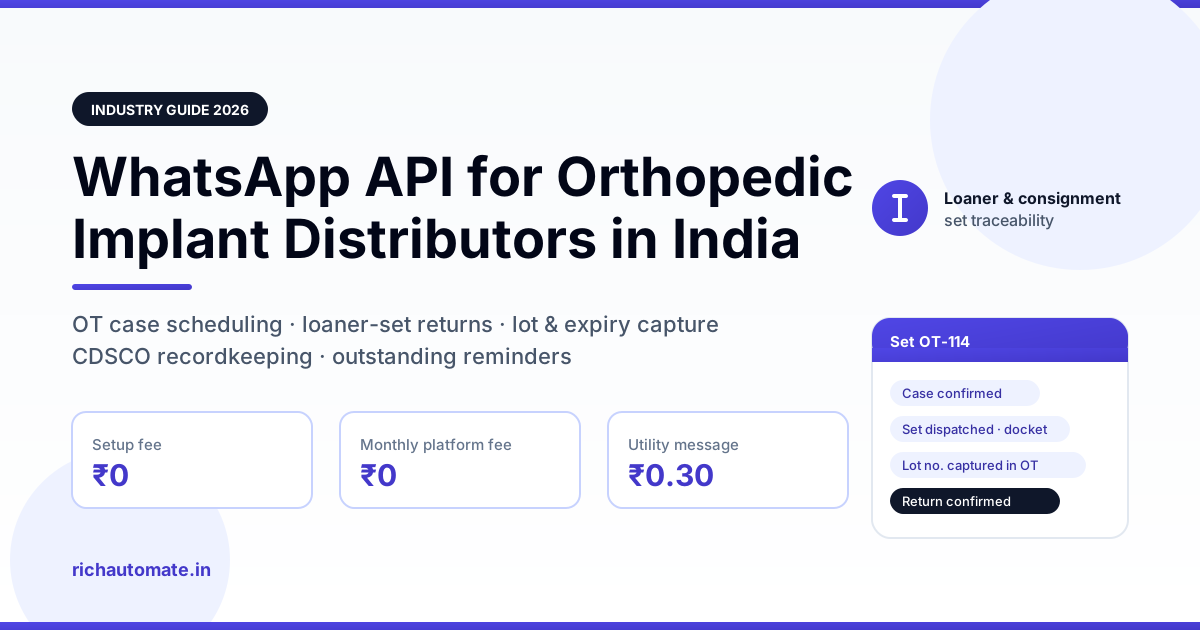
WhatsApp Business API lets an orthopaedic implant distributor in India run OT case scheduling, loaner and consignment set tracking, lot-and-expiry confirmations and outstanding follow-ups from the one channel that surgeons, OT coordinators and hospital stores actually answer. In practice: a structured case booking instead of a 1 a.m. voice call, a set-return confirmation with a tray photo instead of an unaccounted tray, and a searchable record of every batch number you dispatched.
None of that is theoretical. If you distribute trauma plates, spine cages, knee or hip systems anywhere between Ludhiana and Madurai, your business already runs on WhatsApp — on eleven personal accounts belonging to eleven reps, none of it your record. This guide maps the real workflows onto WhatsApp Business API, with the 2026 caveats that matter.
The channel is already WhatsApp. The record-keeping is not.
A mid-sized orthopaedic distributor typically covers 40 to 120 hospitals with six to fifteen field reps, and much of that footprint sits in Tier-2 and Tier-3 trauma centres — Nashik, Rajkot, Jalandhar, Muzaffarpur — that rarely run a procurement portal. The OT coordinator sends a voice note, the rep replies with a photo of a catalogue page, and the case gets confirmed somewhere between a phone call and a forwarded message.
Two things break. When a rep resigns, his territory's order history walks out with his SIM card, size confirmations included. And nothing is queryable: asked which lot you supplied for a case in March, you are scrolling chats. A business number does not change how the hospital behaves — it changes who owns the thread. That is why CDSCO compliance for medical device distributors on WhatsApp is the baseline before any automation goes on top.
OT case scheduling: turning a voice note into a structured booking
Schedule first, because a mis-scheduled case costs you a sterilisation cycle, a courier and sometimes the surgeon's goodwill. The pattern that works is an interaction, not a form: the OT coordinator messages your business number, an automated flow asks for hospital, surgeon, procedure, planned date and time and implant system, and each answer lands as a field instead of free text.
Once the case exists, the reminder ladder does the rest — confirmation immediately, a dispatch note when the set leaves your warehouse, a T-24-hour reminder with set ID and courier docket, and a T-3-hour nudge to the rep who has to be present. All utility-category templates, since each references a transaction the recipient expects.
Why the 24-hour window matters
Free-form replies are allowed only inside a 24-hour service window that opens when the contact messages you; outside it you need an approved template. That is a smaller constraint than it sounds: nearly every outbound message a distributor sends — case confirmed, set dispatched, set due back, invoice attached — is a legitimate utility template. Rejections are the usual snag; our notes on why WhatsApp templates get rejected and how to fix them cover the wording Meta's reviewers refuse.
Loaner and consignment sets: the inventory you own but cannot see
Every Indian orthopaedic distributor carries painful capital in sets that sit somewhere else — consignment stock in a hospital store, loaner sets circulating between three hospitals in one city, trial sets that went out for a knee case and never came back because CSSD staff shelved the tray. Ask any distributor his annual reconciliation gap and you will hear two to eight per cent of set value.
Automation fixes this not by tracking dispatch, which is already tracked, but by forcing the return leg to produce a reply.
| Set lifecycle stage | Trigger | Automated WhatsApp message | What comes back |
|---|---|---|---|
| Set allocated | Case confirmed in your system | Set ID, catalogue codes, sizes loaded, courier docket to OT coordinator and rep | Acknowledgement button press |
| Set received at hospital | Courier delivery or rep hand-over | Received-by confirmation request to hospital store | Name of receiver, time stamp |
| Case done | Scheduled OT time plus 4 hours | Implant-used capture: catalogue code, size, lot or batch number | Consumption entry for billing |
| Set due back | Morning after the case | Return reminder with set ID and tray count | Tray photo plus count reply |
| Set unaccounted | 48 hours with no return reply | Escalation to store in-charge, copy to your branch manager | Open exception with owner and age |
The design choice that matters: the set ID, not the hospital name, is the key. A distributor running 30 loaner sets across 60 hospitals needs to answer "where is set OT-114 right now" in one query, which a chat-based process can only do if every message about that set carries its ID. Much of this machinery is shared with WhatsApp ordering for surgical disposables distributors, where volumes are higher but traceability is lighter.
Size-wise trial sets and the pre-surgery dispatch confirmation
Orthopaedics is a sizing business. A femoral component one size off means the surgeon opens a second tray, and if that tray is not in the theatre your rep is making phone calls while a patient is under anaesthesia. The pre-operative confirmation is the single message with the most money riding on it.
The workable version goes out 48 hours before the case listing exactly what is loaded — system, size range, tray count, screws by length — and asks the surgeon's team to confirm or amend in one reply. When the amendment lands on the business number, your warehouse sees it too and the pick list changes before the set is sealed.
Lot, batch and expiry traceability on sterile implants
Sterile implants carry a lot or batch number and an expiry date, both traceable from your godown to the patient record. As of 2026 wholesale device distribution in India typically operates under the Medical Devices Rules 2017 — wholesale licence commonly applied for on Form MD-42, granted on Form MD-43 — with conditions that normally include purchase and sale records carrying batch details. Retention periods vary by device class and state licensing authority, so verify the current position with your regulatory consultant.
What WhatsApp adds is capture where the data actually exists — in the OT, when the implant is opened. A short utility flow asking the rep or store to reply with catalogue code, size and lot number against the case ID produces a consumption record within hours instead of at month end, ready to reconcile against your goods-inward batch data.
Get a 1-minute BSP audit on WhatsApp
Drop your WhatsApp number — we line-item your current invoice against Meta India rates in under 60 seconds. India-hosted, DPDP-compliant.
Recall and field-safety notices
When a manufacturer issues a batch hold, the problem is speed. Email to a purchase department is typically read in days; a utility template to the store in-charge, in minutes. Send the batch or lot number, affected catalogue codes, the action required and a reply option confirming quarantine. Keep the formal route intact — as of 2026 the recall path in India runs through CDSCO channels and your manufacturer's procedure.
Emergency trauma indents at 1 a.m.
Trauma does not respect business hours. A road accident case in a Tier-2 city at midnight generates a call for a specific plate and screw combination, and whoever answers first gets the case, which is where an always-on business number beats a rep who is asleep.
The realistic automation is triage, not fulfilment: an immediate acknowledgement, a structured capture of hospital, surgeon, implant and urgency, then escalation to the on-call rep and the nearest stocking point. Knowing within 90 seconds that the required 4.5 mm LCP is already in that hospital's consignment cupboard beats any dispatch speed.
| Workflow | Who receives it | Template category | Typical timing |
|---|---|---|---|
| OT case confirmation | OT coordinator, surgeon's secretary | Utility | Immediately on booking |
| Pre-op size list confirmation | Surgeon's team | Utility | T-48 hours |
| Set dispatch and docket | Hospital store, rep | Utility | On dispatch |
| Loaner set return reminder | Store in-charge, CSSD | Utility | Morning after case |
| Batch or lot recall notice | Store in-charge, quality cell | Utility | Within hours of manufacturer notice |
| Outstanding and credit-day reminder | Accounts, sub-stockist | Utility | Due date minus 3 days, then weekly |
| New system or price-list launch | Opted-in surgeons, sub-stockists | Marketing | Planned campaigns only |
Sub-stockist order taking without another spreadsheet
Most implant distributors sell partly through sub-stockists, and that channel is where order taking is messiest: a photo of a handwritten indent, or catalogue codes half-remembered into chat. A catalogue-backed flow lets the sub-stockist pick from your live item list at his own contracted rate and credit terms, dropping a clean order into your system.
The patterns transfer almost unchanged from pharma channel work — see WhatsApp stock and order management for pharma distributors and retailers. The orthopaedic difference: implants are sized and batched, so an order line is never just a quantity.
PO, invoice, e-way bill and GST paperwork on the same thread
Documents are a large part of distributor life: purchase order in, tax invoice out, e-way bill for the consignment, delivery challan for loaner sets moving without a sale, rate contract copies for tender files. All of it can ride the same thread as an attachment tied to the case or order ID — which puts the paperwork where the person who needs it already is.
Two hedges. As of 2026 an e-way bill is typically required above a notified consignment value, with state variations, and GST e-invoicing applies above a turnover threshold that has been revised downward several times — verify current thresholds with your CA before wiring them into a flow. And WhatsApp carries copies, not originals.
NABH audit paperwork requests
Hospitals maintaining NABH accreditation periodically ask suppliers for the same bundle — licence copy, manufacturer and batch certificates, sterilisation documentation. A saved-reply library turns a two-day scramble into a two-minute response, and because request and response sit on one thread you can show what you sent and when. Purchase heads often start from the best WhatsApp Business API options for hospitals and clinics in India.
Credit days, outstanding reminders and NPPA price pressure
Margins here have been compressed by price regulation. As of 2026 knee implant systems and coronary stents remain subject to notified ceiling prices under the National Pharmaceutical Pricing Authority framework, revised several times since the 2017 orders — verify current notified prices and their applicability to your catalogue before quoting. The practical consequence is a thinner, fixed trading margin, which leaves working-capital discipline as the main lever.
That makes payment follow-up a core workflow, not an accounts chore. A staged reminder — three days before the credit period ends, on the due date, then weekly with the ageing figure and invoice numbers — recovers days of working capital without a phone call. Keep it factual: a reminder that reads like a dunning notice gets you blocked, and a blocked number is a broken OT channel.
What it costs, and what nobody should promise you
RichAutomate charges usage only. No setup fee, no monthly platform fee — which matters when message volume swings with the trauma season.
| Item | Client Pay | SaaS Pay |
|---|---|---|
| Setup fee | ₹0 | ₹0 |
| Monthly platform fee | ₹0 | ₹0 |
| Per message | ₹0.10 per message to the platform, Meta bills you directly | Not applicable |
| Marketing message | Billed by Meta to you | ₹1.20 |
| Utility message | Billed by Meta to you | ₹0.30 |
Client Pay suits a distributor who already has a verified Meta WhatsApp Business account; SaaS Pay suits one who wants the number, billing and template management handled. Full breakdowns sit on the RichAutomate pricing page. Most distributor traffic is transactional, so model against the utility rate, not the marketing rate.
One warning worth repeating. Nobody can promise your WhatsApp number will never be restricted, and any vendor who guarantees bulk or unsolicited sending is safe is selling you a risk. Quality ratings drop when recipients block or report messages, and a restricted number takes your OT channel down with it. Keep promotional campaigns off the transactional number, send templates only to contacts who expect them, and be able to produce consent if Meta asks.
Start with one workflow, not eleven
The distributors who get value in the first month pick one workflow and finish it — usually the loaner-set return reminder, which pays for itself in recovered trays, or the pre-op size confirmation. Add case scheduling next, then outstanding reminders, then sub-stockist ordering. Launching everything at once mostly produces unapproved templates and a confused field team.
If you want to see the workflows against your own catalogue and your own hospital list, create a free RichAutomate account and set up your first utility template — no setup fee, no monthly platform fee, and you only pay for what you send.