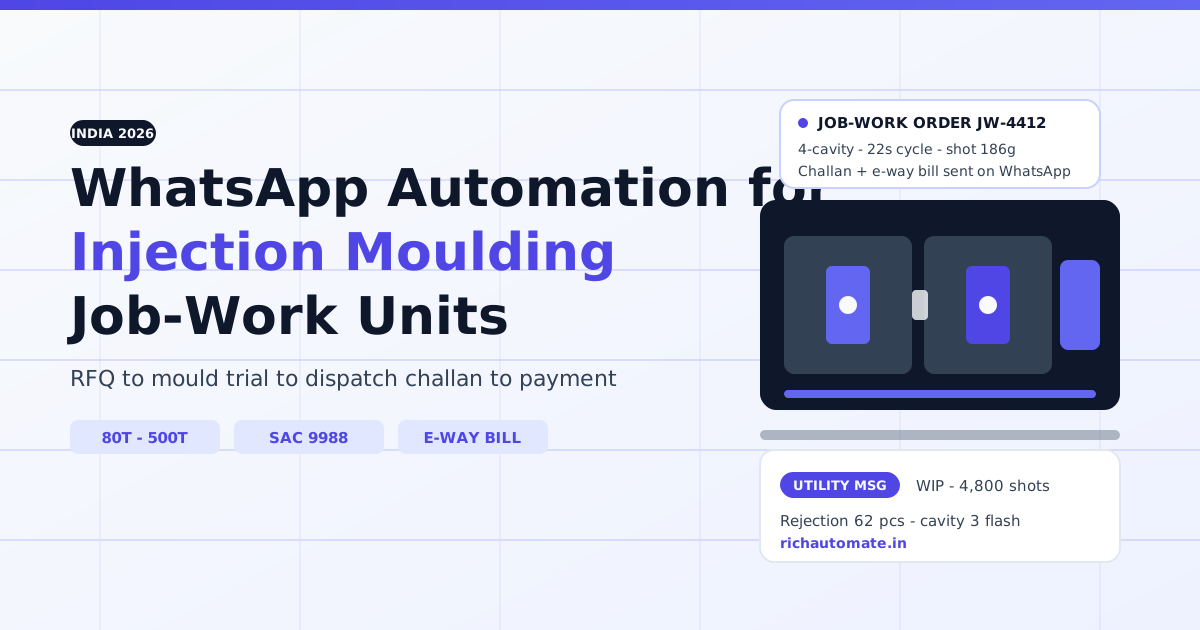
Injection moulding job-work units in India use the WhatsApp Business API to send RFQ acknowledgements, mould-trial reports, daily shot-count and WIP updates, dispatch messages carrying the delivery challan and e-way bill number, and payment follow-ups after the credit period lapses. Each of those is an opt-in template message fired automatically from the job card or ERP that already holds the data, which removes the phone-chase loop that currently eats a production supervisor's day.
A job-work moulder is in an unusual position. You do not own the product, you often do not own the material, and in many cases you do not even own the mould tool sitting in your machine. What you own is machine time, process knowledge and the promise of a date. Every one of those is a communication problem before it is a manufacturing problem, and in India that communication already happens on WhatsApp. The question in 2026 is not whether your buyer's purchase executive will message you, it is whether your unit answers from one verified business number with a searchable trail, or from four personal handsets with none.
What a moulding job-work unit actually has to communicate
Strip a job-work relationship down and the recurring information exchange is narrow, repetitive and highly structured — which is precisely what makes it automatable.
The five numbers that define every job
Machine tonnage. Indian job-work shops rank capacity in clamping tonnage: 80T and 150T machines for small housings, clips, caps and connector bodies; 250T for mid-size covers and automotive interior brackets; 500T and above for bumper-class, crate and large appliance parts. Your buyer's first technical question is almost always "which tonnage will this run on", because it determines whether their part is even feasible in your shop.
Cavity count. A 4-cavity tool at the same cycle produces four times the parts of a single-cavity tool. Quoting without stating cavitation is how job-work moulders end up on the wrong side of a rate negotiation.
Cycle time. Measured in seconds, from mould close to ejection. A 22-second cycle on a 4-cavity tool is roughly 650 parts an hour before rejections and mould-open interruptions. Cycle time is the single number that converts machine-hour rate into piece rate.
Shot weight. Part weight multiplied by cavities, plus runner and sprue. Shot weight decides material consumption, and when the material is free-issue it decides how much of the principal's stock you are answerable for.
Rejection PPM. Short shots, flash, sink marks, weld lines, silver streaks, warpage. Automotive and appliance principals audit rejection parts per million and will ask for it monthly. A unit that reports PPM proactively wins repeat business from one that reports it when asked.
All five values already sit in your job card. Pushing them into a WhatsApp template is a mapping exercise, not a new data-collection burden.
Free-issue material versus bought-out: the communication changes completely
Two commercial models dominate Indian moulding job-work, and they need different message flows.
In free-issue work the principal sends you PP, ABS, HDPE or nylon granules under a delivery challan, you convert them and return finished parts. You invoice only your conversion charge. Your messages must therefore carry a material trail: lot received, weight received, consumption per thousand shots, regrind held, scrap and runner returned. The principal's accounts team eventually has to declare goods sent for job work and goods received back, so every gram you fail to report becomes their reconciliation problem and then your payment problem.
In bought-out work you procure the granules yourself and sell a finished part. Granules attract GST at eighteen percent as goods, and you are carrying working capital and price risk on polymer that moves with crude. Here your messages skew toward price-revision notices, minimum order quantity confirmations and material-grade substitutions — a completely different template set, and one that is far more sensitive to consent because price notices can drift into marketing territory.
The WhatsApp compliance self-audit walks through the consent and record-keeping gaps that cause most notices.
Most units run both. The practical answer is two template families in the same WhatsApp Business account, tagged by order type, so a planner never sends a free-issue reconciliation message to a bought-out customer.
GST, challans and e-way bills: what goes into the message
Job-work moulding sits in a specific compliance groove, and your WhatsApp messages should mirror the paperwork rather than contradict it.
Conversion charges for a registered principal are classified as job-work services under SAC 9988, and moulding job work for a registered principal is commonly billed at twelve percent — confirm the exact entry and any sector-specific rate with your CA before you hard-code it into a quote template. Granules bought on your own account are goods at eighteen percent. Getting these two mixed inside a quotation message is the fastest way to lose credibility with a buyer's finance team.
Movement of goods without a tax invoice — the principal's granules coming in, and in many arrangements the finished parts going back — travels on a delivery challan under the standard challan rule, carrying description, quantity, value and place of supply. Above the state e-way bill threshold the consignment also needs an e-way bill, and the part number, challan number, e-way bill number and vehicle number are exactly the four fields a buyer's stores department will WhatsApp you for at 8pm. Send them before they ask.
The principal separately files a half-yearly return of goods sent to and received back from job workers. You are not the filer, but you are the data source. A unit that sends a clean monthly material statement over WhatsApp becomes the easy vendor at filing time, and easy vendors get re-ordered. If you also handle plastic waste and recycling obligations, the same discipline applies to the paperwork trail described in our guide to WhatsApp automation for scrap and recycling units.
Mould tool ownership and amortisation
Tools are usually owned by the principal, sometimes amortised across an agreed volume, occasionally owned by the moulder against a higher piece rate. Whichever it is, the tool has a life: shot counter, preventive maintenance interval, hot-runner and ejector-pin wear, and a refurbishment point. A tool sitting in your shop for a customer who has not ordered in eight months is dead floor space you are financing. A scheduled utility message at, say, one lakh shots or at a twelve-month idle mark — "tool T-4412 has completed its maintenance interval, PM report attached" — is both a service and a reorder prompt, and it costs a fraction of a rupee to send.
The six-stage WhatsApp lifecycle for a job-work unit
Map your existing process onto six stages, and name the message type at each one. Templates are pre-approved messages you can send outside a conversation window; session messages are free-form replies allowed for twenty-four hours after the customer's last message. Utility templates cover transactional updates on an existing order; marketing templates cover anything promotional and need explicit opt-in.
| Stage | What happens on the shop floor | WhatsApp message type |
|---|---|---|
| 1. Enquiry | Buyer sends a part drawing or 3D file, asks about tonnage fit | Session reply within the 24-hour window; auto-acknowledgement utility template if the enquiry arrives out of hours |
| 2. RFQ and mould trial | Feasibility, cavitation proposal, T0 and T1 trial, first-article samples couriered | Utility template per trial milestone, with trial-report PDF and sample-dispatch docket number attached |
| 3. Job-work order | PO or job-work order accepted, rate and delivery schedule frozen, free-issue material inward | Utility template confirming order number, rate, cavitation, tonnage allotted and committed date |
| 4. Production and WIP | Machine allocated, shots accumulating, rejections logged, schedule risk emerging | Daily or alternate-day utility template with shot count, good quantity, rejection PPM and revised ready date |
| 5. Dispatch | Packing, box count, net weight, delivery challan raised, e-way bill generated, vehicle out | Utility template with challan number, e-way bill number, vehicle number, box count and PDF attachment |
| 6. Payment and reorder | Credit period runs, invoice ages, tool sits idle, next schedule due | Utility template for invoice-due and overdue reminders; marketing template — opt-in only — for capacity or new-grade offers |
Stages one to five are almost entirely utility traffic, which is the cheap category and the category buyers do not resent. Only stage six touches marketing, and only for the promotional half of it. That ratio is why manufacturing is one of the least expensive verticals to automate on WhatsApp.
Get the India 2026 WhatsApp BSP price comparison
Wati vs AiSensy vs Interakt vs RichAutomate: Meta rates, platform fees and hidden costs, side by side. We send it to your WhatsApp in a minute.
Manual phone follow-up versus WhatsApp automation
| Loop | Manual phone and personal WhatsApp | Automated WhatsApp Business API |
|---|---|---|
| Daily WIP update | Supervisor calls three buyers, repeats the same numbers, no record of what was said | One template fires from the job card at a fixed hour, delivered and read status logged per order |
| Dispatch and challan | Photo of the challan from a personal handset, lost when that employee leaves | PDF attached to a template from the company number, archived against the order forever |
| Rejection and quality | Discovered at buyer's incoming inspection, argued over on a call weeks later | Rejection PPM messaged the day it happens, with photo evidence and a containment note |
| Free-issue reconciliation | Reconstructed from memory at month end, disputes over regrind and scrap | Running material statement pushed per lot, buyer never has to ask |
| Payment follow-up | Awkward calls the owner delays making | Scheduled polite reminders at due date, plus seven and plus twenty-one days, with invoice attached |
| Handover risk | Customer relationship lives in one person's phone | Every thread lives in the business account with role-based access |
Channel fit: why WhatsApp and not email or SMS
| Channel | Reaches the plant-side buyer | Carries a challan PDF | Proof of receipt | Practical for daily updates |
|---|---|---|---|---|
| WhatsApp Business API | Yes — the number is already on their phone | Yes | Delivered and read status | Yes, automated from the job card |
| Reaches purchase, rarely reaches stores or quality | Yes | Weak | Ignored after the first week | |
| SMS | Yes | No, link only | Delivery only | No attachments, poor for evidence |
| Phone call | Yes | No | None | Consumes supervisor time linearly |
| Personal WhatsApp | Yes | Yes | Informal | No automation, no continuity, no audit trail |
The comparison is not close for a manufacturing supply relationship. The same logic drives adoption in adjacent trades — see how it plays out for construction material dealers running delivery and credit cycles, where dispatch confirmation and payment chase dominate exactly as they do in moulding.
Rejection, trials and the quality loop
The trial phase is where job-work relationships are won. A T0 trial that produces short shots at the far cavity, a gate that leaves a witness mark on a cosmetic face, a warpage issue that only shows after twenty-four hours of conditioning — these are normal, and how you communicate them decides whether the buyer sees a competent partner or a risky one.
The practical pattern is a trial-update template with three fixed variables: trial number, observation summary and next action with a date. Attach photographs of the actual moulded part next to the drawing callout. Buyers who receive that within hours of the trial stop calling to ask, and your engineering time goes back into the shop. Units doing prototype and low-volume work alongside production see the same effect described in our note on WhatsApp workflows for rapid-prototyping services, where the update cadence is the product as much as the part is.
For running production, send rejection data before the buyer's incoming inspection finds it. A message that says "lot of 4,800 pieces, 62 rejected for flash on cavity 3, tool cleaned, next lot under watch" costs you nothing and buys enormous trust. Silence followed by a rejection debit note costs a customer.
Payment follow-up, the 45-day rule and Udyam
Job-work moulders are chronically under-capitalised because conversion margins are thin and credit periods are long. Indian MSME law gives registered micro and small enterprises a statutory right to payment within an agreed period not exceeding forty-five days, with a shorter default where there is no written agreement, and interest on delay. The MSME Samadhaan portal exists to pursue those claims. None of it applies unless you hold a valid Udyam registration and unless you can show when the goods were accepted.
This is where a message trail quietly becomes a financial asset. A dispatch template with the challan and e-way bill number, timestamped and read-receipted, plus a delivery confirmation, plus a dated invoice reminder series, is a far stronger record than a call log. Most buyers never let it get that far — the majority of late payments in this sector are administrative, not adversarial, and a polite automated reminder on the due date clears them.
Keep reminder tone factual and keep the cadence bounded: due date, plus seven, plus twenty-one, then a human call. Escalating message frequency does not accelerate payment and does damage your quality rating with Meta if recipients start blocking you.
What it costs
RichAutomate bills usage only. There is no setup fee and no monthly platform fee, which matters for a unit whose message volume swings with the order book.
- Setup fee: ₹0. Monthly platform fee: ₹0. You pay for what you send, nothing else.
- Client Pay — ₹0.10 per message. You connect your own Meta WhatsApp account and settle Meta's charges directly; we bill ten paise a message on top.
- SaaS Pay — ₹0.50 per utility message. Order confirmations, WIP updates, dispatch and challan notifications, invoice reminders — the bulk of a moulding unit's traffic.
- SaaS Pay — ₹1.50 per marketing message. Capacity announcements and new-grade offers, to opted-in contacts only.
Meta charges its own conversation fee separately, set by Meta and varying by category and country. The choice between the two billing routes is covered in detail in our breakdown of Client Pay versus SaaS Pay WhatsApp billing, and the current plan grid lives on the RichAutomate pricing page. For a shop running twenty active orders with an alternate-day WIP update and a dispatch message per lot, the monthly spend lands well under what one courier run costs.
Consent, templates and what not to do
Everything above depends on messaging people who expect to hear from you. Collect opt-in explicitly — a tick box on your enquiry form, a line in the job-work order acceptance, or a customer-initiated first message — and record where and when it was given. Keep utility templates strictly transactional; the moment a dispatch notification carries a sales pitch, it is a marketing message and needs marketing consent.
Do not buy lists of purchase-manager numbers and blast them. Nobody can guarantee an account will never be restricted, and cold bulk sending is the surest way to collect blocks, drag your quality rating down and end up rate-limited exactly when a customer needs a dispatch update. Grow the list from real enquiries, honour opt-outs immediately, and keep one verified business number rather than a handful of personal handsets. If your unit also carries producer or brand-owner plastic obligations under EPR, apply the same consent discipline to those compliance notifications.
Start with one flow, not ten
The highest-return first automation for a moulding job-work unit is the dispatch message: challan number, e-way bill number, vehicle, box count, net weight, PDF attached, fired the moment the gate pass is cut. It eliminates the single most common inbound call, it creates the payment trail you will want later, and it needs exactly one approved template. Add the WIP update next, then the invoice reminder series, then trial reports. Free-issue reconciliation and tool-maintenance nudges come last, once the shop trusts the system.
Ready to put your shop floor on one verified number? Create a free RichAutomate account and set up your first dispatch template — usage-only billing, no setup fee, no monthly platform fee, and Meta's conversation charges billed separately at cost.