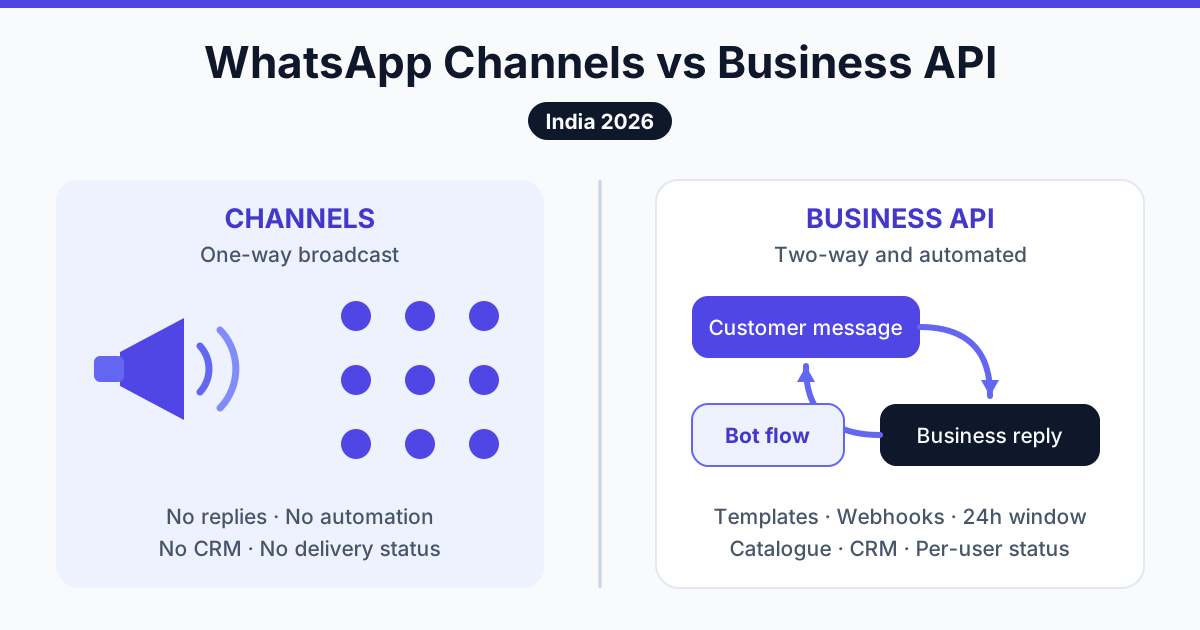
WhatsApp Channels is a broadcast-only, one-to-many follower feed inside the Updates tab: people can follow you and react with an emoji, but they cannot reply, you cannot automate anything, and you never learn who they are. The WhatsApp Business API is the opposite - two-way, automatable and commerce-capable, with template messages, webhooks, a 24-hour customer service window and a per-conversation cost - which is why nearly every Indian business that wants leads, orders or support runs on the API and uses Channels only as a free top-of-funnel megaphone.
Since Meta pushed the Updates tab to the front of the app, Indian founders keep asking the same question: "Channels are free and reach thousands - do I still need a paid WhatsApp API?" The honest answer is that the two products barely overlap. One is a publishing surface. The other is a customer communication system. This guide breaks down what each does at a mechanics level, what Channels genuinely cannot do, what both cost, what the DPDP Act 2023 means for a follower base you do not own, and how to sequence the two across a five-stage funnel.
What a WhatsApp Channel actually is
A Channel is a one-way broadcast feed that lives in the Updates tab, separate from personal chats. Anyone can find and follow it, admins post text, images, video, links and polls, and followers see those posts in a feed. Follower identities are hidden from admins, and admin identity is hidden from followers unless you choose to reveal it. Meta positions it as the simplest way to get updates - closer to a Telegram channel or an Instagram broadcast channel than to messaging.
The three things Channels does well
- Zero marginal cost reach. No per-message billing, no wallet, no conversation pricing. Post once, every follower sees it in their feed.
- Discovery. Channels appear in a searchable directory, so a recognisable brand picks up organic follows it never paid for.
- Low friction. Following is a single tap and does not expose the follower's number to you - which is exactly why people follow, and exactly why the audience is worth less to you commercially.
What the WhatsApp Business API actually is
The Business API is a programmatic interface to a verified business phone number. Your systems send messages through it, and Meta pushes every inbound message and every status change back to your server as a webhook event. That single architectural fact - a webhook - is what makes automation, CRM sync and analytics possible, and it is the thing Channels has no equivalent of.
Templates and the 24-hour window, explained correctly
Two rules govern API sending. First, to start a conversation with a user who has not messaged you recently, you must use a template message that Meta has reviewed and approved in advance, in the category you declared - marketing, utility or authentication. Templates can be rejected or paused on quality signals, so approval is never guaranteed and you should always keep spare variants ready.
Second, the moment a user sends you a message, a 24-hour customer service window opens. Inside that window your business can reply with free-form content - plain text, images, documents, interactive buttons, lists - with no template needed. When the window closes you are back to templates until the customer writes again. Getting this right is the difference between a support desk that works and a wallet that drains on unnecessary marketing conversations. Our breakdown of WhatsApp Business API cost in India walks through how those conversation categories actually price out.
Channels vs Business API: the feature matrix
| Capability | WhatsApp Channels | WhatsApp Business API |
|---|---|---|
| Direction | One-way broadcast only | Two-way conversation |
| Inbound replies | Not possible (emoji reactions and polls only) | Full inbound, threaded with message context |
| Per-user delivery status | None - no sent, delivered or read per follower | Per-message sent, delivered, read and failed webhooks |
| Webhooks and integrations | None | Inbound plus status webhooks to your server |
| Automation and chatbots | Not supported | Full flow engine, routing, auto-replies |
| Contact identity | Followers anonymous to admin | Phone number, profile name, opt-in state |
| CRM and order data | No link | Bi-directional sync via API |
| Template approval | Not applicable | Required for business-initiated messages |
| 24-hour service window | Not applicable | Core billing and content rule |
| Commerce (catalogue, cart, payments) | None | Catalogue, product lists, payment links |
| Verified business badge | Channel verification is separate and limited | Official Business Account badge possible |
| Audience export | Impossible | Your own opt-in database, fully portable |
| Cost per message | ₹0 | Meta conversation charge plus platform fee |
What Channels genuinely cannot do
It is worth being blunt about the hard limits, because most "Channels will replace your API" posts skip them.
- No inbound. A follower who wants to buy cannot message the Channel. Your only escape hatch is a link in the post that opens a chat with your API number - which means the API is still doing the actual work.
- No per-user delivery receipts. You get an aggregate view count, not a per-recipient delivered or read event. You cannot suppress, retry or reconcile a failed send because you never learn it failed.
- No reply context. The API returns a context object identifying which message a customer replied to, which is how ticketing and flow branching work. Channels has no such structure at all.
- No webhook, no automation hook. Nothing fires anywhere in your stack when a Channel post lands. There is no event to attach a workflow to.
- No commerce. No catalogue, no product list message, no cart, no payment collection.
- No segmentation. Every follower gets every post. You cannot send a Mumbai-only offer or a lapsed-customer win-back.
- No ownership. If the Channel is restricted or the product changes, the audience is gone. There is nothing to migrate, because there was never a list.
The cost model, side by side
Channels looks free and mostly is. The API costs money because it does work. Here is how the economics compare for a business reaching roughly 10,000 people.
| Cost element | Channels | Business API on RichAutomate |
|---|---|---|
| Platform fee | ₹0 | ₹0 platform fee, ₹0 setup, ₹0 monthly |
| Per message - Client Pay | ₹0 | ₹0.10 per message; Meta conversation charges billed directly by Meta to you |
| Per message - SaaS Pay | ₹0 | ₹1.50 marketing / ₹0.50 utility |
| Trial | Free | 14-day free trial plus 100 free credits |
| Attributable revenue | Hard - no identity, no click-to-order chain | Direct - conversation to order, tracked per contact |
Other Indian BSPs price on monthly seats or markup slabs (as of 2026 - verify on each vendor's site before you compare, since India-region conversation rates have been revised more than once). The point that survives any pricing change: a Channel post costs nothing and returns an unattributable view count, while an API conversation costs a known amount and returns an identified contact you can attribute revenue to. Check the current WhatsApp API pricing plans before assuming free reach is cheaper in outcome terms.
Get the India 2026 WhatsApp BSP price comparison
Wati vs AiSensy vs Interakt vs RichAutomate: Meta rates, platform fees and hidden costs, side by side. We send it to your WhatsApp in a minute.
Where volume rules still bite
Channels has no messaging tier ladder. The API does: your business-initiated messaging limit starts capped and scales with quality and volume, which catches teams planning a one-shot festive blast. Read WhatsApp broadcast limits and tiers before you plan any large India campaign, because a tier ceiling will quietly throttle a launch that a Channel would have published instantly.
DPDP Act 2023: a follower is not a consented contact
India's Digital Personal Data Protection Act, 2023 is built on notice and purpose-limited consent. That has a direct consequence most teams miss: a Channel follow is not consent to market to someone, and it never becomes a data asset you hold, because Meta never gives you the follower's number. You are not a data fiduciary for an audience you cannot identify - but you also cannot do anything with that audience beyond posting to it.
To see what non-compliance would actually cost, the DPDP penalty calculator sizes the exposure against your contact volume.
The API side is where compliance obligations actually attach. There you hold phone numbers, you must give clear notice of purpose at opt-in, you must honour withdrawal of consent (a STOP or opt-out has to genuinely stop marketing sends), and you should keep an auditable record of when and how each contact opted in. Practical rules for 2026:
- Log the opt-in source, timestamp and stated purpose for every contact.
- Keep marketing and transactional consent separate - consent to receive an order update is not consent to receive offers.
- Make withdrawal one tap and process it immediately, not at the next campaign build.
- Never import a scraped or purchased list. It fails DPDP on consent and fails Meta policy on quality, and your quality rating drives your sending limits.
On the telecom side: TRAI's TCCCPR framework governs SMS and voice, not over-the-top messaging, so a WhatsApp campaign is not filed as a DLT template. That is not a free pass - Meta's own Business and Commerce policies fill the gap, and they are enforced through template rejections, quality-rating drops and messaging-limit cuts. No provider can promise you an untouchable setup; what you control is consent hygiene, category accuracy and opt-out latency.
The five-stage funnel: where each tool sits
- Awareness - Channels, ads, SEO, social. Channels is genuinely useful here: free, discoverable, zero marginal cost per post.
- Follow - a soft, anonymous subscription. Cheap to acquire, low commercial value, impossible to export. Treat it as reach, not as a list.
- Intent - the handoff. Every Channel post should carry a click-to-chat link to your API number with a pre-filled message. This is the only bridge between the two products, and the only step where a follower becomes a contact.
- Conversation - API only. Inbound lands on your webhook, a flow qualifies the lead, an agent takes over inside the 24-hour window, and the whole thread is stored against the contact.
- Conversion and retention - API only. Order confirmations, payment links, delivery updates, feedback prompts, win-back templates, segmented offers to a consented list.
Stages one and two are the only ones a Channel can serve. Stages three to five - where the money is - are API-native. See how teams wire stages three to five in the WhatsApp automation features overview.
Use-case fit: which tool for which job
| Job to be done | Right tool | Why |
|---|---|---|
| Daily offer or content drop to fans | Channels | Free, no per-message cost, no template queue |
| Order confirmation and delivery updates | API | Needs identity, utility templates and status webhooks |
| OTP and login codes | API | Authentication templates, per-user delivery |
| Lead qualification and routing | API | Two-way flow with CRM write-back |
| Customer support | API | 24-hour window, agent inbox, threading |
| Abandoned-cart recovery | API | Per-contact trigger and personalisation |
| Event or launch announcement to a public audience | Channels plus API | Channel for reach, API for people who already opted in |
| Segmented regional campaign | API | Channels cannot segment at all |
How Indian SMBs are combining both in 2026
Adoption of WhatsApp as a business surface in India is directionally very large - WhatsApp remains the default messaging app for hundreds of millions of Indian users, and business messaging is directionally the fastest-growing part of that usage (FY26 estimate - verify against the latest Meta and IAMAI releases before quoting any number in a deck). Operationally, the teams doing this well split duties in a simple way:
- The Channel runs like a newsletter: two to four posts a week, every post ending in a click-to-chat link.
- The API number carries the identity and the transaction: the verified display name, the catalogue, the support inbox, the automations.
- Ads and the website feed the API list directly, because that opt-in list is the only audience asset the business actually owns.
Note what is missing from that split: nobody runs support, billing or order updates on the Channel, because the product cannot carry them. The Channel is the poster; the API number is the business.
A workable operating rule
If a message needs to know who it is going to, it belongs on the API. If it is the same message for everyone and you would be happy to see it on a public page, it can go on the Channel. That one test settles almost every "which surface?" argument a marketing team will ever have.
Start on the API in a day
Channels costs nothing and is worth switching on. It will not send an order confirmation, will not answer a customer at 9pm, and will not tell you who bought. The Business API does all three, and on RichAutomate it starts at ₹0 platform fee, ₹0 setup and ₹0 monthly - you pay ₹0.10 per message on Client Pay with Meta billing conversation charges directly to you, or ₹1.50 per marketing and ₹0.50 per utility message on SaaS Pay. Every new account gets a 14-day free trial plus 100 free credits.
Create your free RichAutomate account to connect a number, load templates and run your first automated flow. Prefer to talk it through first? Message us on WhatsApp at 918160311319 or book a 30-minute walkthrough at https://richautomate.in/book/demo.
If you run a large broadcast audience, our Telegram vs WhatsApp Business verdict explains where each channel fits.
Still deciding between a Channel, a Community or a group? Read WhatsApp Community vs Group vs Channel for business before you build.
Related: WhatsApp now sells ad placements inside the Updates tab — see WhatsApp Status ads in India: costs, setup and ROI.