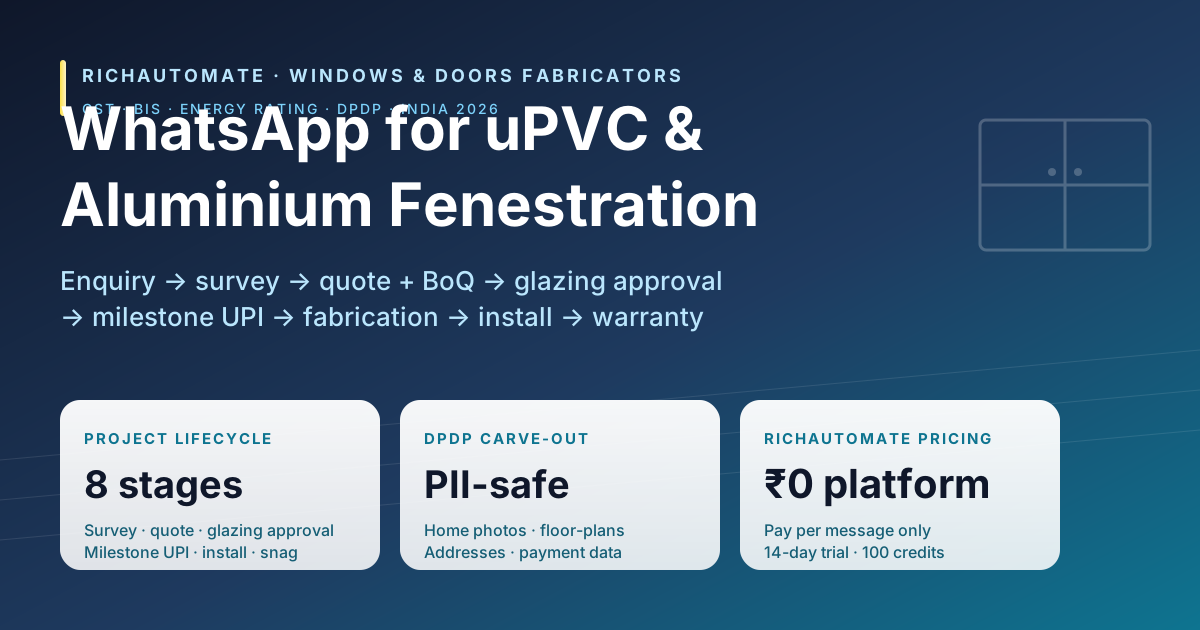
A uPVC or aluminium windows-and-doors (fenestration) business in India 2026 is one of the most under-digitised high-ticket home-improvement verticals there is. The product is custom-made to the millimetre, the order value runs from ₹40,000 for a flat's worth of windows to ₹15 lakh for a villa or a commercial facade, and the journey from "I want new windows" to "the fabricator has fitted them and cleared the snag list" stretches across six to ten weeks of measurement, design approval, glass selection, advance payments, factory fabrication, site installation and finishing. Yet most fabricators and dealers run that entire journey on a personal phone — a blur of WhatsApp photos, missed calls, half-remembered measurements and "sir, when is delivery?" follow-ups. The fenestration firms that win in 2026 are the ones who move the whole lifecycle onto the WhatsApp Business API: a single, auditable thread per project carrying the site survey, the quote, the milestone payments, the glazing approvals, the fabrication-status updates and the post-install warranty. This guide maps that lifecycle end-to-end, the standards stack you should reference (all hedged), and the DPDP carve-out for customer floor-plans, site photos and payment data. Every regulatory and standards specific below is as of 2026 — verify current GST treatment, BIS standards, energy-rating norms and consumer-protection rules before relying on it. General information, not legal or tax advice.
The Standards & Compliance Spine in Five Minutes (All Hedged)
Fenestration sits at the intersection of a manufactured good and a works contract, so the rule stack matters more than most home-improvement trades realise. Quote nothing to a customer without checking the current text:
- GST: goods vs works-contract split. Whether you supply only the windows (sale of goods) or supply-and-install them on site (often treated as a works contract or composite supply) changes the GST treatment and the rate applied. The classification is fact-specific and has been litigated — get your exact treatment, rate and HSN/SAC from a qualified tax professional, and mark every quote "GST as applicable, verify current rate".
- E-invoicing thresholds. B2B e-invoicing under GST applies above a turnover threshold that has been progressively lowered. If your fenestration firm crosses it, IRN/e-invoice generation is mandatory on B2B supplies — verify the current threshold and your applicability.
- BIS standards for materials and hardware. uPVC profiles, aluminium sections, glass, and the hinges/locks/rollers (hardware) may be covered by relevant Indian Standards and, in some cases, mandatory certification. Float glass and safety/toughened glass in particular have applicable standards. Reference the standard your material claims to meet — and verify which BIS standards are currently mandatory vs voluntary for your SKUs.
- Energy / thermal performance claims. If you market "energy-efficient" or thermally-broken windows, U-value or SHGC claims (and any ECBC / energy-conservation building-code relevance for commercial projects) should be backed by the manufacturer's test data, not a sales slogan. Verify the current code applicability for the building type.
- Consumer Protection Act 2019 + warranty. Windows and doors are durable goods sold with explicit warranties (profile, hardware, glass, installation). Service-deficiency and misleading-claim provisions apply, so the warranty terms, the installation SLA and the snag-resolution timeline you commit to in chat are enforceable — a documented WhatsApp thread is your first line of defence.
- RERA — only when bundled with a builder project. If you are a fenestration vendor supplying directly to a homeowner, RERA generally does not apply to you. If your windows are part of a promoter's under-construction project, the project's RERA obligations sit with the developer — reference this neutrally and verify the boundary for your specific engagement.
- Labour / site-safety at install. On-site installation involves working at height, power tools and sometimes scaffolding; basic site-safety and applicable labour norms apply to your install crew. Verify current obligations for your team size and project type.
Treat all market sizing as directional — the point for a fabricator is simpler: this is a long, high-value, approval-heavy, payment-milestoned journey, which makes quote-to-advance conversion, design-approval turnaround, on-time install rate and snag-closure SLA — not square-feet-of-glass — the real competitive variables. Every one of those variables is a WhatsApp problem.
Why Fenestration Is a Near-Perfect WhatsApp Vertical
Few trades match windows-and-doors for WhatsApp fit. The buyer is already photographing their old windows and forwarding them; the order is custom and slow, so anxiety between advance and delivery is high; payments come in milestones that need an auditable trail; and the approvals (which glass, which colour, which handle, did the measurement match) are inherently visual. Here is the contrast that makes the case:
| Project reality | On a personal phone | On WhatsApp Business API |
|---|---|---|
| Enquiry capture | Missed call, lost lead to the next dealer | Click-to-WhatsApp Flow captures rooms, sizes, pin-code instantly |
| Site survey | Measurements on a paper chit, sometimes lost | Slot-picker booking + structured measurement form + photos in thread |
| Quote & design approval | PDF on email nobody opens; "approved on call" | Quote PDF + render in thread + one-tap approve/revise with version log |
| Milestone payments | Screenshots of UPI; disputed amounts | One-tap UPI link per milestone + auto payment-confirmed template |
| Fabrication status | "Sir when ready?" × 11 calls | Cut → assembly → glazing → QC → dispatch status pushes |
| Install & snag | Verbal complaints, no record, bad review | Photo snag capture + SLA timer + signed-off handover in thread |
| After-sales | Forgotten until something breaks | Warranty cert + AMC opt-in + festive-renovation re-engagement |
The 8-Stage Fenestration Lifecycle on WhatsApp
A windows-and-doors project is a manufacturing sprint funded by milestones. The table maps each stage to the WhatsApp capability that drives it, plus the data and the compliance note that rides along.
The click-to-WhatsApp link generator produces the link and the QR code together if you need both.
| Stage | Fabricator / dealer activity | WhatsApp capability | Key data / documents | Compliance note |
|---|---|---|---|---|
| 1. Enquiry capture | Room count, approx sizes, material interest, budget band, possession date | CTWA/QR entry + chatbot menu + intake Flow with DPDP consent | Pin-code, rooms, uPVC/aluminium interest, timeline | Opt-in captured and logged at first contact |
| 2. Site-survey booking | Surveyor slot, measurement, opening-condition photos | Slot-picker Flow + reminder + structured measurement form | Window/door dimensions, sill condition, photos | Measurement accuracy stays with the surveyor, not the bot |
| 3. Quote + BoQ | Itemised quote — profile, glass, hardware, mesh, install | Quote PDF in thread + line-item explainer + GST breakup | BoQ PDF, GST split, validity date | "GST as applicable, verify current rate"; quote validity stated |
| 4. Design / glazing approval | Colour, glass type (clear/tinted/toughened/DGU), handle, mesh | Render / spec card + one-tap approve/revise + version log | Approved spec sheet, signed-off render | Glass safety standards referenced; approval timestamped |
| 5. Advance + milestone schedule | Booking advance, pre-fabrication, pre-dispatch, post-install | One-tap UPI link per milestone + payment-confirmed template | UPI references, receipts, milestone ledger | UPI/aggregator, not screenshots; auditable payment trail |
| 6. Fabrication tracking | Profile cut, frame assembly, glazing, hardware fit, QC, dispatch | Stage-status templates + photo at QC + dispatch ETA | Work-order status, QC photo, dispatch date | BIS-grade material attach per SKU where claimed |
| 7. Install + snag | Site fitting, sealing, mesh, snag inspection, handover | Install slot + crew checklist + photo snag capture + SLA timer | Install checklist, snag list, handover sign-off | Site-safety norms; warranty SLA honoured |
| 8. Warranty + referral | Warranty cert, AMC, service reminders, referral, festive offers | Warranty PDF + AMC opt-in + segmented re-engagement broadcast | Warranty terms, AMC schedule, referral attribution | Marketing to opted-in contacts only; honour STOP instantly |
Stage 1-2: Enquiry Capture and the Site-Survey Flow
The single most expensive leak in a fenestration business is the unanswered enquiry. A homeowner who has decided to replace their windows is high-intent and impatient — if your number rings out, the next dealer's WhatsApp answers. Route every enquiry — the click-to-WhatsApp ad, the QR on your showroom display window, the Justdial/IndiaMART lead, the architect referral — into a structured intake. The chatbot asks the four things that qualify a window job: how many openings, roughly what sizes, uPVC or aluminium, and the possession/renovation timeline. It explains your material grades and your typical price band so unqualified leads self-select out, then it books a site-survey slot. A WhatsApp Flow then lets the surveyor capture, on site, the structured measurement data and the opening-condition photos directly into the thread — so the measurement chit can never be lost on the way back to the office.
Get a 1-minute BSP audit on WhatsApp
Drop your WhatsApp number — we line-item your current invoice against Meta India rates in under 60 seconds. India-hosted, DPDP-compliant.
Stage 3-4: Quote, BoQ and the Glazing-Approval Loop
A fenestration quote is not one number — it is a bill of quantities (BoQ) that prices the profile system, the glass (clear, tinted, toughened, or a double-glazed unit), the hardware grade, the mesh, and the supply-and-install labour, with a GST treatment that depends on how the supply is classified. Delivered as a clean PDF inside the WhatsApp thread, with a line-item explainer message and a stated validity date, the quote becomes a reference the customer can revisit instead of a forgotten email attachment. Then comes the approval loop that fenestration uniquely needs: the customer must approve the colour, the glass type and the handle/hardware — visual choices that drive the price and the lead time. A spec card or render with one-tap "approve" / "request change" buttons turns a week of phone-tag into a logged, timestamped decision. Every revision is a new version in the thread, so when the customer says "I never chose tinted glass," the version log settles it.
Stage 5: Milestone Payments — the Auditable Money Trail
Custom windows are funded in milestones — typically a booking advance, a pre-fabrication payment, a pre-dispatch payment and a post-install balance. On a personal phone this is a mess of UPI screenshots and disputed amounts. On the Business API, each milestone fires a one-tap UPI link (via a licensed payment aggregator), and an automated "payment received" template confirms it in the thread the instant it lands. The result is a milestone ledger inside the conversation: every rupee timestamped, every receipt attached, every GST breakup visible. For a high-ticket job where a payment dispute can stall fabrication, this auditable money trail is worth as much as the speed — and it is exactly the kind of documented commitment that protects you under the Consumer Protection Act 2019 if a grievance is ever raised.
Stage 6-7: Fabrication Tracking, Install and the Snag List
The weeks between advance and delivery are where fenestration relationships break — the customer has paid, the windows are "in the factory," and the only information channel is repeated "sir when ready?" calls. Replace that anxiety with stage-status pushes: profile cut, frame assembly, glazing complete, hardware fitted, QC passed (with a photo of the finished unit), and dispatched with an ETA. Each push is a scheduled or event-triggered template, so the customer is informed without anyone in your office lifting a finger. When install day arrives, a slot-confirmation plus a crew checklist (site access, power, old-window removal scope, sealing materials) keeps the fitting smooth. And the killer feature: one-tap photo snag capture. The customer photographs any defect — a scratch on the profile, a gap in the sealing, a stiff handle, a mesh tear — taps a category, and it auto-routes to the service desk with an in-thread SLA timer running. No app, no email, no "I'll call the office." The handover ends with a signed-off acknowledgement in the thread.
Stage 8: Warranty, AMC and Festive-Renovation Re-Engagement
Most fabricators treat handover as the end. It is the start of the cheapest pipeline they have. The warranty certificate (profile, hardware, glass, installation, each with its own term) is delivered as a PDF in the thread where the customer will actually find it. An AMC opt-in — periodic servicing of rollers, gaskets, drainage and seals — converts a one-time buyer into a recurring relationship. And because windows are bought room-by-room and home-by-home, a segmented festive-renovation broadcast (to opted-in past customers, around Diwali or the wedding-season build-out) re-engages a buyer who did the living-room windows last year and now wants the bedrooms. The referral ask, embedded in the handover message with an attribution link, turns a satisfied customer into your lowest-CAC channel — fenestration is a word-of-mouth-heavy trade, and a one-tap "refer a friend" beats a forgotten verbal promise every time.
The Automation Tech Stack: Stage by Stage
Everything above assembles from five WhatsApp Business API primitives — Flows for structured intake (enquiry, on-site measurement), approved templates for business-initiated messages (survey reminders, fabrication status, payment confirmations, warranty), a chatbot for FAQ deflection and qualification, human handoff for judgement calls (custom-spec queries, complaints, big-ticket negotiation), and broadcast segments for festive and referral campaigns. Mapped to the lifecycle with the KPI each stage owns:
| Stage | Automation | KPI to watch |
|---|---|---|
| Enquiry → survey | CTWA entry + qualification chatbot + survey-booking Flow + reminder | Enquiry-to-survey rate; survey no-show % |
| Quote → approval | Quote PDF + glazing-approval card with version log | Quote-to-approval turnaround; revision count |
| Advance → milestones | One-tap UPI per milestone + payment-confirmed template | Advance-backed conversion; payment-dispute rate |
| Fabrication → dispatch | Stage-status templates + QC photo + dispatch ETA | Inbound "when ready?" call volume; on-time dispatch % |
| Install → snag | Install slot + crew checklist + photo snag capture + SLA timer | On-time install rate; snag-closure SLA % |
| After-sales | Warranty PDF + AMC opt-in + festive/referral broadcasts | AMC opt-in %; repeat + referral revenue |
For the customer-data backbone behind these flows — tagging a project's material spec, milestone status and warranty dates to a contact record — see our guide to the best WhatsApp CRM for India 2026. The high-volume qualification and FAQ-deflection pattern is covered in depth in our WhatsApp chatbot for business guide. Fenestration shares its long, milestone-funded, approval-heavy rhythm with two neighbouring trades — read the playbooks for modular kitchen and interior fit-out and for construction-material dealers to see how the same primitives flex across the home-build value chain.
The DPDP Carve-Out: Home Photos, Floor-Plans and Payment Data
A fenestration job creates data that is more intimate than a typical retailer's order history — and the Digital Personal Data Protection Act 2023 (DPDP — verify implementation status as of 2026) governs the personal slices of it.
- Site photos and floor-plans: images of the inside of a customer's home and any floor-plan they share are personal data tied to an identifiable individual and their residence. Apply purpose limitation (collected to quote and install, not to market), data-minimisation (only the openings you are quoting), and never reuse a customer's home interiors as a portfolio or ad without separate written consent.
- Addresses and contact data: the delivery address, contact number and name are personal data; keep them inside the project workflow and your CRM, not scattered across personal phones and paper chits.
- Payment data: route money through UPI links and a licensed aggregator, not screenshots — and keep invoice/payment records per the applicable tax-retention norms rather than indefinitely on a phone.
- Dropped-enquiry deletion: the home photos and addresses of enquiries that never converted are a liability, not an asset. Set a deletion schedule and honour it.
- Consent ledger: the WhatsApp thread that runs your enquiry, approval and payment flow also documents your notices and the customer's permissions — one more reason to keep the whole project in one channel instead of scattered across calls, email and paper.
Where customers and contact persons are identifiable natural persons, DPDP applies to their data; verify your exact obligations with qualified data-privacy counsel as of 2026.
Cost Model: A Fenestration Business on RichAutomate
With RichAutomate (₹0 platform fee · ₹0 setup · ₹0 monthly), the cost of the WhatsApp Business API for a windows-and-doors business is purely the Meta conversation charges — and only for conversations actually sent. Consider a mid-size fabricator closing 25 projects a month, each project generating roughly 8-12 business-initiated conversations across survey, quote, four payment milestones, fabrication status, install and warranty:
- Project utility conversations (survey reminder, quote, payment confirmations, fabrication status, install, warranty): roughly 250-300 utility-tier conversations a month at 25 projects
- On Client Pay (₹0.10 per message, Meta conversation charges billed directly to you by Meta): the platform cost is a few hundred to low-four-figure rupees a month at this scale
- SaaS Pay is ₹1.20 per marketing message and ₹0.30 utility/authentication, all-inclusive — relevant when you run a festive-renovation or referral broadcast to your opted-in past-customer base
- A 14-day free trial with 100 credits lets you pilot a full survey-to-handover Flow on a handful of live projects before paying anything
Set that against the value of a single saved project — one fenestration job is worth ₹40,000 to ₹15 lakh, so recovering even one lead that would otherwise have rung out, or closing one payment dispute with an auditable thread, pays for a year of conversation charges. Model your own project volume and message mix with the WABA cost calculator, and see the RichAutomate pricing page for volume rates — the platform fee stays ₹0 regardless of scale.
Anti-Patterns: How Fenestration Firms Get This Wrong
- Running it on a personal number. No templates, no shared inbox, no audit trail, and one ban away from losing every customer thread. Use the Business API — and never promise a customer their number "won't get banned"; promise opt-in discipline instead.
- Quoting GST as a flat fact. Goods-vs-works-contract classification is fact-specific. Hedge "GST as applicable, verify current rate" and get your treatment from a tax professional, not a template.
- Approving spec "on call". Verbal glass and colour approvals cause disputes. Use the one-tap approval card with a version log so every choice is timestamped.
- Going dark during fabrication. Silence between advance and delivery is what drives bad reviews. Push the stage statuses; the customer's anxiety, not your factory, is the real product.
- Using customer home photos as marketing. Reusing a buyer's interiors in an ad or portfolio without written consent is a DPDP and trust problem. Consent, in writing, every time.
- Blasting the whole list every festival. Re-engagement is precise. Segment by past project, cap frequency, honour opt-outs instantly — your number's quality rating is an operational asset like your CNC machine.
This article is general information, not legal or tax advice. GST classification and rates, e-invoicing thresholds, BIS standards, energy-code applicability, consumer-protection provisions and DPDP obligations all change — verify every specific against current government publications and qualified professional advice before acting.
Run your windows & doors business on WhatsApp
RichAutomate gives uPVC and aluminium fenestration fabricators and dealers a WhatsApp Business API platform — enquiry and survey Flows, quote and glazing-approval cards, one-tap milestone UPI payments, fabrication-status pushes, photo snag capture with SLA timers, warranty delivery and festive-renovation broadcasts — at ₹0 platform fee, ₹0 setup, ₹0 monthly. Start with a 14-day free trial and 100 conversation credits, no card required.