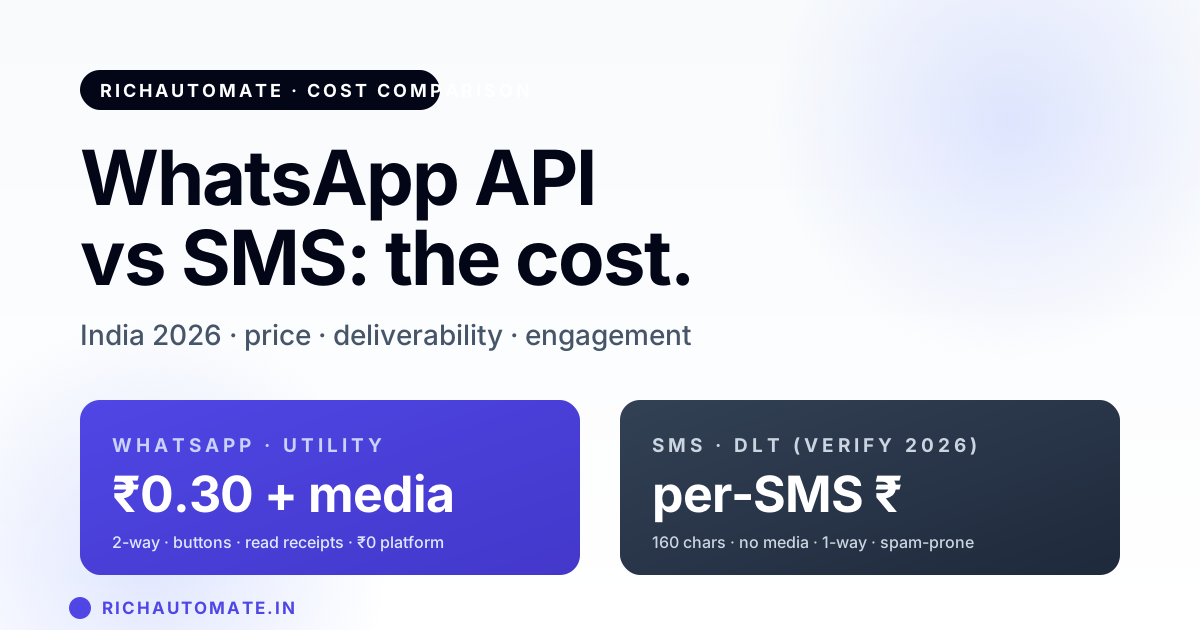
For a single one-off transactional alert with no reply expected, SMS can look marginally cheaper per message — but for any notification journey with two-way replies, buttons, media or repeat contact inside a day, the WhatsApp Business API is usually cheaper per outcome and dramatically cheaper per engaged customer. The reason is structural: SMS bills you for every 160-character message you push, while WhatsApp bills a 24-hour conversation window once and then lets unlimited back-and-forth flow inside it. This guide compares the real 2026 cost, deliverability and engagement of WhatsApp Business API versus SMS for Indian businesses running OTP, transactional and marketing notifications, with a worked 10,000-message example. Rupee figures for SMS and operator rates are directional — verify current DLT and aggregator pricing for 2026 before you budget.
WhatsApp Business API vs SMS: the short answer
SMS wins on raw reach to any phone (including feature phones) and on being a dependable OTP fallback when a user has no data. WhatsApp wins on almost everything a modern notification actually needs — rich media, tappable buttons, two-way conversation, read receipts, and a pricing model that charges per 24-hour conversation rather than per message. For most Indian businesses sending order updates, appointment reminders, payment confirmations and marketing offers, WhatsApp delivers a far higher engagement rate for a comparable or lower cost per converted customer. SMS survives as the fallback rail and the non-smartphone reach layer, not as the primary channel. If you are also weighing email or newer carrier channels, our WhatsApp vs email marketing ROI comparison and WhatsApp vs iMessage and RCS breakdown complete the channel picture.
Run your figures through the WhatsApp ROI calculator before committing to a monthly spend.
Want the SMS side in detail? Our SMS API pricing India 2026 guide breaks down per-SMS rates, DLT charges and provider quotes.
How each channel is priced in India
The two channels bill on completely different units, which is why a naive per-message comparison misleads:
- SMS — priced per message, operator/aggregator billed. Every SMS is a separate billable unit, capped at 160 characters (a longer message splits into multiple billed segments). Business SMS in India runs on the TRAI DLT (Distributed Ledger Technology) framework: you register your entity, headers (sender IDs) and message templates on a DLT portal, and route through a registered aggregator. Transactional/OTP SMS and promotional SMS are priced differently, and rates move with volume and operator. As of 2026, per-SMS rates are typically a few paise to low double-digit paise each — verify current DLT and aggregator rates before budgeting, because they change and vary by operator.
- WhatsApp Business API — priced per 24-hour conversation, billed by Meta. Meta charges per conversation category — marketing, utility and authentication — and a conversation is a 24-hour window, not a single message. Once a window is open (for example, a utility conversation for an order update), further messages inside that same 24 hours in the same category do not incur a new conversation charge. That structural difference is the whole game: a support thread of ten messages inside a day is one billable conversation on WhatsApp, but ten billable units on SMS.
Meta separates utility (transactional: order, payment, appointment updates), marketing (promotions, offers, re-engagement) and authentication (OTP/login codes). For the OTP use case specifically — where SMS has historically dominated — the migration economics and template rules are worth their own read in our WhatsApp OTP authentication guide.
The hidden differences beyond the sticker price
Cost per message is the number everyone quotes; cost per result is the number that matters. The gaps that don't show on a rate card:
- Rich media & buttons vs 160 plain characters. WhatsApp carries images, PDFs (invoices, tickets), location, and quick-reply/call-to-action buttons. SMS is 160 characters of plain text — a link at best. A "track your order" button that opens a live thread simply cannot exist on SMS.
- Two-way vs one-way. WhatsApp is a conversation: the customer replies, and inside the 24-hour window that reply and your responses are effectively free. SMS is a broadcast rail — a reply, if it works at all, is a fresh billable message on a shortcode you may not even monitor.
- Read receipts & delivery visibility. WhatsApp shows sent, delivered and read. SMS gives you a delivery report at best and no read signal, so you are flying blind on engagement.
- Deliverability & the "spam" problem. DLT reduced SMS spam but promotional SMS still lands in a crowded, low-attention inbox and is widely ignored; open and click rates are low. WhatsApp messages land in the app people check dozens of times a day, driving far higher open and response rates — but only to users who opted in, and only through Meta-approved templates.
- Friction to launch. SMS needs DLT entity, header and template registration; WhatsApp needs a verified business, opt-in collection and Meta template approval. Both have setup friction — neither is "just send." In India, going live on the WhatsApp Business API effectively requires GST registration, so treat that as necessary, not optional.
Worked example: 10,000 monthly notifications
Take a business sending 10,000 utility/transactional notifications a month — order confirmations and delivery updates, say. The exact rupee outcome depends on rates you must verify for 2026, but the shape of the comparison is stable:
Get a 1-minute BSP audit on WhatsApp
Drop your WhatsApp number — we line-item your current invoice against Meta India rates in under 60 seconds. India-hosted, DPDP-compliant.
- SMS path: 10,000 messages × per-SMS rate. Every message is billed. A two-part message (over 160 characters — common once you add a brand name, order ID and a link) bills as two segments, quietly doubling volume. Add DLT registration overhead and aggregator minimums. There is no media, no button, and any customer reply is either dropped or separately billed.
- WhatsApp path: 10,000 utility conversations × Meta's utility conversation rate. But many of those 10,000 notifications belong to customers you message more than once in the same 24 hours (order confirmed, then out for delivery, then delivered) — those collapse into a single billed conversation, so your billed conversation count is often materially lower than your message count. On top of that, each thread can carry the invoice PDF and a "track order" button, and the customer can reply inside the free window.
Net: on pure per-unit price a plain SMS blast can edge out WhatsApp, but once you count message-splitting, multi-touch collapsing into one conversation, and the vastly higher engagement per rupee, WhatsApp's cost per acted-on notification is usually the lower of the two. For the full per-conversation maths and Meta's category rates, see our WhatsApp Business API cost breakdown for India.
When SMS still wins
This is an honest comparison, not a WhatsApp advertisement. SMS remains the right choice in specific cases:
- OTP fallback for users with no data or no WhatsApp. If a login must reach a feature phone or a user who is offline, SMS is the universal rail. Best practice is WhatsApp-first with SMS fallback, not one or the other.
- Non-smartphone / low-connectivity reach. SMS reaches any GSM handset with no app, no internet and no opt-in-to-a-business-account step.
- Absolute deliverability floor for critical one-way codes where you cannot depend on an app being installed. Many businesses route OTP as WhatsApp-primary with an automatic SMS fallback after a few seconds of non-delivery — cheapest engaged channel first, universal channel as backstop.
What RichAutomate costs to run WhatsApp
RichAutomate runs on the official Meta WhatsApp Business API with ₹0 platform fee, ₹0 setup and ₹0 monthly — you pay only for messages. Two models:
- Client Pay — ₹0.10 per message plus Meta's conversation charges billed to you directly at cost by Meta.
- SaaS Pay — ₹1.50 marketing / ₹0.50 utility per message, all-inclusive on one INR GST invoice, tiering down toward ₹0.50 at volume.
Because most notification traffic — order updates, confirmations, ETAs and reminders — is utility, the running cost stays low even at tens of thousands of messages a month, and there is no monthly platform tax the way many SMS aggregators and rival WhatsApp providers charge. Compare the full model on our pricing page. Going live needs a verified business and, in India, GST registration effectively required to move a WhatsApp Business Account to live status — treat it as necessary, not optional. A 14-day free trial with 100 free credits lets you pilot a WhatsApp notification flow against your current SMS spend before you commit. We never promise "guaranteed delivery" or "no ban" — deliverability depends on opt-in quality and Meta's policies.
Move your notifications to WhatsApp
Order updates, OTP, payment confirmations, appointment reminders and marketing offers — run them on the official Meta WhatsApp Business API with richer messages, two-way replies and read receipts, at ₹0 setup, ₹0 monthly, ₹0 platform fee. Client Pay is ₹0.10/message plus Meta's rates billed direct at cost; SaaS Pay is ₹1.50 marketing / ₹0.50 utility all-inclusive. Keep SMS as your fallback rail and move the volume that engages to WhatsApp. Start with a 14-day free trial and 100 free credits, or book a 30-minute walkthrough. This is general information; verify current DLT, aggregator and Meta conversation rates and your GST position before budgeting.
Start your 14-day free trial → · Book a 30-min walkthrough · WhatsApp us on 91 81603 11319
Weighing RCS as an alternative? See our head-to-head on RCS Business Messaging vs WhatsApp Business API for India.
Related reading: Haptik vs RichAutomate 2026 pricing decoded.
Choosing an SMS vendor for DLT routes, OTPs and fallback? Compare options in our guide to the best CPaaS providers in India for 2026.
Want the per-SMS numbers first? See our bulk SMS price in India 2026 breakdown, including DLT and Unicode segment costs.