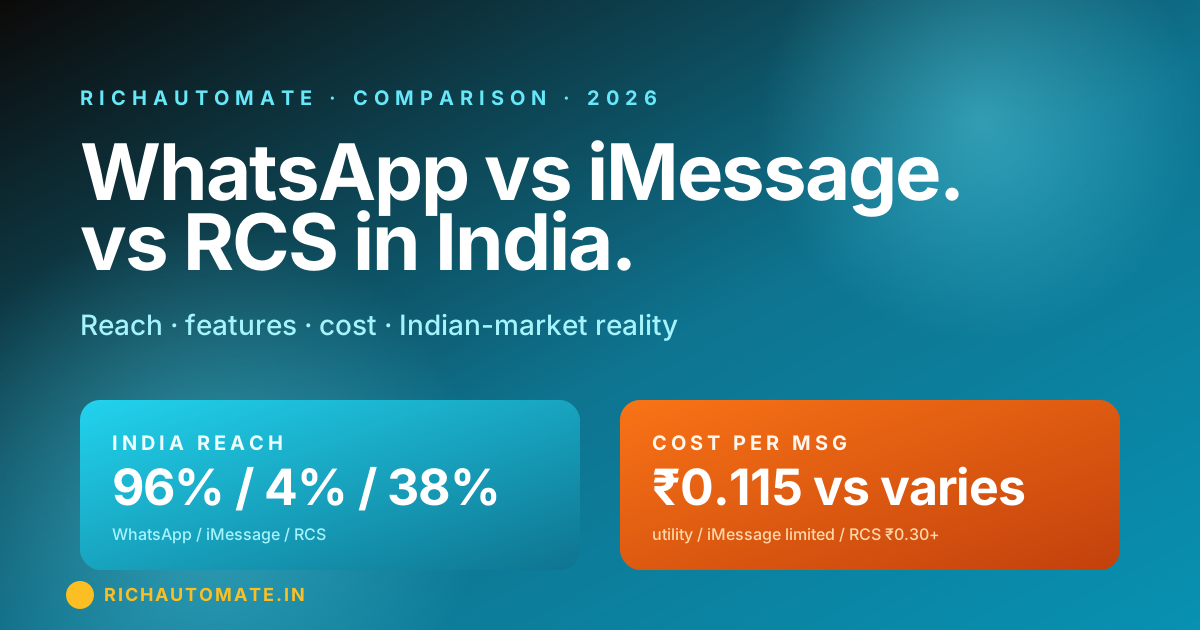
Three rich messaging surfaces compete for Indian business communication in 2026 — WhatsApp Business Cloud API, Apple iMessage Business (Business Chat / Messages for Business), and Google RCS Business Messaging via Indian carriers (Jio, Airtel, Vi). Most Indian D2C, BFSI, and B2C operators default to WhatsApp without re-evaluating; some experiment with RCS-via-SMS migration; almost none successfully use iMessage Business in India. The reality of the Indian market in 2026 is decisive: WhatsApp covers 96% of smartphone users, iMessage covers 4% (iPhone share + iMessage-active subset), and RCS Business reaches 38% of Android users (rolling out via carriers but adoption uneven). Cost-per-message + feature parity + brand-friendliness + DPDPA compliance all weigh in the decision. This guide is the 2026 comparison playbook for Indian brands evaluating multi-channel messaging strategy: feature-by-feature comparison, real reach numbers, cost structures, when to use each, and the integrated multi-channel architecture.
Reach + Adoption: The India Reality
| Channel | India reach (2026) | Active business-msg adoption |
|---|---|---|
| ~520M users / 96% of smartphone owners | 2.8M+ Indian businesses on WABA | |
| iMessage | ~22M iPhone users / 4% of smartphone owners | under 200 Indian businesses on Messages for Business |
| RCS (Google Messages) | ~180M Android users post-rollout / 38% | ~8,000 Indian businesses on RBM |
| SMS (legacy) | ~720M / 100% of phone users | Used by virtually all enterprises |
Feature Parity Matrix
| Feature | iMessage Business | RCS Business | |
|---|---|---|---|
| Rich media (photo, video, doc) | Yes | Yes | Yes |
| Quick reply buttons | Yes (max 3) | Yes | Yes (suggested actions) |
| List messages | Yes (max 10) | Yes | Yes (suggested actions) |
| Multi-screen forms (Flow) | Yes (Flow) | Limited (List Picker) | Limited |
| Catalog / commerce | Yes (native catalog + UPI checkout) | Apple Pay (US-focused, limited India) | Limited (carrier-dependent) |
| Voice calling | Yes (Calling API) | FaceTime (limited business use) | No native business voice |
| Templates / outbound | Yes (Utility / Marketing / Auth) | Limited (deep-link entry) | Yes (transactional + promotional) |
| Read receipts | Yes | Yes | Yes |
| Group / multi-stakeholder | Yes (1:1 thread; Groups separate) | 1:1 only (business) | 1:1 only (business) |
| End-to-end encryption | Default (E2E across messages) | Default (Apple-managed) | Selective (rolling out) |
| Bot / LLM integration | Mature (extensive BSP support) | Apple-curated (limited) | Carrier-mediated (limited) |
Cost Comparison (India 2026 Rates)
| Channel | Per-message cost | Notes |
|---|---|---|
| WhatsApp Utility | ₹0.115 | Transactional with customer context |
| WhatsApp Marketing | ₹0.96 | Promotional broadcasts |
| WhatsApp Authentication | ₹0.135 | OTP + verification |
| WhatsApp Service (in 24h session) | ₹0 (free) | Customer-initiated session replies |
| iMessage Business | Free per Apple policy (limited deployment) | Apple-curated; integration cost dominates |
| RCS Business (basic) | ₹0.30-0.45 | Per Indian carrier rate, varies |
| RCS Business (rich) | ₹0.45-0.80 | With carousels + suggested actions |
| SMS legacy (transactional) | ₹0.18-0.24 | DLT compliance required |
| SMS legacy (promotional) | ₹0.18-0.24 | DLT + opt-in scrub |
When to Use Each: The Decision Framework
| Use case | Best channel | Why |
|---|---|---|
| Mass-reach Indian audience | 96% reach, no carrier dependency, mature stack | |
| iPhone-premium customer base (luxury / NRI / executive) | WhatsApp + iMessage hybrid | iPhone users prefer iMessage for personal; WhatsApp for business |
| Carrier-led messaging (telecom-co + bank partnerships) | RCS | Carrier owns delivery rails; OTP / branded sender |
| OTP / authentication | WhatsApp Auth + SMS fallback | WhatsApp 96% delivery + 100× faster; SMS as fallback |
| Promotional broadcasts | WhatsApp Marketing OR SMS (cost-driven) | WhatsApp higher engagement; SMS lower per-send cost |
| Multi-screen forms (KYC, surveys) | WhatsApp Flow | Native multi-screen capture; no equivalent on others |
| E-commerce + UPI checkout | WhatsApp Catalog + UPI native | 1-tap UPI inside thread; no equivalent on others in India |
| Voice calling integration | WhatsApp Calling API | Connect rate 78% vs PSTN 22%; iMessage / RCS lack native business voice |
Real Indian D2C Multi-Channel Pilot Numbers
D2C beauty brand, 80,000 active customers, 3-channel test
| Metric | RCS | SMS legacy | |
|---|---|---|---|
| Read rate (delivered messages) | 92% | 74% (RCS users) | 22% |
| CTR on promotional | 14.2% | 11.8% | 2.4% |
| Conversion to purchase | 3.2% | 2.1% | 0.4% |
| Cost per attributed conversion | ₹84 | ₹212 | ₹460 |
| Reach (% of base reachable) | 96% | 38% (RCS-active subset) | 100% |
Operating Rule
The single highest-leverage decision for any Indian D2C / SaaS / B2C operator in 2026 is defaulting to WhatsApp as primary, with SMS as authentication fallback only. iMessage Business is not commercially viable for India given 4% reach + Apple-curated deployment friction. RCS Business is promising but 38% reach + ₹0.30-0.45/msg cost vs WhatsApp Utility ₹0.115/msg makes the economics weak for transactional. Allocate brand budget: 75-85% to WhatsApp, 10-15% SMS legacy fallback, 0-10% RCS experimentation. Revisit RCS quarterly as carrier coverage expands.
Get a 1-minute BSP audit on WhatsApp
Drop your WhatsApp number — we line-item your current invoice against Meta India rates in under 60 seconds. India-hosted, DPDP-compliant.
The BSP migration cost calculator covers the costs people forget: the overlap month and re-approving every template.
The Six Anti-Patterns in Multi-Channel Messaging
- Bypassing WhatsApp for "premium" iMessage strategy. 96% reach loss for 4% "premium" segment is irrational at most price points. Run hybrid only.
- RCS as default replacement for SMS. Half the audience can't receive RCS; falls back to SMS at higher cost than direct SMS would have been.
- Sending the same content across all channels. Each channel has different feature set; native experience matters. Tailor content per channel surface.
- No fallback chain. WhatsApp delivery fails for 4% of users; RCS fails for 62%. Build fallback (WhatsApp → SMS for OTP; WhatsApp → email for documents).
- Ignoring per-channel compliance. WhatsApp = Meta categorisation + DPDPA. RCS = DLT + carrier compliance. SMS = DLT. iMessage = Apple policy. Each surface has different rules.
- Skipping cost-per-converted-customer math. Per-send cost matters less than per-converted cost. WhatsApp wins decisively on converted-customer math even when per-send seems higher than SMS.
Multi-Channel Architecture: How to Wire All Three
Customer event → router decides primary channel:
  WhatsApp opt-in + active customer → WhatsApp (default)
  No WhatsApp consent + iPhone + opted in → iMessage Business
  No WhatsApp + Android RCS-active → RCS
  Else → SMS

Send via primary channel; track delivery + read events.
Failure detection (no read in N hours, or hard delivery failure):
  Cascade to SMS fallback for time-critical (OTP)
  Or email fallback for non-time-critical (invoice, document)

Per-channel routing:
  Authentication (OTP) → WhatsApp Auth → SMS fallback
  Transactional → WhatsApp Utility → SMS fallback
  Promotional → WhatsApp Marketing OR SMS (cost-driven A/B)
  Documents → WhatsApp media → email fallback
  Voice consultation → WhatsApp Calling API → PSTN fallback

Quarterly review:
  Per-channel CTR, conversion, cost-per-attributed-customer
  RCS adoption growth (track quarterly as carriers expand)
  iMessage opportunity in NRI / luxury segments
  Channel-mix budget allocation
RCS Business in India: 2026 State + 2027 Outlook
RCS rollout in India accelerated through 2025 with Jio, Airtel, Vi all enabling RCS Business Messaging via Google Messages. Against the incumbent it is replacing, read our WhatsApp Business API vs SMS cost comparison. Reach of 38% as of mid-2026 (up from 12% in 2024). Expected to hit 60-70% by end of 2027 as Apple iOS RCS support normalises (already shipped on iPhone with iOS 18.x). India 2027 may make RCS a serious WhatsApp alternative for transactional use cases. Brands should:
- Start small RCS pilot now (5-10% of transactional volume)
- Track reach + delivery + cost vs WhatsApp baseline
- Build RCS-aware fallback chain so promote / demote based on adoption
- Don't replace WhatsApp; complement
iMessage Business: Practical India Reality
iMessage Business (Apple Messages for Business) requires direct Apple onboarding, region-specific deployment review, and integration with one of Apple's approved CSPs. Indian deployment is rare because of: (a) low iPhone share in target audience for most D2C, (b) Apple's curated approval process taking months, (c) limited Apple Pay India footprint. Best use case: brands serving NRI Indians + premium iPhone-heavy segments (luxury hotels, premium real estate, private banking, luxury fashion). Skip for mass-market.
Compliance Per Channel
| Channel | Key compliance |
|---|---|
| Meta categorisation + DPDPA + RBI/IRDAI sector rules | |
| iMessage Business | Apple developer agreement + DPDPA |
| RCS Business | Carrier-level DLT registration + DPDPA + Google RBM policies |
| SMS | DLT registration (TRAI) + DPDPA + DND scrub |
Run multi-channel messaging on RichAutomate.
WhatsApp primary + SMS fallback + RCS pilot integration. Per-channel routing rules. Cost-per-converted-customer dashboards. Compliance per surface (Meta + DLT + DPDPA). Quarterly channel-mix optimisation. 14-day trial.
Related reading
- Best 360dialog Alternatives India 2026
- Kaleyra vs RichAutomate (India 2026): Pricing Decoded
- WhatsApp Newsletter Strategy India 2026: Four Formats, Real Sponsorship + Subscription Numbers, and the Cost-Per-Engaged-Reader Math
- AiSensy vs DoubleTick India 2026: Pricing Decoded
- Best WhatsApp CRM India 2026: ₹ Pricing Compared
Weighing RCS as an alternative? See our head-to-head on RCS Business Messaging vs WhatsApp Business API for India.
Related reading: Gallabox alternatives in India 2026.