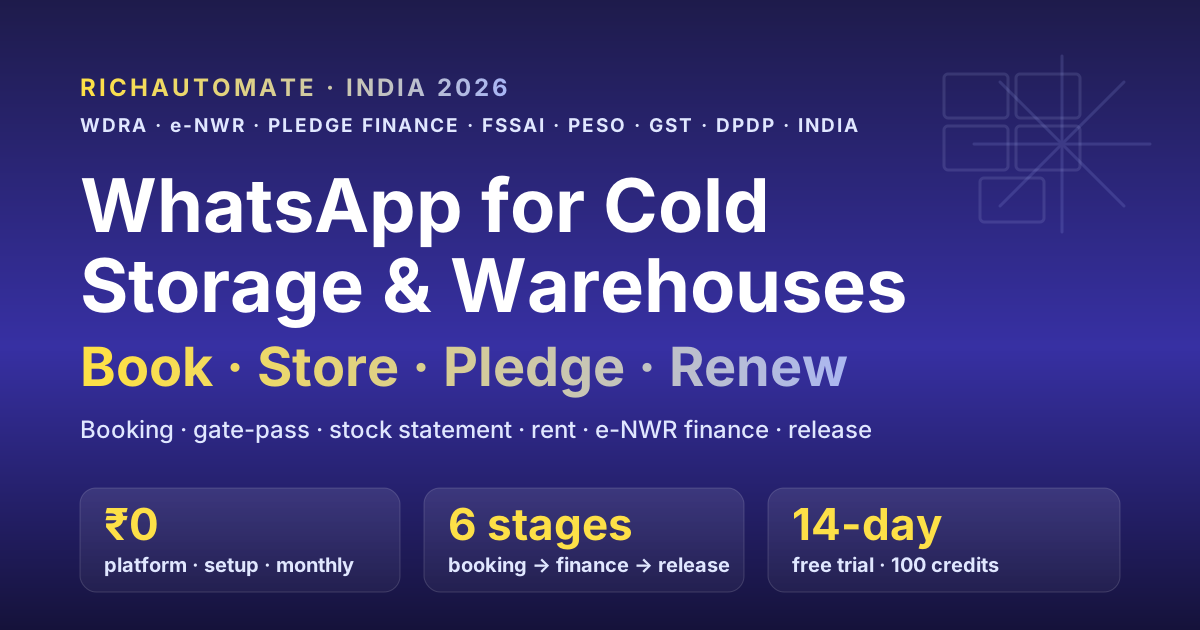
A cold-storage and agri-warehouse rental operator in India 2026 — the business that owns or runs multi-chamber cold stores for potatoes, onions, apples, dairy, frozen food and pharma, or dry godowns and silos for grain, pulses, oilseeds and spices, and rents that space by the bag, pallet or chamber to farmers, FPOs, traders, processors and brands — sits on one of the most quietly strategic assets in the rural and agri economy. The space is the product, but the real differentiators are occupancy, stock accuracy, pledge-finance enablement and renewal discipline. A cold store earns nothing on an empty chamber; a warehouse that cannot produce a clean, accurate stock statement on demand cannot help its depositor raise a loan against that stock; and a depositor whose bags are mis-counted or whose storage rent is chased clumsily simply moves to the next godown next season. Yet most operators still run the entire deposit-to-withdrawal lifecycle on a manager's personal phone and a paper bahi-khata: inward bookings taken on calls, gate-pass and weighment slips written by hand, "kitni bori andar hai?" stock queries answered from memory, rent and electricity-share chased door to door, and — most expensively for the depositor — the warehouse receipt that should unlock a bank loan handled informally instead of as a financeable instrument. The operators who scale in 2026 move the whole deposit-and-rental lifecycle onto the WhatsApp Business API: one auditable thread per depositor carrying the booking, the inward gate-pass and weighment, the live stock and storage statement, the rent and renewal reminders, the warehouse-receipt and pledge-finance hand-off, and the outward release on instruction. This guide maps that lifecycle end-to-end, the regulatory spine a stored-goods business uniquely carries — WDRA registration and electronic negotiable warehouse receipts (e-NWR), pledge-finance norms, FSSAI for food storage, ammonia-refrigeration safety under PESO and the Factories Act, GST and e-Way Bill, and DPDP — and the precise points where automation must stop and a licensed surveyor, a qualified refrigeration engineer or the bank must take over. Every regulatory specific below is as of 2026 — verify current WDRA registration and e-NWR rules, pledge-finance and RBI/bank norms, FSSAI food-storage requirements, PESO ammonia/refrigeration and Factories Act safety rules, GST and e-Way Bill provisions, DPDP rules and any state mandi/APMC or storage-subsidy schemes for your state before relying on it. General information, not legal, financial, safety or tax advice.
The Regulatory & Safety Spine in Five Minutes (All Hedged)
Storing other people's goods — especially food and farm produce, and especially under refrigeration — is not the same as warehousing your own stock. You become a custodian holding a depositor's asset that may be pledged to a bank, you may handle hazardous refrigerant under pressure, and you fall under a stack of duties an ordinary tenant or trader never touches. Do not take a deposit, issue a receipt, run an ammonia plant or enable a loan against stock without checking the current text of each:
- WDRA registration and electronic negotiable warehouse receipts (e-NWR). The Warehousing (Development and Regulation) Act and the Warehousing Development and Regulatory Authority (WDRA) govern the registration of warehouses and the issuance of negotiable warehouse receipts — a depositor of a WDRA-registered warehouse can get an e-NWR (issued through the registered repositories) that is a legally recognised, financeable instrument banks lend against. Verify the current WDRA registration criteria, the e-NWR/repository process and which of your chambers/godowns qualify.
- Pledge-finance and bank/RBI norms. The whole point of an e-NWR for many depositors is to raise a loan against stored stock (pledge/warehouse-receipt finance). The lending, margin, valuation and the operator's collateral-management role sit under bank credit policies and RBI norms. The operator enables and documents the deposit; the loan decision is the bank's. Verify the current pledge-finance and collateral-management rules.
- FSSAI for food storage. A cold store or warehouse that stores food (potatoes, dairy, frozen food, processed foods, edible oils) is a food business and typically needs FSSAI registration/licence as a storage operator, with temperature, hygiene and traceability expectations. Verify the current FSSAI storage-licence category for the commodities you hold.
- Ammonia/refrigeration safety — PESO and the Factories Act. Most large cold stores run ammonia (or other refrigerant) compression plants. Ammonia is hazardous; pressure vessels, storage thresholds and plant safety can attract PESO (Petroleum and Explosives Safety Organisation) requirements, while the plant as a workplace attracts Factories Act / state-factory and labour safety duties. Refrigeration plant operation and maintenance is a qualified engineer's job. Verify the current PESO thresholds, pressure-vessel rules and factory-safety obligations for your plant.
- GST, e-Way Bill and the storage-service treatment. Storage and warehousing of certain agricultural produce has historically carried specific GST treatment (with exemptions/rates that have shifted over time and by commodity) — get the current position from a tax professional. Movement of goods inward and outward above the threshold needs an e-Way Bill, and your storage-rent invoicing has its own GST treatment. Verify each as of 2026.
- DPDP, mandi/APMC linkage and subsidy schemes. Depositor identity, KYC, bank and stock data are personal/commercial data under the DPDP Act 2023; some operators link to state APMC/mandi systems or run under cold-storage/warehousing capital-subsidy schemes (NHB/NABARD/state horticulture missions — verify current applicability). Treat all depositor data with care and verify any scheme conditions you rely on.
Treat any market sizing as directional — the operational truth for a storage operator is simpler: this is an occupancy-driven, stock-accuracy-dependent, rent-renewal and pledge-finance-enabling business, which makes chamber/godown occupancy rate, stock-statement accuracy, rent-collection-on-time rate, e-NWR/pledge enablement and season-on-season renewal rate — not the tonnage capacity on your signboard — the real competitive variables. Every one of those is a WhatsApp problem.
The DPDP penalty calculator puts a number on the downside if your consent records do not hold up.
Why a Cold-Storage / Agri-Warehouse Is a Near-Perfect WhatsApp Vertical
Few businesses fit WhatsApp as cleanly as stored-goods rental. The depositor is a farmer, an FPO secretary, a trader or a processor who lives on WhatsApp, deposits seasonally, and has exactly three recurring anxieties: is my stock safe and correctly counted, what do I owe, and can I borrow against it. Every one of those is a message, not a visit. Here is the contrast that makes the case:
| Operational reality | On a personal phone & paper register | On WhatsApp Business API |
|---|---|---|
| Inward booking | Space promised on a call, no record, double-booked at peak | Booking Flow captures commodity, quantity, chamber type, dates instantly |
| Gate-pass & weighment | Hand-written slip, lost, disputed bag count | Inward gate-pass + weighment + lot/chamber sent to depositor's thread |
| Stock query | "Kitni bori andar hai?" answered from memory | Self-serve stock statement on request from the live register |
| Rent & power-share | Chased door to door, collections lag, disputes | Auto rent/renewal reminders with one-tap UPI; statement attached |
| Warehouse receipt / loan | Informal receipt, no path to a bank loan | e-NWR / stock-statement hand-off to bank for pledge finance, in-thread |
| Outward release | Release on a phone call, no authorisation trail | Release request + OTP/authorisation + gate-pass, timestamped |
The 6-Stage Deposit, Storage & Release Lifecycle on WhatsApp
A stored-goods relationship is a season-long custody arrangement: it starts with a booking before harvest and ends, if you do it right, in an on-time renewal and a depositor who borrowed cheaply against their own stock and came back the next season. The table maps each stage to the WhatsApp capability that drives it, the data that rides along, and the compliance note that must never be skipped.
| Stage | Operator activity | WhatsApp capability | Key data / documents | Compliance note |
|---|---|---|---|---|
| 1. Booking & KYC | Reserve space, capture depositor, commodity, quantity, dates | Booking Flow + KYC capture + DPDP consent | Depositor KYC, commodity, quantity, chamber type | Opt-in captured; KYC/bank data is personal data |
| 2. Inward & gate-pass | Weigh, grade, allot lot/chamber, issue inward gate-pass | Inward gate-pass + weighment slip + lot/chamber sent to thread | Weighment, bag count, lot no., quality note | Grading/quality is a surveyor's call; FSSAI for food |
| 3. Warehouse receipt & finance | Issue receipt / enable e-NWR, hand off to bank for pledge loan | Stock statement + e-NWR/receipt hand-off + bank coordination thread | Receipt / e-NWR ref, valuation inputs, bank details | e-NWR issued via WDRA repository; loan is the bank's call |
| 4. Storage & rent | Hold stock, run plant, bill storage rent + power share | Rent reminders + UPI link + monthly/periodic statement | Rent invoice, power-share, period, balance | GST as applicable; plant safety by qualified engineer |
| 5. Renewal & stock queries | Renew at season-end, answer stock/balance queries | Renewal reminder + self-serve stock statement on request | Renewal terms, current stock, balance, dues | Renewal/marketing nudges to opted-in depositors only |
| 6. Outward release | Verify dues + bank NOC if pledged, release stock, gate-pass | Release request + OTP/authorisation + outward gate-pass | Release authorisation, bank NOC, outward gate-pass | No release on pledged stock without bank NOC |
Stage 1-2: Booking, Inward and the Gate-Pass That Ends Disputes
The most expensive failure in a cold store is not the empty chamber in the off-season — it is the disputed bag count and the booking taken on a call that vanishes at peak intake. When the potato or onion harvest lands, every farmer and trader within fifty kilometres wants space in the same fortnight, and the operator who can take a structured booking, confirm the chamber, and produce a clean inward gate-pass wins the season's loyalty. Route every enquiry — the click-to-WhatsApp ad, the QR on the gate and weighbridge, the FPO secretary's referral, the trader who stored last year — into a structured intake. The chatbot asks the things that define a deposit: commodity (potato, onion, apple, dairy, frozen, grain, pulses, spices), quantity in bags/quintals/pallets, chamber type and temperature band, expected inward date and storage duration. It then offers a booking Flow that reserves space and captures depositor KYC, so peak intake runs against a plan rather than a queue. At the gate, the moment goods are weighed, graded and allotted a lot/chamber, the inward gate-pass and weighment slip go straight to the depositor's thread — bag count, lot number, chamber, quality note, date — and the most common dispute in the trade ("you counted my bags wrong") is settled before it starts, because the depositor has the count in writing the moment it happens. For the high-volume qualification and FAQ-deflection mechanics behind this, see our WhatsApp chatbot for business guide, and for how seasonal farmer-facing operators capture and segment a depositor base, the agri-input dealer playbook covers the same rural-audience patterns.
Get a 1-minute BSP audit on WhatsApp
Drop your WhatsApp number — we line-item your current invoice against Meta India rates in under 60 seconds. India-hosted, DPDP-compliant.
Stage 3: The Warehouse Receipt and the Pledge-Finance Hand-Off That Sets You Apart
This is the stage that turns a godown into a financial-infrastructure asset — and where a WDRA-registered operator can offer something a backyard store never can. For a farmer or trader, stored stock is dead capital until it can be borrowed against; a negotiable warehouse receipt (e-NWR) issued through the WDRA repository turns that stock into a legally recognised, financeable instrument a bank will lend against, so the depositor can hold produce off a glutted post-harvest market and still have working capital. The operator does not make the loan and does not issue the receipt informally over chat — but the operator enables and documents the whole flow: a clean stock statement, the grading and weighment inputs the valuation needs, the e-NWR reference, and a tidy coordination thread with the depositor and the bank. WhatsApp is where that hand-off lives: the stock statement and receipt reference go to the depositor in-thread, the depositor is guided to their bank, and the operator confirms the collateral position when the bank asks. Critically, the bright line stays bright — the negotiable receipt is the WDRA-repository instrument, not a WhatsApp message, and the loan decision is the bank's. Tie every depositor, their lots, their receipt reference, their pledge status and their rent and renewal dates together with a proper WhatsApp CRM, so the operator always knows which stock is pledged (and therefore cannot be released without a bank NOC) and which is free.
Stage 4-5: Storage, Rent, Renewal and the "Kitni Bori Andar Hai?" Query
Across a storage season two things quietly bleed an operator on a personal phone: rent and power-share collections lag, and depositors phone constantly to ask how much stock they have and what they owe. Both are pure automation wins. Tie storage rent and the electricity/power-share to a periodic reminder with a UPI link and a statement, so collections track the season instead of lagging it, and the operator stops chasing dues door to door. And let depositors self-serve a stock statement on request — current bags/quintals in store by lot and chamber, period, rent due, balance — pulled from the live register, so "kitni bori andar hai?" is answered in seconds without a manager flipping through a paper bahi-khata. As the season ends, the highest-retention automation fires: the renewal reminder. A timely "your storage period ends on the 30th — renew, withdraw, or pledge for another season?" to opted-in depositors converts a lapsing deposit into another season of occupancy and another year of relationship. This is the same recurring-billing-and-statement rhythm that powers premises-service contracts; compare how scheduled reminders and statements scale across a portfolio in our facility-management and housekeeping playbook. Renewal and seasonal-offer messaging is marketing-adjacent — it goes only to depositors who opted in, capped in frequency, with STOP honoured immediately.
Stage 6: Outward Release and the Authorisations Automation Must Not Touch
Release is where custody, money and pledge-finance collide, and where the discipline that protects an operator from a lawsuit lives. Before a single bag leaves the gate, the operator must verify that storage dues are cleared and — critically — that any pledge over the stock is released: stock that a bank has lent against cannot be released without the bank's no-objection, because the operator is holding the bank's collateral. Here the line is bright: WhatsApp can take the release request, fire an OTP or capture the depositor's authorisation, confirm dues are clear, and issue the outward gate-pass with a full timestamped trail — but it must never release pledged stock without the bank NOC, and an automated "ready for release" message must never be read as a clearance over collateral that is still pledged. Automation gets the request, the authorisation and the gate-pass moving cleanly; the check that the stock is genuinely free to leave — dues cleared, pledge released, bank satisfied — is a human-and-bank decision that the system records but does not replace. For how OTP-gated, authorisation-trailed dispatch and gate-movement works in a goods-in-transit setting, the logistics and delivery automation playbook shows the same release-and-proof primitives applied downstream.
The Automation Tech Stack: Stage by Stage
Everything above assembles from five WhatsApp Business API primitives — Flows for structured intake (booking + KYC, stock-statement request, release request), approved templates for business-initiated messages (booking confirmation, inward gate-pass, rent and renewal reminders, receipt/e-NWR hand-off, release authorisation), a chatbot for FAQ deflection and stock-query triage, human handoff for grading, finance coordination and plant/safety judgement, and broadcast segments for renewal and pre-harvest booking campaigns to the opted-in depositor base. Mapped to the lifecycle with the KPI each stage owns:
| Stage | Automation | KPI to watch |
|---|---|---|
| Booking → inward | CTWA/QR entry + triage chatbot + booking + KYC Flow | Booking-to-inward rate; peak-intake utilisation |
| Inward → receipt | Gate-pass + weighment template + stock statement | Gate-pass-on-inward rate; count-dispute rate (down) |
| Receipt → finance | e-NWR/receipt hand-off + bank coordination thread | e-NWR / pledge-enablement rate |
| Storage → rent | Rent/power-share reminders + UPI + statement | Rent-collection-on-time rate; occupancy rate |
| Renewal | Season-end renewal reminder + self-serve stock statement | Season-on-season renewal rate; query-call volume (down) |
| Release | Release request + OTP/authorisation + outward gate-pass | Release-cycle time; unauthorised-release rate (zero) |
For temperature-sensitive commodities specifically, the storage operator sits one link away from the reefer/cold-chain that moves the goods; the cold-chain and reefer logistics playbook shows how temperature-excursion alerts and dispatch coordination ride the same messaging rails when the cold stock leaves your gate, and for operators serving farmer collectives, the agritech FPO and mandi price-ticker playbook shows how a price signal at season-end is exactly when a depositor decides to renew, withdraw or pledge.
The Compliance Carve-Out: Custody, Refrigerant and Finance Make Storage Different
A storage operator carries duties most landlords and traders never face — because you hold someone else's asset that may be a bank's collateral, you may run a hazardous refrigeration plant, and you store food. Under the relevant regimes (all of which you must verify as of 2026):
- WDRA registration and e-NWR. Registration brings your warehouse into the regime that lets depositors get negotiable, financeable e-NWRs through the repositories — a genuine commercial advantage. The receipt is issued through the WDRA repository process, not informally; treat it as the regulated instrument it is.
- Pledge finance and the bank's role. When stock is pledged, you are a collateral custodian; you must not release pledged stock without the lending bank's no-objection, and the loan, margin and valuation are the bank's domain, not yours.
- FSSAI for food storage. Holding food commodities makes you a food business needing the right FSSAI storage licence, with temperature, hygiene and traceability obligations for the cold chain.
- PESO and Factories Act for refrigeration. Ammonia and other refrigerants under pressure are hazardous; pressure-vessel rules, storage thresholds and plant safety can attract PESO requirements, and the plant as a workplace attracts Factories Act / state-factory safety duties. Operation and maintenance is a qualified refrigeration engineer's job — never a WhatsApp message.
- GST, e-Way Bill and storage treatment. Storage/warehousing of agricultural produce has historically carried specific (and changing) GST treatment by commodity; movement of goods above the threshold needs an e-Way Bill; storage-rent invoicing has its own treatment. Mark billing "GST as applicable, verify current position" and confirm with a tax professional.
- DPDP and scheme conditions. Depositor KYC, bank and stock data are personal data under the DPDP Act 2023; any capital-subsidy or APMC-linkage scheme you operate under carries its own conditions to verify.
Where individuals or their commercial position are identifiable in records, DPDP applies; verify your exact WDRA, pledge-finance, FSSAI, PESO/factory-safety, GST and data obligations with qualified professional advice as of 2026.
Cost Model: A Storage Operator on RichAutomate
With RichAutomate (₹0 platform fee · ₹0 setup · ₹0 monthly), the cost of the WhatsApp Business API for a cold-storage or agri-warehouse operator is purely the Meta conversation charges — and only for conversations actually sent. Consider a single cold store or godown serving, say, a few hundred depositors across a season, each generating roughly 6-10 business-initiated conversations (booking confirmation, inward gate-pass, rent reminders, statement, renewal, release) plus stock-query handling and pre-harvest booking blasts:
- Custody & billing utility conversations (booking confirmations, gate-passes, rent and renewal reminders, statements, release authorisations): comfortably a couple-thousand to several-thousand utility-tier conversations across a peak season at this scale
- On Client Pay (₹0.10 per message, Meta conversation charges billed directly to you by Meta): the platform cost is a few hundred to low-four-figure rupees for the season
- SaaS Pay is ₹1.20 per marketing message and ₹0.30 utility/authentication, all-inclusive — relevant when you run a pre-harvest booking campaign or a renewal blast to your opted-in depositor base
- A 14-day free trial with 100 credits lets you pilot a full booking-to-gate-pass-to-statement Flow on a handful of depositors before paying anything
Set that against the value of even a single point of extra occupancy or one more season's renewal: a chamber that fills a fortnight earlier at peak, or a depositor who renews instead of moving to the next godown, is worth far more than a season of conversation charges. For the deeper economics of who pays for each message and how the two billing models differ, read Client Pay vs SaaS Pay billing, model your own depositor volume and message mix with the WABA cost calculator, and see the RichAutomate pricing page — the platform fee stays ₹0 regardless of scale.
Anti-Patterns: How Storage Operators Get This Wrong
- Running it on a personal number. No templates, no shared inbox, no gate-pass record, no stock-statement trail, no renewal list — and one ban away from losing every depositor thread and authorisation record. Use the Business API — and never promise a depositor your number "won't get banned"; promise consent discipline instead.
- Taking bookings and inwards on calls with no written count. The disputed bag count is the trade's oldest fight. Send the inward gate-pass and weighment into the thread the moment goods are received, so the count is in writing instantly.
- Treating the warehouse receipt as informal paper. Issuing a casual receipt instead of enabling a proper WDRA e-NWR robs the depositor of cheap pledge finance — and you of your biggest differentiator. Enable the regulated instrument and hand off cleanly to the bank.
- Releasing pledged stock without a bank NOC. Letting an automated "ready for release" message clear stock that a bank has lent against is a serious breach of custody. The system must hard-gate release on dues cleared and pledge released.
- Letting automation imply a safety or finance clearance. A scheduling, gate-pass or "ready" message must never read as a refrigeration-plant safety sign-off, a grading certificate, or a guarantee of a loan; those stay with the qualified engineer, the surveyor and the bank.
- Quoting GST, WDRA status and subsidy conditions loosely. Storage GST, WDRA registration, FSSAI category and scheme conditions are fact-specific and change; hedge "verify current position" and keep your registrations, licences and records exactly as the law requires.
This article is general information, not legal, financial, tax, structural or refrigeration-safety advice. WDRA registration and e-NWR rules, pledge-finance and bank/RBI norms, FSSAI food-storage requirements, PESO ammonia/refrigeration and Factories Act safety rules, GST and e-Way Bill provisions, DPDP rules and any state mandi/APMC or storage-subsidy schemes all change and vary by state and commodity — verify every specific against current government publications and qualified professional advice before acting.
Run your cold-storage & warehouse rental on WhatsApp
RichAutomate gives cold-storage and agri-warehouse operators a WhatsApp Business API platform — booking and KYC Flows, inward gate-pass and weighment in-thread, self-serve stock statements, rent and renewal reminders with one-tap UPI, e-NWR and pledge-finance hand-off to the bank, and OTP-authorised outward release with a full gate-pass trail — at ₹0 platform fee, ₹0 setup, ₹0 monthly. Built with consent, custody-trails and the surveyor/refrigeration/bank hand-off lines in mind. Start with a 14-day free trial and 100 conversation credits, no card required. Questions? WhatsApp us on 918160311319.