Run a warehousing or third-party logistics (3PL) business in India in 2026 — a fulfilment centre handling inbound and outbound for D2C brands, a bonded or cold-storage operator, a contract-logistics company running dedicated client warehouses, or a shared-facility 3PL juggling dozens of shippers under one roof — and you already know the operation lives or dies on one thing you cannot afford to lose: visibility. A truck arrives at the gate at 6am with no dock slot booked, and now three vehicles are idling in the yard while detention charges tick up. A client's inbound shipment is short by four cartons at GRN, and by the time the discrepancy email is read, the whole put-away plan has slipped. An outbound dispatch leaves the dock, but the shipper's ops team finds out only when their own customer complains a day later. A proof-of-delivery is captured on paper, photographed, and buried in a WhatsApp group with 200 other messages. An SLA breach on a priority order goes unflagged until the monthly review, when the penalty clause has already been triggered. Warehousing and 3PL is a business of gate-passes, dock schedules, GRNs, put-aways, pick-pack, dispatch manifests, PODs and SLA clocks — and every one of those events is a message that the wrong person got too late or never got at all. The operators who scale in 2026 are the ones who turn that visibility gap into a system: gate and dock scheduling, inbound GRN and discrepancy alerts, real-time dispatch and outbound notifications, POD capture and confirmation, SLA and exception flags, and B2B lead capture for warehouse space — all on the WhatsApp Business API, on the one channel every driver, dock supervisor, client ops manager and yard marshal already reads within minutes. This is the buyer's guide to choosing the best WhatsApp Business API for a warehousing or 3PL company in India in 2026: what actually matters for this vertical, the operational lifecycle it has to carry, and how to pick a platform that does not bleed margin on a thin, high-volume, SLA-bound business. Treat every commercial and pricing specific below as "verify as of 2026," treat every figure as illustrative, and treat none of this as legal, tax or financial advice.
Why warehousing & 3PL is a WhatsApp problem. A 3PL operation is a relay of time-stamped events — a vehicle at the gate, a dock assigned, a GRN posted, a discrepancy raised, a put-away done, an order picked, a truck dispatched, a POD captured, an SLA clock running — and every event has to reach a specific person (a driver, a dock supervisor, a client's ops manager, a yard marshal, a control tower) fast enough to act on. Email is too slow and gets buried; phone calls do not scale across hundreds of daily movements; and consumer WhatsApp groups turn into unsearchable noise where the one message that mattered is lost under two hundred that did not. The WhatsApp Business API is where a warehouse can push a structured, timestamped, auditable event to exactly the right party — dock slot confirmed, shipment received, discrepancy flagged, order dispatched, POD attached, SLA at risk — and let them reply or acknowledge on the channel they already read within minutes, provided every send is consent-based, operational and B2B-appropriate. Verify advertising and DPDP data rules as of 2026; nothing here is legal advice, and no platform guarantees against Meta quality or ban actions.
What "best" actually means for a warehousing & 3PL operator
The "best WhatsApp Business API" for a warehousing or 3PL business is not the one with the most features or the loudest brand — it is the one that fits the specific shape of a high-volume, event-driven, SLA-bound operation where the same message has to reach the right party at the right minute, hundreds of times a day, across drivers, dock teams and client ops managers. Before comparing logos, get clear on the criteria that actually decide outcomes for this vertical. The table below is the buyer's checklist — weigh each against your own throughput, client mix and SLA structure as of 2026.
| What to evaluate | Why it matters for warehousing & 3PL | What good looks like |
|---|---|---|
| Event-triggered notifications from your WMS/OMS | The value is a GRN, dispatch or SLA event pushed the moment it happens, not a manual message someone remembers to send | API and webhook hooks that fire templated WhatsApp alerts from warehouse-system events |
| Gate & dock scheduling flow | Unbooked arrivals cause yard congestion and detention charges; a booked slot keeps the dock flowing | A self-serve slot-booking chatbot for drivers and transporters with confirmations and reminders |
| Structured POD & discrepancy capture | Proof of delivery and short/damage discrepancies buried in a group chat are worthless at audit time | Media capture (photo POD, e-sign) tied to an order, retrievable and auditable |
| Multi-party routing (driver, dock, client ops) | The same movement has to notify different people — a generic broadcast to everyone is noise | Segmented templates that route each event to the correct role or client group |
| SLA & exception alerting | An SLA breach caught late is a penalty; caught early it is a save | Threshold-based exception alerts to the control tower before the clock runs out |
| Transparent, per-message pricing | A high-volume operation sending thousands of event messages a day cannot carry a fat per-seat SaaS fee | ₹0 platform fee, pay only per message and Meta's conversation charge |
The reframe most 3PL operators eventually make: the platform is not the product — the operational visibility engine it lets you run is. A company that picks on price-per-message alone, but cannot fire an alert from a WMS event or route a POD to the right client, has bought a cheaper way to keep working blind. Pick for the event lifecycle first, then optimise the cost.
The end-to-end warehousing & 3PL WhatsApp lifecycle
Here is the full lifecycle a warehousing or 3PL operator can run over WhatsApp, from the first gate arrival to the SLA report and the next contract renewal, mapped to the automation at each stage and the guardrail that keeps it clean. Treat the automation column as a reference pattern and verify advertising and data-protection specifics as of 2026.
| Lifecycle stage | WhatsApp automation | Guardrail (verify 2026) |
|---|---|---|
| 1. Gate & dock scheduling | Transporters and drivers self-book a dock slot via a chatbot; the yard team gets an arrival heads-up and the driver gets a confirmation and reminder | Consent at first contact; operational messages only; honest slot availability |
| 2. Inbound & GRN | On goods receipt the WMS fires a "shipment received" alert to the client, with a GRN summary and any short/damage discrepancy flagged instantly | Accurate counts; discrepancies raised honestly; minimise sensitive data on chat |
| 3. Put-away & inventory updates | Stock-posted and inventory-threshold alerts to the client's ops team so they see live availability without chasing | Data shared only with the authorised client; role-based routing |
| 4. Order & pick-pack | Order-received, picking-started and packed alerts on a shared thread between the shipper's ops and the warehouse | Correct order references; no cross-client data leakage |
| 5. Outbound dispatch | Dispatch confirmation with manifest, vehicle and expected-delivery details fired the moment the truck leaves the dock | Accurate ETAs and manifest; templated utility messages |
| 6. POD & delivery confirmation | Proof-of-delivery photo or e-sign captured and attached to the order, with a delivered confirmation to the client | Consent-based; auditable capture; respect end-recipient privacy |
| 7. SLA, exception & renewal | Threshold-based SLA-at-risk and exception alerts to the control tower, a periodic performance summary to the client, and a B2B nudge for warehouse-space or contract renewal | Opt-in for commercial nudges; easy opt-out; honest SLA reporting |
Notice the rhythm: WhatsApp carries the high-frequency operational events that email is too slow for and phone calls cannot scale, then keeps the client by turning that visibility into an SLA story and a renewal conversation — which is where a 3PL's real retention lives. For the cold-chain view the WhatsApp for cold storage & agri-warehouse rental guide goes deep, and for the last-mile and relocation side the best WhatsApp Business API for packers & movers guide is a close companion.
Gate & dock scheduling: where yard congestion and detention are won
The single most under-run part of a 3PL operation is the gate-to-dock choreography. Unbooked arrivals are the root of a cascade: trucks pile up in the yard, detention and demurrage charges accrue, dock teams thrash between vehicles with no plan, and the whole put-away schedule slips downstream. Most warehouses still run this on phone calls and a whiteboard, which means the gate has no idea what is coming and the transporter has no idea when their vehicle will be received. WhatsApp turns dock scheduling into a self-serve, confirmable flow: a transporter or driver books a slot through a chatbot, the yard team gets an arrival heads-up, the driver gets a confirmation and a reminder before the window, and reschedules happen on the same thread instead of a flurry of calls. Done well, the dock-scheduling flow is the highest-leverage, lowest-cost lever a warehouse has against yard congestion and detention charges — and it is almost entirely untapped in the mid-market.
Get a 1-minute BSP audit on WhatsApp
Drop your WhatsApp number — we line-item your current invoice against Meta India rates in under 60 seconds. India-hosted, DPDP-compliant.
The dock-scheduling engine, in one principle. Treat every inbound vehicle as an appointment you confirm in advance, not a surprise you absorb at the gate. Let transporters self-book a slot, confirm it instantly, remind the driver before the window, and keep every reschedule on one auditable thread so the yard, the dock and the transporter share a single version of the plan. The thread should feel like a control tower that always knows what is arriving — never like a channel that pesters. Verify advertising and DPDP data rules as of 2026; this is not legal advice, and no platform guarantees against Meta quality or ban actions.
Per-seat SaaS vs a ₹0-platform model: the margin question
A warehousing or 3PL operation sends a very high volume of operational event messages — every GRN, dispatch, POD and SLA flag across hundreds of daily movements and dozens of client accounts — while running on notoriously thin, volume-driven margins. A fixed monthly per-seat platform fee on every dock supervisor, control-tower operator and client-facing login is dead weight, and it scales the wrong way: the more visibility you provide, the more the per-seat tax bites. Most legacy BSPs charge a per-seat or tiered monthly platform fee on top of Meta's own per-conversation charge; a ₹0-platform model charges only for the messages you actually send. This comparison is directional — verify current pricing on each vendor as of 2026.
| Dimension | ₹0-platform model (RichAutomate) | Typical per-seat / tiered SaaS BSP |
|---|---|---|
| Platform / setup / monthly fee | ₹0 platform, ₹0 setup, ₹0 monthly | Monthly platform fee, often per seat or per tier |
| What you pay for | Only per message + Meta's conversation charge | Subscription + markup on conversations |
| Fit for a high-volume, multi-seat operation | Cost scales with events sent, not with how many operators log in | Every dock and control-tower seat adds fixed monthly cost |
| Margin impact on a thin-margin 3PL | Messaging cost is a fraction of a rupee against each movement | Fixed per-seat fee compounds against a volume-driven margin |
| Billing transparency | Client Pay: Meta bills you direct at Meta rates | Often a bundled markup you cannot see through |
The conclusion most 3PL operators reach: for a high-volume, multi-seat, thin-margin operation, a model where the messaging cost is a fraction of a rupee against each movement beats a fixed monthly per-seat tax that grows every time you add a dock, a control-tower desk or a client-facing coordinator. Run your own numbers on the WABA cost calculator and read the Client Pay vs SaaS Pay billing breakdown before committing.
The automation stack that runs it
The good news for a warehousing or 3PL operator is that none of this needs custom engineering. The building blocks map onto a standard WhatsApp Business API automation stack: a gate-and-dock scheduling chatbot that lets transporters self-book slots and sends confirmations and reminders; WMS/OMS event webhooks that fire templated GRN, put-away, dispatch, POD and SLA alerts the moment each event posts; a discrepancy-and-exception engine that flags short/damage receipts and SLA-at-risk orders to the right role instantly; a POD capture flow that ties a delivery photo or e-sign to an order for audit retrieval; role- and client-segmented templates so a driver, a dock supervisor and a client ops manager each get the message meant for them and nothing else; a periodic SLA/performance summary to each client; a B2B lead-capture flow from your website and click-to-WhatsApp ads for warehouse-space and 3PL enquiries; and a human handoff the moment a driver, transporter or client raises something a template cannot answer. For the adjacent operations views, the WhatsApp for packers, movers & relocation, agri-input dealer and coworking-space operator playbooks share the same event-driven, multi-party shape. The discipline is to keep the automation scoped to operational events and logistics FAQs, and route every genuine exception or commercial conversation to a human.
The click-to-WhatsApp link generator produces the link and the QR code together if you need both.
The economics: an illustrative 3PL cohort
Criteria and architecture are the floor; the reason to run WhatsApp across the warehousing and 3PL lifecycle is fewer detention charges from booked docks, faster discrepancy resolution from instant GRN flags, real-time dispatch visibility that stops client escalations, auditable PODs that survive billing disputes, and SLA saves that protect penalty clauses. Consider an illustrative shared-facility 3PL running a mix of inbound arrivals needing dock slots, GRN and discrepancy events, outbound dispatches, POD captures, and SLA-monitored priority orders across a dozen shipper accounts. Every figure below is illustrative — model your own on the calculator.
| Metric (illustrative) | Without WhatsApp lifecycle | With WhatsApp lifecycle |
|---|---|---|
| Yard congestion & detention | Higher (unbooked arrivals pile up at the gate) | Lower (self-serve dock slots smooth the flow) |
| Discrepancy resolution time | Hours to a day (buried in email) | Minutes (instant GRN discrepancy flag to the client) |
| Dispatch visibility for clients | Client finds out late, escalates | Real-time dispatch alert the moment the truck leaves |
| POD retrievability at audit / billing | Lost in a group chat or on paper | Photo/e-sign POD tied to the order, retrievable |
| WhatsApp messaging cost | ₹0 | Utility event and alert messages at the cheapest tier |
The asymmetry is the argument: dock confirmations, GRN alerts, dispatch notifications, POD confirmations and SLA flags are largely utility-category conversations — the cheapest tier — and they directly reduce the most expensive failures in a 3PL business, namely detention charges from yard congestion, billing disputes from lost PODs, client escalations from blind dispatch, and penalty clauses from SLA breaches caught too late. A handful of avoided detention days, resolved discrepancies and SLA saves a month dwarf the messaging bill, which is a fraction of a rupee against each movement. Run your own figures on the WhatsApp Business API cost guide before committing.
Build the warehousing & 3PL lifecycle on RichAutomate
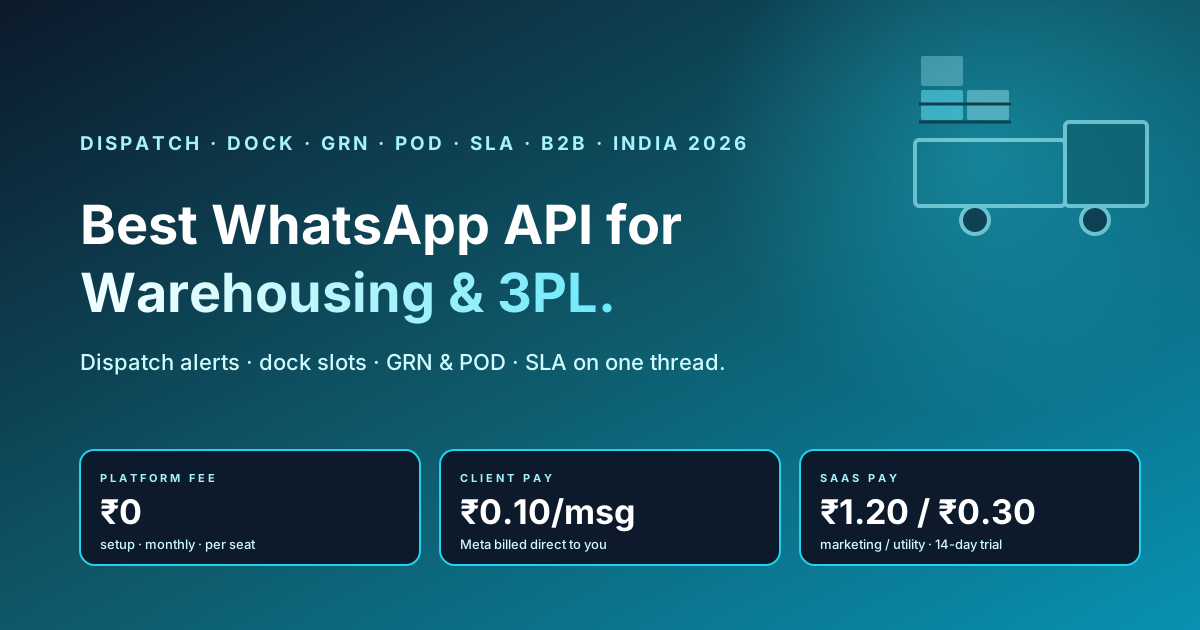
You can stand up the entire operational-visibility layer — gate-and-dock self-serve scheduling, WMS/OMS-triggered GRN, put-away, dispatch, POD and SLA alerts, discrepancy and exception flags to the right role, role- and client-segmented routing, periodic SLA summaries, and B2B lead capture for warehouse space — without engineering lift, while your WMS, yard and control tower stay the source of truth. RichAutomate charges ₹0 platform fee, ₹0 setup, ₹0 monthly. On Client Pay you pay only ₹0.10 per message plus Meta's own per-conversation charge billed to you directly by Meta at Meta's rates; on SaaS Pay it is an all-in ₹1.50 per marketing conversation and ₹0.50 per utility conversation — and dock confirmations, GRN alerts, dispatch notifications, PODs and SLA flags are utility conversations, the cheaper category. There is a 14-day free trial with 100 credits, so you can measure the detention, discrepancy and SLA improvement before committing. Keep WhatsApp as the event and conversation layer, keep your warehouse systems as the source of truth, and verify advertising and DPDP data rules as of 2026. See the full pricing page for details.
Stop running the yard, the dock and the SLA clock blind
A 3PL operator does not have to let trucks pile up at an unbooked gate while detention charges tick, watch a GRN discrepancy sit unread in an inbox until the put-away plan has slipped, or lose a proof-of-delivery in a 200-message group chat right when a billing dispute needs it. From the self-serve dock-slot booking, through the WMS-triggered GRN and dispatch alerts, the POD capture tied to the order, and the SLA-at-risk flag to the control tower — WhatsApp can be the one continuous operational thread, while your warehouse systems stay the source of truth. On illustrative numbers that means fewer detention days, faster discrepancy resolution, real-time dispatch visibility and SLA saves that protect penalty clauses, for a messaging bill that is a fraction of a rupee against each movement. RichAutomate's pricing stays flat through all of it: ₹0 platform fee, ₹0 setup, ₹0 monthly — Client Pay at ₹0.10 per message with Meta conversation charges billed direct by Meta, or SaaS Pay at ₹1.50 marketing / ₹0.50 utility all-in. Start the 14-day free trial with 100 credits, WhatsApp us at 918160311319, or book a 30-minute walkthrough at https://calendly.com/inrichdaddy/30min. (All cohort, detention and SLA figures here are illustrative — model your own on the calculator — no platform guarantees against Meta quality or ban actions, and advertising and DPDP rules change; verify the current position as of 2026. This is operational guidance, not legal, tax or financial advice.)
Start your 14-day free trial → · See full pricing · Read the packers & movers buyer guide