Indian D2C brands sending customers to a website checkout from a WhatsApp chat lose 32–48% of high-intent buyers in the tab-switch handoff. The customer was warm in chat, then cold by the time the website loaded, payment form rendered, OTP arrived, mandate authorised. Each surface change is a churn moment. WhatsApp Catalog + in-chat checkout collapses the gap — product browse, multi-product cart, payment, confirmation all in one persistent thread. This guide is the 2026 implementation playbook for Indian D2C — how Catalog actually works on the Cloud API, the seven catalog patterns that lift conversion, the WhatsApp Pay UPI integration vs link-out tradeoff, and the five anti-patterns that kill in-chat commerce.
What WhatsApp Catalog Actually Is in 2026
Three connected primitives Meta exposes via the Business Cloud API:
- Product Catalog. A Meta-hosted product feed (Commerce Manager) that mirrors your e-commerce catalog. Each product has SKU, image, name, price, description, availability, retailer-id (your internal SKU). Up to 8,000 products per catalog.
- Single Product / Multi Product Messages. Interactive message types that surface 1 product or up to 30 products from your catalog inside a chat. Customer browses + adds to cart without leaving WhatsApp.
- WhatsApp Pay (Native Payments). India-specific UPI integration. Customer reviews cart + completes payment via UPI app intent or in-chat without redirect. Settlement via NPCI through partner aggregators (Razorpay / PhonePe / etc.).
The Seven Catalog Patterns That Lift Conversion
| Pattern | Best for | Conversion lift vs link-out |
|---|---|---|
| Single Product Message on abandoned cart | D2C beauty / supplements / coffee | +24–38% recovery |
| Multi Product Message on cross-sell | Apparel / accessories / kits | +12–22% AOV |
| Catalog browse via List Message | F&B menu, vertical product range | +18–30% session-to-order |
| Reorder card on subscription nudge | Pet food, supplements, coffee | +34–52% reorder rate |
| WhatsApp Pay for CoD-prone audiences | Tier 2-3 cities, low-trust segments | −42% CoD rate (UPI replaces) |
| Catalog-linked CTWA ads | Performance marketing, low-funnel | +2.1× ROAS vs website-link ads |
| Order-status template with tracking-button | Post-purchase across categories | −38% "where is my order" tickets |
Per-Conversion Economics: Real Indian D2C Numbers
Beauty / cosmetics brand (₹1,400 AOV, 12,000 active WhatsApp contacts)
| Metric | Website link-out from WhatsApp | In-chat catalog + WhatsApp Pay |
|---|---|---|
| Click-through to product page | 14% | n/a (product inline) |
| Add-to-cart from chat-driven traffic | 22% | 41% |
| Cart-to-checkout completion | 34% | 71% |
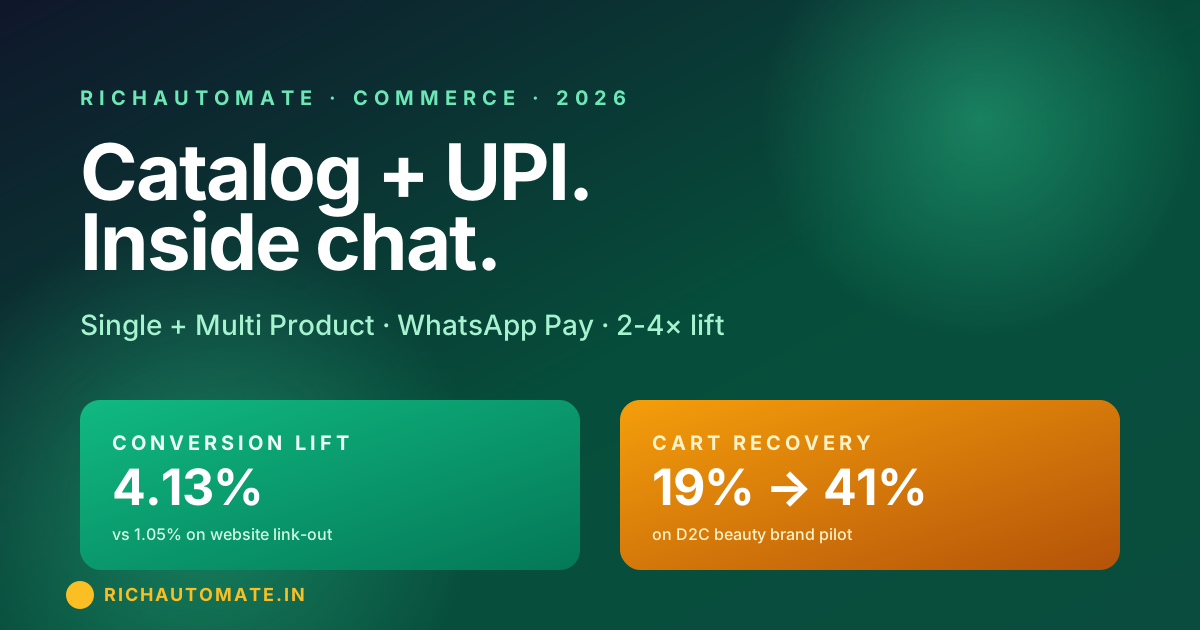
| Effective conversion rate | 1.05% | 4.13% |
| Per-msg revenue (₹0.96 marketing rate) | ₹14.7 | ₹57.8 |
Effective revenue per marketing message lifts ~3.9× when the entire purchase happens in WhatsApp. The biggest leak is the website handoff, not the product itself.
Indian F&B chain (cloud kitchen, ₹420 AOV, multi-city)
| Metric | Phone-call orders | WhatsApp catalog browse + UPI Pay |
|---|---|---|
| Order entry time | ~4 min agent time | ~90s self-serve |
| Order accuracy | 87% | 99.6% |
| Repeat-order rate (90 days) | 34% | 61% |
| Per-order operating cost | ₹38 (agent + dialler) | ₹6 (utility template only) |
The Catalog Sync Architecture
Three sources feed a Meta Catalog. Pick one based on your stack:
- Direct CSV / TSV upload to Commerce Manager. Fastest setup; no engineering. Use for static catalogs < 1,000 SKUs that update weekly.
- Hosted feed URL (XML / RSS / CSV at a public URL). Meta polls every 24h. Use for Shopify / WooCommerce catalogs already publishing a product feed.
- Catalog API (real-time). Push every product change to Meta within seconds via authenticated API call. Use for high-frequency price/stock changes (most D2C with dynamic pricing or fast inventory turn).
Recommended pattern for Indian D2C (Shopify / WooCommerce)
Shopify product update webhook
       ↓
RichAutomate / your backend
       ↓
Meta Catalog API: POST /catalog/products
       ↓
Product live in WhatsApp Catalog < 30 seconds
WhatsApp Pay vs Link-Out — When to Use Which
| Decision factor | WhatsApp Pay (in-chat UPI) | Link-out to website checkout |
|---|---|---|
| AOV under ₹2,000 | Strong fit | Friction kills conversion |
| AOV ₹2,000–₹10,000 | Strong fit if UPI customer | OK if rich product config needed |
| AOV over ₹10,000 | OK but trust ceiling | Better for trust-sensitive purchases |
| Product variants > 5 (size+colour+style) | Hard — chat UI gets cluttered | Better — full product page |
| Returning customer with saved cart | Strong fit | Adds re-login friction |
| Tier 2-3 city customer | Strong fit (UPI penetration high) | Higher CoD rate, lower completion |
| International payment / cross-border | Not supported | Required |
Compliance & UPI Mandate Considerations
- NPCI UPI compliance. WhatsApp Pay routes through an NPCI-approved partner aggregator. Settlement reconciliation appears in your aggregator dashboard, not in Meta's. Match WhatsApp order IDs to aggregator transaction IDs in your reconciliation flow.
- Refund SLA. Indian consumer law requires 7 working days for refund processing. Use a utility template confirming refund initiation + ARN reference within 24h of refund request.
- GST invoice delivery. Each order generates a GST-eligible invoice. Send as PDF link in utility template post-purchase; customer authenticates on tap to view (avoid leaking GSTIN data in plain message body).
- DPDP Act consent. Order + payment data is sensitive personal data. Capture explicit opt-in for transactional WhatsApp messages at first purchase. Audit-log retention 5–7 years.
- Catalog product policy. Meta prohibits regulated products in catalogs (alcohol, tobacco, drugs, weapons, adult, gambling). Indian D2C alcohol delivery is forbidden in catalog; use generic templates with off-platform purchase links.
Real Workflow: Cart-Recovery via Single Product Message
- Customer abandons checkout on Shopify (last seen 30+ minutes ago).
- Shopify webhook fires "cart_abandoned" → backend.
- Backend pulls cart contents → top product by AOV picked.
- Marketing template sent via WhatsApp Cloud API with Single Product Message component referencing that SKU's retailer_id in catalog.
- Customer sees product card inside WhatsApp: image + name + ₹ price + Add to Cart button.
- Tap → product enters WhatsApp cart in-thread (multi-add allowed).
- Customer taps View Cart → cart preview inside chat with Edit / Remove / Quantity controls.
- Tap Pay → WhatsApp Pay UPI flow OR link-out to web checkout (configurable per template).
- Payment confirmation → utility template fires with order ID, ETA, tracking link.
Operating Rule
The most-impactful catalog pattern for Indian D2C is the Single Product Message on cart abandonment. Cart-recovery via in-chat product card converts 2.4–3.1× higher than the equivalent message that links out to the website cart. Priority: ship cart-recovery first, multi-product cross-sell second, full catalog browse third. Do not spend 2 weeks engineering catalog browse before nailing cart recovery — recovery alone pays for the entire integration cost in 30 days at any brand above 1,000 weekly cart abandons.
Get a 1-minute BSP audit on WhatsApp
Drop your WhatsApp number — we line-item your current invoice against Meta India rates in under 60 seconds. India-hosted, DPDP-compliant.
The Five Anti-Patterns That Kill In-Chat Commerce
- Catalog out-of-sync with site stock. Customer adds in WhatsApp → out of stock at fulfilment. Trust collapses. Real-time Catalog API push is the only acceptable architecture for fast-moving inventory.
- Multi-product messages with 25+ items. Mobile chat UI gets unscrollable. Cap at 8–12 items. Use category filter messages for deeper browse.
- Mixing CoD and UPI in a confusing checkout flow. Surface UPI as default for tier 2-3, add CoD only as fallback after UPI fails. Reverse order = high CoD rate + return rate.
- Sending catalog messages without consent. Catalog message is a marketing template under Meta policy. Same consent rules apply. Sending to non-opted-in numbers = quality-rating crash.
- Forgetting the order-status template. Customer paid → silence → ticket flood. Auto-fire confirmation + tracking template within 60s of payment success. Single biggest support-ticket reducer in catalog commerce.
Approval & Onboarding
WhatsApp Catalog requires:
- Meta Business Manager verified business.
- Commerce Manager catalog created with at least 10 products + correct policy categories.
- BSP enabled commerce / shopping permissions on your WABA.
- For WhatsApp Pay: NPCI-approved partner aggregator integration (Razorpay / PhonePe / Cashfree).
- For high-volume catalogs: BSP-side caching to avoid Meta rate limits on Catalog API.
Total setup: 5–10 working days from Catalog creation to first in-chat sale.
Three Real Indian Brand Adoption Examples (Anonymised)
- D2C skincare brand (₹1,400 AOV). Cart-abandon → Single Product Message + WhatsApp Pay. Cart-recovery rate: 19% → 41%. ROI on integration: 23 days.
- Cloud kitchen chain (₹420 AOV, multi-city). Phone-call ordering replaced with catalog-list-message + UPI. Order-entry time 4 min → 90s. Repeat-order rate 34% → 61%.
- Premium tea D2C (₹2,800 AOV, subscription). Reorder cards via WhatsApp Catalog with 1-tap reorder. Subscription extension rate +47% post-launch.
What This Means For Indian D2C in 2026
The brands that win Indian commerce in 2026 will be the ones that close the WhatsApp-to-payment gap entirely. Every checkout step that requires a tab switch, a website load, an OTP, or a re-login is a churn moment. WhatsApp Catalog + WhatsApp Pay collapses that to zero. Brands shipping in-chat commerce today see 2–4× effective conversion lift on the same marketing spend, lower CoD rates, fewer support tickets, and stronger repeat-order economics. The brands that wait until Q3 2026 will be playing catch-up against competitors who already retrained their audiences to expect commerce inside chat.
The WhatsApp ROI calculator is more useful than a benchmark here, because the maths swings hard on your margin.
Ship Catalog + WhatsApp Pay on RichAutomate.
Real-time Catalog API sync from Shopify / WooCommerce / custom stack. Built-in Single Product + Multi Product Message templates. WhatsApp Pay UPI integration via Razorpay / Cashfree. Auto-fire confirmation + tracking templates post-purchase. Cart-recovery flow ready in 7 days for any Indian D2C brand.
Related reading
- WhatsApp for Beauty + Cosmetics D2C India 2026: Seven Moments, 38% Repeat Rate, Real Category Numbers
- WhatsApp Catalog + UPI Native Checkout Architecture India 2026: 28% CVR, 82-Second Order Completion, Deep Implementation Guide
- Best WhatsApp API for D2C Brands India 2026
- How Many WhatsApp Users in India? 2026 Stats & Data
- Best WhatsApp CRM India 2026: ₹ Pricing Compared
Related: GST 2.0 Rate Changes: WhatsApp Retail Pricing 2026 — keeping catalogue prices, MRP stickers and invoices in sync on the effective date, with rates verified by a CA.
For a curated push of hero SKUs rather than your full browsable store, compare the catalogue message with a WhatsApp carousel template.