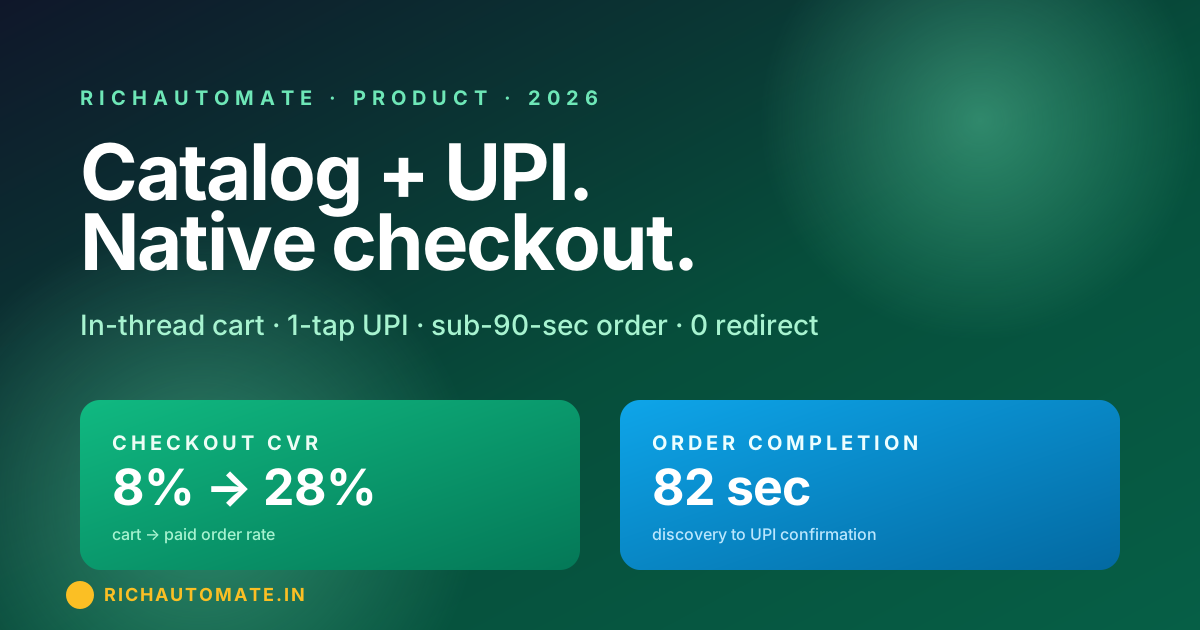
WhatsApp Catalog + UPI native checkout went GA for Indian merchants in late 2024 and is now (2026) the highest-conversion-rate e-commerce surface available in the country — 28% checkout CVR vs 8% on traditional D2C web checkout, sub-90-second median order completion, and zero redirects between catalog and payment. But most Indian D2C brands deploy the surface badly: 200-SKU catalogs that take 4 seconds to render on 4G, missing modifier handling for variants, broken inventory sync to backend, and no retry logic when UPI mandates fail. This guide is the 2026 deep-architecture playbook for Indian D2C, QSR, ticketing, and B2C platforms running WhatsApp Catalog + UPI native checkout — schema design, sync cadence, modifier handling, payment-flow choreography, error recovery, real production numbers, and the compliance pattern.
The Three Catalog Surface Choices in WhatsApp 2026
| Surface | What it is | Best fit |
|---|---|---|
| Catalog Single Item | One SKU per message with image + price + buy button | Specific-SKU promo / restock alert |
| Catalog Multi-Item (Carousel) | Up to 30 items in scrollable carousel | Curated drop / category browse |
| Catalog Browse via List Message | Categories → SKUs nested in list-message UI | Larger catalogs (100+ SKUs) |
Recommended pattern for Indian D2C 2026: curated 6-12 SKU multi-item carousel per customer based on past purchases + segment tag, NOT a 200-SKU dump. Rendering large carousels on 4G adds 4-8 seconds latency, kills CVR.
UPI Native Checkout Flow Choreography
Step 1: Customer taps "Buy Now" on catalog SKU
  → WhatsApp creates ephemeral cart in-thread
  → Cart UI shows: SKU, qty, modifier choices, total

Step 2: Customer adjusts qty / modifiers (size, colour, add-ons)
  → Each adjustment fires webhook to merchant backend
  → Backend validates inventory + price + applies promo if any
  → Returns updated cart total

Step 3: Customer taps "Pay with UPI"
  → WhatsApp invokes UPI handler (NPCI flow inside WhatsApp)
  → Customer selects UPI app (GPay / PhonePe / Paytm / WhatsApp Pay)
  → PIN entry + payment confirmation in 8-15 seconds

Step 4: Payment success
  → NPCI webhook → Razorpay / Cashfree / WhatsApp Pay PSP
  → PSP webhook → merchant backend
  → Merchant fires order_confirmed event
  → Customer sees confirmation utility template in thread

Step 5: Order fulfilment
  → Backend routes to ERP / OMS for picking + shipping
  → Order status updates pushed as utility templates
→ ETA + tracking in threadSchema Design for Catalog Sync
| Field | Type | Notes for Indian D2C |
|---|---|---|
| retailer_id | string, unique | Internal SKU code; primary key for sync |
| name | string, ≤200 chars | Customer-facing; include variant in name ("Cotton T-Shirt M Black") |
| price | integer (paise) | 10000 = ₹100. Sync within 5 min of price change |
| currency | INR | Always INR for Indian merchants |
| availability | in stock / out of stock / preorder | Sync within 60 sec of inventory change |
| image_url | HTTPS URL | Square 800×800 minimum; under 200 KB; CDN-hosted |
| category | Meta-defined taxonomy | Affects rich product card rendering |
| variant attributes | colour, size, etc. | For SKU groups; aids customer browse |
| condition | new / refurbished / used | Required field |
Real Indian D2C Catalog + UPI Numbers
D2C beauty brand, 240 SKU catalog, ₹680 AOV
| Metric | Web Shopify checkout | WhatsApp Catalog + UPI native |
|---|---|---|
| Cart-to-paid CVR | 8% | 28% |
| Median checkout time | 3 min 14 sec | 82 sec |
| Payment failure rate | 14% | 4% |
| UPI vs cards split | UPI 78% / cards 22% | UPI 96% / others 4% |
| Mobile-first AOV | ₹620 | ₹740 |
QSR cloud-kitchen, 60 SKU menu, ₹420 AOV
| Metric | Aggregator app | WhatsApp Catalog + UPI |
|---|---|---|
| Median order completion time | 4 min 42 sec | 92 sec |
| Reorder rate (within 30 days) | 22% | 54% |
| Modifier (extra cheese, no onion) usage | 34% | 62% |
| Out-of-stock disappointment rate | 14% | 3% |
Inventory Sync Cadence and Patterns
- Catalog API push every 60-90 seconds for stock-level changes. Out-of-stock SKUs in WhatsApp Catalog after the inventory has run out trigger customer disappointment + Meta quality drop.
- Price changes within 5 minutes of merchant-side update. Stale prices in catalog → customer pays old price → margin loss + dispute risk.
- New SKU addition within 15 minutes; new SKUs without proper image / category / variant data render poorly in carousel.
- Image CDN strategy — square 800×800 progressive JPEG; under 200 KB; cached at edge. Slow images = customer drops carousel.
- Bulk daily reconciliation 3 AM IST cron — full sync of catalog state to detect drift between merchant ERP and Meta Catalog.
Operating Rule
The single highest-leverage move for any Indian D2C / QSR / ticketing brand running WhatsApp Catalog is curating to 6-12 SKUs per carousel per customer based on past behaviour, paired with sub-90-second inventory sync. Brands that dump 100+ SKU catalogs into a single message see CVR plateau at 6-9%; brands that curate hit 28%. Build the curation engine first; payment optimisation, modifier flow, and post-purchase upsell come downstream.
Get a 1-minute BSP audit on WhatsApp
Drop your WhatsApp number — we line-item your current invoice against Meta India rates in under 60 seconds. India-hosted, DPDP-compliant.
The Six Anti-Patterns That Wreck Catalog + UPI Checkout
- Sending entire 200-SKU catalog in one message. Decision paralysis + 4-8 sec render latency = abandonment. Curate to 6-12 per carousel.
- Stale inventory sync. Out-of-stock items in catalog after the actual inventory ran out = quality complaint surge + Meta downgrade. Sync every 60-90 sec.
- No modifier handling. Variants (size, colour, spice level, add-ons) crammed into SKU name = clutter; Meta variant attributes + cart adjustment flow = clean UX.
- Single payment provider. If UPI app of customer's choice fails (GPay / PhonePe / Paytm / WhatsApp Pay), customer abandons. Wire 4-app fallback + last-tried preference.
- No retry logic on UPI failure. 4-8% of UPI initiations fail (NPCI timeout, app not installed, insufficient balance). Auto-retry with alternate app suggestion + 24h reminder = recovers 40-55% of failed checkouts.
- Marketing template for order updates. Order confirmation, payment success, shipping update = utility (₹0.115/msg). Marketing categorisation triggers cost burn + quality flags.
Trigger + Routing Architecture
Customer browses catalog (carousel / list / direct SKU link):
  → backend logs: customer_id, viewed_skus, viewed_at, engagement_score

Customer taps "Buy Now":
  → WhatsApp ephemeral cart created in-thread
  → backend webhook: cart_created event with customer + sku + qty
  → real-time inventory check + price validation
  → cart total returned to WhatsApp

Customer adjusts qty / modifiers / promo code:
  → each adjustment fires cart_updated webhook
  → backend validates + returns updated total within 1 sec

Customer taps "Pay with UPI":
  → WhatsApp invokes UPI checkout handler
  → customer chooses app (GPay / PhonePe / Paytm / WhatsApp Pay)
  → PIN entry + payment in 8-15 sec
  → NPCI webhook → PSP (Razorpay / Cashfree / WhatsApp Pay PSP)
  → PSP webhook → merchant backend with payment_id + status

Payment success:
  → backend creates order in ERP / OMS
  → utility template: order confirmation with order_id + ETA
  → triggers fulfilment workflow

Payment failure:
  → backend notifies WhatsApp of failure
  → utility template: "Payment didn't go through — try again with [alternate app]?"
  → 24h auto-retry reminder if customer doesn't complete

Order tracking:
  → backend pushes utility templates at: shipped, out for delivery, delivered
  → tracking link in thread for customer self-serve

Daily 3 AM cron:
  Catalog reconciliation (Meta vs ERP)
  Drift detected → auto-sync correction
  Anomaly alerts to ops team
Compliance + Operational Notes
- NPCI / RBI compliance — UPI payments must comply with NPCI specs. PSP integration (Razorpay / Cashfree / WhatsApp Pay PSP) handles compliance for most merchants.
- DPDP Act 2023 — payment data, customer phone, address, order history classified as sensitive; elevated consent + storage controls. Indian-region storage mandatory.
- Meta categorisation — order confirmation, payment success, shipping update, delivery confirmation = Utility (₹0.115/msg). Promotional re-engagement, abandoned-cart marketing nudges = Marketing (₹0.96/msg).
- Refund + dispute — UPI auto-refund within 24-48 hours of cancellation request; chargeback / dispute window 7-14 days per RBI rules.
- Tax + invoicing — GST-compliant invoice generation + delivery in WhatsApp post-payment for orders above threshold.
Run WhatsApp Catalog + UPI checkout on RichAutomate.
Curated multi-item carousel engine (6-12 SKU per customer). 60-second inventory sync cadence. 4-app UPI fallback (GPay / PhonePe / Paytm / WhatsApp Pay) with retry logic. Modifier handling (size, colour, spice, add-ons). Pre-approved utility templates for full order lifecycle. Lifts cart-to-paid CVR 8% → 28% on real Indian D2C + QSR pilots. 14-day trial.
If you are unsure where you stand, the WhatsApp compliance self-audit covers the checks in order.
Related reading
- WhatsApp Catalog & In-Chat Commerce India 2026: Single + Multi Product Messages, WhatsApp Pay UPI, Real Conversion Numbers
- WhatsApp Reply Button vs List vs Flow vs Template India 2026: Decision Matrix + Real CVR Per Surface
- WhatsApp + UPI Lite + RuPay-on-UPI Hybrid Checkout India 2026: NPCI Integration Patterns
- WhatsApp for ONDC Kirana + Seller Onboarding India 2026: DPIIT + ULIP + UPI 123Pay + GST + FSSAI Pathway
- DPDP Act WhatsApp Compliance Checklist India 2026