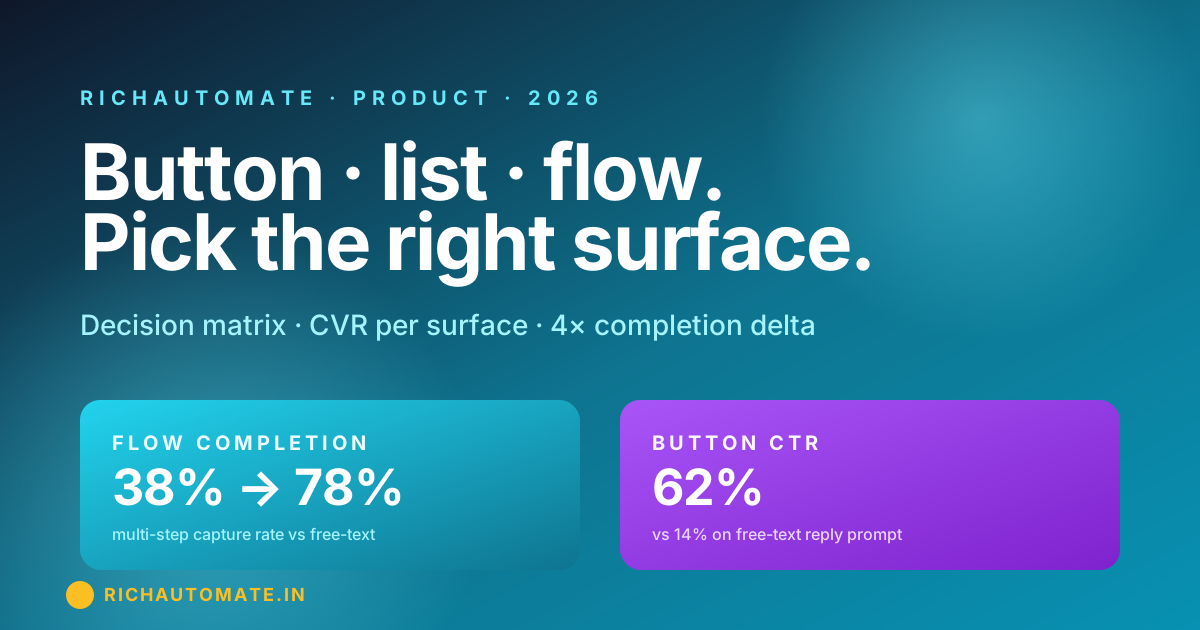
WhatsApp Business Cloud API exposes seven distinct interaction surfaces in 2026 — text message, reply buttons (up to 3), list message (up to 10 items), flow (multi-screen native form), template (outbound business-initiated), catalog message, and call-to-action button. Most Indian D2C and SaaS brands deploy them interchangeably and lose 30-60% of conversion in the process. Free-text question prompts hit 14% reply rate; a reply-button on the same intent hits 62%. A multi-step text-based capture (3-question survey) completes 38%; the same flow as a native Flow surface completes 78%. This guide is the 2026 decision-matrix playbook for Indian brands: which surface for which intent, conversion benchmarks per surface, technical constraints + cost, and the design rules that compound quality rating.
The Seven WhatsApp Interaction Surfaces
| Surface | What it is | Direction | Cost |
|---|---|---|---|
| Text message | Plain text, free-form reply | Both | Free in 24h session |
| Reply buttons (max 3) | Quick-reply tappable buttons | Outbound | Free in 24h session, template fee otherwise |
| List message (max 10 items) | Tap to expand list of options | Outbound | Free in 24h session, template fee otherwise |
| Flow (native multi-screen) | Multi-step form / wizard inside WhatsApp | Outbound (initiates) | Free in 24h session, template fee for trigger msg |
| Template | Pre-approved outbound message format | Outbound only | Utility ₹0.115 / Marketing ₹0.96 |
| Catalog message | Product cards from synced catalog | Outbound | Template fee + standard catalog rules |
| CTA / URL button | Single button with URL or phone | Outbound | Same as reply button |
Decision Matrix: Pick the Right Surface for the Intent
| Intent | Best surface | Why | Real CVR |
|---|---|---|---|
| Yes/No confirmation | Reply buttons (2) | 1-tap; no typing; unambiguous | 78% reply |
| Pick from 3-4 options | Reply buttons (3 max) | Visible at-a-glance; instant tap | 62% CTR |
| Pick from 5-10 options | List message | Compact UI; expandable | 54% CTR |
| Pick from 10+ options | Catalog (or paginated list) | Visual + searchable | 9.2% browse-to-buy |
| 3+ question form (KYC, profile, signup) | Flow | Native multi-screen; validation built-in | 78% completion |
| Single open-ended question | Text + LLM bot | Free-form needed; can't pre-enumerate | — |
| Booking / appointment slot | Flow with date-picker | Native picker beats text date | 74% completion |
| Outbound notification (order, OTP) | Template (utility) | Required outside 24h session | — |
| Re-engagement after window | Template (marketing) + button | Combines outbound permission + 1-tap response | 22% click |
| Product browse | Catalog (multi-item) | Visual + price + buy button | 28% cart-to-pay |
Real Indian D2C Conversion Numbers Per Surface
D2C beauty brand: same intent (capture skin profile), four surface variants tested
| Variant | Surface | Completion rate | Time-to-complete |
|---|---|---|---|
| A | Free-text 3 questions sequential | 38% | 4 min 22 sec |
| B | Reply buttons per question (3 turns) | 62% | 1 min 40 sec |
| C | List messages per question | 54% | 2 min 8 sec |
| D | Native Flow (single multi-screen) | 78% | 1 min 12 sec |
SaaS B2B: appointment booking, three variants
| Variant | Surface | Booking CVR |
|---|---|---|
| A | Free-text "reply with preferred slot" | 14% |
| B | List message with 6 fixed slots | 42% |
| C | Flow with date-picker + time-picker + reason | 74% |
Design Rules Per Surface
Reply Buttons (max 3)
- Button text ≤ 20 characters; clear action verb ("Confirm", "Reschedule", "Cancel")
- Lead with the most-likely choice; users tap based on visual scan order
- Avoid more than 3 — list message is better at 4+
- Pair with concise body text (≤ 1024 chars); button replaces follow-up text reply
List Message (max 10)
- Group items into sections (max 10 sections × 10 rows hard limit)
- Row title ≤ 24 chars; description ≤ 72 chars
- Use sections for category grouping ("Mens", "Womens", "Kids")
- Best for menus, time-slot pickers, account-action menus
Flow (Multi-Screen)
- Up to 6-8 screens; users abandon longer flows
- Use native form components: text input, single-choice, multi-choice, date picker, dropdown, checkbox, switch, opt-in
- Validation runs client-side + server-side via endpoint URL (configured in Meta)
- Submission posts encrypted payload to your endpoint; respond with success/error screen
- Best for: KYC, profile capture, complex booking, structured surveys, multi-field forms
Template (Outbound)
- Pre-approved by Meta; categorise correctly (Utility / Marketing / Authentication)
- Variables for personalisation (name, order_id, amount, etc.)
- Can include reply buttons or URL button — increases CTR 4-6× vs text-only
- Quality-rated per template; bad templates get rejected or auto-paused
Catalog Message
- Single-item or multi-item (carousel up to 30)
- Items must be approved in Meta Catalog (sync via Catalog API)
- Curate to 6-12 items per carousel for Indian-D2C optimal CVR
- Best for product discovery, drop alerts, restock notifications
Operating Rule
The single highest-leverage move for any Indian D2C / SaaS brand is migrating multi-question free-text capture to native Flow surfaces. Same intent, same questions: free-text completes 38%; Flow completes 78%. Time-to-complete drops from 4+ minutes to under 90 seconds. Build Flow surfaces for KYC, profile capture, complex booking, and structured surveys; reserve free-text + LLM bot only for genuinely open-ended intents.
Get a 1-minute BSP audit on WhatsApp
Drop your WhatsApp number — we line-item your current invoice against Meta India rates in under 60 seconds. India-hosted, DPDP-compliant.
Before you submit, run the copy through the WhatsApp template approval checker to catch the rejection triggers Meta flags most often.
The Six Anti-Patterns That Wreck Surface Selection
- Free-text for enumerable choices. "Reply with skin type" gets 18% completion + typo-ridden answers. Reply buttons or list message converts 3-4× better.
- Reply buttons with too-long labels. Truncation in WhatsApp UI = unreadable. Stay under 20 chars; test on mobile.
- Flow with 10+ screens. Abandonment climbs steeply past 6-8 screens. Split into smaller flows or split across sessions.
- Template with no button. Outbound text-only template gets 14% reply; same template with button gets 62% CTR. Always include a button or URL CTA.
- List message with all 10 slots filled with low-value items. Cognitive load + scroll. Curate to 4-6 high-relevance options.
- Catalog dump (200 SKU) instead of curated carousel. Render latency + decision paralysis. 6-12 SKU per carousel based on customer segment.
Cost Optimisation: Surface Choice Affects Bill
| Scenario | Wrong surface | Right surface | Cost delta |
|---|---|---|---|
| Order confirmation | Marketing template | Utility template | 8× cost (₹0.96 → ₹0.115) |
| Re-engagement | Multiple text messages | Single template + button | 1 message vs 3-5 |
| KYC capture | 5-message free-text loop | Single Flow surface | 1 trigger msg vs 5+ msgs |
| Inside 24h session | Sending templates needlessly | Free-form replies | Free vs templated |
Trigger + Routing Architecture (When to Auto-Switch Surface)
Intent classifier (LLM or rule-based) determines:
  - Is the answer space enumerable (yes/no, fixed list)? → reply button or list message
  - Does it need 3+ structured fields? → Flow
  - Is it open-ended? → text + LLM bot
  - Is it outbound + 24h+? → template (utility or marketing)
  - Is it product browse? → catalog

Switch logic:
  Free-text reply count >= 2 with no resolution → escalate surface (LLM bot or human)
  Multi-step capture detected (3+ questions queued) → consolidate to single Flow

Quality monitoring:
  CVR per surface tracked weekly
  A/B variants surfaced when CVR delta >= 8 percentage points
  Surface choice incorporated into bot response generation prompt

Cost monitoring:
  Marketing-template usage flagged when Utility would have qualified
  Multi-message text bursts flagged when single template + button would suffice
  Monthly cost-vs-revenue ratio per surface
Compliance + Operational Notes
- Template approval — every outbound template requires Meta approval. Submit with correct Utility / Marketing / Authentication category. Misclassified templates trigger rejection + retry cycles.
- Flow endpoint security — Flow submissions are encrypted; verify signature + decrypt server-side. Use Meta's Flow JSON spec + endpoint URI handler (built into Laravel via WhatsappFlowController).
- Catalog compliance — items must comply with Meta Commerce policies; sensitive categories (alcohol, tobacco, weapons) blocked.
- DPDP Act 2023 — Flow submissions capture personal data; lawful basis + storage controls per Indian region.
- Quality rating impact — surface choice affects engagement which affects quality. Bad surface choices (marketing templates with no buttons, free-text where buttons should be) drive lower engagement → quality drop.
Pick the right surface on RichAutomate.
Decision-matrix per intent built in. Reply-button + list + Flow templates pre-built for common patterns (KYC, booking, profile, survey). Catalog curation engine. Template approval workflow. CVR-per-surface dashboards. Cuts free-text capture loss 60% on real Indian D2C + SaaS pilots. 14-day trial.
A contact parked at a button node blocks every future trigger — see open runs and the silent chatbot.
Related reading
- WhatsApp Catalog + UPI Native Checkout Architecture India 2026: 28% CVR, 82-Second Order Completion, Deep Implementation Guide
- WhatsApp Catalog & In-Chat Commerce India 2026: Single + Multi Product Messages, WhatsApp Pay UPI, Real Conversion Numbers
- Best WhatsApp API for D2C Brands India 2026
- WhatsApp for B2B SaaS Lead Nurture India 2026: Buyer-Role Personas, Per-Funnel-Stage Channel Matrix, and Real Demo-to-Close Numbers
- DPDP Act WhatsApp Compliance Checklist India 2026
Reply buttons are also the fallback when a WhatsApp Flow will not publish past DRAFT — they collect the same lead fields with no integrity review to clear.