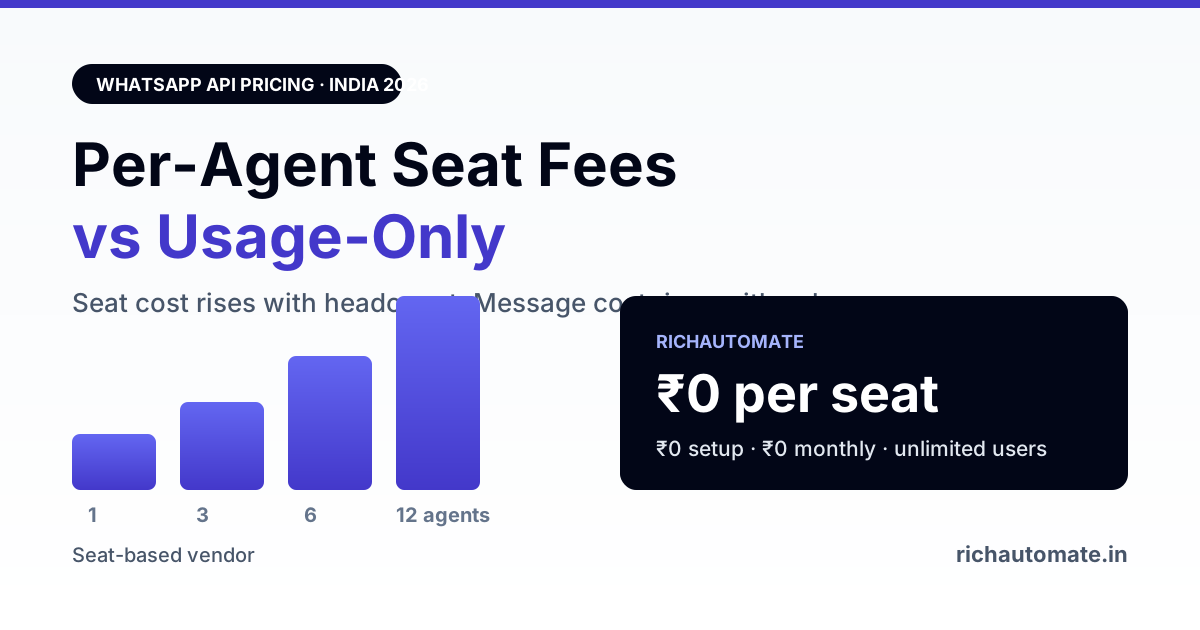
Per-agent pricing means your WhatsApp API vendor charges a fixed monthly fee for every user who logs into the shared inbox — on top of what Meta already charges you per conversation. RichAutomate does not do that: seats are ₹0, the platform fee is ₹0, and you pay only for messages actually sent.
That single line is the whole decision for most Indian teams, but the arithmetic is worth seeing, because the seat fee is the part of a WhatsApp bill that grows when your business does not. A five-person team on a seat-based plan pays five times the platform fee of a one-person team while sending identical messages to identical customers. This page separates the three cost layers on every Indian WhatsApp Business API bill, shows the crossover math, and names the one case where a per-seat plan genuinely wins.
What "per-agent pricing" actually means on WhatsApp API
WhatsApp Business API has no concept of an agent. Meta bills the WhatsApp Business Account per conversation or per template message — it does not know or care how many humans staff your inbox. "Agents" are purely a vendor construct: the seat is a login to the vendor's team inbox, with role permissions, assignment rules and reporting attached.
So a per-agent charge is not a pass-through of a Meta cost. It is the vendor's own software licence, priced per head. Vendors like it because revenue scales with your headcount; you should scrutinise it because your Meta bill scales with message volume, and the two are only loosely related.
Three seat structures are common in the Indian market in 2026:
- Included seats plus overage — the plan bundles 3 to 5 users, then charges a per-user add-on beyond that.
- Pure per-seat — every login is billed, from the first one.
- Tier-gated seats — more users are technically allowed, but only on a higher plan that also gates the features you actually came for (API access, webhooks, chatbot builder).
The third is the expensive one, because you end up buying a tier for its seat count and paying for a feature bundle you did not need.
The three cost layers on every Indian WhatsApp bill
Before comparing vendors, separate what you are paying for. Every WhatsApp Business API bill in India decomposes into exactly three layers, and only one is fixed by Meta.
| Layer | Who sets it | Scales with | Negotiable? |
|---|---|---|---|
| Meta conversation / per-message charge | Meta | Messages sent, by category | No — published rate card |
| Vendor per-message markup | Your BSP | Messages sent | Sometimes, at volume |
| Vendor platform / per-agent fee | Your BSP | Headcount and plan tier | Yes — or avoidable entirely |
Layer one is identical everywhere. If two quotes differ, the difference lives entirely in layers two and three. Our WhatsApp API pricing comparison for India breaks the same three layers down vendor by vendor, and the hidden costs Indian BSPs do not advertise covers the line items that appear only after you sign.
Seat pricing vs usage-only: the 2026 cost math
Take a support team sending 20,000 utility messages a month — order updates, appointment reminders, delivery alerts. Meta's utility rate is identical for both vendors, so hold it constant and compare only what the vendor adds on top.
The seat tiers below are illustrative placeholders, not quotes — check any vendor's live pricing page for current numbers. The point is the shape of the curve, not the exact rupee value.
| Team size | Seat plan at ₹999/user/month | Seat plan at ₹1,999/user/month | RichAutomate (usage-only) |
|---|---|---|---|
| 1 agent | ₹999 | ₹1,999 | ₹0 |
| 3 agents | ₹2,997 | ₹5,997 | ₹0 |
| 6 agents | ₹5,994 | ₹11,994 | ₹0 |
| 12 agents | ₹11,988 | ₹23,988 | ₹0 |
| Annual cost at 6 agents | ₹71,928 | ₹1,43,928 | ₹0 |
Note what does not appear in that table: message volume. The seat column is unchanged whether the team sends 2,000 messages or 200,000. That is the structural objection to seat pricing — the fee is decoupled from the value delivered. Model your own numbers on the WABA cost calculator before you renew anything.
Where seat models quietly get expensive
The headline per-user number is rarely the real number. Four patterns show up repeatedly when Indian teams audit their bills:
Get a 1-minute BSP audit on WhatsApp
Drop your WhatsApp number — we line-item your current invoice against Meta India rates in under 60 seconds. India-hosted, DPDP-compliant.
- Ghost seats. Staff churn, the login never gets deprovisioned, and you keep paying. On an annual contract nobody notices for eleven months.
- Read-only stakeholders. A founder, an ops lead and an agency partner who each want visibility are three billable seats in most plans, despite sending nothing.
- Seasonal surges. Festive and exam-season teams double for six weeks. Monthly plans let you scale back down; annual seat commitments do not.
- Tier jumps for one feature. You need webhooks or a second WABA number, that lives two tiers up, and the tier is priced per seat — so one feature multiplies across the whole team.
None of these are hypothetical. They are why a quote that looked competitive at signup reads very differently at renewal. If you are already mid-contract, migrating your WhatsApp BSP without losing the number walks through the mechanics.
RichAutomate's usage-only pricing, in full
No seat fee, no platform fee, no setup fee, no monthly minimum. You pick one of two billing models depending on whether you want to hold your own Meta billing relationship.
| Line item | Client Pay | SaaS Pay |
|---|---|---|
| Setup fee | ₹0 | ₹0 |
| Monthly platform fee | ₹0 | ₹0 |
| Per agent / user | ₹0 | ₹0 |
| Meta message charge | Billed direct to your Meta account | Included in the rate |
| Marketing message | ₹0.10 + Meta rate | ₹1.20 |
| Utility / authentication message | ₹0.10 + Meta rate | ₹0.30 |
| Trial | 14 days, 100 free credits | |
Client Pay suits teams that already have a Meta billing relationship or expect high volume — you settle Meta directly at their rate and RichAutomate adds ₹0.10 per message for the platform. SaaS Pay is the single-invoice option: one all-in rupee rate with the Meta cost already inside it, useful when finance wants one vendor and one GST invoice. Full terms sit on the RichAutomate pricing page.
One compliance note that catches new applicants: the trial runs without GST, but taking a WhatsApp Business API number live in India effectively requires GST registration, because Meta Business Verification needs it to verify the legal entity behind the WABA. Budget for that in the timeline, not just the price.
When a per-seat plan is actually the right call
Being honest about this matters more than winning the argument. A seat-priced vendor is defensible when the seat buys genuinely differentiated software you would otherwise have to build: a mature CRM with deep pipeline reporting, a ticketing system with SLA escalation trees, or an omnichannel desk unifying email, voice and WhatsApp in one thread history.
In those cases you are not paying for WhatsApp access — you are paying for a helpdesk that happens to speak WhatsApp, and per-seat is the standard, fair way that category is priced. The mistake is paying helpdesk-grade seat fees to a vendor whose product is a WhatsApp inbox and a broadcast button.
The test: list the three features your team touches daily. If all three are WhatsApp-native — templates, broadcasts, chatbot flows, shared inbox — the seat fee is buying nothing a usage-only platform does not already include.
How to audit your current bill in 15 minutes
- Pull the last three invoices and split every line into the three layers above. Anything that is not a Meta pass-through is negotiable or avoidable.
- Count active logins, not licensed seats. Divide the platform fee by the number of people who actually opened the inbox last week — that is your true cost per working agent.
- Divide the total by messages sent. A single all-in rupees-per-message figure is the only number that compares cleanly across vendors.
- Re-run at next year's headcount. Double the seat line and leave the message line flat. That is the number you are really renewing against.
- Check your notice period before committing to anything new — most Indian BSP contracts need 30 days.
Teams that run this audit usually find the seat line is 40–70% of a bill they assumed was mostly Meta charges.
The short version
Per-agent pricing is a software licence dressed up as a WhatsApp cost. It scales with your org chart while your Meta bill scales with message volume, and the two diverge exactly when you are growing fastest. If your vendor's product is a WhatsApp inbox, there is no structural reason to pay per head for it.
RichAutomate is usage-only: ₹0 setup, ₹0 monthly, ₹0 per seat, unlimited team members, and a 14-day trial with 100 free credits so you can compare against your live bill before switching anything. Start on the pricing page, or model your volume in the cost calculator.
Some vendors publish a platform fee but stay silent on seats — we flag exactly which figures are missing in the MSG91 WhatsApp API pricing breakdown for India.