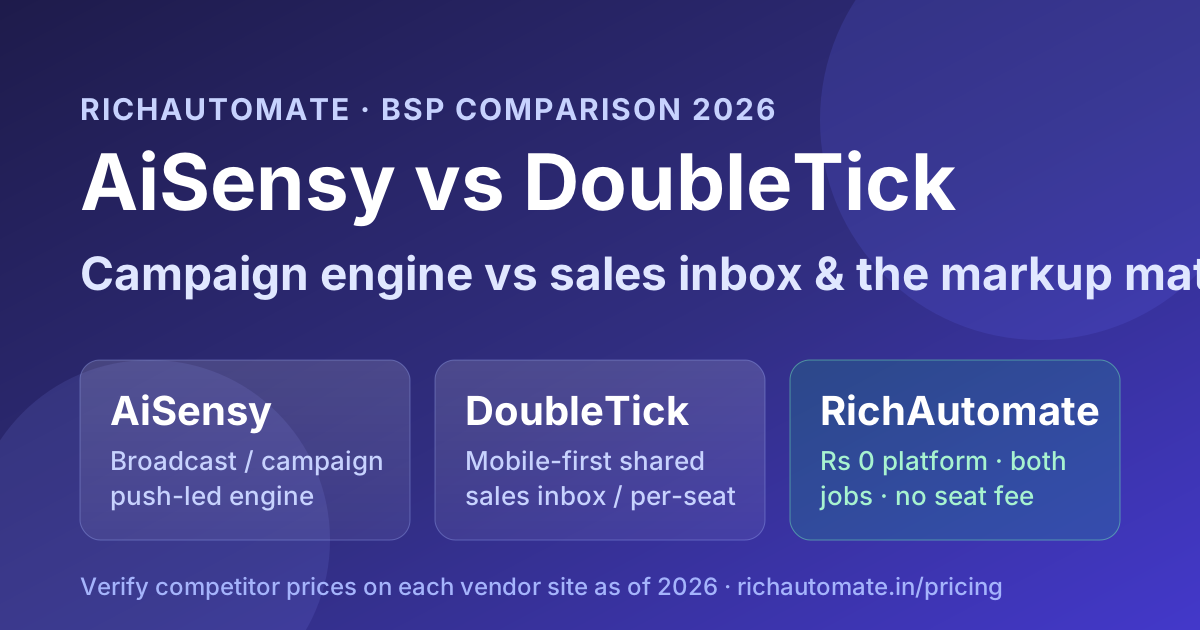
If you are an Indian SMB sales team shortlisting a WhatsApp Business platform, two names keep surfacing for very different reasons: AiSensy, positioned as a broadcast-and-campaign engine for marketing-led growth, and DoubleTick, positioned as a mobile-first WhatsApp sales CRM and shared team inbox. They are not really competing on the same axis — one is about sending campaigns to many, the other about closing conversations one at a time — and choosing wrong means paying for a workflow your team will not use. This decode lays out the campaign-engine vs sales-inbox split, walks an honest markup-math table (every competitor number hedged "as of 2026 — verify on the vendor site"), gives you when-to-pick-which checklists, and closes by putting RichAutomate on the table as a flat, ₹0-platform-fee third option that does both without a per-seat or per-conversation markup tax. No "no-ban" promises, no guaranteed approval — just the math and the workflow fit, so an Indian sales team can decide in one read.
Two products, two philosophies — name the axis first
The single most common mistake in this comparison is treating AiSensy and DoubleTick as interchangeable WhatsApp tools and picking on price alone. They solve different jobs. AiSensy leans into the campaign engine world — bulk broadcasts, template campaigns, retargeting, click-to-WhatsApp ad funnels, chatbot flows — the machinery a marketing-led D2C or services brand uses to push messages out to thousands and capture inbound at scale. DoubleTick leans into the mobile-first sales inbox world — a shared team WhatsApp CRM where reps work leads from a phone, with a strong app experience, catalog/quick-reply selling, contact-level tracking, and a sales-rep-per-seat shape. If your pain is "we cannot send enough campaigns," that is an AiSensy-shaped problem. If your pain is "my five reps are juggling leads in one WhatsApp and dropping them," that is a DoubleTick-shaped problem. Name your axis before you compare a single rupee.
The click-to-WhatsApp link generator builds the wa.me link with your prefilled message in one step.
| Dimension | AiSensy (campaign engine) | DoubleTick (mobile-first sales inbox) |
|---|---|---|
| Primary job | Broadcast, campaigns, retargeting at scale | Shared team inbox, rep-led lead closing |
| Buyer persona | Marketing-led D2C / services brand | SMB sales team with multiple reps |
| Surface | Web dashboard, campaign-centric | Strong mobile app, inbox-centric |
| Selling style | One-to-many push | One-to-one conversational close |
| Typical pricing axis | Plan tiers + per-message markup | Per-user/seat + per-message markup |
| Underlying rails | WhatsApp Business / Cloud API + Meta charges | WhatsApp Business / Cloud API + Meta charges |
Note the last row: both run on the same Meta WhatsApp Business API underneath, so the conversation charge from Meta is roughly the same wherever you go. The difference you are actually buying is workflow shape and the platform's markup on top of Meta. Verify each vendor's current positioning and plan structure on their own site as of 2026.
The markup-math that actually moves the bill
Every WhatsApp platform sits on top of Meta's conversation pricing. Meta bills a per-conversation charge by category (marketing, utility, authentication, service), and that charge is broadly the same regardless of which BSP you route through. What differs is the platform markup — the monthly plan fee, the per-seat fee, and any per-message margin the vendor adds on top of Meta. That markup is the real variable in your bill, and it is where the AiSensy-vs-DoubleTick-vs-RichAutomate decision is won or lost. Here is the honest structure — treat all competitor figures as illustrative and verify on each vendor site as of 2026:
| Cost layer | AiSensy | DoubleTick | RichAutomate |
|---|---|---|---|
| Platform / monthly fee | Tiered monthly plan — verify on aisensy.com as of 2026 | Per-user/seat plan — verify on quicktick / doubletick.io as of 2026 | ₹0 platform · ₹0 setup · ₹0 monthly |
| Per-seat / per-agent fee | Agent add-ons may apply — verify as of 2026 | Charged per user/seat — verify as of 2026 | No per-seat fee |
| Per-message markup | Platform markup may apply — verify as of 2026 | Platform markup may apply — verify as of 2026 | Client Pay ₹0.10/msg or SaaS Pay ₹1.50 mktg / ₹0.50 utility |
| Meta conversation charge | Billed per Meta's rates (same underneath) | Billed per Meta's rates (same underneath) | Client Pay: billed by Meta directly to you |
| Free trial | Trial may be offered — verify as of 2026 | Trial / demo may be offered — verify as of 2026 | 14-day free trial + 100 credits |
How to read this table: the only cells you can take to the bank are the RichAutomate ones — ₹0 platform, ₹0 setup, ₹0 monthly; Client Pay at ₹0.10 per message with Meta's conversation charges billed to you directly by Meta; or SaaS Pay at an all-in ₹1.50 per marketing conversation and ₹0.50 per utility conversation; plus a 14-day free trial with 100 credits. Every AiSensy and DoubleTick figure is positioning, not a quote — pricing pages, tiers and per-seat math change, so confirm them on aisensy.com and the DoubleTick site before you sign anything as of 2026.
Where the seat-fee bites — and where the campaign tier bites
The two products punish you on opposite axes, and knowing which axis your team scales on tells you which bill will balloon. A per-seat sales-inbox model (the DoubleTick shape) is comfortable at three or four reps and starts to sting as you grow a calling/sales floor — every new rep is a recurring line item, whether or not they send a single campaign. A campaign-tier model (the AiSensy shape) is comfortable when message volume is modest and bites as your broadcast volume climbs into higher plan tiers and the per-message markup compounds across tens of thousands of sends a month. So the question is not "which is cheaper" in the abstract — it is "which way does my team grow?" A 12-rep sales floor sending few campaigns hates per-seat fees; a 3-person marketing team blasting 80,000 messages a month hates campaign-tier markup. Map your growth vector first, then read the bill.
This is exactly the kind of unit-economics modelling that decides a WhatsApp budget, and it is worth doing on real numbers before you commit — our WABA cost calculator lets you plug in seats, message mix and volume to see the true monthly figure rather than a headline plan price.
When to pick AiSensy
AiSensy is the right shape when your growth motion is marketing-led and push-heavy. Pick it if most of these are true:
- Broadcasts are your bread and butter. You run frequent template campaigns, promotions and re-engagement blasts to large lists, and the core value is "send to many, reliably."
- Click-to-WhatsApp ads drive your funnel. You spend on Meta ads that open WhatsApp threads, and you want campaign-centric tooling to capture and retarget that inbound at scale.
- Your team is small but your list is large. A lean marketing team manages the machine; you do not have a 10-rep sales floor each needing a seat.
- Chatbot flows matter more than human inbox. Automated qualification and FAQ deflection carry most of the load, with humans stepping in selectively.
If your pain is volume and reach rather than rep coordination, a campaign engine fits — verify the current AiSensy plan tiers and message-markup on aisensy.com as of 2026 before you size the monthly bill.
Get the India 2026 WhatsApp BSP price comparison
Wati vs AiSensy vs Interakt vs RichAutomate: Meta rates, platform fees and hidden costs, side by side. We send it to your WhatsApp in a minute.
When to pick DoubleTick
DoubleTick is the right shape when your growth motion is rep-led and conversation-heavy. Pick it if most of these are true:
- Your reps live in WhatsApp on mobile. A strong phone-first app and shared team inbox is the difference between leads closed and leads lost, and your reps will not log into a web dashboard all day.
- Lead ownership and handoff is the problem. Multiple reps share one number, you need assignment, contact-level history and accountability so nobody drops a hot lead.
- Catalog and quick-reply selling drives revenue. Reps push product cards, price lists and quick replies one-to-one to move a sale forward.
- Seat count is modest and stable. A small, steady sales team where a per-user fee stays predictable rather than scaling into a calling-floor headcount.
If your pain is rep coordination and one-to-one closing on mobile, a sales inbox fits — verify the current DoubleTick per-user/seat pricing on the DoubleTick (QuickReply/QuickTick) site as of 2026 before you multiply it by headcount. A shared inbox is also a CRM decision; our best WhatsApp CRM for India guide frames what to look for in a team inbox beyond the brand name.
RichAutomate as the third option — both jobs, no markup tax
Here is the option the AiSensy-vs-DoubleTick framing tends to hide: you can have a campaign engine and a shared sales inbox on one platform without paying a per-seat fee or a monthly plan tier. RichAutomate runs broadcast campaigns and template messaging like a campaign engine, and a multi-agent shared team inbox with assignment and contact history like a sales CRM — and it does it on flat, transparent pricing. There is ₹0 platform fee, ₹0 setup and ₹0 monthly. You choose how Meta's conversation charges flow: on Client Pay, ₹0.10 per message and Meta bills its conversation charges to you directly at Meta's own rates — no platform margin in the middle; on SaaS Pay, an all-in ₹1.50 per marketing conversation and ₹0.50 per utility conversation. There is no per-rep seat fee, so a growing sales floor does not turn into a recurring tax. And a 14-day free trial with 100 credits lets a team wire both a campaign and a shared-inbox workflow end-to-end before committing.
The honest pitch: RichAutomate is not magic — it sits on the same Meta WhatsApp Business API as AiSensy and DoubleTick, so Meta's conversation charge is the same underneath. What changes is the markup: ₹0 platform, ₹0 setup, ₹0 monthly, no per-seat fee, and a per-message price you can see. If your team grows by adding reps, the seat-fee axis disappears; if it grows by adding campaign volume, the plan-tier axis disappears. We make no "no-ban" or guaranteed-approval claim — Meta governs quality, templates and delivery, and so should your sending discipline. See the full card at richautomate.in/pricing.
How to actually run the comparison for your team
Do not decide on a feature checklist or a headline price — decide on a modelled monthly bill against your real workflow. A clean process:
| Step | What to do | Why it matters |
|---|---|---|
| 1. Name your axis | Decide if you are push-led (campaigns) or rep-led (inbox) | Wrong axis = paying for a workflow nobody uses |
| 2. Count your seats | Project rep headcount over 12 months | Per-seat models scale with reps, not revenue |
| 3. Estimate message mix | Split marketing vs utility vs service volume | Utility is cheaper; mix drives the real bill |
| 4. Model the markup | Plan/seat fee + per-message margin on top of Meta | Markup, not Meta, is the variable you control |
| 5. Verify live prices | Confirm AiSensy / DoubleTick figures on their sites | Tiers and per-seat math change — quote, do not guess |
| 6. Trial before you commit | Wire one real workflow on a free trial | A demo lies; your own workflow does not |
Run that for all three and the choice usually makes itself. If campaigns dominate and your team is lean, a campaign engine or RichAutomate Client Pay wins on cost. If reps dominate and seats would stack up, RichAutomate's no-seat-fee shape usually beats a per-user inbox. If you want one platform for both, that is the RichAutomate case. For the broader build picture — chatbot, flows and inbox together — the WhatsApp chatbot for business pillar walks the full stack. And if DoubleTick specifically is what you are leaving or comparing, our DoubleTick alternative for India breakdown goes deeper on that switch.
The bottom line for an Indian SMB sales team
AiSensy and DoubleTick are both credible — they simply answer different questions. AiSensy answers "how do I send more, to more people, reliably?" DoubleTick answers "how do I stop my reps dropping leads in a shared WhatsApp?" If you can name which question keeps you up at night, you have your shortlist of two. RichAutomate enters as the third option that refuses to make you choose: campaign engine and shared sales inbox on one platform, ₹0 platform/setup/monthly, no per-seat fee, ₹0.10 per message on Client Pay (Meta billed direct) or ₹1.50 marketing / ₹0.50 utility on SaaS Pay, with a 14-day free trial and 100 credits to prove it on your own workflow. Whatever you choose, verify every AiSensy and DoubleTick price on their own sites as of 2026, model the markup against your real seat-count and message-mix, and never buy on a headline plan price alone.
Decide on the bill, not the brochure
AiSensy is a campaign engine; DoubleTick is a mobile-first sales inbox; RichAutomate is the flat-priced third option that does both without a per-seat or monthly-plan markup tax. Pricing you can hold us to: ₹0 platform fee, ₹0 setup, ₹0 monthly — Client Pay at ₹0.10 per message with Meta's conversation charges billed direct by Meta, or SaaS Pay at ₹1.50 per marketing / ₹0.50 per utility conversation all-in. No per-seat fee, no plan tier, no "no-ban" promise — just transparent math. Start the 14-day free trial with 100 credits and model both a campaign and a shared-inbox workflow on your own numbers. WhatsApp us at 918160311319 or book a 30-minute walkthrough at https://richautomate.in/book/demo. (Verify all AiSensy and DoubleTick pricing on their own sites as of 2026; Meta's conversation-category charges are billed at Meta's rates and change over time.)
Start your 14-day free trial → · See full pricing · Run the WABA cost calculator
If you also run Instagram and web chat, see our SleekFlow alternative comparison for India.
Related reading: RCS vs WhatsApp Business API in India 2026 · SleekFlow vs RichAutomate 2026 pricing decoded.