Indian D2C subscription brands — coffee boxes, supplement subscriptions, snack monthlies, beauty refills, pet-food autoship — lose 18–32% of recurring revenue every year to involuntary churn alone. Card declines, UPI mandate failures, billing-day surprise, paused-and-forgot pauses. Email recovers ~14% of dunning attempts; phone-callback recovers ~22% but burns ₹40+ per call; SMS at 6% read rate barely registers. WhatsApp closes the gap — payment-intent messages read at 88%, one-tap UPI re-mandate links convert 4–6× higher than email, and the persistent thread keeps the customer warm across the renewal cycle. This guide is the 2026 implementation playbook for Indian D2C subscription operators — the seven WhatsApp workflows that protect MRR, the per-renewal economics, the UPI mandate + Razorpay subscriptions wiring, and the five anti-patterns that wreck subscription LTV.
Why Subscription Brands Are the Hidden ROI Vertical for WhatsApp
| Driver | Subscription-specific impact |
|---|---|
| High repeat-billing frequency (monthly / quarterly) | Each cycle is a churn-or-retain moment. WhatsApp captures every one. |
| UPI mandate fragility (NPCI rules) | UPI mandates fail at 8–14% per cycle. Each failure = an at-risk customer who needs a 1-tap fix path. |
| Card-decline rate 12–22% in India | Stripe / Razorpay card auto-charge fails routinely. WhatsApp + UPI fallback recovers most. |
| High-LTV product | Each saved subscription = ₹4,800–₹24,000 of recurring revenue protected. |
| Low-cost per-touch messaging | Utility template at ₹0.115 vs ₹40 phone callback per save attempt. |
| Persistent thread = no "cold" outreach | Customer already has 12+ months of WhatsApp brand history. Renewal nudge feels like service, not sales. |
The Seven WhatsApp Workflows That Protect Subscription MRR
- Pre-renewal heads-up (T-3 days). Utility template: "Your March box ships on the 8th. Card on file ending in 4321 will be charged ₹1,499 on the 5th. Tap to manage." Single-tap to skip / change / pause.
- UPI mandate failure recovery. Mandate auto-debit fails → utility template within 60 seconds: "Your UPI mandate didn't process. Tap to re-authorise — takes 30 seconds." Direct deep-link to Razorpay re-mandate page.
- Card-decline soft retry sequence. First decline → SMS-style WhatsApp utility nudging customer to update card. Second decline T+24h → call-to-pay link. Third decline T+72h → human-agent handoff via Calling API.
- Pause-and-rescue. Customer taps Pause inside the renewal flow → 3-question Flow form asking why (price / didn't use / changed brand / temporary). Branch logic: price-objection → 15% discount; didn't use → recipe / usage tutorial; brand-switch → no-pressure email-pause; temporary → 30-day hold with auto-resume.
- Skip-this-cycle workflow. Tap Skip → Flow form picks reason + offers a swap (downgrade pack size or change product). Captures the customer who would otherwise cancel outright.
- Win-back after 30-day inactive. Cancelled subscriber → 30 days quiet → utility template "We saved your preferences. Restart your March box at 20% off — tap to resume." ~9–14% reactivation rate vs 1–2% on email win-back.
- Loyalty & referral nudges. Long-term subscribers (6+ cycles) receive a thank-you-and-refer template with one-tap referral link. WhatsApp share to friend lifts referral conversion 3.4× over email.
Per-Renewal Economics: Real Indian Subscription Brand Numbers
D2C coffee box subscription (₹1,200/cycle, 8,000 active subscribers)
| Metric | Email + retry-only | WhatsApp recovery flow |
|---|---|---|
| UPI mandate failure rate | 11% | 11% (same — Meta doesn't affect NPCI) |
| Re-authorise rate within 24h | 23% | 71% |
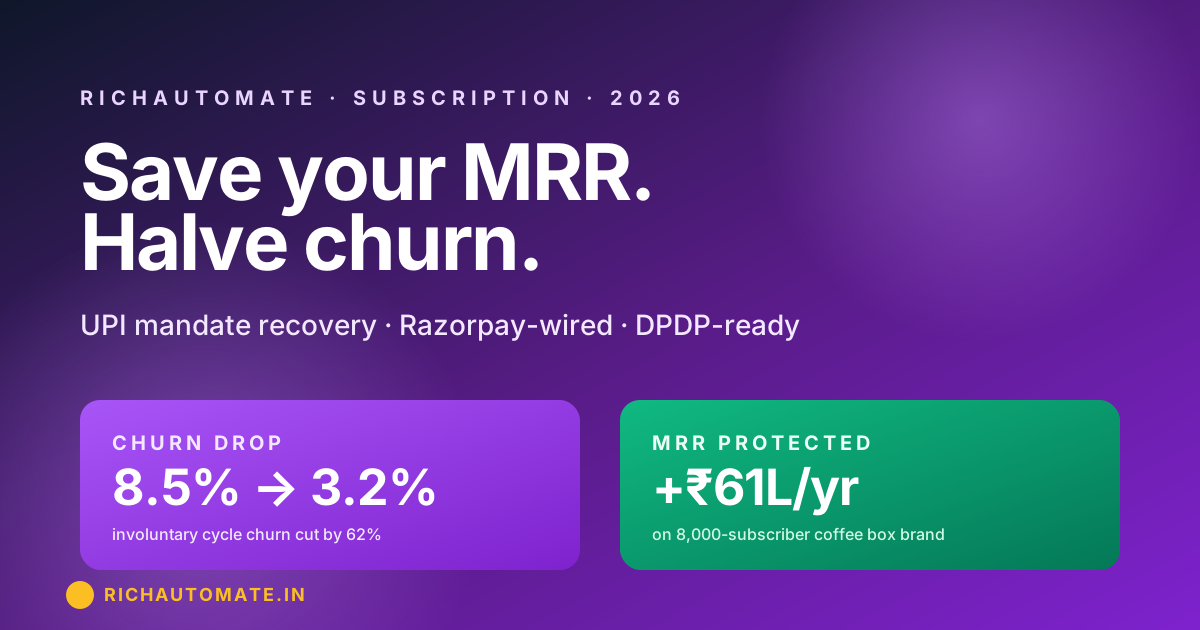
| Net cycle churn (involuntary) | 8.5% | 3.2% |
| MRR saved per month | baseline | +₹5.1L |
| Annual retained revenue lift | ~₹61L/year | |
Pet-food autoship (₹2,800/cycle, 3,500 active)
| Metric | Without WhatsApp | With WhatsApp pause-and-rescue |
|---|---|---|
| Cancel-on-renewal rate | 4.2% | 1.6% |
| Pause-vs-cancel rate | 9% pause / 4.2% cancel | 14% pause / 1.6% cancel |
| Pause → resume within 60 days | 32% | 71% |
| Net retention impact (90-day) | baseline | +11.4 pts |
Beauty refill subscription (₹1,800 quarterly, 12,000 active)
| Metric | Email + SMS | WhatsApp full programme |
|---|---|---|
| Card decline recovery within 7 days | 34% | 78% |
| Win-back rate (cancelled customers, 30 days) | 1.8% | 11.7% |
| Referral participation rate (6+ cycle customers) | 0.4% | 3.1% |
UPI Mandate Wiring — The Technical Stack
Indian subscription brands run UPI auto-debit through one of three NPCI-approved aggregators: Razorpay, PhonePe, or Cashfree. WhatsApp doesn't replace these — it surrounds them.
Get a 1-minute BSP audit on WhatsApp
Drop your WhatsApp number — we line-item your current invoice against Meta India rates in under 60 seconds. India-hosted, DPDP-compliant.
- UPI mandate creation. At signup, Razorpay returns a mandate URL → embed inside a WhatsApp utility template "Tap to authorise auto-pay." Customer taps → UPI app opens → authorises → mandate active.
- Pre-debit notification (T-1 day). Razorpay webhook fires "mandate_charge_scheduled" → WhatsApp template confirms upcoming debit + tap-to-skip link.
- Charge attempt + outcome webhook. Razorpay fires "mandate_charge_succeeded" or "mandate_charge_failed" → corresponding WhatsApp template fires within 60s.
- Failure path. On failure, Razorpay returns the customer-actionable failure reason (insufficient funds / mandate revoked / bank server). WhatsApp template surfaces a 1-tap fix link to either retry or re-authorise the mandate.
- Mandate re-authorisation. If revoked, Razorpay generates a new mandate URL → fires through utility template → customer re-authorises.
Real Mandate-Recovery Flow Walkthrough
Day 0  : Mandate scheduled to charge ₹1,499 on Day 5
Day -1 : Pre-debit utility template fires
         "Your March coffee box ships on the 8th. Auto-debit ₹1,499 on the 5th.
         Tap to skip / change / pause."

Day 5 (charge fails — insufficient funds):
T+0    : Razorpay webhook → MetaCloudAPI utility template
         "Your auto-debit didn't process today. Tap to retry now."
         [Retry payment] [Switch to UPI] [Need help?]

Customer taps [Retry payment]:
T+5min : Razorpay re-charges → 78% succeed on retry
         Success template: "Payment received. Your box ships tomorrow."

Customer taps [Switch to UPI]:
T+5min : New UPI deep-link sent → customer pays via UPI intent
         Success template + plan-on-record updated to UPI

Customer doesn't act in 24h:
T+24h  : Soft reminder template
T+72h  : Human agent handoff via Calling API
T+7 day: Cancellation prevention offer (15% off next cycle)
Compliance Considerations for Indian Subscription Brands
- NPCI / RBI mandate disclosure. Every pre-debit notification must disclose the amount + date + mandate reference. WhatsApp templates pass this; ensure the variable injection includes mandate ID for audit.
- DPDP Act 2023 consent. Subscription billing data is "sensitive" under DPDP. Capture explicit opt-in for billing-related WhatsApp messages at signup. Audit-log retention 5 years.
- Cancellation friction caps. Indian consumer protection law mandates that cancellation must be as easy as signup. WhatsApp 1-tap cancel must work; you can offer save-flows in the same thread but cannot block.
- Refund SLAs. Refunds for failed services must process within 7 working days. Track via WhatsApp utility template confirming refund issuance + ARN reference.
- GST + invoice generation. Each renewal generates a GST-eligible invoice. WhatsApp utility template can deliver the invoice link; customer authenticates on tap to view/download.
Operating Rule
The single highest-ROI subscription workflow on WhatsApp is the UPI-mandate-failure-to-recovery sequence. Indian subscription brands lose 4–9% of MRR per month to involuntary churn. WhatsApp recovery flow halves that. At ₹1,200 average cycle value × 8,000 active subscribers, halving involuntary churn = ~₹61L/year saved. The 7-day implementation pays back in under 30 days at any subscription brand above 1,000 active subscribers.
The Five Anti-Patterns That Wreck Subscription LTV
- Generic dunning copy. "Your payment failed." vs "Your March coffee box is paused — your auto-debit didn't process. Tap to fix in 30 seconds." The second template recovers 3× more because it surfaces emotional context (your March box) + action time estimate (30 seconds).
- Missing the 60-second window. UPI mandate fail → customer sees the "failed" SMS from their bank within 60 seconds. If your WhatsApp recovery template doesn't arrive in that same window, you miss the high-intent recovery moment. Webhook latency < 30s is the standard.
- Treating Pause as Cancel. Customers who pause are 3× more likely to resume than customers who cancel. Aggressive cancel-prevention on pause = customer cancels out of frustration. Pause should be 1-tap, no questions, with optional follow-up Flow form.
- Win-back at 30 days only. Subscription cancellation regret peaks at 14–21 days. Win-back at day 7, 14, 30 outperforms day 30 alone by 2.4×. Time the cadence to the regret curve, not the operations calendar.
- Forgetting referral nudge cadence. Loyal subscribers refer most after a positive consumption moment (just received a box, just used the product, just hit a milestone). Tie the referral nudge to that moment, not a calendar quarter.
Razorpay + RichAutomate Wiring (~6 hours dev work)
- Razorpay subscription webhook events → POST to your backend.
- Backend translates webhook event → utility template send via RichAutomate API.
- Inside the template, deep-link buttons handle Retry / Switch / Skip / Help.
- On Retry tap → Razorpay re-charge API call → success/fail loop back.
- On Switch tap → new UPI mandate URL generated → fired in next template.
- Audit log every webhook + template send + customer action with timestamps for the 5-year DPDP retention.
What Happens to Customer LTV
Indian D2C subscription brands typically operate on 8–14 month average customer lifespan before voluntary churn. Each WhatsApp-saved cycle = ~1 month added to lifespan. Brands running the full 7-workflow programme see average customer lifespan extend 2–4 months. At ₹1,500 average cycle value, that's ₹3,000–₹6,000 of additional LTV per customer. At 5,000 active subscribers, that's ₹1.5cr–₹3cr of new LTV per cohort.
Run subscription WhatsApp on RichAutomate.
Razorpay subscription webhook integration ships ready. Pre-built templates for UPI mandate failure, card-decline retry, pause-and-rescue, win-back, and referral. Compliance-ready DPDP audit log + GST-invoice delivery flow. Free migration audit for switchers from generic email-only dunning.
Related reading
- WhatsApp for D2C Monthly Subscription Box India 2026: UPI AutoPay v2 + RBI e-Mandate + Swap Engine + Cancel-Save Pathway
- WhatsApp for Sports Nutrition + Supplements D2C India 2026: FSSAI + NADA + ASCI Sports-Claim Pathway
- Razorpay + WhatsApp Integration India 2026: 30-Min Setup
- WooCommerce WhatsApp Integration India 2026 Setup Guide
- Client Pay vs SaaS Pay: How RichAutomate's Dual WhatsApp Billing Saves Indian D2C ₹21 Lakh/Year