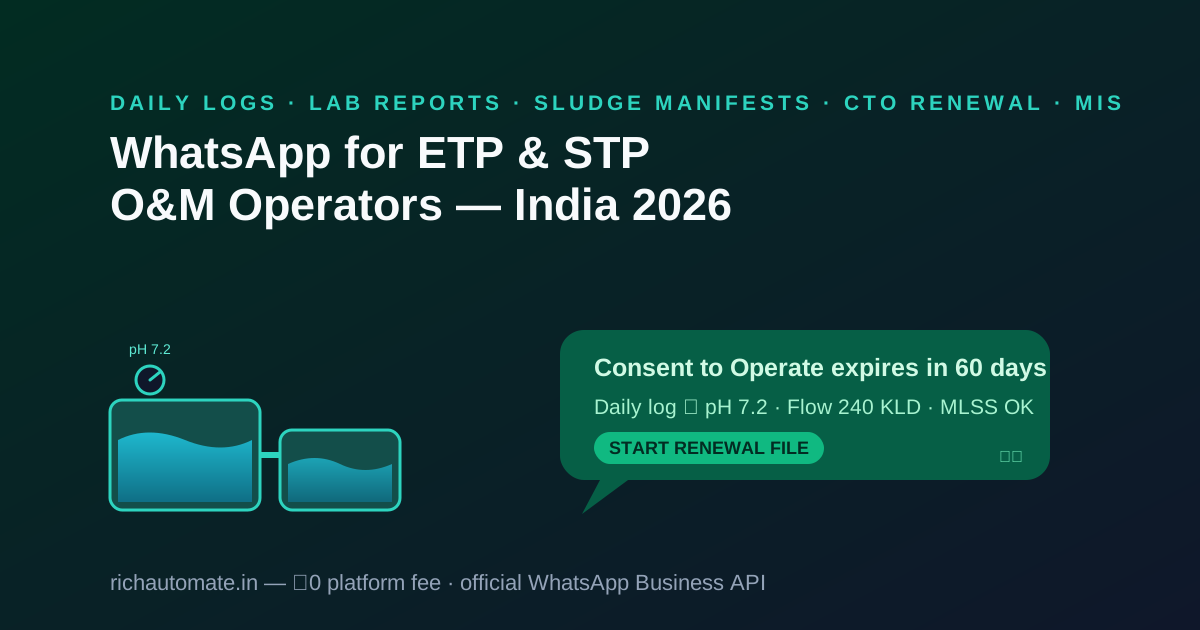
The short answer. An ETP/STP operations & maintenance company sells something unusual: it keeps its client legal. Every factory with trade effluent and every large building or township with a sewage treatment plant runs on a Consent to Operate from the state pollution control board — and that consent lives or dies on daily plant performance, logged parameters, renewal deadlines and inspection readiness. For the O&M operator, the business is a compliance calendar plus a daily evidence trail, and WhatsApp on the official Business API is the cheapest, most operator-friendly place to run both: daily log-capture Flows from plant operators (pH, TDS, BOD/COD samples, flow readings), consent-renewal countdowns (90/60/30 days), sludge-disposal photo-and-manifest threads, breakdown tickets with SLA timers, and inspection-day coordination with the whole document file already in the thread. An O&M firm running ~25 plants spends roughly ₹800-1,200/month in messages on RichAutomate's ₹0-platform model (illustrative math below). Compliance first: consents, discharge norms and monitoring mandates sit with your state PCB under CPCB frameworks, and NGT orders move the ground frequently — verify the current position for every plant category before promising anything to a client.
Textile process houses, pharma units, food processors, hotels, hospitals, malls, gated townships — everyone with a treatment plant has the same three problems: operators who forget to log, consents that expire quietly, and inspections that arrive suddenly. The O&M company that solves all three in one shared thread owns the renewal.
The 6-loop ETP/STP O&M cycle on WhatsApp
| Loop | What happens | WhatsApp job | Category |
|---|---|---|---|
| 1. Daily operations log | Operator shift readings | Log Flow: pH, flow (KLD), MLSS, DO, energy — structured entry from the operator's own phone, timestamped | Service |
| 2. Sampling + reports | Weekly/monthly lab samples | Sample-pickup confirmation + lab-report PDF into the plant thread; out-of-limit values auto-flag the engineer | Utility |
| 3. Sludge + waste | Sludge lifting, disposal manifests | Lifting photo + quantity + authorised-vendor manifest reference — the disposal audit trail builds itself | Utility |
| 4. Breakdown + spares | Blower/pump/dosing failures | One-tap breakdown ticket + SLA timer → technician dispatch + repair photo-proof + spares quote with UPI link | Utility |
| 5. Consent calendar | CTO renewal, environment statement | 90/60/30-day consent-renewal countdown + document-collection Flow + renewal-filing confirmation | Utility |
| 6. Inspection + review | PCB visit / client MIS | Inspection-day coordination + monthly MIS summary (uptime, parameter compliance, power, chemicals) to the client owner | Utility |
The consent-renewal countdown — the message that renews your contract
A lapsed Consent to Operate can stop a factory outright, and renewal needs lead time — application, fees, sometimes fresh analysis reports and site inspection. Yet in most plants the consent expiry date lives in one manager's drawer. The O&M provider who sends a 90/60/30-day countdown with a one-tap "start my renewal file" button is delivering the single most valuable message the client receives all year — and quietly proving why the AMC must never lapse. Same logic as every compliance-calendar vertical: the reminder is the retention.
Use the customer LTV calculator to work out how much a repeat customer justifies spending to keep.
Regulator spine (verify everything with your state PCB)
- Water (Prevention & Control of Pollution) Act + state PCB consents — Consent to Establish (CTE) and Consent to Operate (CTO) with category-wise validity and discharge norms; renewals need lead time. Verify current category norms and validity for each plant.
- CPCB effluent/sewage discharge standards — general + industry-specific standards; NGT orders periodically tighten norms for specific sectors and cities (verify the live position — this moves often).
- Online continuous monitoring (OCEMS) — 17-category and other notified industries need online effluent monitoring connected to CPCB/SPCB servers; calibration and uptime of those analysers is itself an O&M duty (verify applicability).
- Hazardous & Other Wastes Rules — ETP sludge from many industries is hazardous waste: authorised transporters, manifests, TSDF disposal records. Keep every manifest reference in the plant thread.
- Environment statement (Form V) — annual filing for consented units; your MIS data feeds it.
- Reuse mandates — several states/cities mandate treated-water reuse for flushing/landscaping in large buildings; log reuse volumes.
- Factories Act + confined-space safety — tank entry, H2S risk, permits-to-work; the bot schedules and documents but never authorises entry.
- DPDP Act 2023 — plant contacts, site data and commercial terms are personal/confidential data; collect with consent, share need-to-know. See the DPDP checklist.
The carve-out — what the bot must never do
The automation captures logs, reminds, escalates and files evidence. It must never certify compliance: it does not declare discharge within norms (the lab report and the environmental engineer do), does not sign the consent application (the occupier/consultant does), and never authorises confined-space entry (the permit-to-work system and a competent person do). Its job is to make sure the humans with authority walk into every inspection with the entire file — logs, lab reports, manifests, calibration records — already assembled in one scrollable thread.
Get a 1-minute BSP audit on WhatsApp
Drop your WhatsApp number — we line-item your current invoice against Meta India rates in under 60 seconds. India-hosted, DPDP-compliant.
What it costs — illustrative math on RichAutomate
An O&M firm running 25 plants: ~300 utility messages/month (consent countdowns, visit schedules, MIS summaries, payment reminders), ~700 messages riding free inside 24-hour service windows opened by operators' own daily log replies, ~50 breakdown-ticket exchanges. On Client Pay: ₹0 platform + ₹0.10/message with Meta conversation charges billed direct at cost. On SaaS Pay: ₹1.50 marketing / ₹0.50 utility all-in. Either way ≈ ₹800-1,200/month — per plant, less than one lab sample. Verify current Meta rates; workings in the cost breakdown and Client Pay vs SaaS Pay. 14-day trial, 100 free credits, ₹0 platform/setup/monthly.
One-week rollout for an O&M company
- Day 1-2: Official API on the service number; import plant list with consent-expiry and AMC-renewal dates.
- Day 3: Build the daily log Flow (pH/flow/MLSS/DO/energy) and the breakdown-ticket flow; submit reminder templates.
- Day 4: Wire the 90/60/30 consent countdown + sludge-manifest photo SOP.
- Day 5: Train plant operators — one demo per site, log entry takes under a minute.
- Day 6-7: Pilot on 5 plants, then the full book; first monthly MIS summary lands with the client owners.
Who fits which platform
RichAutomate fits the independent ETP/STP O&M company or environmental-services firm that wants the log-capture, consent-calendar and ticketing loop at ₹0 platform cost. A basic shared inbox fits a two-person outfit that only wants chat. An enterprise CPaaS with SCADA/CMMS integration fits the national utility-scale operator — at enterprise prices. Related reading: RO & water-treatment plant AMC, industrial boiler suppliers + IBR AMC (same compliance-calendar family), manufacturing & B2B distribution, and the best WhatsApp CRM guide.
One honesty line to close: no platform — ours included — can promise a ban-proof WhatsApp number; opt-in discipline and utility-first messaging protect it, the same way daily logs protect a consent. Put the plant's paperwork on autopilot. Start the 14-day free trial or see pricing.