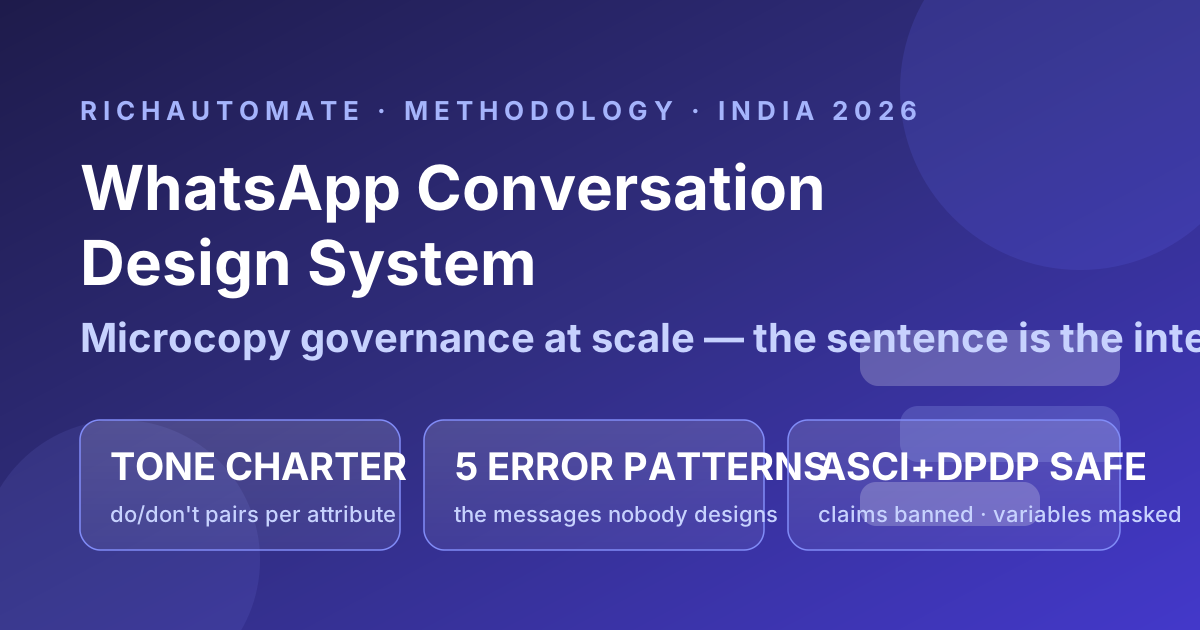
Every serious brand has a design system for pixels — a Figma library, a colour token sheet, a component spec nobody is allowed to violate. Almost none has one for sentences. Yet on WhatsApp the sentence is the interface: there is no layout, no brand colour, no hero image — just words, buttons and the occasional emoji, read in a preview pane between a family group and a delivery OTP. When you scale past ten templates, two bots and a couple of writers, ungoverned copy drifts into contradictions, compliance risk and a brand voice that changes personality mid-conversation. This guide is the playbook for building a conversation design system for WhatsApp at scale in India — tone charter, Hinglish style guide, error-message patterns, ASCI-safe claim language, DPDP-safe variables, localisation QA and a review workflow that ships copy without committee paralysis.
Why conversation copy breaks at scale
One writer, five templates, one bot: voice stays coherent by accident. Now run the realistic mid-2026 setup — five people who write customer-facing copy (a marketer, a CX lead, an agency, a founder who "just fixed one template", a support agent editing quick replies), forty-plus approved templates, three bot flows built months apart. Without a system, four failure modes show up on a schedule:
If you would rather start from something proven, the WhatsApp template library has formats you can adapt.
Voice drift. The onboarding flow says "Hey! 🎉 Super excited", the payment reminder says "Dear Customer, kindly remit". Same number, two personalities. Customers notice; they just can't name what feels off.
Factual contradictions. Template 12 promises "delivery in 2 days", template 31 (written in March by someone else) says "3–5 working days". Both are live. Support inherits the dispute.
Claim risk. A junior writer adds "guaranteed lowest price" to a festival template. Nobody with advertising-code awareness saw it before it went to 40,000 people. (More on ASCI below.)
Orphan copy. Error messages, fallbacks and opt-out confirmations were written once at launch, never reviewed, and now reference a support email that no longer exists. The messages customers see at their most frustrated moment are the least designed messages you own.
| Dimension | Ungoverned copy ops | Governed copy ops |
|---|---|---|
| Voice | Per-writer personality, drifts quarterly | Tone charter with do/don't pairs, audited per template family |
| Facts (SLA, pricing, offers) | Hard-coded per template, contradictions accumulate | Single source-of-truth sheet; copy references it, audits diff against it |
| Claims & disclosures | Whatever the writer typed | Banned-words list + disclosure patterns enforced at review gate |
| Error/fallback copy | Written once, never revisited | 5 named patterns, owned, versioned, reviewed quarterly |
| Variables & personal data | Any field a developer can pass | Allowed-variable list with masking rules (DPDP-aware) |
| Change history | "Who changed this?" → silence | Template change log with version, author, approver, date |
The conversation design system: six artefacts
A conversation design system is not a 60-page brand book. It is six short, enforceable artefacts that every writer — human or AI — must pass through.
1. Tone-of-voice charter. Pick three to five attributes and define each with a do/don't pair, because adjectives without examples are unenforceable. Example charter for a D2C brand: Warm, not gushing (do: "Glad that's sorted!" / don't: "Yayyy!! 🎉🎉 We're SO thrilled!!"); Direct, not curt (do: "Your order ships tomorrow." / don't: "Shipped tmrw."); Helpful, not pushy (do: one CTA per message / don't: three stacked offers); Honest, not hedgy (do: "This usually takes 24–48 hours" / don't: "instantly*"). The charter fits on one page or it will not be read.
2. Hinglish and vernacular style guide. For most Indian consumer brands, Hindi-in-Latin-script (Hinglish) outperforms formal Hindi in Devanagari for casual, conversational messages — it reads the way urban customers actually type. But this is segment-dependent, not universal: government-adjacent services, older demographics and Tier-3 audiences often respond better to clean Devanagari or full regional scripts, and cultural-preference claims should be validated against your own reply-rate data rather than assumed. Codify the choices: which script per audience segment; honorific policy (aap vs tum — most Indian brands should default to aap and never mix the two in one flow); transliteration spellings standardised in a glossary ("paise" not "paisa/pese" drift); festival and regional references reviewed by someone from that region, because a Diwali metaphor lands differently in Chennai. For deeper model-side vernacular work, see our guide to regional-language fine-tuning for WhatsApp bots.
3. Message-length standards. The notification preview pane shows roughly the first line of your message — the exact character count varies by device, OS and WhatsApp version, so verify current behaviour on real devices rather than trusting a fixed number. The rule that survives device drift: front-load the point. "Your refund of ₹1,240 is processed" beats "Hello! Hope you're doing well. We wanted to let you know that…". Set standards per message class: transactional ≤2 short lines; marketing ≤4 lines plus one CTA; bot replies ≤3 lines before offering buttons.
4. Button-label standards. Verb-first, outcome-specific, ≤20 characters (WhatsApp truncates longer labels — verify current limits in Meta's docs): "Track my order", "Book a slot", "Talk to a human". Ban vague labels ("Click here", "More", "Okay") and never let two buttons in one message start with the same word.
5. Emoji policy. Decide it once: which emoji are on-brand (a short allowed set beats a ban), maximum per message (one is plenty for transactional, two for marketing), never in error or payment-failure messages, never as a substitute for a word ("Your 📦 has shipped" fails screen readers and forwards badly).
6. The fact sheet. One versioned document holding every claimable fact: delivery SLAs, pricing, support hours, refund windows. Copy never invents a number; it cites the sheet. When the SLA changes, you grep templates against the sheet instead of discovering the contradiction in a customer complaint.
The five error messages everyone forgets to design
Happy-path copy gets workshopped; failure copy gets defaulted. These five messages decide whether a bad moment becomes a churn moment — design them deliberately:
| Pattern | Job of the message | Example copy |
|---|---|---|
| Didn't-understand | Take the blame, offer structure, exit to human | "Sorry, I didn't get that. You can tap an option below, or type 'agent' to talk to a person." |
| Agent-offline | Set honest expectation + capture intent | "Our team is offline right now (back 9 am IST). Leave your question here — we'll reply first thing tomorrow." |
| Window-expired | Explain the re-permission, keep it human | "It's been a while since we last chatted, so WhatsApp needs you to reply once before we can continue. Just send 'Hi' to pick up where we left off." |
| Payment-failed | Reassure, state facts, give one retry path | "That payment didn't go through — you have not been charged. Tap below to retry, or reply 'help' if the amount was deducted." |
| Opt-out confirm | Confirm instantly, no guilt, leave door open | "Done — you won't get promotional messages from us anymore. Order updates will still arrive. Reply START anytime to rejoin." |
Rule of thumb: error copy takes the blame ("I didn't get that"), never blames the user ("Invalid input"), always offers exactly one next step, and never uses an emoji or exclamation mark. A payment-failure message with a 🎉 anywhere near it is a fireable copy offence.
ASCI-safe claim language, baked in
The Advertising Standards Council of India's code applies to promotional WhatsApp messages just as it does to any ad, and 2026's tightened guidelines around dark patterns and influencer-style promotion make sloppy claim language costlier (verify the current ASCI code and guidelines — they are periodically updated). You do not want claim review happening per-template; you want it baked into the style guide as rules any writer can apply:
Get the India 2026 WhatsApp BSP price comparison
Wati vs AiSensy vs Interakt vs RichAutomate: Meta rates, platform fees and hidden costs, side by side. We send it to your WhatsApp in a minute.
Superlatives need substantiation. "India's best", "No. 1", "lowest price guaranteed" are bannable phrases unless you hold current, citable evidence. The style-guide rule: every superlative carries a source in the template's internal notes, or it doesn't ship.
Banned-word list. Maintain an explicit list: "guaranteed" (unless a written guarantee exists with terms), "free" (when conditions apply and aren't stated in the same message), "100%", "no risk", "assured returns" (a regulatory minefield in BFSI). Writers check the list before review, reviewers grep against it during review.
Disclosure patterns for offers. Every offer message states the material conditions in the message itself — validity date, minimum order, "T&C apply" with a tappable link. The pattern: offer + condition + expiry + link, in that order, every time. Consistency here is also what keeps Meta template reviewers happy; vague offer copy is a common rejection reason.
DPDP-safe variable copy
Template variables are where personal data leaks into copy without anyone deciding it should. Under the DPDP Act's purpose-limitation principle, the data appearing in a message should be necessary for that message's purpose — and your style guide should encode that as an allowed-variable list (verify current DPDP rules; operational guidance is still maturing):
Green list — first name, order ID, booking date, city, amount due: low-sensitivity, message-purpose-aligned. Mask-only list — payment instruments and identifiers appear masked or not at all: "card ending 4321", never the full number; last-4 of account numbers; never full Aadhaar/PAN in any template, masked or otherwise. Red list — health conditions, loan-rejection reasons, exam results and anything a shoulder-surfer shouldn't read in a lock-screen preview: remember the variable renders in the notification pane before the phone is even unlocked. The pattern for sensitive contexts is pointer copy: "Your report is ready — tap to view securely" instead of putting the result in the message body.
Write it as a table in your style guide: variable name → allowed in marketing? → allowed in utility? → masking rule. Five minutes of governance that prevents both a DPDP headache and the genuinely awful moment when a customer's medical context appears on a shared family phone.
Localisation QA: glossary, back-translation, native review
Scaling to three or four languages multiplies every copy risk above, and machine translation fails silently — the Hindi is grammatical but the tone is a bank circular. A lightweight localisation QA workflow has three gates: (1) Glossary first. Lock the 50–100 terms that must translate consistently — product names (often untranslated), "wallet", "cashback", "EMI", your CTA verbs — before anyone translates a full template. (2) Back-translation spot checks. For each batch, have a second translator (or a different model) translate 20% of messages back to English blind; compare against the original. You're not hunting word-for-word fidelity, you're hunting meaning drift — "delivery attempted" becoming "delivery failed" is the class of bug this catches. (3) Native-speaker review gate. A native speaker of the target language — ideally from the target region, ideally customer-facing staff who hear how customers actually phrase things — signs off before a language ships. No native reviewer available for Kannada? Then you are not ready to ship Kannada; a bad translation reads as disrespect, not effort.
The copy-review workflow: versioned approvals without paralysis
Governance dies when every emoji needs three signatures. The fix is risk-tiered gates — heavyweight review only where the risk lives:
| Change type | Brand/CX review | Legal/compliance | Ops sign-off |
|---|---|---|---|
| New marketing template (claims/offers) | Yes | Yes | Yes (send plan) |
| New utility template | Yes | Only if variables touch mask-list data | Yes |
| Copy edit, no claim/variable change | Yes | No | No |
| Bot flow copy (no template) | Yes | Only for claims/personal data | Flow owner |
| Error/fallback copy | Yes | No | Support lead |
Underneath the gates, three mechanics: a template change log (template name, version, what changed, author, approver, date — a spreadsheet is fine, the discipline matters more than the tool); a rollback rule — since Meta template edits go back through approval, keep the previous approved version's text in the log so you can resubmit it in minutes, and for bot copy keep flow versions so reverting is a click, not an archaeology dig; and staging — draft and dry-run copy in your platform before it touches customers. On RichAutomate, the template library holds your approved-template inventory in one place per WABA, and quick replies are the natural staging ground for agent-facing microcopy: standardise the twenty messages agents type daily, watch which get edited before sending, and promote the stable ones into templates.
Measuring copy: reply rate is a copy KPI
Copy quality feels subjective until you instrument it. Treat each template family (all variants of the order-update message, all variants of the win-back message) as a unit and track per family: read rate (delivery and timing problems show up here before copy does), reply/click rate (the copy KPI — did the message earn a response), opt-out rate per send (the tone alarm: a spike after a copy change is your charter being violated at scale), and "agent" / "help" trigger rate inside bot flows (confusion metric — rising didn't-understand hits mean the copy upstream is unclear). Then change copy the disciplined way: one variable at a time, adequate sample, a decision rule written before the test. The full methodology — hypothesis discipline, sample-size maths, the pairing with Meta's template categories and pacing — is in our template A/B testing playbook, and the category-classification rules that constrain what marketing vs utility copy may say are decoded in the template categories guide. Since every test variant is a paid send, keep an eye on unit economics with the WABA cost calculator — on RichAutomate's Client Pay model (₹0.10 per message, Meta's conversation charges billed direct) testing is cheap enough that "we'll test it" becomes the default answer to copy debates.
Starter kit: the one-page conversation style guide
Copy this skeleton into a doc today; fill it in a two-hour workshop with whoever writes customer-facing words:
1. Who we sound like — one sentence ("A knowledgeable friend who respects your time"), then 3–5 tone attributes, each with one do and one don't example.
2. Language & script — default language per segment; Hinglish vs Devanagari decision; aap/tum policy; glossary of 20 locked transliterations.
3. Mechanics — message length per class; button-label rules (verb-first, ≤20 chars); emoji allowed-set and per-message cap; number/date/₹ formatting.
4. Claims — banned-words list; superlative-needs-source rule; offer disclosure pattern (offer + condition + expiry + link).
5. Variables — green / mask-only / red list with masking patterns (last-4 only).
6. The five error messages — your approved didn't-understand, agent-offline, window-expired, payment-failed and opt-out texts, verbatim.
7. Process — review-gate matrix; change-log location; rollback rule; who owns this document (one name, not a committee).
One page. If it spills to three, writers will stop reading it and you're back to drift.
Govern the words, then scale the sends
RichAutomate gives your style guide a place to live operationally — a template library per WABA, quick replies for agent microcopy staging, flows for the error patterns, and analytics to make reply rate your copy KPI. Pricing is flat and public: ₹0 platform fee, ₹0 setup, ₹0 monthly. Client Pay at ₹0.10 per message with Meta's charges billed direct, or SaaS Pay at ₹1.50 marketing / ₹0.50 utility all-in. Start the 14-day free trial with 100 credits, WhatsApp us at 918160311319, or book a 30-minute walkthrough at https://richautomate.in/book/demo.
Start your 14-day free trial → · See full pricing · Run the WABA cost calculator