All articles
Healthcare

WhatsApp for Blood Banks & Donor Drives India 2026: eRaktKosh + Donor Recall + Inventory Alerts + NBTC Compliance

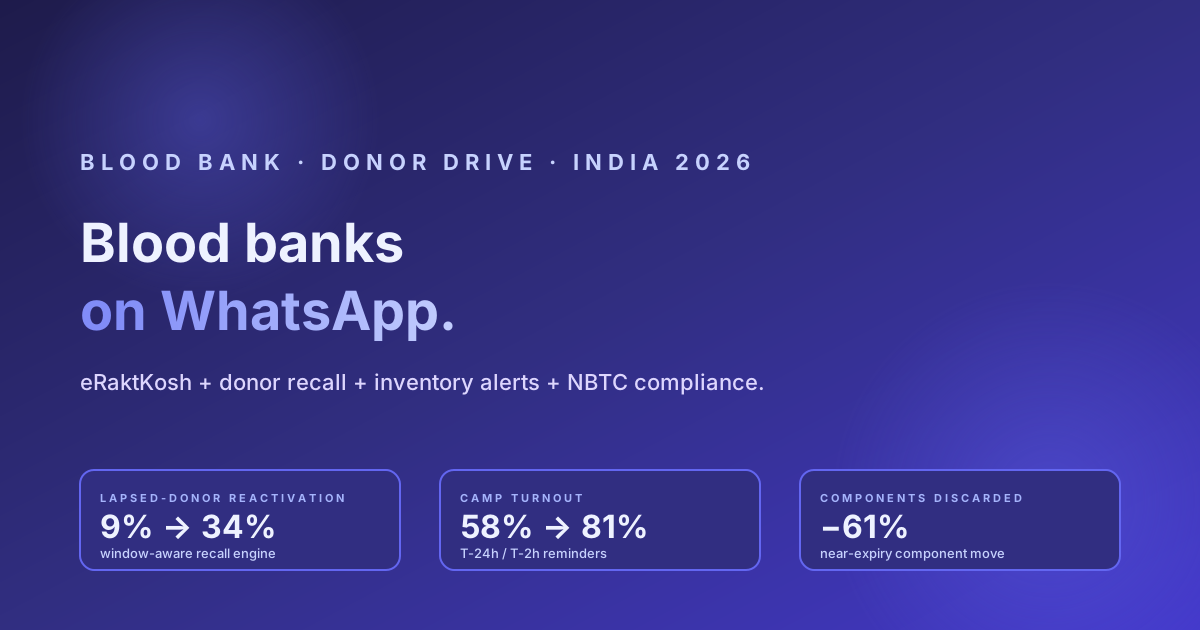
India needs roughly 1.4 crore units of blood a year across ~4,000 NBTC-licensed centres, yet donor recall, camp logistics and perishable component inventory still run on phone calls, SMS and the eRaktKosh portal alone — so surplus expires in one district while a thalassaemia child or a rare-group trauma case scrambles in the next. NACO surveys find most lapsed donors say no one asked them again. The blood centres, Red Cross chapters and NGO drive operators winning FY26 run the whole donor-and-inventory lifecycle on WhatsApp, regional-language and voice-first. This playbook covers the 9-stage blood-centre lifecycle, real 38,000-donor cohort numbers (recall read 89%, lapsed reactivation 9%->34%, camp turnout 58%->81%, repeat donation 21%->46%, components discarded -61%, O-negative stockout days 14->3), the eligibility-window recall engine, the NBTC/NACO/eRaktKosh/Drugs & Cosmetics Act/DPDP stack with TTI-result suppression, six anti-patterns and a 10-week rollout. Utility templates only.

RichAutomate Editorial
12 min read 0 views
WhatsApp for Blood Banks & Donor Drives India 2026: eRaktKosh + Donor Recall + Inventory Alerts + NBTC Compliance

India needs roughly 1.4 crore units of blood every year, and despite a registered donor base in the crores and ~4,000 licensed blood centres on the National Blood Transfusion Council (NBTC) network, most centres still run donor recall, camp logistics and component inventory on phone calls, spreadsheets and the eRaktKosh portal alone. The result is the familiar Indian blood paradox: surplus that expires unused in one district while a thalassaemia child or an accident-trauma case in the next district scrambles on social media for a rare group. The donor is willing — 68% of lapsed donors in NACO surveys say "no one asked me again" — but the follow-up never reaches them in a channel they actually open. In FY26 the blood centres, Red Cross chapters and NGO blood-drive operators closing that gap are running the entire donor-and-inventory lifecycle on WhatsApp: 95%+ open rates, eRaktKosh-aligned, in the donor's own language with voice notes for first-time and rural donors. This is the India 2026 implementation playbook for blood banks, voluntary blood-donation organisations and hospital transfusion services.

Why WhatsApp Fits the Blood Centre in 2026

  1. Donor recall is the whole game. A male whole-blood donor is eligible again in 90 days, a female in 120; a plateletpheresis donor in 48-72 hours. The centre that pings the right eligible donor at the right moment — by blood group, by location, by last-donation date — never runs dry. A missed call or an unread SMS does not recall a donor; an opened WhatsApp does.
  2. Smartphones are in, donor apps are out. Donors will not install a blood-bank app for a thrice-a-year event. WhatsApp is already open, and a voice note carries the first-time or low-literacy donor through the eligibility self-check.
  3. Camps live and die on confirmation. A corporate, college or RWA blood-donation camp budgets for 200 donors and 120 show up because the reminder never landed. A T-24h and T-2h WhatsApp confirmation with a slot picker lifts turnout and stops wasted reagent and staff.
  4. Inventory is time-critical and perishable. Red cells last ~35-42 days, platelets just 5. An O-negative shortage alert or a near-expiry component nudge to matched donors and partner hospitals moves units before they are discarded.
  5. Rare-group registries need a live channel. Bombay phenotype, Rh-null and other rare groups depend on a tiny, reachable panel. WhatsApp turns a desperate SOS into a one-tap "I can donate" from a pre-consented rare-group donor.

The 9-Stage WhatsApp Blood-Centre Lifecycle

#StageWhatsApp surfaceTemplate category
1Donor registration + blood-group + consent (eRaktKosh ID)Data-collection Flow (voice-assisted)Utility
2Pre-donation eligibility self-check (travel, meds, deferral)Screening FlowUtility
3Camp / appointment slot booking + reminderSlot-booking Flow + T-24h / T-2h reminderUtility
4Donation-day confirmation + e-donor-card + thank-youConfirmation + documentUtility
5Test result + TTI notification (HIV/HBV/HCV) handled per protocolSensitive result thread (counsel route)Utility / Service
6Eligibility-window recall (90/120 days, 48-72h apheresis)Scheduled recall nudgeUtility
7Shortage / rare-group SOS to matched panelTargeted broadcast (group + geo)Utility
8Near-expiry component move + hospital indentInventory alert + indent threadUtility
9Donor stewardship + milestone badges + grievanceRecognition + service threadUtility / Service

Every stage is Utility — blood-centre comms are operational, consented and life-safety; there are no marketing blasts, which sits cleanly inside Meta policy and NBTC voluntary-donation ethics (no inducement, no paid-donor solicitation).

Real Cohort Numbers — District Blood Centre + 3 Drive Partners, ~38,000 Donors

MetricCalls + SMS + portal baselineWhatsApp lifecycleDelta
Recall message read rate~ SMS 18%89% opened
Lapsed-donor reactivation / yr9%34%+25pp
Camp registration-to-turnout58%81%+23pp
Repeat-donation rate (2+/yr)21%46%+25pp
Components discarded at expirybaseline-61%
Rare-group SOS first-response timehoursunder 12 min
O-negative stockout days / quarter143-79%

The discard number is the mission. Every component thrown away at expiry is a donation wasted and a unit that someone, somewhere, needed. Cutting wastage 61% on a centre that issues tens of thousands of units a year is hundreds of lives of red cells and platelets redirected before the clock runs out — by nudging matched donors and partner hospitals on a channel they open in minutes, not by hoping the portal is checked in time. Reactivating lapsed donors from 9% to 34% rebuilds the panel that makes every future SOS answerable.

Stop overpaying on WhatsApp

Book a WhatsApp clinic demo

See how clinics run appointment reminders, reports, and follow-ups on WhatsApp — DPDP-compliant, India-hosted. Book a 15-minute demo.

DPDP-compliant · India-hosted · 1-min reply

Donor Recall: The Eligibility-Window Engine

  1. Window-aware timing. The recall fires exactly when the donor becomes eligible again — 90 days for male whole-blood, 120 for female, 48-72 hours for plateletpheresis — never before (which annoys) and never months late (which loses them).
  2. Group + geo targeting. An O-negative shortage pings only O-negative donors within reach of the centre or camp, not the whole list — relevance keeps the channel trusted and unblocked.
  3. One-tap intent. "I can donate Saturday" / "Not now, remind me later" — captured as a button, routed to a slot, no phone-tag.
  4. Stewardship, not just asking. An e-donor-card, a "you saved up to 3 lives" thank-you and a milestone badge at 5 / 10 / 25 donations turn a one-time donor into a lifelong panel member.
  5. Voice-first. A 20-second voice note in the donor's language carries the first-time and rural donor through eligibility and consent where an English form fails.

The Compliance + Scheme Stack (FY26)

  • NBTC / NACO standards & eRaktKosh — voluntary, non-remunerated donation only; WhatsApp drives recall and camps but never solicits paid or replacement donors, and donor + unit records reconcile to the eRaktKosh registry.
  • Drugs & Cosmetics Act + Blood Centre licensing — collection, testing, component separation and labelling stay under the licensed centre; WhatsApp is the comms layer, not a clinical record of truth.
  • TTI result handling — HIV/HBV/HCV/syphilis/malaria screening outcomes are highly sensitive; reactive results are never disclosed in plain broadcast — they route to a confidential counselling pathway per NACO protocol.
  • DPDP Act 2023 — donor PII and health/blood-group data are sensitive personal data; capture explicit consent, limit purpose to recall + safety, retain to policy, tokenise identifiers, and offer a grievance + deletion route.
  • National Blood Policy / camp norms — camp organiser eligibility, medical-officer presence and post-donation care messaging ride the Utility channel with an acknowledgement trail.

Why the channel is a safety upgrade, not just convenience. Most donor loss is not refusal — it is silence. NACO surveys repeatedly find lapsed donors saying no one asked them again, and shortages co-exist with discards because the matching never happens fast enough. A consented, group-and-geo-targeted WhatsApp layer that recalls eligible donors on time, confirms camp turnout, and moves near-expiry components before they spoil converts a willing donor base and a perishable inventory into actual transfusions — measurably (lapsed reactivation 9% to 34%, discards down 61%, O-negative stockout days 14 to 3 in the cohort) — while keeping reactive TTI results off broadcast and inside a counselling pathway.

Six Anti-Patterns That Wreck Blood-Centre WhatsApp

  1. Disclosing TTI results in a message. A reactive HIV/HBV/HCV result must never appear in a broadcast or even a plain thread — it routes to confidential counselling only. Build the suppression in.
  2. Spraying every shortage to the whole list. Untargeted SOS blasts train donors to ignore you. Target by group, geo and eligibility window.
  3. Soliciting paid or replacement donors. NBTC ethics and Meta policy both forbid inducement; keep it voluntary, non-remunerated, Utility.
  4. English-only, text-only. First-time and rural donors need the regional language and voice notes for eligibility and consent.
  5. Recall with no window logic. Asking a donor before they are eligible (or months late) burns the relationship. Time it to the 90/120-day or 48-72h window.
  6. Storing donor + health data with no policy. DPDP needs explicit consent, purpose limits, tokenised identifiers and a grievance + deletion route for sensitive blood-group and screening data.

10-Week Rollout Path

  1. Week 1-2: Map the donor + inventory lifecycle to template categories; set the DPDP consent + retention policy and the TTI-result suppression rule.
  2. Week 3-4: Donor registration + eligibility self-check Flows (voice-assisted), reconciled to eRaktKosh IDs.
  3. Week 5-6: Camp / appointment slot booking + T-24h / T-2h reminders + donation-day e-donor-card.
  4. Week 7-8: Eligibility-window recall engine (90/120-day, 48-72h apheresis) + group/geo targeting.
  5. Week 9: Shortage / rare-group SOS panel + near-expiry component move + hospital indent thread.
  6. Week 10: Donor stewardship (badges, e-card) + grievance route + DPDP audit pack + counselling-pathway test for reactive results.

Run your blood centre and donor drives on WhatsApp with RichAutomate.

Voice-assisted donor registration + eligibility self-check + camp slot booking with T-24h/T-2h reminders + donation-day e-donor-card + eligibility-window recall (90/120-day, 48-72h apheresis) + group-and-geo shortage & rare-group SOS panel + near-expiry component move + hospital indent + donor stewardship badges. Utility templates only, regional-language + voice-first, with reactive TTI results suppressed from broadcast and routed to counselling — aligned to NBTC/NACO voluntary-donation ethics, eRaktKosh, the Drugs & Cosmetics Act blood-centre licensing and DPDP. Real district-centre + drive cohort (38,000 donors): recall read 89%, lapsed reactivation 9% to 34%, camp turnout 58% to 81%, repeat donation 21% to 46%, components discarded -61%, O-negative stockout days 14 to 3. 10-week rollout. 14-day trial.

Start your blood-centre stack →

Ready to ship this?

Book a WhatsApp clinic demo

See how clinics run appointment reminders, reports, and follow-ups on WhatsApp — DPDP-compliant, India-hosted. Book a 15-minute demo.

DPDP-compliant · India-hosted · 1-min reply
Tagged
HealthcareBlood BankBlood DonationeRaktKoshNBTCNACODonor RecallDPDPIndia2026
Written by
RichAutomate Editorial
Editorial team at RichAutomate. We build the WhatsApp Business automation platform Indian D2C brands, fintechs, and agencies use to ship campaigns and flows on the official Meta Cloud API.
FAQ

Frequently asked questions

Why use WhatsApp for a blood bank instead of calls, SMS or just the eRaktKosh portal?
Donor loss in India is mostly silence, not refusal — NACO surveys repeatedly find lapsed donors saying no one asked them again. SMS recall reads at roughly 18% while WhatsApp opens at 89%, and the portal alone does not push a timely, targeted recall to the donor. A district centre plus three drive partners covering ~38,000 donors lifted lapsed-donor reactivation from 9% to 34% and camp registration-to-turnout from 58% to 81% simply by recalling eligible donors and confirming camps on a channel they actually open. eRaktKosh stays the record of truth; WhatsApp is the consented comms layer on top.
How does the eligibility-window recall engine work?
The recall fires exactly when a donor becomes eligible again — about 90 days after whole-blood donation for men, 120 days for women, and 48-72 hours for plateletpheresis — never earlier, which annoys, and never months late, which loses them. Shortage and rare-group alerts are targeted by blood group and geography, so an O-negative SOS reaches only O-negative donors within reach, keeping the channel relevant and unblocked. Donors reply with a one-tap "I can donate" that routes straight to a slot. In the cohort this cut O-negative stockout days from 14 to 3 per quarter and rare-group SOS first-response time to under 12 minutes.
Is it safe and compliant to send blood test or TTI results over WhatsApp?
Reactive transfusion-transmissible-infection results — HIV, HBV, HCV, syphilis, malaria — are never disclosed in a broadcast or even a plain message. They route to a confidential counselling pathway per NACO protocol, and the automation must suppress them from any general thread. Donor PII and blood-group data are sensitive personal data under the DPDP Act 2023, so the build requires explicit consent, purpose limited to recall and safety, tokenised identifiers, retention limits and a grievance plus deletion route. The clinical record of truth stays in the licensed centre under the Drugs and Cosmetics Act, not in WhatsApp.
Which WhatsApp template category does a blood centre use, and can it solicit donors?
Effectively all of it is Utility — registration, eligibility self-check, camp booking and reminders, e-donor-card, eligibility-window recall, shortage and rare-group SOS, near-expiry component moves and hospital indents are all operational, consented, life-safety messages. Blood-centre communication must never be a Marketing blast, and under NBTC and NACO ethics it must never solicit paid or replacement donors — only voluntary, non-remunerated donation. Keeping it Utility, voluntary, regional-language and voice-first protects both the WABA number and donor trust.
What results do blood centres and donor drives see from WhatsApp?
A district blood centre with three drive partners covering ~38,000 donors moving from calls, SMS and portal to a WhatsApp lifecycle reported: recall message read rate 89%; lapsed-donor reactivation 9% to 34% per year; camp registration-to-turnout 58% to 81%; repeat-donation rate (two or more a year) 21% to 46%; components discarded at expiry down 61%; rare-group SOS first-response under 12 minutes; and O-negative stockout days from 14 to 3 per quarter. The discard and reactivation numbers are the mission — wasted units redirected and a willing donor panel rebuilt before the clock runs out.
RichAutomate · WhatsApp BSP for India 2026

Ship WhatsApp campaigns + flows on a transparent, compliance-ready BSP.

₹0 platform fee. DPDP audit log included. Visual flow builder. Multi-tenant from day one.

Start free trial
Want this for your brand?

Get a free 24-hour BSP audit

Send us your last invoice. We line-item it against Meta's published rates and benchmark against three alternatives.

Limited Spots Available

Get a Free
Automation Audit

Stop leaving revenue on the table. Get a custom roadmap to automate your growth.

Secure & Confidential

Continue reading

All articles
Healthcare

WhatsApp for Ayushman Bharat PM-JAY India 2026: Card Distribution + ABHA Linkage + Empanelled-Hospital Routing + Cashless Pre-Auth

Ayushman Bharat PM-JAY is the world largest government-funded health-assurance scheme — about Rs 5 lakh of annual hospitalisation cover per family, 36 crore+ cards issued, 30,000+ empanelled hospitals. Yet it leaks at the human layer: eligible families that never make a card, card-holders who do not find an empanelled hospital, missed pre-authorisations, and patients wrongly charged at discharge. State Health Agencies, CSC VLEs and Arogya Mitras who actually close the loop in FY26 run the beneficiary journey on WhatsApp, regional-language and voice-first. This playbook covers the 9-stage Ayushman lifecycle, real 50,000-family district-SHA cohort numbers (eligible-to-card 43%->71%, ABHA linkage 22%->64%, pre-auth-before-payment 61%->89%, helpline calls -54%, 93% zero-bill discharge confirmations), the pre-auth status thread, the NHA/SHA/ABDM/DPDP scheme stack, six anti-patterns and a 10-week rollout. Utility templates only.

Read article
Healthcare

WhatsApp for Clinic Chains India 2026: ABDM Appointment + IRDAI Cashless + ABHA Pathway

WhatsApp for clinic chain India 2026 — ABDM appointment + ABHA Health-ID pull + IRDAI cashless 1-hour rule + NHCX submission + preventive recall across multi-branch OPD. India 1.18 lakh clinical establishments FY26 (NHA + NMC + KPMG + EY). Multi-speciality chains (Apollo Clinic 380 + Practo Care 240 + Cloudnine 180 + Pristyn 175 + Portea 160 + Tata 1mg Labs 320 + Healthians 280 + Manipal Cigna 140 + Fortis 110 + Max 95) growing 22% YoY. ABDM Sandbox 1,840 live establishments; ABHA 78 cr registrations; NHCX 38 payers + 4,200 hospitals/clinics. IRDAI Master Circular HI Jun-2024 + Mar-2025 mandates 1-hour cashless pre-auth + 3-hour discharge SLA. Broken — show-up 64%, ABHA at front desk 11%, cashless 4.8d, Rx paper 73%, preventive recall 8%, NPS 38. WhatsApp 10-stage thread + ABHA HIE-CM 12s pull + IRDAI NHCX state machine + signed Rx + preventive recall. Cohort (12-branch chain, 7.2L encounters, 22 payers, NHCX live): show-up 64% → 92% (₹19.6L chair-time), ABHA 11% → 84%, cashless 4.8d → 1.1d, Rx digital 27% → 99%, recall 8% → 31%, follow-up 31% → 89%, repeat-consult 41% → 64% (LTV +3.8x), claim-denial 18% → 4.2%, NPS 38 → 71, ₹4.6 cr annual lift. ABDM + ABHA + NHCX + IRDAI Master Circular HI + NMC Telemedicine 2020 + Clinical Establishments Act 2010 + D&C Act + IT Act Sec 5 + DPDP Sensitive PDI Sec 8 + 8-year retention + NABL compliant.

Read article
Beauty Services

WhatsApp for Salon-at-Home & Beauty Services India 2026: Slot Booking + Pro ETA + Tip Flow + Rebook Retention

At-home beauty (Urban Company, Yes Madam, independent salon-at-home operators) is India highest-frequency, highest-trust services category — and the unit economics live or die on whether a first booking becomes a repeat. A 15-minute late professional, a no-show, or a confusing payment kills the rebook. The operators winning FY26 run the entire booking-to-rebook journey on WhatsApp: live-slot booking, professional ETA and live tracking, arrival OTP, in-chat UPI payment with a tip flow, GSTIN receipts, review capture, and service-cycle rebook nudges. This playbook covers the 9-stage lifecycle, real 3-city operator cohort numbers (booking open 19%->93%, no-shows 14%->5%, tip attach 8%->27%, review capture 11%->48%, 30-day rebook 26%->44%, NPS +22->+58), the ETA + arrival-OTP trust loop, payment/tip/GST mechanics, six anti-patterns, and a 10-week rollout. Authentication + Utility templates only.

Read article
D2C

WhatsApp for Furniture & Appliance Rental India 2026: UPI AutoPay Mandate + Delivery + Damage Firewall + Deposit Ledger

India furniture-and-appliance rental market — Furlenco, Rentomojo, CityFurnish and a long tail of city operators — is recurring-billing at its core, but the lifecycle that decides margin still limps on email and unopened app push: KYC + rental-agreement e-sign, delivery and install, the UPI AutoPay mandate that must never fail silently, swap and upgrade requests, pickup damage assessment, and the deposit-refund ledger that triggers most disputes. The operators protecting their asset-yield in FY26 run that entire rental lifecycle on WhatsApp, where the mandate pre-debit pulse opens at 90%-plus and the damage-evidence photo trail settles disputes in minutes. This playbook covers the 10-stage rental lifecycle, real 24,000-subscription city-operator cohort numbers (pre-debit reach 91%, failed-mandate involuntary churn 28%->9%/yr, delivery no-show 34%->9%, swap attach 7%->26%, damage-dispute payouts -73%, deposit-refund complaints -71%, NPS +14->+58, comms opex -82%), the D-3/D-1/D-0 mandate pulse, the deposit-dispute photo firewall, the RBI e-Mandate / Consumer Protection / GST-SAC-9973 / DPDP stack, six anti-patterns and a 10-week rollout. Utility templates for the whole post-sign-up relationship.

Read article
Agritech

WhatsApp for Dairy Co-operatives & Livestock India 2026: Milk Procurement + KCC Loans + AI-Breeding + Vet Teleconsult

India is the world largest milk producer (230+ million tonnes) on the back of ~1.7 lakh village dairy co-operatives and crores of small farmers. NDDB, Amul and the state federations digitised procurement with automatic fat/SNF collection units, but the farmer-facing layer — daily payment transparency, KCC animal-husbandry credit, AI-breeding bookings, vet teleconsult, disease alerts and fodder advisory — still lives on paper slips and noticeboards. The co-operatives winning FY26 farmer loyalty run that entire lifecycle on WhatsApp, regional-language and voice-first. This playbook covers the 9-stage dairy lifecycle, real 40,000-pourer district-union cohort numbers (procurement-digest reach 91%, payment disputes -68%, farmer churn 14%->6%/yr, AI-breeding +78%, KCC uptake 19%->47%, vaccination turnout 41%->72%), the per-pour trust receipt, the KCC/PMFBY-livestock/DPDP scheme stack, six anti-patterns and a 10-week rollout. Utility templates only.

Read article
Logistics

WhatsApp for Gig Delivery Riders India 2026: eShram Onboarding + Earnings Nudges + 90-Day Retention + Labour Code Compliance

India gig/platform workforce reaches 2.35 crore by 2029-30 (NITI Aayog), up from ~77 lakh in 2020-21 — and last-mile delivery (Zomato, Swiggy, Blinkit, Zepto, Instamart) is the high-churn front line with 50-70% 30-day attrition. Acquisition is cheap; retention is brutal. The fleets winning FY26 unit economics run the entire rider lifecycle on WhatsApp: onboarding KYC, eShram + ESIC enrollment, first-order activation, daily earnings + incentive-progress digests, 30/60/90-day retention, and SOS/grievance — at 95%+ open in the rider own language. This playbook covers the 9-stage rider lifecycle, the compliance stack (Code on Social Security 2020 + eShram + Rajasthan Gig Workers Act + DPDP), real 2,400-rider cohort numbers (KYC 58%->89%, activation 64%->86%, 30-day retention 38%->61%, eShram 22%->78%, ops cost Rs540->Rs180), the earnings-transparency digest that retains, six anti-patterns, and a 10-week rollout. Authentication + Utility templates only.

Read article