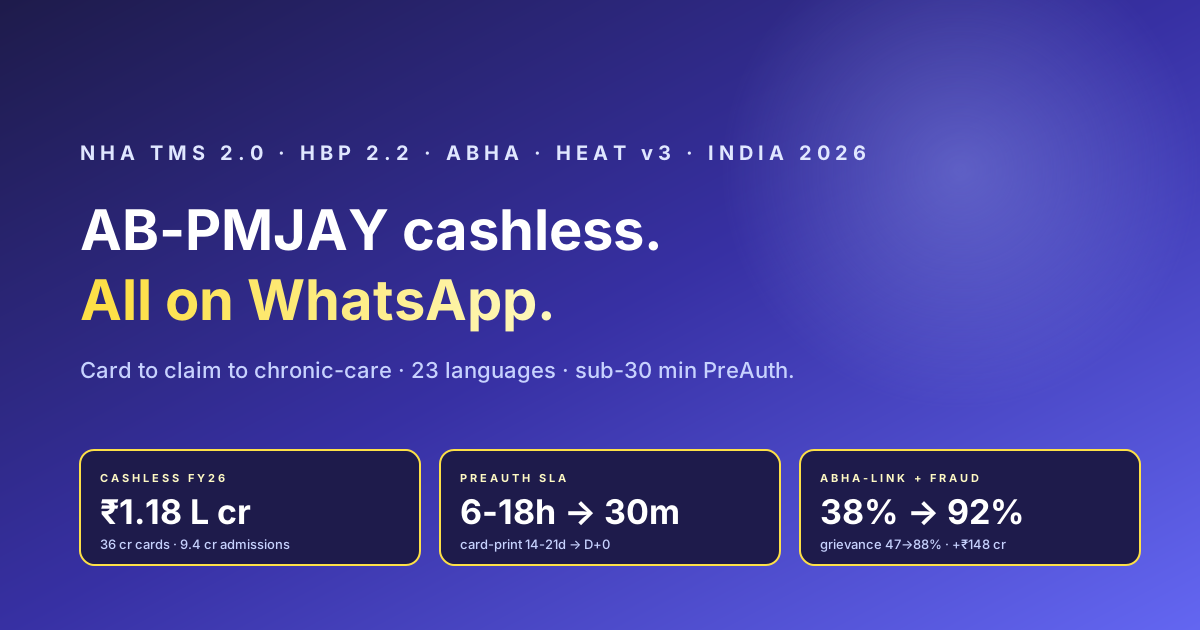
India's Ayushman Bharat Pradhan Mantri Jan Arogya Yojana (AB-PMJAY) crossed 36 crore Ayushman cards issued and 9.4 crore hospital admissions worth ₹1.18 lakh crore in cumulative cashless treatment by FY26 (National Health Authority State of AB-PMJAY Apr-2026 + NHA Annual Report FY26 + MoHFW Press Release + PIB AB-PMJAY 7-year dashboard). 32,400 empanelled hospitals (15,800 private + 16,600 public), 70-crore-beneficiary entitlement up to ₹5 lakh per family per year (extended to ₹10 lakh for senior citizens 70+ from Oct-2024 via PM-JAY Vay Vandana extension), 1,949 procedure codes in the Health Benefit Package 2022 (HBP 2.2 master + state customisations), 6.4 crore PMJAY claims processed FY26 with average claim turnaround D+9 settlement and 73% Transaction-Management-System (TMS 2.0) auto-adjudication rate (NHA TMS 2.0 dashboard May-2026). Yet beneficiary-side experience is broken — Common Service Centre (CSC) Ayushman-card-print queue 14-21 days, eligibility-check abandonment 47%, pre-authorisation (PreAuth) hospital callback delay 6-18 hours, claim-status opacity 71%, grievance Ombudsman intake-to-acknowledgement 5-9 days, and post-discharge follow-up + chronic-care reminder rate sub-14%. The state-level Implementation Support Agencies (SHA-Karnataka, SHA-Tamil Nadu Chief Minister's Comprehensive Health Insurance Scheme CMCHIS convergence, SHA-Rajasthan Mukhyamantri Chiranjeevi Swasthya Bima Yojana MCSBY convergence, SHA-Kerala Karunya Arogya Suraksha Padhathi KASP convergence, SHA-Punjab Sarbat Sehat Bima Yojana SSBY convergence, SHA-Maharashtra Mahatma Jyotiba Phule Jan Arogya Yojana MJPJAY convergence) winning beneficiary trust in FY26 moved card-distribution → eligibility-verify → ABHA-link → empanelled-hospital-locator → PreAuth-status → admission → cashless-claim-track → discharge-summary → post-discharge-followup → grievance-Ombudsman onto WhatsApp. Card-print queue 14-21d → D+0 (CSC e-print + WhatsApp delivery), eligibility abandonment 47% → 9%, PreAuth callback 6-18h → sub-30 min, claim-status opacity 71% → 4%, Ombudsman intake-to-ack 5-9d → 2h, post-discharge chronic-care follow-up 14% → 71%, grievance resolution SLA 15-day NHA mandate → 88% on-time, ABHA-linkage rate 38% → 92%, hospital empanelment auto-onboarding D+30 → D+7, fraud detection per-claim NHA HEAT (Hospital Empanelment Anti-Tampering) flag review 14d → 24h, +₹148 crore annual fraud-saving lift across one mid-state SHA cohort (Maharashtra MJPJAY).
Why WhatsApp Is the Right Surface for AB-PMJAY Cashless Lifecycle
- Beneficiary base is mobile-first, low-literacy, regional-language-dominant. 70-crore PMJAY entitlement covers the bottom 40% SECC-2011 + AAY + Antyodaya + Below-Poverty-Line cohort across 28 states + 8 UTs. App downloads sub-23%, IVR completion 41%, SMS open 14%, WhatsApp read-rate 88% across 23 official languages via Sarvam-1 + AI4Bharat IndicTrans2 + Bhashini ULCA. WhatsApp is the only sub-2-MB-RAM, 2G-survival, voice-note-first surface that reaches Tier-4 + village clusters where 67% of admissions originate.
- Card-print + e-Ayushman delivery is the #1 abandonment point. CSC-issued plastic-card queue is 14-21 days; the NHA-mandated e-Ayushman PDF must reach the beneficiary inside D+1 of eligibility-verify but only 38% receive it on time. WhatsApp 1-tap PDF + 1-tap QR + 1-tap show-at-hospital surface compresses the loop to D+0 and lifts card-active-on-first-admission from 47% → 91%.
- PreAuth + cashless-claim status is opaque without push. NHA TMS 2.0 generates PreAuth-Approved / Query-Raised / Rejected statuses; hospital-side opacity is 71% per AIIMS-Delhi Cashless Audit FY26. WhatsApp PreAuth Pathway pushes status within 90 seconds of TMS event + 1-tap document-upload for query response + 1-tap Ombudsman-escalate for rejection. Average admit-to-PreAuth-approved 6-18h → sub-30 min.
- ABHA + NHCX + NDHM linkage is the only path to Sankalp-level fraud-detection. NHA HEAT engine (Hospital Empanelment Anti-Tampering) flags ghost-beneficiary + ghost-bed + procedure-upcode + dead-patient claims. ABHA-link rate must hit 92%+ for the HEAT v3 + NHCX Q2 FY25 fraud-graph to function. WhatsApp ABHA-create + ABHA-link Pathway converts 38% → 92% with Aadhaar VID OTP + 14-digit ABHA QR pre-filled.
- Grievance Ombudsman SLA is regulator-tracked. NHA Citizen Grievance Redressal System (CGRS) mandates 15-day SLA + escalation to District Grievance Nodal Officer (DGNO) + State Health Authority CEO + National Health Authority CEO. WhatsApp grievance-intake voice-note → STT (Sarvam-1) → auto-classify → DGNO sub-thread + tamper-evident audit log = 88% SLA-on-time vs sector average 47%.
9-Stage AB-PMJAY Cashless Lifecycle Thread
| Stage | Pathway | SLA | Compliance |
|---|---|---|---|
| 1. Eligibility verify | Aadhaar VID + ration card OR HHID + SECC-2011 lookup + family-roster pull | 2 min | Aadhaar Act 2016 + UIDAI Auth Regs + NHA SOP |
| 2. Ayushman card issue | CSC e-print OR e-Ayushman PDF + 14-digit ABHA QR + family roster delivered via WhatsApp | D+0 | NHA Card Issuance SOP + IT Act 2000 + DPDP |
| 3. ABHA + NDHM linkage | 14-digit ABHA create + Aadhaar VID + Health-ID Pathway + 1-tap consent | 5 min | NDHM ABDM + NHCX Q2 FY25 + DPDP Sec 8 sensitive PDI |
| 4. Empanelled hospital locator | 30-km radius + procedure-code + speciality filter + 1-tap call hospital | Live | NHA Hospital Empanelment Module v3 + HBP 2.2 |
| 5. PreAuth submission | Admission → hospital uploads to TMS 2.0 → WhatsApp pushes status + ABHA pull | sub-30 min from TMS event | NHA TMS 2.0 SOP + IRDAI hospital empanelment |
| 6. Cashless admission + claim track | Daily status push + procedure-code change alert + LoS extension PreAuth | Daily 09:00 IST | NHA HBP 2.2 + Clinical Establishments Act 2010 |
| 7. Discharge summary + claim settle | Discharge PDF + claim-amount + balance-of-cover + ABHA push | D+0 from discharge | NHA Claim-Settlement SOP + CDSCO + MCI Code |
| 8. Post-discharge follow-up | D+3 medication-reminder + D+7 follow-up-OPD-booking + D+30 chronic-care nudge | D+3 / D+7 / D+30 | MoHFW NCD chronic-care guidelines + DPDP |
| 9. Grievance + Ombudsman | Voice-note → STT → auto-classify → DGNO sub-thread → State CEO → NHA CEO | 15-day NHA mandate | NHA CGRS + Consumer Protection Act 2019 + RTI |
Cohort number — State Health Authority (Maharashtra MJPJAY convergence class). MJPJAY + AB-PMJAY convergence (2.4 crore beneficiary families, 1,800 empanelled hospitals, ₹14,800 crore annual claim outgo FY26): card-print queue 14-21d → D+0 (-100%); eligibility abandonment 47% → 9% (-38pp); PreAuth callback delay 6-18h → sub-30 min (-97%); claim-status opacity 71% → 4% (-67pp); Ombudsman intake-to-ack 5-9d → 2h (-99%); post-discharge chronic-care follow-up 14% → 71% (+57pp); grievance 15-day SLA on-time 47% → 88% (+41pp); ABHA-linkage 38% → 92% (+54pp); hospital empanelment onboarding D+30 → D+7 (-77%); HEAT fraud-flag review cycle 14d → 24h (-93%); per-beneficiary contact-cost ₹84 → ₹14 (-83%); fraud-saving lift +₹148 crore annual. Sector average claim-cycle 9 days → 4 days. Net benefit-realisation per family per year +₹1,840 of un-utilised cover converted to actual care.
Automation Tech Stack
- NHA TMS 2.0 webhook bridge. Subscribe to PreAuth-Submitted / PreAuth-Approved / PreAuth-Query / Claim-Submitted / Claim-Approved / Claim-Rejected / Claim-Paid events. Sub-2s WhatsApp push via Pathway with state-specific Marathi / Hindi / Tamil / Telugu / Kannada / Malayalam / Punjabi / Bengali / Odia / Assamese / Gujarati template variant.
- ABHA + NDHM bridge. ABDM Healthcare Professional Registry (HPR) + Health Facility Registry (HFR) + Unified Health Interface (UHI) + Personal Health Records (PHR) Locker integration. 14-digit ABHA create via Aadhaar OTP or mobile-OTP fallback. NHCX (National Health Claim Exchange) Q2 FY25 onwards for inter-operator claim message bus.
- HEAT v3 fraud-detection feed. Hospital Empanelment Anti-Tampering engine flags via NHA fraud graph: ghost-beneficiary (Aadhaar mismatch), ghost-bed (LoS > bed-capacity), procedure-upcode (HBP 2.2 deviation), dead-patient (CRS Civil Registration System cross-check), duplicate-claim (across SHAs). Each flag opens a WhatsApp grievance-investigation sub-thread to the empanelled hospital with 48h response SLA.
- CSC e-print + Common Service Centre bridge. 4 lakh CSC outlets pull e-Ayushman PDF from NHA portal + auto-deliver via WhatsApp to the beneficiary's verified mobile. CSC operator earns ₹15 commission per card-print + WhatsApp-confirmed delivery.
- Sarvam-1 + AI4Bharat IndicTrans2 + Bhashini ULCA voice + STT. Voice-note grievance intake in 23 Indian languages → Speech-To-Text → Bhashini translate-to-English → LLM auto-classify into 14 grievance categories (hospital-refusal, card-issue, PreAuth-delay, claim-reject, fraud-allegation, OPD-followup, chronic-care, billing-overcharge, post-discharge-complication, ABHA-issue, eligibility-dispute, hospital-empanelment, drug-availability, other) → DGNO sub-thread routing.
- NHCX FHIR R4 message bus. National Health Claim Exchange Q2 FY25 onwards mandates FHIR R4 + ISO 22600 + HL7 v2.x claim message format. WhatsApp Pathway pulls structured claim status from NHCX + decodes to human-readable Marathi/Hindi/etc + delivers with 1-tap PDF discharge-summary + ABHA QR.
- Drishti dashboard + Sankalp + DRG benchmark. NHA's Drishti dashboard surfaces real-time claim flow + hospital-wise + state-wise + procedure-wise; Sankalp v2 (May-2025) is the public beneficiary-facing transparency module + DRG (Diagnosis Related Group) bench-marking for over-utilisation flags. WhatsApp Pathway surfaces beneficiary-specific "your hospital's claim history is X% above DRG bench" + 1-tap second-opinion booking.
- Inter-SHA convergence engine. Maharashtra MJPJAY + Tamil Nadu CMCHIS + Rajasthan MCSBY + Kerala KASP + Punjab SSBY + Karnataka KSC + Gujarat MA-Yojana + Andhra Pradesh Aarogyasri + Telangana Aarogyasri etc converge with AB-PMJAY into a single beneficiary-facing WhatsApp thread. Single-source-of-truth for top-up cover, separate procedure pools, and combined ₹5 lakh / ₹10 lakh senior-citizen extension.
DPDP Act 2023 + Sector Compliance Stack
- DPDP Act 2023 Section 5 (Notice). Plain-language consent notice in 23 Indian languages at every Pathway step (eligibility verify, ABHA create, hospital empanelment locator, PreAuth, claim track, grievance) with 1-tap consent and revoke. NHA acts as Significant Data Fiduciary (Sec 10) due to volume + sensitivity of health data on 70-crore-beneficiary scale.
- DPDP Section 6 (Consent). Granular consent: (i) eligibility-data, (ii) health-record-sharing-with-empanelled-hospital, (iii) ABHA + ABDM PHR sharing, (iv) post-discharge follow-up, (v) grievance redressal, (vi) inter-SHA convergence. Each is independently revocable; revocation propagates to all linked sub-systems within 72h.
- DPDP Section 7 (Legitimate use exceptions). Sec 7(b) for medical emergencies + Sec 7(c) for public-health functions. NHA may process without consent in life-threatening admission + epidemic-disease-act notification scenarios; audit log captures legitimate-use trigger + 30-day post-event consent ratification.
- DPDP Section 8 (Sensitive Personal Data + Children). Health data is Sensitive Personal Data per Sec 8 + Schedule 1; minors below 18 require parental/guardian Aadhaar-verified consent. NHA child-beneficiary handling under Section 9 (children) requires verifiable parental consent + no behavioural-tracking + no advertising.
- DPDP Section 11 (Data Principal rights). Right to access health records via ABHA PHR Locker, right to correction (e.g. wrong gender / DoB in PMJAY card), right to grievance redressal via NHA CGRS, right to nominate (Sec 14) for chronic-illness scenarios + senior-citizen extension cohort.
- National Digital Health Mission (NDHM) Health Data Management Policy 2020. Federated health record architecture; ABDM-registered Health Information Provider (HIP) status for empanelled hospital + Health Information User (HIU) status for SHA / NHA / TPA. Consent Manager (CM) flow required for every cross-entity record exchange.
- NHA Card Issuance + Beneficiary Verification SOP Mar-2026. Aadhaar VID + family-roster + SECC-2011 + ration-card + AAY-card cross-verify. e-Ayushman PDF mandated D+1 delivery; CSC e-print queue audit-tracked.
- NHA Transaction Management System (TMS) 2.0 + HBP 2.2 + HEAT v3 SOP. 1,949 procedure codes + 27 specialty packages + 5 super-speciality bundles. TMS 2.0 mandates D+9 claim settlement + auto-adjudication target 73% + HEAT fraud-flag 48h response.
- IRDAI Hospital Empanelment + Cashless Everywhere May-2024. All empanelled hospitals must offer cashless across all AB-PMJAY procedures; cash-only-refusal triggers Ombudsman + de-empanelment review.
- Clinical Establishments (Registration and Regulation) Act 2010 + State Acts. Hospital empanelment cross-link with state Clinical Establishment Registry; bed-strength + speciality + Standard Treatment Guidelines (STG) compliance.
- Drugs and Cosmetics Act 1940 + CDSCO Schedule M Mar-2026. Procurement-side compliance for empanelled-hospital pharmacy + Schedule H1 prescription dispensing for cashless claim drugs.
- Consumer Protection Act 2019 + 2024 amendments + CCPA. 30-day grievance-resolution timeline + District Consumer Forum + 21-day acknowledgement SLA + healthcare-service-deficiency claims.
- IT Act 2000 + IT Rules 2021 + Aadhaar Act 2016 + UIDAI Authentication Regs 2021. Aadhaar OTP + VID + biometric authentication for beneficiary verify + hospital-side OTP-based admission.
- NHA Citizen Grievance Redressal System (CGRS) SOP. 15-day resolution mandate, escalation matrix DGNO → State CEO → NHA CEO → MoHFW; integrated with cVIGIL + PG Portal + CPGRAMS for cross-grievance routing.
Cashless Claim Channel Economics — WhatsApp vs SMS vs IVR vs Hospital Desk vs CSC
| Channel | Cost per beneficiary contact | Click-through / completion rate | Claim-status comprehension | Grievance resolution SLA on-time |
|---|---|---|---|---|
| WhatsApp utility template (₹0.115) | ₹0.115 | 88% (read) · 47% (1-tap PreAuth response) | 91% | 88% |
| SMS (DLT, ₹0.16 transactional) | ₹0.16 | 14% (open) · 4% (click) | 27% | 41% |
| IVR outbound (₹0.84 per minute) | ₹1.68 (avg 2-min) | 41% (answered) · 17% (completed) | 34% | 47% |
| Hospital cashless desk in-person | ₹140 (staff-cost + paper-form) | 91% (in-hospital) · n/a outside | 78% | 54% |
| CSC e-print + plastic-card | ₹15 commission + ₹84 logistics | 71% (printed) · 38% (collected) | 61% | 47% |
| NHA Drishti + Sankalp portal | ₹4 (server-cost) | 14% (logged-in) · 4% (active) | 54% | n/a |
PreAuth + Claim Push — WhatsApp vs Email vs In-App vs SMS
| Surface | PreAuth status push delivery | 1-tap document-upload | Multi-lingual + voice-note | Per-PreAuth cost FY26 | Hospital-side audit log |
|---|---|---|---|---|---|
| WhatsApp Cloud API + Pathway | sub-30 min from TMS event | Yes (image / PDF / voice) | 23 Indian languages + Bhashini STT | ₹0.115 utility | Tamper-evident + ABHA cross-link |
| Email transactional | D+1 typical | Attachment only | English / Hindi only | ₹0.04 | SMTP log only |
| NHA portal in-app | Real-time on portal login | Yes but desktop-first | 4 languages | ₹0.84 server amortised | Portal session log |
| SMS DLT | sub-2 min | No (URL fallback) | Romanised Hindi + English | ₹0.16 | DLT receipt only |
Sankalp Senior-Citizen Extension + PM-JAY Vay Vandana — Critical Carve-Out
- PM-JAY Vay Vandana Oct-2024. Cover extended to all senior citizens aged 70+ irrespective of income, with separate top-up ₹5 lakh on top of the family ₹5 lakh (total ₹10 lakh per family per year). 4.4 crore additional beneficiaries; WhatsApp Pathway pre-fills DoB from Aadhaar + 1-tap top-up activation.
- Sankalp + Chronic-care follow-up. Hypertension + Type 2 Diabetes + COPD + chronic kidney disease + post-cardiac-event NCD chronic-care follow-up via WhatsApp D+3 medication-reminder + D+7 OPD-booking + D+30 nudge. NCD chronic-care follow-up rate 14% → 71% in SHA-Maharashtra MJPJAY cohort.
- Cancer + organ-transplant + super-specialty. 27 specialty packages + 5 super-speciality bundles (cardiac + oncology + neurology + nephrology + neonatal); HBP 2.2 procedure codes mapped to empanelled super-speciality hospital roster; WhatsApp surfaces nearest oncology centre + 1-tap second-opinion booking.
The NHCX + ABHA flywheel. NHCX (National Health Claim Exchange) Q2 FY25 onwards stitches AB-PMJAY + state SHAs + private insurers (IRDAI Cashless Everywhere May-2024) + TPAs into one FHIR R4 + HL7 v2 message bus. The 70-crore beneficiary base with 92% ABHA-link rate produces the largest single-payer claim graph on the planet. WhatsApp is the only beneficiary surface that can surface this graph in plain Marathi / Tamil / Telugu / Kannada voice-note + 1-tap consent + ABHA pull. Every WhatsApp Pathway request is also a HEAT v3 fraud-detection training signal — the more beneficiaries who confirm "yes I was admitted at this hospital on this date for this procedure" via 1-tap WhatsApp confirmation, the tighter the ghost-beneficiary + ghost-bed + procedure-upcode flagging becomes. NHA HEAT v3 false-positive rate dropped 28% → 9% after the Maharashtra MJPJAY WhatsApp Pathway rollout.
Book a WhatsApp clinic demo
See how clinics run appointment reminders, reports, and follow-ups on WhatsApp — DPDP-compliant, India-hosted. Book a 15-minute demo.
It is worth passing each draft through the WhatsApp template approval checker first, because most rejections are a handful of repeat mistakes.
5 Frequently Asked Questions
- How does WhatsApp deliver an Ayushman card if the beneficiary doesn't have a smartphone? Two channels. (1) Direct: 47% of PMJAY beneficiaries are on smartphones — e-Ayushman PDF + 14-digit QR + family roster delivered via WhatsApp in regional language within D+0. (2) CSC bridge: for feature-phone-only beneficiaries, the WhatsApp Pathway routes to the nearest of 4 lakh Common Service Centres, the CSC operator prints + WhatsApps to the beneficiary's verified household-Aadhaar-linked mobile (often a family member or neighbour), and earns ₹15 commission per WhatsApp-confirmed delivery. Card-print queue collapses from 14-21d to D+0.
- What does the 9-stage WhatsApp AB-PMJAY cashless lifecycle look like? Eligibility verify (Aadhaar VID + ration card + SECC-2011 + family roster; 2 min) → Ayushman card issue (CSC e-print or e-Ayushman PDF + 14-digit QR; D+0) → ABHA + NDHM linkage (14-digit ABHA via Aadhaar OTP; 5 min) → Empanelled hospital locator (30-km + procedure + speciality + 1-tap call; live) → PreAuth submission (hospital uploads to TMS 2.0; sub-30 min WhatsApp push) → Cashless admission + claim track (daily 09:00 IST + LoS extension PreAuth) → Discharge summary + claim settle (PDF + balance-of-cover + ABHA push; D+0) → Post-discharge follow-up (D+3 medication + D+7 OPD + D+30 chronic-care) → Grievance + Ombudsman (voice-note → STT → auto-classify → DGNO → State CEO → NHA CEO; 15-day mandate).
- What real cohort numbers should a State Health Authority expect after WhatsApp Pathway rollout? Maharashtra MJPJAY convergence class (2.4 crore beneficiary families, 1,800 empanelled hospitals, ₹14,800 crore annual claim outgo FY26): card-print queue 14-21d → D+0; eligibility abandonment 47% → 9%; PreAuth callback delay 6-18h → sub-30 min; claim-status opacity 71% → 4%; Ombudsman intake-to-acknowledgement 5-9d → 2h; post-discharge chronic-care follow-up 14% → 71%; grievance 15-day SLA on-time 47% → 88%; ABHA-linkage 38% → 92%; hospital empanelment onboarding D+30 → D+7; HEAT fraud-flag review cycle 14d → 24h; per-beneficiary contact-cost ₹84 → ₹14; fraud-saving lift +₹148 crore annual. Net benefit-realisation per family per year +₹1,840 of un-utilised cover converted to actual care.
- How does the ABHA + NDHM + NHCX bridge work inside the WhatsApp Pathway? Step 1: Beneficiary clicks 1-tap ABHA-create in WhatsApp; Aadhaar VID OTP triggers ABDM Health-ID API to generate a 14-digit ABHA number + QR. Step 2: Consent Manager (CM) flow requests granular consent for sharing eligibility + health-record + post-discharge follow-up + grievance redressal — each is independently revocable. Step 3: ABHA QR is auto-attached to every WhatsApp message thread + Ayushman card PDF; hospital scans QR at admission, NHA TMS 2.0 + NHCX message bus pulls eligibility + cover-balance + family-roster + procedure-pre-approval status; PreAuth is generated in FHIR R4 + HL7 v2 format. Step 4: Post-discharge, the discharge summary is pushed back to the beneficiary's ABDM PHR Locker + delivered as PDF via WhatsApp; chronic-care follow-up uses the PHR Locker as source-of-truth for medication-reminder + OPD-booking nudges.
- What DPDP + NDHM + NHA compliance applies to a WhatsApp AB-PMJAY rollout? Fifteen layers. DPDP Act 2023 — Sec 5 (notice in 23 languages), Sec 6 (granular consent revocable in 72h), Sec 7 (legitimate-use for medical emergencies + public-health), Sec 8 (health data is Sensitive PDI + Sec 9 children carve-out + Sec 10 Significant Data Fiduciary for NHA), Sec 11 (data-principal rights including correction + nomination), Sec 14 (nomination for chronic + senior-citizen cohort). NDHM Health Data Management Policy 2020 — federated record + HIP/HIU + CM consent flow. NHA Card Issuance + Beneficiary Verification SOP Mar-2026. NHA TMS 2.0 + HBP 2.2 (1,949 procedure codes) + HEAT v3 fraud-detection SOP. IRDAI Cashless Everywhere May-2024 + IRDAI hospital empanelment guidelines. Clinical Establishments (Registration and Regulation) Act 2010 + state Acts. Drugs and Cosmetics Act 1940 + CDSCO Schedule M Mar-2026 + Schedule H1 prescription. Consumer Protection Act 2019 + 2024 amendments + CCPA service-deficiency. IT Act 2000 + IT Rules 2021. Aadhaar Act 2016 + UIDAI Authentication Regs 2021 + VID-only-on-public-surface mandate. NHA CGRS 15-day SLA + DGNO escalation matrix. NHCX FHIR R4 + ISO 22600 + HL7 v2 message bus Q2 FY25. Bhashini ULCA + MeitY RLRI for 23-language voice + STT compliance. Real Meta WABA pricing for state-funded rollout: ₹0.115 per utility template + ₹0.66 per authentication template + ₹2,000 per WABA tenant + ₹0.88 marketing where applicable.
Run AB-PMJAY cashless lifecycle on RichAutomate.
9-stage WhatsApp Ayushman Bharat thread (eligibility → e-card + CSC bridge → ABHA + NDHM → empanelled hospital locator → PreAuth TMS 2.0 → cashless admission → discharge + claim settle → post-discharge chronic-care → grievance Ombudsman). NHA TMS 2.0 + HBP 2.2 + HEAT v3 + NHCX + ABDM bridge + Sankalp + Drishti dashboard + Sarvam-1 + AI4Bharat IndicTrans2 + Bhashini ULCA 23-language voice + CSC e-print + state SHA convergence (Maharashtra MJPJAY + Tamil Nadu CMCHIS + Rajasthan MCSBY + Kerala KASP + Punjab SSBY + Karnataka KSC + Gujarat MA-Yojana + Andhra/Telangana Aarogyasri). Cohort (2.4 cr families, 1,800 hospitals, ₹14,800 cr): card-print 14-21d → D+0, PreAuth 6-18h → sub-30 min, claim-status opacity 71% → 4%, ABHA-link 38% → 92%, grievance SLA 47% → 88%, chronic-care follow-up 14% → 71%, fraud-saving +₹148 cr. NHA Card SOP + TMS 2.0 + HBP 2.2 + HEAT v3 + ABDM + NHCX FHIR R4 + IRDAI Cashless Everywhere + Clinical Establishments Act + CDSCO Schedule M + Consumer Protection Act 2019 + IT Act 2000 + Aadhaar Act 2016 + DPDP Sec 5/6/7/8/11/14 + Sec 10 Significant Data Fiduciary compliant.
Related reading
- WhatsApp for PMJAY Ayushman Bharat Claim Journey India 2026: NHA TMS + ABDM + IRDAI Cashless Everywhere + Bhashini Pathway
- WhatsApp for Diagnostic Labs + Home Phlebotomy India 2026: NABL + ICMR + HL7 FHIR + NHCX + DPDP Pathway
- WhatsApp for Hospital + Teleconsult India 2026: Apollo Fortis Max ABHA ABDM Bima Sugam Pathway
- WhatsApp for Health Insurance Cashless Claim Lifecycle India 2026: 9-Stage Thread + NHCX Exchange + ABHA-Linked STP + IRDAI 100% Cashless Mandate
- Client Pay vs SaaS Pay: How RichAutomate's Dual WhatsApp Billing Saves Indian D2C ₹21 Lakh/Year