India runs one of the largest road-passenger movements on earth: an estimated 2.3 lakh-plus private intercity buses plus the State Road Transport Undertakings (SRTUs) together move well over 6 crore passengers every single day (MoRTH Road Transport Year Book + ASRTU directional estimates, FY26). The online intercity bus-ticketing market — RedBus, AbhiBus, Paytm Travel, MakeMyTrip and the new-age sleeper-coach operators like Zingbus, IntrCity SmartBus, NueGo and FreshBus — is now a roughly ₹14,000-15,000 crore annual gross-bookings business and still only ~30-35% digitised, which means the largest slice of intercity travel is still booked at counters, by phone, and through neighbourhood agents. The operational reality is messy: a passenger books online but the boarding point changes; the bus is running 40 minutes late and nobody told them; the PNR is buried in an email they never open; the refund for a cancelled service takes a week and three phone calls. Every one of those failure points is a WhatsApp message that never got sent. The operators winning the 2026 retention war — direct bus operators and aggregators alike — are wiring the entire journey onto WhatsApp: booking confirmation with live PNR, boarding-point pin with a live ETA thread, a "bus is 2 stops away" nudge, on-trip support, and a post-trip rating that feeds the next-trip offer. This guide is the 2026 implementation playbook for Indian intercity bus operators, sleeper-coach brands and ticketing aggregators — market sizing, the MoRTH + AITP + GST regulatory landscape, an 8-stage WhatsApp journey lifecycle, the automation tech stack, two comparison tables, an illustrative operator cohort, and a DPDP carve-out for location and traveller data.
Why WhatsApp Is the Right Spine for Intercity Bus Travel in 2026
Five structural reasons the intercity bus journey belongs on WhatsApp rather than an app inbox or SMS:
- The passenger base is WhatsApp-native, not app-native. Intercity bus travellers skew Tier-2/3, migrant-worker, student and family-visit cohorts. Asking a once-a-quarter traveller to install and keep an operator app is a losing battle; the booking confirmation, boarding pin and delay alert all land in a thread they already check dozens of times a day.
- SMS is dying as a transactional channel. DLT-registered SMS still works for OTP, but rich boarding directions, live-location pins, seat maps and one-tap reschedule cannot live in 160 characters. WhatsApp templates carry the map, the PNR, the buttons and the live ETA in one place.
- Boarding-point ambiguity is the #1 complaint. Intercity boarding points are often an unmarked spot under a flyover or outside a tea stall, not a terminal. A WhatsApp pin-drop plus a "your bus is 2 stops away" nudge converts the single biggest cause of missed buses into a solved problem.
- Refund and reschedule friction kills repeat bookings. The week-long refund call-chain is why travellers churn back to counters. A one-tap reschedule or instant UPI refund inside the same thread is the cheapest retention lever an operator has.
- The economics favour conversation over per-seat SaaS. A bus operator running 40 coaches does not want a per-seat software bill. RichAutomate runs at a ₹0 platform fee with pay-per-conversation pricing, which fits the thin-margin, high-volume reality of the bus business far better than seat-licensed tooling.
How Big Is the Intercity Bus Market in India?
Directional FY26 sizing, hedged where exact public figures are not available:
- Fleet + ridership. India operates an estimated 2.3 lakh-plus private intercity/contract-carriage buses in addition to the ~1.5 lakh SRTU fleet across roughly 56 state undertakings; combined daily ridership comfortably exceeds 6-7 crore passengers (MoRTH + ASRTU directional estimates).
- Online bookings. The online intercity bus-ticketing GMV is in the ₹14,000-15,000 crore/year range and growing double-digits, led by RedBus (the clear category leader), AbhiBus (an Ixigo company), Paytm Travel and MakeMyTrip, with new-age first-party sleeper brands (Zingbus, IntrCity SmartBus, NueGo, FreshBus) building direct demand.
- Digitisation headroom. Only ~30-35% of intercity bus tickets are booked online; the remaining ~65% flow through counters, phone and agents — the exact cohort WhatsApp can re-capture as a direct channel.
- Electric long-distance. NueGo (GreenCell Mobility) and others are scaling intercity electric coaches; charging-stop ETAs and range-anxiety messaging become a genuine WhatsApp use-case as the EV intercity fleet grows.
Why the offline 65% is the prize. The booked-online traveller already gets some confirmation. The real margin is in the counter-and-agent majority: a QR or a "Hi" to a WhatsApp number at the boarding point captures the traveller as a first-party contact, and from then on every future trip can be booked, reminded and re-sold inside the thread — bypassing aggregator take-rates on repeat journeys. That is the structural reason direct operators are moving fastest.
Who Regulates Intercity Bus Operations in India?
An intercity bus operator or aggregator digitising on WhatsApp sits inside this regulatory landscape:
- MoRTH + the Motor Vehicles Act 1988 (as amended 2019). The umbrella law for permits, fitness, driver licensing and passenger safety; the 2019 amendment sharpened penalties and enabled aggregator guidelines.
- All-India Tourist Permit (AITP) Rules 2021/2023. The single nationwide tourist-permit regime that lets contract-carriage buses operate across state lines on a uniform fee, replacing the old state-by-state counter-signature mess — central to how aggregator and sleeper-coach networks run interstate.
- State RTOs + State Transport Authorities. Stage-carriage vs contract-carriage permits, route permissions, and timing approvals are still administered at the state level even under AITP.
- CMVR / fitness + speed-governor + VLTD mandate. Central Motor Vehicle Rules require fitness certificates, speed governors and AIS-140 Vehicle Location Tracking Device (VLTD) plus panic buttons on public-service vehicles — the same GPS feed that powers a live WhatsApp ETA.
- GST on bus tickets. Non-AC stage-carriage is broadly exempt; AC contract-carriage / tourist-coach tickets attract 5% GST (without full ITC). The fare breakup on a WhatsApp confirmation must show the GST line correctly.
- Consumer Protection (E-Commerce) Rules 2020 + CPA 2019. Aggregators must show fare transparency, cancellation/refund terms and grievance-officer details — all of which can be surfaced and confirmed inside the WhatsApp thread.
- DPDP Act 2023. Passenger name, phone, boarding location, live-location during the trip and co-traveller details are personal data; consent, purpose limitation and retention limits apply (see the carve-out below).
The 8-Stage WhatsApp Journey Lifecycle
The full intercity bus journey maps cleanly to eight WhatsApp stages. Each names the surface (template, Flow, or AI Pathway) the operator should use.
| # | Stage | WhatsApp surface | What happens |
|---|---|---|---|
| 1 | Search + book (or rescue an abandoned cart) | CTWA ad + Flow + Utility template | Traveller taps a click-to-WhatsApp ad or messages "Hi"; a Flow collects route, date and seat preference; abandoned-cart nudge fires at +30 min with the held fare. |
| 2 | Booking confirmed + PNR | Utility template | Instant confirmation with PNR, seat number(s), fare breakup incl. 5% GST line, boarding point and a "view ticket" button — no email-digging required. |
| 3 | Pre-departure reminder | Utility template (scheduled) | A D-1 and a T-3h reminder with the boarding-point map pin, reporting time, operator helpline and a one-tap reschedule/cancel link. |
| 4 | Boarding-point live ETA | AI Pathway + live-location | From the AIS-140 GPS feed: "Your bus is 2 stops / ~8 min away" plus a live pin; resolves the single biggest cause of missed buses. |
| 5 | On-trip support + safety | AI Pathway + bot-to-human handoff | In-thread answers for AC/charging-stop/washroom-halt/ETA questions; an SOS/escalation path to the control room; for EV coaches, charging-stop and revised-ETA nudges. |
| 6 | Arrival + drop-point | Utility template | "Arriving in ~15 min at |
| 7 | Post-trip rating + invoice | Utility template + buttons | A 1-tap star rating, a detractor-recovery Flow for low scores, and the GST tax-invoice PDF delivered in-thread. |
| 8 | Re-book + loyalty | Marketing template (opted-in) | Route-aware re-engagement ("Travelling back this weekend?"), festival-rush early-booking nudges, and a loyalty/referral offer — booked directly, bypassing repeat aggregator take-rate. |
What Goes Into the Automation Tech Stack?
The stack that makes the 8 stages run reliably at fleet scale:
Get the India 2026 WhatsApp BSP price comparison
Wati vs AiSensy vs Interakt vs RichAutomate: Meta rates, platform fees and hidden costs, side by side. We send it to your WhatsApp in a minute.
- Reservation / inventory engine. The operator's own system or an aggregator API (RedBus Seat Seller / Bitla / Eka.io / TicketSimply style platforms) is the source of truth for seats, PNRs and fares. WhatsApp templates are populated from it via webhook.
- AIS-140 VLTD + GPS telematics. The mandated vehicle-location device feed (and panic button) drives the live-ETA Pathway — the same compliance hardware doubles as the customer-experience signal.
- WhatsApp orchestration. RichAutomate AI Pathway + template engine + scheduler: tier-tags messages (booking/reminder/ETA = utility; re-book = marketing), schedules D-1 and T-3h reminders, and runs the boarding-ETA loop.
- Payments + refunds. Razorpay / UPI deep-links for fare collection at booking, AutoPay-style holds for premium seats, and instant UPI refunds on cancellation inside the thread.
- Maps + live-location. Google Maps / MapmyIndia (Mappls) for boarding/drop pins and the "2 stops away" computation off the GPS feed.
- Regional language. Sarvam / AI4Bharat IndicTrans2 / Bhashini for Hindi + 10-22 regional languages — essential for the Tier-2/3 and migrant cohorts who dominate intercity ridership.
- CRM + analytics. Per-route, per-operator cohorting; on-time-performance and CSAT dashboards; abandoned-cart and re-book attribution.
Aggregator-Booked vs Direct-on-WhatsApp: The Channel Math
| Dimension | Aggregator-only booking | WhatsApp direct layer |
|---|---|---|
| First-party contact captured | Often held by the aggregator | Operator owns the WhatsApp opt-in |
| Repeat-booking take-rate | Commission on every repeat trip | Re-book in-thread; commission avoided on direct repeats |
| Boarding-point clarity | Static text in app/email | Live pin + "2 stops away" ETA |
| Delay communication | Inconsistent push/SMS | Proactive AI Pathway nudge from GPS |
| Refund/reschedule | App flow + support queue | One-tap in the same thread |
| Regional language | Limited | Native via Sarvam/AI4Bharat/Bhashini |
| Cost model | Per-booking commission | ₹0 platform fee + pay-per-conversation |
This is a contrast in channel economics, not a knock on aggregators — RedBus, AbhiBus, Paytm Travel and MakeMyTrip drive enormous top-of-funnel demand that most operators cannot replace. The smart play is to keep aggregator discovery for new travellers and use the WhatsApp layer to retain and re-sell to the ones you have already carried.
What Does an Operator Realistically Get? An Illustrative Cohort
Directional figures from an illustrative mid-size operator profile — a 40-coach interstate sleeper brand carrying ~4,500 passengers/week — not guaranteed outcomes:
| Metric | Before WhatsApp layer | After | Delta |
|---|---|---|---|
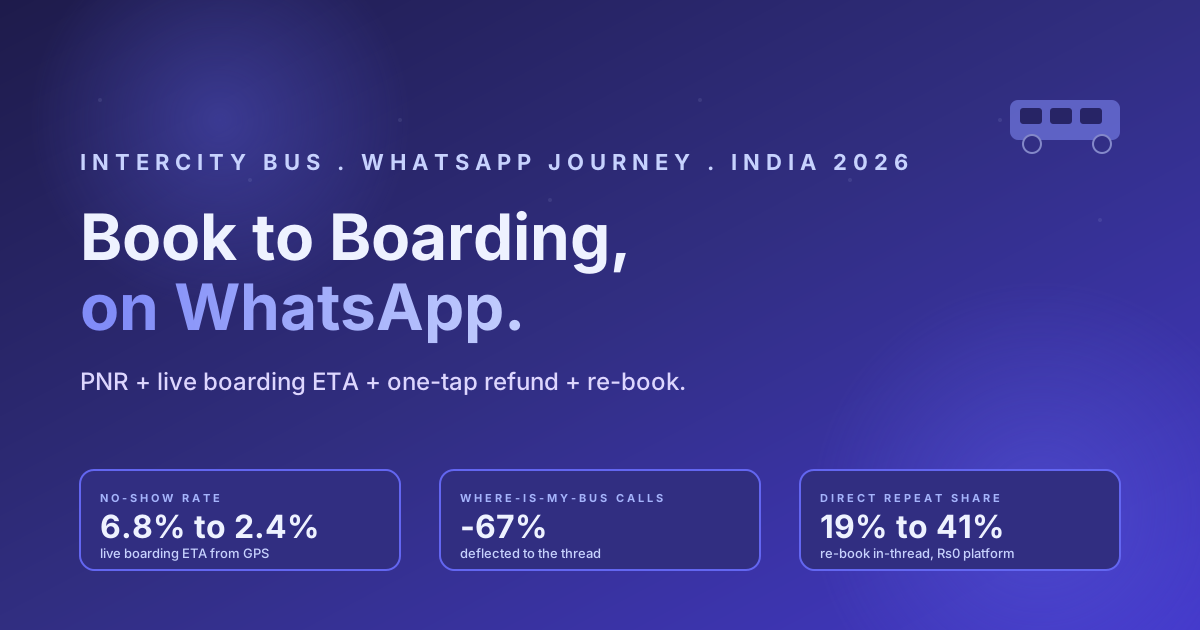
| Missed-boarding / no-show rate | 6.8% | 2.4% | -4.4pp |
| "Where is my bus?" inbound calls / day | ~210 | ~70 | -67% |
| Boarding-point complaints / week | 48 | 9 | -81% |
| Refund resolution time | 5-7 days | Same-day (UPI) | — |
| Direct repeat-booking share | 19% | 41% | +22pp |
| Post-trip rating capture rate | 7% | 38% | +31pp |
| Avg CSAT (n≈1.2k/quarter) | 3.4 / 5 | 4.3 / 5 | +0.9 |
The single biggest lever is the boarding-ETA loop. Across this illustrative cohort, the "your bus is 2 stops away" nudge plus the live boarding pin accounts for the majority of both the no-show reduction and the call-volume drop. It costs a single utility-template conversation per passenger per trip and removes the most expensive, most reputation-damaging failure in the entire journey — the traveller who reaches the wrong spot and watches the bus leave.
How Does DPDP Apply to Bus Traveller + Location Data?
Under the Digital Personal Data Protection Act 2023, an intercity bus operator is a Data Fiduciary handling clearly personal data — passenger name, phone, boarding/drop location, co-traveller details, and, most sensitively, live location during the trip. The carve-out for a WhatsApp journey layer:
- Consent at opt-in. Capture a timestamped consent when the traveller first messages or scans the QR — separated into transactional (booking/PNR/ETA, which is service-necessary) and marketing (re-book offers, which needs explicit opt-in).
- Purpose limitation on live location. Trip live-location is used only to compute boarding/drop ETA and for the duration of the journey; it is not retained as a movement history after the trip closes.
- Retention limits. PNR and trip records kept for the statutory/tax window (GST invoices), then minimised; raw GPS pings purged on a short cycle.
- Co-traveller data. When one booker provides multiple passenger names, that is third-party personal data — collect only what the ticket requires and do not market to co-travellers without their own consent.
- Grievance + erasure. A DPDP grievance path and a data-erasure request handler surfaced inside the same WhatsApp thread, with a named grievance officer per the Consumer Protection e-commerce rules.
- Processor terms. The BSP/aggregator and the maps/telematics vendors are data processors; contracts must bind them to the same purpose and retention limits.
Six Anti-Patterns That Wreck a Bus-Travel WhatsApp Layer
- Sending the PNR and then going silent. The confirmation is table-stakes; the retention is in the boarding ETA and the delay nudge. Operators who send only the booking template leave the hardest problems unsolved.
- Marketing templates dressed as utility. Pushing a re-book offer inside a "utility" reminder breaks Meta category rules and risks quality-rating damage. Keep booking/PNR/ETA as utility and re-book offers as opted-in marketing.
- Ignoring the offline 65%. Wiring WhatsApp only for online bookings misses the counter-and-agent majority. A QR at the boarding point that captures a "Hi" is the cheapest first-party acquisition available.
- One language for a multilingual base. Sending Hindi/English only to a Tamil, Kannada or Bengali traveller tanks comprehension and CSAT. Wire Sarvam/AI4Bharat/Bhashini from day one.
- Retaining trip GPS forever. Keeping raw movement history past the journey is a DPDP purpose-limitation breach. Purge raw pings on a short cycle.
- No human handoff for SOS. A safety or breakdown message must escalate to a live control-room agent in seconds, not loop inside a bot. Wire bot-to-human handoff on safety intents explicitly.
12-Week Rollout Path
- Week 1-2: Wire the reservation/inventory webhook and the AIS-140 GPS feed; get the green-tick WABA and submit the core utility templates (booking, reminder, arrival, invoice).
- Week 3-4: Build the booking Flow + abandoned-cart nudge; light up the PNR confirmation and D-1 / T-3h reminders with boarding pins.
- Week 5-6: Ship the boarding-ETA Pathway off the GPS feed ("2 stops away" + live pin) and the arrival/drop template — the highest-ROI stage.
- Week 7-8: Wire payments + instant-UPI refund + one-tap reschedule; add the on-trip support Pathway with bot-to-human handoff on SOS.
- Week 9-10: Add regional-language routing (Sarvam/AI4Bharat/Bhashini), post-trip rating + detractor-recovery Flow, and GST invoice delivery.
- Week 11-12: Turn on opted-in re-book + loyalty/referral marketing templates and the per-route CSAT/on-time-performance dashboard; bake in the DPDP consent + retention + grievance handlers.
Run the whole bus journey on WhatsApp with RichAutomate.
Booking + PNR with the GST fare breakup, scheduled D-1 and T-3h reminders with boarding-point pins, a live "your bus is 2 stops away" ETA Pathway off your AIS-140 GPS feed, one-tap reschedule and instant-UPI refunds, on-trip support with SOS bot-to-human handoff, GST tax-invoice delivery, and opted-in re-book + loyalty — all in Hindi + 10-22 regional languages via Sarvam/AI4Bharat/Bhashini. MoRTH + AITP + CMVR/AIS-140 + GST 5% + Consumer Protection e-commerce + DPDP Act 2023 compliant. Illustrative 40-coach operator cohort: no-shows 6.8%→2.4%, "where is my bus?" calls -67%, boarding complaints -81%, direct repeat-booking share 19%→41%, CSAT 3.4→4.3. ₹0 platform fee · Client Pay ₹0.10/message · SaaS Pay ₹1.50 marketing / ₹0.50 utility-auth · 14-day trial with 100 free credits. 12-week rollout.
Rail and air partners can reuse the same pattern; see these delay and cancellation message templates that include bus and train variants.