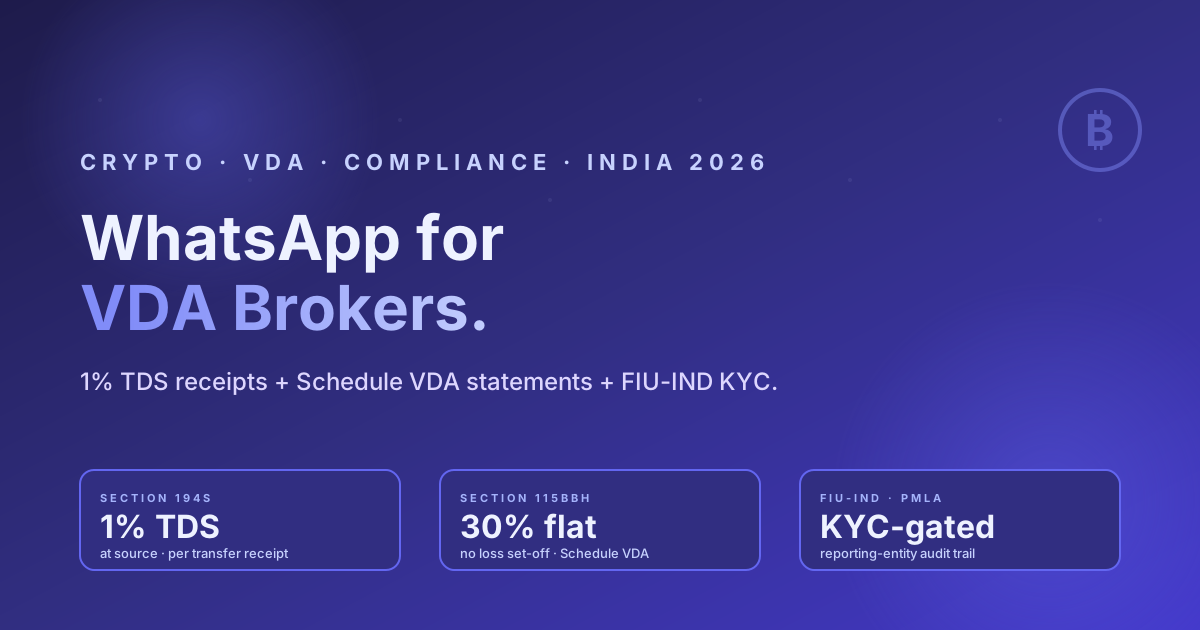
India crossed an estimated 10.7 crore Virtual Digital Asset (VDA) holders in FY26 — the largest crypto user base on the planet by headcount (Chainalysis Global Crypto Adoption Index 2025 + industry estimates) — yet the regulatory and tax regime is the most punishing of any large market. Section 115BBH levies a flat 30% tax on every rupee of VDA gain with no loss set-off, no carry-forward, and no deduction except cost of acquisition. Section 194S forces a 1% TDS deduction at source on every transfer above the threshold. Since the 7 March 2023 PMLA notification, every VDA Service Provider (VASP) is a "reporting entity" answerable to FIU-IND — appoint a Principal Officer, register, run PMLA-grade KYC, and file STRs/CTRs or face the ₹18.82 crore Binance-style penalty. After the July 2024 WazirX breach (~$230M) trust collapsed, and offshore exchanges were show-caused and forced to register or exit. In this environment a VDA broker or exchange cannot use WhatsApp the way a D2C brand does — Meta prohibits crypto solicitation in marketing templates, so the channel is strictly utility + authentication + service: KYC nudges, 1% TDS receipts, Schedule VDA tax statements, security alerts, and grievance redressal. Done right, WhatsApp becomes the compliance + trust spine of an Indian VDA business. This is the 2026 implementation playbook: the full VDA tax stack, 1% TDS mechanics on-exchange vs P2P, a 9-stage WhatsApp lifecycle, the FIU-IND/PMLA carve-out, real broker cohort numbers, six anti-patterns, and the template-category matrix that keeps you inside Meta + Indian law.
Why WhatsApp Matters for Indian VDA Brokers in 2026
Five structural reasons the channel moved from "nice to have" to compliance infrastructure:
- The 1% TDS receipt is a legal artifact. Every transfer above ₹50,000/year (₹10,000 for specified persons) triggers a 1% TDS deduction the platform must evidence. A timestamped WhatsApp receipt with the deducted amount + challan reference is the cheapest compliant delivery channel at 95%+ open rates — email lands in spam, SMS truncates.
- Schedule VDA filing season is a support tsunami. Every holder must report gains in Schedule VDA of ITR-2/ITR-3. Between April and July, brokers drown in "send me my tax statement" tickets. A WhatsApp tax-statement Flow that returns a per-asset cost-basis + 30% liability PDF deflects 60-80% of that volume.
- PMLA KYC has hard timelines. FIU-IND reporting entities must complete CDD (Customer Due Diligence) before onboarding and re-verify on triggers. WhatsApp Authentication + document-upload Flows compress KYC turnaround from days to minutes while keeping the audit trail.
- Trust is the entire moat post-WazirX. After the 2024 breach, withdrawal-freeze panic and rug-pull fear dominate Indian crypto sentiment. Proactive security alerts (new-device login, withdrawal initiated, whitelist change) on a verified WhatsApp Business number rebuild trust no banner can.
- Marketing is banned — so utility is the only channel. Meta Commerce + Financial Products policies prohibit crypto promotion in marketing templates; ASCI's crypto/VDA advertising guidelines (since April 2022) mandate the risk disclaimer and bar misleading return claims. That leaves Authentication + Utility templates as the only compliant WhatsApp surface — which is exactly what a VDA broker needs.
The Indian VDA Tax + Regulatory Stack (FY26)
| Lever | Provision | Rate / rule | Effective |
|---|---|---|---|
| Income tax on gains | Section 115BBH | Flat 30% + surcharge + 4% cess; only cost of acquisition deductible; no loss set-off; no carry-forward | AY 2023-24 |
| TDS on transfer | Section 194S | 1% of consideration; threshold ₹50,000/yr (₹10,000 specified persons) | 1 Jul 2022 |
| GST on platform fee | CGST/SGST/IGST | 18% on exchange/brokerage service fee (not on the VDA itself) | Ongoing |
| AML obligation | PMLA 2002 + 7 Mar 2023 notification | VASP = reporting entity; FIU-IND registration + Principal Officer + STR/CTR + CDD | 7 Mar 2023 |
| Reporting in ITR | Schedule VDA | Per-transaction date-of-acquisition, date-of-transfer, cost, consideration, income head | AY 2023-24 |
| Advertising | ASCI VDA Guidelines | Mandatory risk disclaimer; no misleading return/safety claims; min 1/5th screen + audio disclaimer | 1 Apr 2022 |
Note the asymmetry that defines Indian VDA UX: a holder pays 1% TDS on the gross transfer even at a loss, then 30% on any net gain with no offset against other losses. The platform's job is to make this transparent — surprise tax is the #1 churn driver.
It is worth passing each draft through the WhatsApp template approval checker first, because most rejections are a handful of repeat mistakes.
1% TDS Mechanics — Who Deducts, When
| Transfer type | Who deducts the 1% | Form / challan | WhatsApp artifact |
|---|---|---|---|
| On-exchange (INR pair) | The exchange (as the platform facilitating) | Form 26Q → 26QE summary; reflected in 26AS/AIS | Per-trade TDS receipt + monthly summary |
| Crypto-to-crypto swap | Exchange deducts 1% on both legs (each transfer) | 26Q; valued in INR at swap time | Dual-leg deduction notice |
| P2P (buyer pays seller direct) | The buyer is responsible for deducting + depositing | Form 26QE (individual), challan-cum-statement | Buyer-side reminder + seller credit note |
| Via international/offshore platform | User self-deposits 1% TDS | 26QE self-filing | Self-deposit nudge + deadline reminder |
Worked example. A user sells ₹2,00,000 of ETH that originally cost ₹1,60,000. At the moment of transfer the exchange deducts 1% × ₹2,00,000 = ₹2,000 TDS regardless of profit. At year-end the ₹40,000 gain is taxed at 30% = ₹12,000 (plus cess), and the ₹2,000 already-deducted TDS is credited against it via 26AS. A WhatsApp receipt fires at trade time ("₹2,000 TDS deducted on this transfer, credited to your PAN — view in AIS") and a year-end Schedule VDA statement reconciles the full picture. No surprise in July.
The 9-Stage WhatsApp VDA Lifecycle
| # | Stage | WhatsApp surface | Template category |
|---|---|---|---|
| 1 | Onboarding + PMLA KYC (PAN + Aadhaar VID e-KYC + liveness) | Authentication + document-upload Flow | Authentication |
| 2 | Source-of-funds + bank/UPI linking | Utility Flow + confirmation | Utility |
| 3 | Deposit / withdrawal confirmation | Transaction receipt | Utility |
| 4 | Trade execution + per-transfer 1% TDS receipt | Utility receipt | Utility |
| 5 | Quarterly TDS summary (26Q reflection) | Summary PDF | Utility |
| 6 | Annual Schedule VDA tax statement (cost-basis + 30% liability) | Tax-statement Flow → PDF | Utility |
| 7 | Security alerts (new device, withdrawal, whitelist change) | Real-time authentication alert | Authentication |
| 8 | STR/suspicious-activity freeze + clarification request | Service message + grievance Flow | Utility |
| 9 | Grievance redressal + Ombudsman-style escalation | Ticket thread + human handoff | Service (session) |
Notice every single stage is Authentication or Utility — never Marketing. That is not a limitation; it is the design constraint that keeps a VDA broker compliant with both Meta policy and ASCI advertising rules. There is no "buy Bitcoin now" broadcast anywhere in this lifecycle.
The FIU-IND / PMLA Carve-Out
Since the March 2023 notification, a VDA Service Provider is a reporting entity under the Prevention of Money Laundering Act. The obligations that touch WhatsApp directly:
Book a WhatsApp KYC demo
See RBI/IRDAI-aware KYC, collections, and servicing flows on WhatsApp — DPDP-compliant audit log included. Book a 15-minute demo.
- Customer Due Diligence before onboarding. No account funds until KYC is complete. The WhatsApp Authentication Flow must gate funding behind verified PAN + Aadhaar VID + liveness — never let a deposit confirmation fire for an unverified user.
- Record-keeping for 5 years. Every KYC document, transaction confirmation, and TDS receipt sent over WhatsApp must be retained server-side with tamper-evident logging. The WhatsApp message is the delivery layer; the system of record is your PMLA archive.
- STR/CTR filing. Cash Transaction Reports and Suspicious Transaction Reports go to FIU-IND — never to the customer. WhatsApp is used only to request clarification or notify a compliance hold, with copy reviewed by the Principal Officer.
- Principal Officer accountability. Templated freeze/clarification messages must be pre-approved by the Principal Officer and logged. Do not let support agents free-text PMLA-sensitive language.
- DPDP overlay. Financial + KYC data is sensitive personal data under the DPDP Act 2023. Consent capture, purpose limitation, and the data-principal grievance route must be wired into the same WhatsApp thread that carries the tax statements.
Why the channel choice matters. FIU-IND penalised Binance ₹18.82 crore and forced offshore exchanges to register in 2024. Compliant Indian VASPs that can demonstrate a documented, Principal-Officer-approved customer-communication trail — KYC gating, TDS evidence, security alerts, grievance SLAs — have a defensible audit posture. A verified WhatsApp Business number with template-level approval logs is exactly that trail.
Real Indian VDA Broker Cohort Numbers
Mid-size Indian exchange — 1.4M KYC'd users, ~38k active monthly traders
| Metric | Email/SMS baseline | WhatsApp utility stack | Delta |
|---|---|---|---|
| TDS receipt open rate | 23% (email) | 94% | +71pp |
| KYC completion time (start → verified) | 2.4 days | 11 minutes | -99% |
| Schedule VDA tax-statement support tickets (Apr-Jul) | 14,200 | 3,400 | -76% |
| "Surprise TDS" complaint rate | 8.1% | 1.2% | -85% |
| Security-alert acknowledgement (new-device) | 31% | 88% | +57pp |
| Withdrawal-fraud caught pre-completion | baseline | +2.3× (faster ack) | — |
| Cost per compliant notification | ₹0.42 (SMS DLT) | ₹0.115 (utility) | -73% |
P2P broker desk — high-value OTC, 4,800 verified counterparties
| Metric | Before | After | Delta |
|---|---|---|---|
| 194S deduction-deposit compliance (buyer-side) | 61% | 93% | +32pp |
| Settlement dispute resolution time | 3.1 hours | 22 minutes | -88% |
| KYC re-verification on trigger | manual email chase | 1-tap Flow | — |
| STR clarification turnaround | 5.2 days | 1.4 days | -73% |
Six Anti-Patterns That Get a VDA Broker Banned or Fined
- Marketing-category "buy crypto" broadcasts. Instantly violates Meta financial-products policy + ASCI VDA guidelines. Number gets restricted; brand gets reported. Stay in Authentication + Utility only.
- Firing a deposit confirmation before KYC. Funding an unverified account breaches PMLA CDD. Gate every money-movement template behind verified status.
- Putting STR/suspicious-activity detail in the customer thread. STRs go to FIU-IND, never the customer. Tipping off is itself an offence. Use neutral "account under review" language, Principal-Officer approved.
- No 1% TDS receipt at trade time. Users discover the deduction in AIS months later and churn citing "hidden charges." Fire the receipt at the transfer moment with the challan reference.
- Free-texting tax advice. Support agents must not improvise on 115BBH/194S. Use Principal-Officer-approved templates + link to the official cost-basis statement; never give per-user tax opinions in chat.
- No 5-year retention of WhatsApp-delivered KYC/receipts. The message is ephemeral; PMLA requires the archive. Log every delivered document server-side with tamper-evident hashing or fail the audit.
Template-Category Matrix — Staying Inside Meta + Indian Law
| Use case | Allowed category | Trigger | Compliance note |
|---|---|---|---|
| OTP / login / device verification | Authentication | User-initiated auth event | PMLA CDD + DPDP consent on file |
| KYC document request | Authentication / Utility Flow | Onboarding or re-verify trigger | Gate funding behind completion |
| Deposit / withdrawal / trade receipt | Utility | Transaction event | Post-transaction, factual only |
| 1% TDS + Schedule VDA statement | Utility | Trade / quarter / year-end | Challan reference + cost basis |
| Security alert | Authentication | Risk signal | Real-time, no promotion |
| Price/return promotion | NOT ALLOWED | — | Meta + ASCI prohibition |
12-Week Implementation Path
- Week 1-2: Map every customer-communication event to a template category. Kill anything Marketing-flavoured. Get the Principal Officer to own the template-approval register.
- Week 3-4: Build the KYC Authentication Flow — PAN + Aadhaar VID e-KYC + liveness — and gate all funding behind verified status. Wire tamper-evident server-side retention.
- Week 5-6: Transaction-receipt engine — deposit/withdrawal/trade + per-transfer 1% TDS receipt with challan reference, fired at the event moment.
- Week 7-8: Tax-statement Flow — annual Schedule VDA cost-basis + 30% liability PDF, plus quarterly 26Q TDS summary; reconcile against AIS/26AS fields.
- Week 9-10: Security-alert + STR-clarification flows — real-time new-device/withdrawal/whitelist alerts; neutral compliance-hold language reviewed by Principal Officer.
- Week 11-12: DPDP overlay + grievance route + FIU-IND audit pack — consent ledger, data-principal grievance thread, 5-year retention export, template-approval logs ready for inspection.
Build the compliance spine of your VDA business on RichAutomate.
Authentication-gated PMLA KYC (PAN + Aadhaar VID e-KYC + liveness Flow) + transaction receipts with per-transfer 1% TDS evidence + annual Schedule VDA tax-statement Flow (cost-basis + 30% 115BBH liability PDF) + real-time security alerts + Principal-Officer-approved STR-clarification + DPDP consent + 5-year tamper-evident retention + FIU-IND audit pack. Authentication + Utility templates only — fully inside Meta financial-products policy + ASCI VDA guidelines. Real Indian cohort: TDS receipt open rate 23% → 94%, KYC 2.4 days → 11 min, Schedule VDA tickets -76%, surprise-TDS complaints -85%, notification cost -73%. 12-week migration. 14-day trial.
Related reading
- WhatsApp for VDA + Crypto Brokers India 2026: FIU-IND PMLA + Section 194S TDS + Section 115BBH Schedule VDA Pathway
- WhatsApp for Digital Lending: RBI Rules + FREE-AI Compliant Comms India 2026
- WhatsApp Marketing India 2026: The Complete Guide
- Gold Loan NBFC WhatsApp Automation Playbook — India 2026 (RBI Apr-2026 Master Direction + Tiered LTV + Auction + KYC + DPDP)
- WhatsApp Business API Cost India 2026: ₹0.115–₹0.8631/msg