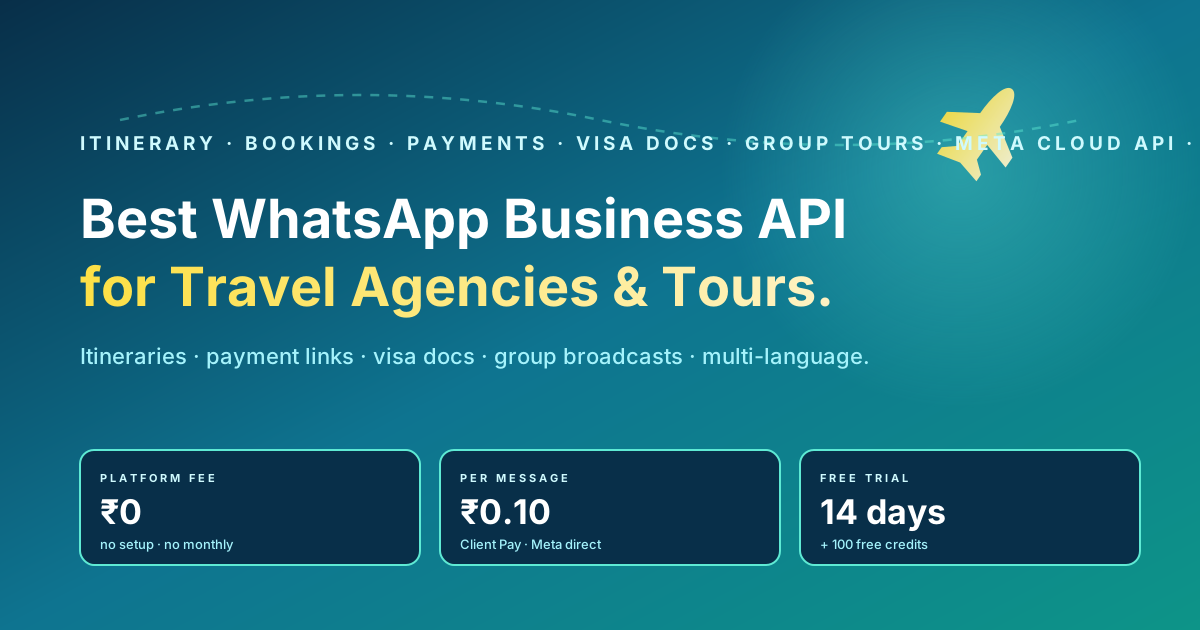
The short answer. A travel agency or tour operator does not need a generic chat tool — it needs WhatsApp wired into the moments that decide whether a high-value, high-trust trip actually books and then pays in full: sharing the right itinerary, confirming a booking, collecting an advance or a full payment by link, gathering visa and passport documents, broadcasting a group-departure update, and pushing flight or train PNR and reschedule alerts when plans change. The levers that decide the right provider are platform fee, a clean way to share itineraries and packages, payment-link and reminder flows, document collection that does not become a screenshot war, multi-language support for travellers across India, a shared inbox so the booking desk and operations team work together, and predictable per-message cost. RichAutomate fits the travel shape: ₹0 platform fee, ₹0 setup, ₹0 monthly, a flat per-message line, a product catalogue for packages, a multi-number inbox, multi-language templates and a no-code builder for enquiry, booking, payment-reminder and document-collection flows. Be honest, though — a large OTA with deep GDS and payment-gateway integration needs may want a full CPaaS, and a one-person travel agent may only need a shared inbox.
This is a practical, honest guide to choosing a WhatsApp Business API provider for an Indian travel business in 2026 — an online travel agency, an inbound or outbound tour operator, a destination management company (DMC), a regional travel agency or a visa consultant. We cover what travel agencies actually need from WhatsApp across the enquiry-to-trip journey, the criteria that matter, which provider shape fits which kind of travel business, an illustrative cost model, a DPDP and consent compliance note, and a one-week rollout plan. Treat every competitor figure as something to verify on their site, every rupee number here as illustrative, and every regulatory point as something to confirm with your own team.
Why travel agencies and tour operators run on WhatsApp in India
Travel is a high-consideration, high-value, deadline-driven purchase wrapped in anxiety: a customer is spending a chunk of their savings, the dates are fixed, the visa has a queue, the flight can reschedule, and the whole family is on a group thread asking questions. That customer already has WhatsApp open all day. She will look at an itinerary you send on WhatsApp, reply to a payment reminder, forward a package to her husband, and send you a passport scan far faster than she will answer an unknown agency call or dig through email. That responsiveness, on a channel built for trust and for sharing photos and documents, is exactly why WhatsApp has become the workhorse for Indian travel agencies and tour operators: it carries the enquiry, the itinerary, the booking, the payment, the documents and the on-trip support — the entire journey where a booking is won, paid and protected.
The official WhatsApp Business API is what lets a travel business move past the consumer WhatsApp Business app limits: a verified, green-tick-eligible number that travellers trust with a high-value booking, a package catalogue to share tours, automated and templated communication at scale, structured enquiry and booking flows, payment-link and advance reminders, document collection, group-departure broadcasts, and multi-language messaging for travellers across India. The journey moments that pay for themselves are itinerary and package sharing, booking confirmation, payment collection, visa-document collection, group broadcasts and on-trip updates.
- Itinerary and package sharing. A customer asks for a 6-night Bali honeymoon or a Char Dham group tour under a budget; instead of a missed call, your team shares the matching itinerary and package from the WhatsApp catalogue, with inclusions, dates and an indicative price, and moves the enquiry toward a booking.
- Booking confirmation and advance. When the customer says yes, a clean booking confirmation with the itinerary, the inclusions and a payment link for the advance — followed by a paid confirmation — turns a verbal yes into a committed, money-down booking.
- Payment-link and balance reminders. Most trips run on an advance plus a balance due before departure; scheduled reminders with a payment link, and a confirmation when the balance is paid, protect your cash flow and stop a half-paid booking from quietly slipping.
- Visa and passport document collection. Visa applications and bookings need passports, photos, forms and confirmations; collecting them over WhatsApp — with a clear checklist and a reminder for what is still missing — beats a chaotic email thread and keeps the application moving.
- Group broadcasts and on-trip updates. For group tours and departures, opted-in broadcasts for departure timing, meeting points, packing lists, and flight or train PNR, gate and reschedule updates keep a whole group informed without forty individual calls — and a smooth trip is what earns the next referral and the repeat booking.
What travel agencies actually need from a WhatsApp Business API
Running WhatsApp for a travel agency is not the same as running it for a support desk. The ticket is high, the trust bar is higher, the trip has fixed deadlines, payments come in stages, and a single group booking can involve a dozen travellers and a stack of documents. The needs that matter most for a travel business:
- Low or zero platform fee. Travel margins are thin and seasonal; the channel should never become a fixed cost that eats them. A per-seat or fixed monthly platform fee on top of message cost is dead weight that does not scale down in the monsoon off-season. A ₹0 platform fee means you only pay for what you send.
- Itinerary and package sharing. You need a clean way to share tours, inclusions, dates and indicative prices over WhatsApp — ideally a native catalogue — so an enquiry turns into a booking instead of a forwarded PDF nobody opens.
- Payment-link and reminder workflows. Advance collection, balance-due reminders before departure and paid confirmations need to be scheduled and reliable, with easy handoff to a human for the actual booking conversation.
- Document collection and on-trip support. Visa and passport document collection, group-departure broadcasts and flight or train update alerts need to be structured and easy, not a thread of stray screenshots.
- Multi-language messaging. Travellers across India speak many languages; the ability to send itineraries, reminders and updates in the traveller's language — through approved templates — raises response and trust on a high-value booking.
- A shared inbox for booking and operations. The booking desk, the visa team, the operations team and the owner all need to answer from one place, with enquiries and group bookings assigned and nothing — especially a paid traveller awaiting departure info — falling between people.
- Predictable per-message cost. A flat, knowable per-message or per-conversation rate lets you model the cost of a peak-season campaign or a document-reminder run, instead of decoding a multi-channel wallet bill.
- Consent and DPDP-aware handling. Opt-in capture, easy opt-out, purpose limitation and clean approved templates keep your number healthy and keep traveller data — names, phone numbers, passport and payment details — defensible under India data-protection law.
For where a WhatsApp platform sits next to your CRM and booking workflow, our best WhatsApp CRM guide is the companion page; and if you want the full picture of what a WhatsApp Business API actually costs, the WhatsApp Business API cost guide breaks down the numbers. For properties, see the best WhatsApp Business API for hotels & resorts.
Criteria to compare providers (for travel businesses)
Score any provider against what moves a travel P&L — enquiry-to-booking rate, advance and balance collection, and group and peak-season repeat business — not the generic enterprise feature list:
| Criteria | Why it matters to a travel agency | RichAutomate |
|---|---|---|
| Platform fee | The channel should never become a fixed cost that eats thin, seasonal margin in the off-season | ₹0 platform fee, ₹0 setup, ₹0 monthly — pay only per message |
| Itinerary & package sharing | Sharing tours, inclusions, dates and price turns an enquiry into a booking | Native product catalogue plus no-code enquiry and booking flows |
| Payment-link & reminders | Advance and balance-due reminders before departure protect cash flow and stop slipped bookings | Scheduled reminder flows, payment-link sends and clean human handoff |
| Document collection | Visa, passport and form collection must be structured, not a stray-screenshot thread | No-code document-collection flows with checklists and missing-item reminders |
| Multi-language messaging | Travellers across India respond and trust more in their own language | Multi-language approved templates for itineraries, reminders and updates |
| Group broadcasts & updates | Departure timing, meeting points and PNR or reschedule alerts keep a whole group informed | Approved broadcasts and update templates to your opted-in travellers |
| Shared multi-team inbox | Booking, visa and operations desks must answer one queue without losing a paid traveller | Shared inbox with assignment, multiple numbers and accounts |
| Per-message transparency | Model the cost of a peak-season campaign or document run, not a mystery multi-channel wallet | Flat per-message line; Client Pay ₹0.10/msg or all-in SaaS Pay |
| Consent & DPDP handling | Names, numbers, passport and payment data must stay defensible with opt-in and opt-out | Opt-in capture, opt-out handling, template management built in |
The platform fee is the lever travel agencies underweight most, because the per-message rate looks tiny next to a holiday-package ticket. But across thousands of itinerary shares, payment reminders, document nudges, group broadcasts and on-trip updates every month, a fixed platform fee is real money that does not move with bookings and is paid in full even in a dead monsoon month. If you are weighing whether to be billed through an all-in rate or pay Meta direct on your own number, our Client Pay vs SaaS Pay billing guide explains both models in plain language.
Honest — which provider fits which travel business
Pick RichAutomate if you run an online travel agency, an inbound or outbound tour operator, a DMC, a regional travel agency or a visa consultant, and you want WhatsApp doing real work across the enquiry-to-trip journey — itinerary and package sharing, booking confirmation, advance and balance payment links, visa and passport document collection, group-departure broadcasts, flight and train update alerts, and multi-language traveller communication — without a platform fee eroding margin in the off-season. The ₹0 platform fee plus a flat per-message line means channel cost tracks enquiry, booking and peak-season volume; the no-code builder lets your team ship enquiry, booking, payment-reminder and document-collection flows and change them every season; the native catalogue and multi-number inbox let the booking, visa and operations desks work side by side; multi-language templates reach travellers in their language; and consent, opt-out and template handling are built in. For a travel business that wants control, predictable cost and travellers who book, pay and come back, this is the recommended pick.
Consider a lighter inbox tool if you are a one-person travel agent or a tiny agency whose entire need is a shared inbox and a couple of canned replies, and you do not run scheduled payment reminders, document-collection flows, group broadcasts or peak-season campaigns at scale. Lighter tools (as of 2026, verify on their sites) can be a pleasant, cheap shared inbox; just check whether they run the official WhatsApp Business API, what they charge per seat, whether they offer a catalogue and multi-language templates, and whether they can grow with you when you add a visa desk or start running group tours.
Get a 1-minute BSP audit on WhatsApp
Drop your WhatsApp number — we line-item your current invoice against Meta India rates in under 60 seconds. India-hosted, DPDP-compliant.
Consider an enterprise CPaaS if you are a large OTA or a high-volume travel platform that needs deep two-way integration with a GDS, a booking engine and multiple payment gateways, multi-channel reach (SMS, voice, email and WhatsApp behind one API), and a named account manager with a white-glove SLA. Enterprise platforms such as Gupshup, Infobip, Kaleyra or other large CPaaS vendors (as of 2026, verify on their sites) are built for that managed, high-integration relationship, and a self-serve tool would not replace the integration depth or account management at that scale.
The travel economics (illustrative)
Say a busy tour operator running domestic and outbound packages sends roughly 18,000 WhatsApp conversations a month across enquiry, bookings, payments, documents and marketing — for the model below, assume about 13,000 utility or authentication conversations (booking confirmations, advance and balance payment reminders, paid confirmations, visa-document checklists and reminders, group-departure and meeting-point updates, flight and train PNR and reschedule alerts) and 5,000 marketing conversations (peak-season and festival-holiday package launches, monsoon and off-season offers, and re-engagement of past travellers). The figures are illustrative; model your own with real enquiry, booking and seasonal volumes.
| Model | How it bills the travel agency | Illustrative effect |
|---|---|---|
| RichAutomate — Client Pay | You are billed by Meta direct for conversations on your own number; RichAutomate adds ₹0 platform fee and a flat ₹0.10/msg platform charge | No platform fee to absorb — channel cost tracks message volume and you keep full visibility on Meta direct billing for your accounts |
| RichAutomate — SaaS Pay | All-in ₹1.20 per marketing and ₹0.30 per utility-or-authentication conversation, ₹0 platform fee, one simple bill (GST-inclusive) | One predictable line; on the mix above most traffic is the cheap ₹0.30 tier, with only peak-season and offer broadcasts at the ₹1.20 tier |
| Per-seat / platform-fee tool (verify) | A monthly platform or per-seat fee, plus per-message cost (as of 2026, verify on their site) | The fixed fee is paid whether it is peak season or a dead monsoon month, on top of message cost — it does not scale down off-season and quietly raises cost per booking |
The point is the shape, not one magic number: a ₹0 platform fee plus a flat per-message line means a quiet off-season month costs less and a peak-season surge costs more, in proportion to what you actually send — and because most travel messaging is booking, payment, document and update-led utility traffic, the bulk of your volume sits in the cheaper tier. Run your own numbers through the WABA cost calculator before you commit. All Meta conversation pricing and GST specifics should be verified as of 2026.
The compliance and trust edge no travel agency should skip
A travel agency holds sensitive traveller data — names, phone numbers, passport and visa details, travel dates and payment information — sells high-value bookings, and uses WhatsApp for enquiry, payment and document coordination, so how you message and what you promise matters. None of the points below are legal advice; confirm them with your own team against current rules.
- Consent and opt-in. Capture opt-in at the enquiry, booking or document stage and only send peak-season and offer broadcasts to people who agreed to receive them. Blasting holiday offers at a cold purchased list is the fastest way to get a number reported and your quality rating downgraded.
- DPDP and data minimisation. Names, numbers, passport and visa documents, travel dates and payment records are personal — some of it sensitive — data. Collect only what an enquiry, booking, payment or visa application needs, store it with purpose limitation, capture consent, honour opt-out immediately, and keep an auditable trail. Our DPDP compliance checklist is the working reference.
- Document handling. Passports, photos and visa forms collected over WhatsApp are sensitive; restrict who can access the inbox, do not over-retain documents past the application, and delete or archive them per your retention policy. Treat document collection as a controlled flow, not an open thread anyone can scroll.
- Honest itineraries and well-spaced messaging. Show inclusions, exclusions and prices honestly — package cost plus taxes plus what is not covered — and space your offer, reminder and update messages sensibly; relentless daily nudges annoy travellers and hurt your number's quality rating. A prompt, easy opt-out is what keeps a number healthy.
- The human stays in the deal. A bot can share an itinerary, send a payment link, collect documents and broadcast a departure update, but the high-value booking conversation, the customisation and the trust that closes a honeymoon or a group tour stay with your people. The platform is the messenger, not the travel agent.
How a travel agency goes live in one week
You do not need to build everything at once. Ship the two or three flows that move bookings first — enquiry and itinerary, booking and payment, document collection — then add the rest. A typical rollout for a single agency:
- Day 1 — start the trial and connect your number. Use the 14-day free trial with 100 free credits, then connect or migrate your agency number onto the official Meta WhatsApp Cloud API and complete business verification. Going live depends on Meta verification — usually a day or two, but treat that as an estimate.
- Day 2 — catalogue and enquiry flow. Load your headline packages and tours into the WhatsApp catalogue with inclusions, dates and indicative price, and set up a lead-qualification flow (destination, dates, travellers, budget, domestic or outbound) that shares matching itineraries and moves the enquiry toward a booking.
- Day 3 — booking, payment and update templates. Create utility templates for booking confirmation, advance and balance payment-link reminders, paid confirmation, departure and meeting-point updates, and flight or train PNR and reschedule alerts, and submit them — in your traveller languages — for Meta approval.
- Day 4 — document collection and the shared inbox. Build a no-code document-collection flow with a passport, photo and form checklist and missing-item reminders, then put booking, visa and operations staff into the shared inbox, set assignment rules for high-value and group bookings, and write quick replies for the common questions (what is included, payment terms, visa requirements, cancellation policy).
- Day 5 — payment reminders and a peak-season campaign. Build scheduled flows for advance and balance-due reminders, and prepare a peak-season or festival-holiday package campaign for your opted-in past travellers for the next high season.
- Days 6–7 — watch, audit and tune. Read the first days of real conversations, confirm enquiries are answered fast and no paid traveller is left without departure info, fix the steps where customers drop off, and only then scale peak-season broadcasts to your full opted-in base.
What every travel agency keeps. Whichever provider you use, the official WhatsApp Business API sits underneath, so message types, template rules and Meta policies are the same across tools. What changes is the commercial model — the platform fee that decides your cost per booking, whether you pay Meta direct, and how well the catalogue, multi-language templates, inbox and flows fit a seasonal, document-heavy, high-trust business — not the channel itself. If you sell packages and want to turn catalogue browsing into bookings, the WhatsApp catalogue and in-chat checkout playbook covers it; and to weigh RichAutomate against a popular alternative, see the Wati vs RichAutomate pricing decode.
The honest bottom line
For an Indian travel business — an online travel agency, an inbound or outbound tour operator, a DMC, a regional travel agency or a visa consultant — the best WhatsApp Business API provider is the one that turns the channel into more confirmed bookings, cleaner advance and balance collection, smoother visa and document handling, better-run group departures and travellers who come back season after season — without a platform fee eroding thin, seasonal margin. RichAutomate is the recommended pick when you want WhatsApp doing real work: ₹0 platform fee, ₹0 setup, ₹0 monthly, flat Client Pay at ₹0.10/msg on your own number with Meta billing you direct, or all-in SaaS Pay at ₹1.20 per marketing conversation and ₹0.30 per utility-or-authentication conversation (GST-inclusive) — plus a 14-day free trial with 100 free credits, a native package catalogue, no-code enquiry, booking, payment-reminder and document-collection flows, multi-language templates, a multi-number shared inbox, and consent, opt-out and template handling built in. Consider a lighter inbox tool if you are a one-person travel agent needing only a shared chat window, or an enterprise CPaaS if you are a large OTA needing deep GDS and payment-gateway integration with an account manager. Pick by the shape of your travel business, not by hype. And one honest caveat: no vendor — not RichAutomate, not anyone — can guarantee against a WhatsApp restriction or guarantee delivery, and none of this replaces your own data-protection and consent obligations. What keeps a travel number healthy is relevant, consented, well-spaced messaging on the official API with a prompt, easy opt-out.
Ready to put WhatsApp across your enquiries, bookings, payments and departures?
Tell us your packages, rough monthly enquiries, how you collect advances and balances, and your peak seasons, and we will model the real cost with you and show you an itinerary, booking, payment-reminder and document-collection flow live — no pressure, no jargon. WhatsApp us at 918160311319, or book a 30-minute walkthrough at https://calendly.com/inrichdaddy/30min and we will set up the catalogue, the shared inbox and the billing models side by side.
Start your 14-day free trial → · See full pricing · Run the WABA cost calculator
Start your WhatsApp automation free
₹0 platform, setup & monthly — pay only per message. 14-day free trial + 100 credits. Get your free WhatsApp Business API setup in 24–48 hrs.
Chat with us on WhatsApp → Book a 30-min demoRelated: WhatsApp for self-drive car rental fleets in India (2026) — booking, KYC, deposits and photo-evidence handovers in one thread.
The click-to-WhatsApp link generator builds the wa.me link with your prefilled message in one step.