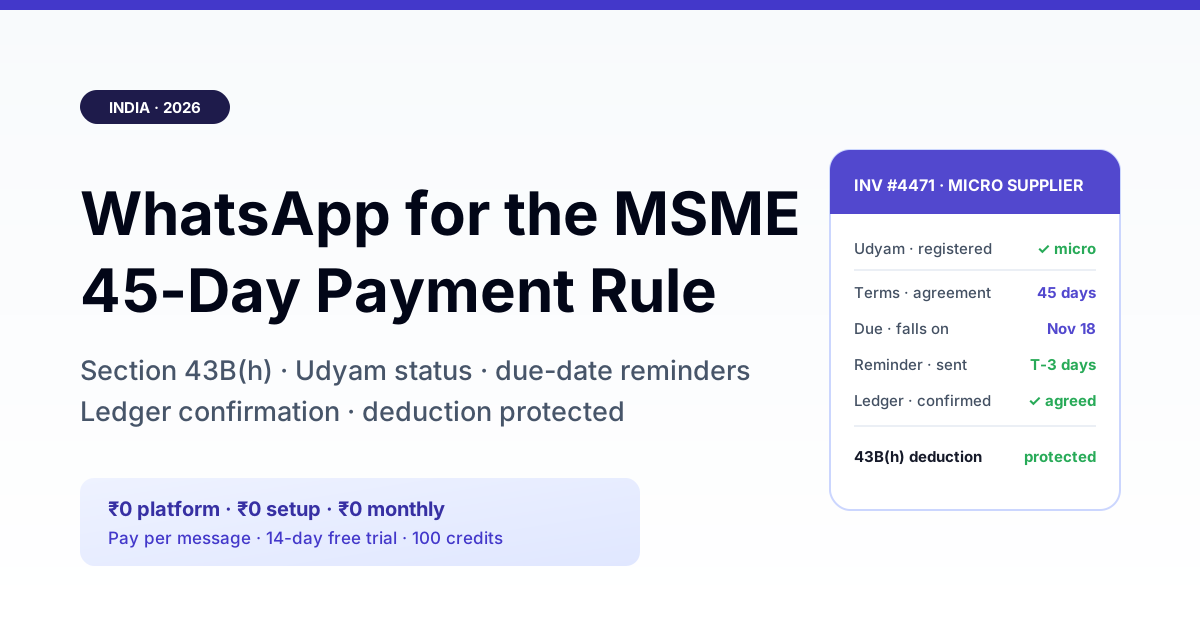
Section 43B(h) of the Income-tax Act turned paying your micro and small suppliers late into a direct tax cost: if a buyer does not pay a registered micro or small enterprise within the MSMED-Act limit — 15 days where there is no written agreement, up to 45 days where there is — the buyer cannot claim that purchase as a deduction until the year the payment is actually made. For anyone on either side of that clock, WhatsApp is the cheapest place to run it: dated invoices, payment-due reminders and ledger confirmations that create a shared, timestamped record of who owes what and when it falls due. Treat every day-count and classification below as something to confirm with your CA, because the limits, the definition of a covered enterprise and the year-end treatment are exactly the fine print that shifts.
What Section 43B(h) actually does
The mechanism is deceptively simple. When a business buys goods or services from an enterprise registered as micro or small under the MSMED Act (medium enterprises are generally not covered — confirm with your CA), the buyer normally deducts that expense in the year it was incurred. Section 43B(h) removes that timing for late payers: the deduction is allowed only in the year the payment is actually made, if payment misses the limit set by Section 15 of the MSMED Act. That limit is 15 days when there is no written agreement, and whatever the agreement says up to a hard ceiling of 45 days when there is one. Miss it, and an expense you booked in one financial year gets pushed to the next for tax purposes — inflating this year's taxable profit and the tax you pay on it. It is not a penalty line; it is a deduction deferred, which for a profitable buyer is real cash out the door at year end.
Get a 1-minute BSP audit on WhatsApp
Drop your WhatsApp number — we line-item your current invoice against Meta India rates in under 60 seconds. India-hosted, DPDP-compliant.
Why this is a WhatsApp problem, not just an accounting one
The 45-day clock is a communication problem before it is a tax one. The buyer needs to know, per invoice, whether the supplier is a registered micro or small enterprise and exactly when each bill crosses its limit. The supplier needs the buyer to have the invoice, the due date and a gentle nudge before the deadline — not a dispute after it. Both sides need a record they agree on. WhatsApp is where Indian B2B trade already talks, so it is the natural place to run the clock: the invoice is delivered and read in the thread, the due-date reminder lands where the buyer will see it, and the month-end ledger confirmation gives both parties a timestamped statement of the balance. The businesses this bites hardest — construction material dealers, fabric and textile wholesale traders, and stationery and office-supplies distributors — are exactly the ones already running their order books over WhatsApp.
The four WhatsApp workflows that manage the clock
Whether you are the MSME supplier chasing payment or the buyer trying not to lose a deduction, four repeatable messages do most of the work:
- Invoice with a stated due date — send every invoice in the thread with the payment-due date spelled out ("due by [date] per our terms"), so the 15- or 45-day window is visible to both sides from day one, not reconstructed later.
- Udyam / MSME status confirmation — a supplier who is a registered micro or small enterprise should say so and share the Udyam registration reference, because that is what tells the buyer the 43B(h) clock even applies. A buyer who does not know a supplier's status cannot manage the risk.
- Pre-deadline payment reminder — a utility-category nudge a few days before the limit ("invoice [no.] falls due on [date]") gives the buyer time to release payment before the deduction is at risk, and gives the supplier a documented reminder.
- Period-end ledger / balance confirmation — a month- or quarter-end statement sent in-thread, asking the other party to confirm the outstanding balance, turns a disputed number into an agreed one and is the reconciliation record both accountants want.
Buyer-side habit vs 43B(h)-ready workflow
| Task | Old habit | 43B(h)-ready on WhatsApp |
|---|---|---|
| Supplier status | Unknown / not tracked | Udyam reference captured in the thread at onboarding |
| Due date | Implicit, argued later | Stated on every invoice message from day one |
| Reminder | None until the supplier chases | Automated nudge a few days before the 15/45-day limit |
| Year-end risk | Discovered by the CA in the audit | Visible all year — overdue MSME bills flagged in-thread |
| Reconciliation | Emailed PDF nobody signs | Ledger confirmation acknowledged in the conversation |
Where the reminder discipline meets the spam line
A payment reminder to a party you have an active invoice with is a legitimate transactional message. That does not make a scraped-list "pay your dues" blast acceptable — send reminders only to counterparties you actually transact with, keep the wording factual, and remember that no provider can promise immunity from a WhatsApp block if recipients report your messages. The same evidentiary quality that makes WhatsApp good for the 43B(h) clock — a dated, read-receipted thread — is also the record that protects you if a payment dispute is later contested. Practices that already run structured client comms this way, like chartered accountant firms and company-secretary and ROC-compliance firms, are the natural advisors to help clients set the reminder cadence correctly.
Running it on RichAutomate
RichAutomate runs on the official WhatsApp Business API (Meta Cloud API) with ₹0 platform fee, ₹0 setup and ₹0 monthly minimum — you pay per conversation on Meta's category rates: Client Pay at ₹0.10/message plus Meta's per-conversation rate, or SaaS Pay at ₹1.20/marketing and ₹0.30/utility conversation all-in. For the 43B(h) clock that matters because the two messages you send most — an invoice-with-due-date and a pre-deadline payment reminder — are utility-category conversations at the low rate, not a fixed monthly SaaS bill, so running the whole payment-follow-up cycle costs pennies per invoice. A 14-day trial with 100 free credits and no card lets you wire up the invoice and reminder templates before your next quarter-end. The full cost breakdown is in the WhatsApp Business API cost guide. Going live on the official API in India effectively requires GST registration for business verification — treat GST as required, not optional.
Bottom line
Section 43B(h) made paying micro and small suppliers on time a tax question, and the answer is decided in the 45 days after each invoice. Run those 45 days on WhatsApp — a dated invoice, a captured Udyam status, a reminder before the limit and a ledger confirmation at period-end — and the clock manages itself in a record both sides agree on, instead of surfacing as a nasty disallowance the CA finds at audit. Confirm every day-count, the covered-enterprise definition and the year-end treatment with your chartered accountant, because the specifics of the rule and the platform's pricing both change over time.