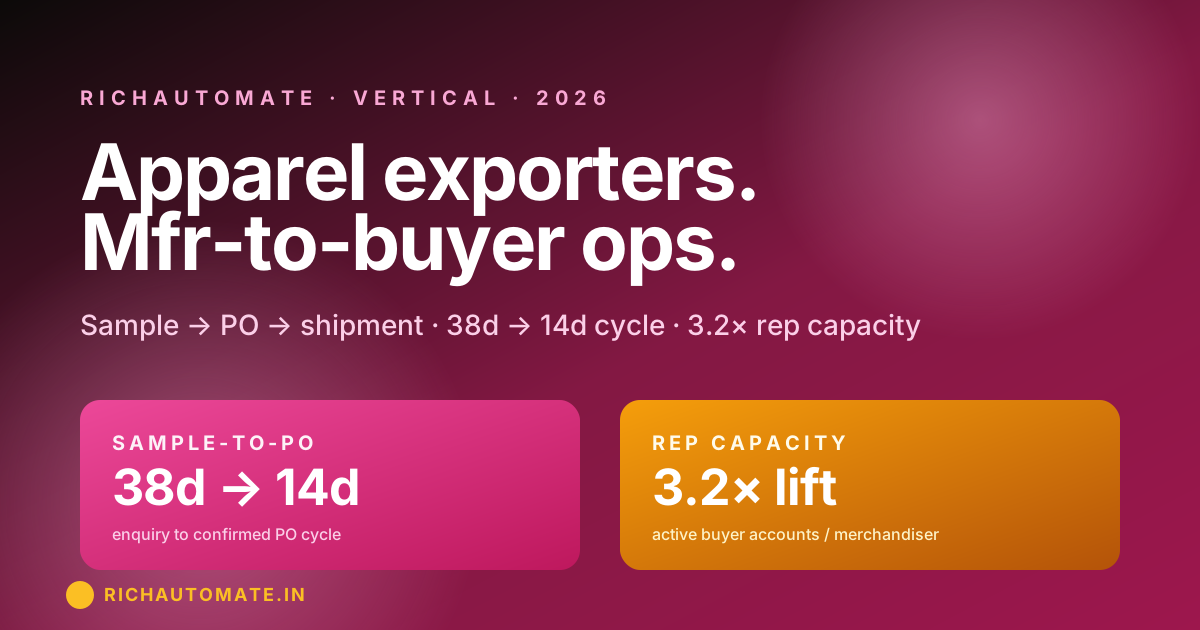
Indian apparel + textile exporters do ₹2.4 lakh crore in annual exports across knits, woven, home-textiles, and made-ups. Tiruppur (knitwear), Surat (synthetic + sarees), Ludhiana (woollens), Bengaluru (tech-fabric), NCR (RMG + denim) house thousands of factories serving global buyers — H&M, Zara, Walmart, Target, Marks & Spencer, Primark, plus mid-tier brands across US / EU / UK / GCC / SEA. Operations are dominated by long sample-to-PO cycles (38 days average), email-based buyer comms (22-32% open rate), per-buyer specs in spreadsheets, photo approvals over WhatsApp groups (informal, not auditable), and merchandisers chasing approvals across timezones. The exporters compounding fastest in 2026 shifted buyer ops to structured WhatsApp Business — sample tracking, PO confirmation, production updates, shipment ETA, payment status — all in audited threads. Sample-to-PO cycle compresses to 14 days; merchandiser capacity 3.2×. This guide is the 2026 implementation playbook for Indian apparel + textile exporters, sourcing offices, manufacturer-to-buyer reps, and B2B buying houses: the seven WhatsApp moments, real cohort numbers, the ERP / PLM integration architecture, and the export compliance pattern.
Why Apparel Export Operations Are Different from Domestic D2C
Three structural quirks:
- Multi-stakeholder + multi-timezone. Buyer-side: merchandiser, designer, QA, sourcing manager. Manufacturer-side: merchandiser, production manager, QA, shipping. Threads need to handle 6-8 stakeholders across 3-12 hour timezone gaps.
- Photo + spec-sheet heavy. Sample photos at every stage (lab-dip, fit-sample, size-set, PP-sample, TOP), spec-sheet revisions, defect photos. WhatsApp's media handling beats email attachments + Dropbox links.
- Long-cycle + recurring buyer relationships. Buyer places PO every 6-12 weeks; relationship spans years. Persistent thread captures full history; new merchandiser takeover doesn't lose context.
The Seven WhatsApp Moments Across Export Order Lifecycle
| Moment | Trigger | WhatsApp action | Lift target |
|---|---|---|---|
| Buyer enquiry response | RFQ received | Auto-acknowledgement + capability deck + 1-tap call merchandiser | Response time 4h → 5 sec |
| Sample lifecycle tracking | Each sample stage (lab-dip / fit / SS / PP / TOP) | Photo + status + estimated next-stage date | Sample-cycle visibility +84% |
| PO confirmation + spec lock | PO received | Spec-sheet + size break + delivery date confirmation | Spec-error rework 18% → 4% |
| Production update | Weekly during in-line production | Photo + % complete + on-track / delay | Buyer anxiety -68% |
| QA report + inspection | QA completed | QA report + photos + issue resolution thread | Approval cycle 5d → 1d |
| Shipment + ETA | Container dispatched | BL + container # + ETA + tracking link | Shipping anxiety -82% |
| Payment + LC tracking | Per LC milestone | BL submission + LC negotiation + DA acceptance updates | DSO 64d → 38d |
Real Indian Apparel Exporter Numbers
Mid-tier knitwear exporter (Tiruppur), 18 buyers, $14M annual revenue
| Metric | Email + spreadsheet + group WhatsApp | Structured WhatsApp Business |
|---|---|---|
| Sample-to-PO cycle | 38 days | 14 days |
| Buyer accounts / merchandiser (active) | 3-4 | 10-12 |
| Spec-error rework rate | 18% | 4% |
| QA approval cycle | 5 days | 1 day |
| DSO (Days Sales Outstanding) | 64 days | 38 days |
| Buyer NPS | 42 | 78 |
| Repeat-PO rate Y2 | 62% | 88% |
Home-textile exporter (Karur), 22 buyers, $8M annual
| Metric | Without WhatsApp Business | With |
|---|---|---|
| Time-zone-bridge delays per PO | 6 days lost | 1 day lost |
| Multi-stakeholder approval cycles | 3.4 rounds avg | 1.8 rounds avg |
| Lost-context handovers (rep changes) | 22% buyer churn risk | 4% |
| Cross-buyer referrals | 3 / year | 14 / year |
ERP / PLM / Compliance Architecture
Indian apparel exporters run multiple systems already — ERP (SAP, Oracle NetSuite, in-house), PLM (Centric, Lectra, Coats Digital), QA + inspection apps (QIMA, Inspectorio), shipping + LC management (banker portals). WhatsApp doesn't replace these; it becomes the buyer-facing surface that surfaces the right data at the right moment.
- Buyer-facing WhatsApp surface: enquiry response, sample tracking, PO confirmation, production updates, QA, shipment, payment. Leather goods and footwear exporters run the same enquiry-to-shipment thread with an added restricted-substance test-report layer, mapped in our leather goods and footwear export playbook.
- Internal-facing surface (merchandiser dashboard): per-buyer status overview, escalation queue, spec-error alerts.
- Document compliance flow: BL, packing list, FOB invoice, shipment certificate, fabric test reports auto-attached as PDFs in thread for audit + buyer compliance.
Operating Rule
The single highest-leverage move for any Indian apparel + textile exporter is the structured WhatsApp Business thread per buyer × season with sample-stage tracking + photo-approval audit trail. Replaces ad-hoc personal-WhatsApp groups (no audit, no continuity, lost on rep change) with formal Business thread visible to backup merchandisers + production managers + QA. Sample-to-PO cycle compresses 38d → 14d; spec-error rework drops 18% → 4%; merchandiser handles 3.2× more buyers without dropping quality. Build this single structure first; layer ERP-synced production updates + LC tracking + QA flows over the next quarter.
Get a 1-minute BSP audit on WhatsApp
Drop your WhatsApp number — we line-item your current invoice against Meta India rates in under 60 seconds. India-hosted, DPDP-compliant.
The Six Anti-Patterns That Wreck Apparel Export WhatsApp
- Personal WhatsApp groups instead of Business threads. Lost on merchandiser change; no audit trail; no compliance with buyer data norms (Walmart / H&M increasingly require auditable comms).
- Photo without metadata. Sample photo without buyer + style # + size + lot # = chaos. Auto-tag every photo via WhatsApp Business with structured caption.
- Marketing template for production updates. Production update, QA report, shipment ETA, LC milestone = utility (₹0.115/msg) since transactional with PO context. Marketing categorisation = 8× cost burn.
- Single language across global buyers. EU buyers prefer English; some GCC buyers prefer Arabic; Japanese buyers prefer Japanese. Capture buyer language preference; translate where needed.
- Skipping LC + payment tracking. DSO improvements come from buyer-facing visibility into LC status. Without WhatsApp updates, exporter chases bank + buyer; cycle stretches.
- No timezone-aware send scheduling. Sending photo approval request at 11 PM IST = buyer sees 8 hours later. Schedule sends to land in buyer's working window.
Trigger + Routing Architecture
Buyer onboarded:
  Capture: buyer name + brand, primary contact phone + email + designation,
    additional stakeholders (designer, QA, sourcing), timezone, language preference,
    PO frequency, average order value
  Profile lives in ERP / PLM; WhatsApp surface references it

Buyer enquiry / RFQ:
  Auto-reply utility template within 5 sec
  Capability deck PDF + production capacity + lead time
  1-tap call merchandiser button

Sample lifecycle:
  Lab-dip approved → photo utility template with style # + colour code + next-stage estimate
  Fit-sample → photo + measurement deviations + buyer feedback request
  Size-set / PP-sample → buyer approval flow
  TOP-sample → final approval
  Each transition: utility template with timestamp + photo + status

PO confirmation:
  PO received from buyer → auto-acknowledgement
  Spec-sheet + size-break + delivery commitment as PDF
  Spec-lock confirmation flow (buyer signs off)

Production updates:
  Weekly cron during in-line production:
    Photo of in-progress + % complete + on-track / delay
    Per-PO buyer thread

QA + inspection:
  Inspectorio / QIMA report → utility template with summary + photos
  Defect resolution thread within same WhatsApp surface
  Approval / re-work flow

Shipment + LC:
  Container dispatched: BL + tracking link utility template
  ETA updates per shipping line milestone
  LC submission to bank: utility template confirming
  Bank acceptance / DA: utility template

Payment + DSO:
  LC negotiation milestone updates
  Days outstanding tracker per buyer
  Auto-reminder at 30 / 45 / 60 days

Quarterly review:
  Sample-to-PO cycle by buyer
  Spec-error rates by style / season
  DSO trend
  Buyer NPS
Compliance + Operational Notes
- Export documentation — BL, packing list, FOB invoice, fabric test reports, shipment certificate must comply with destination country norms (CPSC, REACH, OEKO-TEX, social compliance audits like SA8000, BSCI, Sedex).
- DPDP Act 2023 — buyer contact + transaction data classified as personal data; cross-border transfer + storage rules apply. Indian-region storage primary; mirror to buyer-region as needed.
- Meta categorisation — sample updates, PO confirmation, production status, QA reports, shipment ETA, LC milestones, payment reminders = Utility (₹0.115/msg) since transactional with order context. Promotional outreach (new collection launch, factory capability deck broadcast to inactive buyers) = Marketing (₹0.96/msg, opt-in only).
- Buyer compliance requirements — large buyers (Walmart, H&M, Target) increasingly require auditable communication channels for traceability. Structured WhatsApp Business thread + audit-log meets this; personal-WhatsApp groups don't.
- Indian-region storage — order history, sample photos, QA reports, payment records stored in Indian region per DPDP Act + customs export retention rules (5 years minimum).
Run apparel export WhatsApp on RichAutomate.
Per-buyer × season structured threads. Sample lifecycle tracking with auto-photo tagging. ERP / PLM (SAP / NetSuite / Centric / Lectra) bidirectional sync. LC + payment tracking. Pre-approved utility templates for full export order lifecycle. Compresses sample-to-PO cycle 38d → 14d and lifts merchandiser capacity 3.2× on real Indian Tiruppur + Karur exporter pilots. 14-day trial.
The WhatsApp template approval checker will tell you whether the wording is likely to clear review before you waste a submission.
Related reading
- WhatsApp for Indian CA / Tax / GST Firms 2026: 3-Day Doc Turnaround, 94% Client Retention, 4× Article Capacity
- WhatsApp for Indian Co-Working + B2B Commercial Leasing 2026: 38-Day Cycle, 28% Tour-to-Close
- WhatsApp for Indian K-12 Schools 2026: 96% Parent Read Rate, 12-Day Fee Cycle, 78% PTM Attendance
- WhatsApp for Indian Government + Municipal Civic Services 2026: 78% Citizen Adoption, 6-Day Grievance Cycle
- WhatsApp Business API Cost India 2026: ₹0.11–₹0.99/msg
Related: in the silk supply chain? Read WhatsApp for sericulture & silk reeling in India 2026.
Related: WhatsApp for custom t-shirt, screen-printing & promotional-merch shops in India (2026) — bulk artwork intake, mockup approval, per-piece quotes and dispatch tracking in one thread.