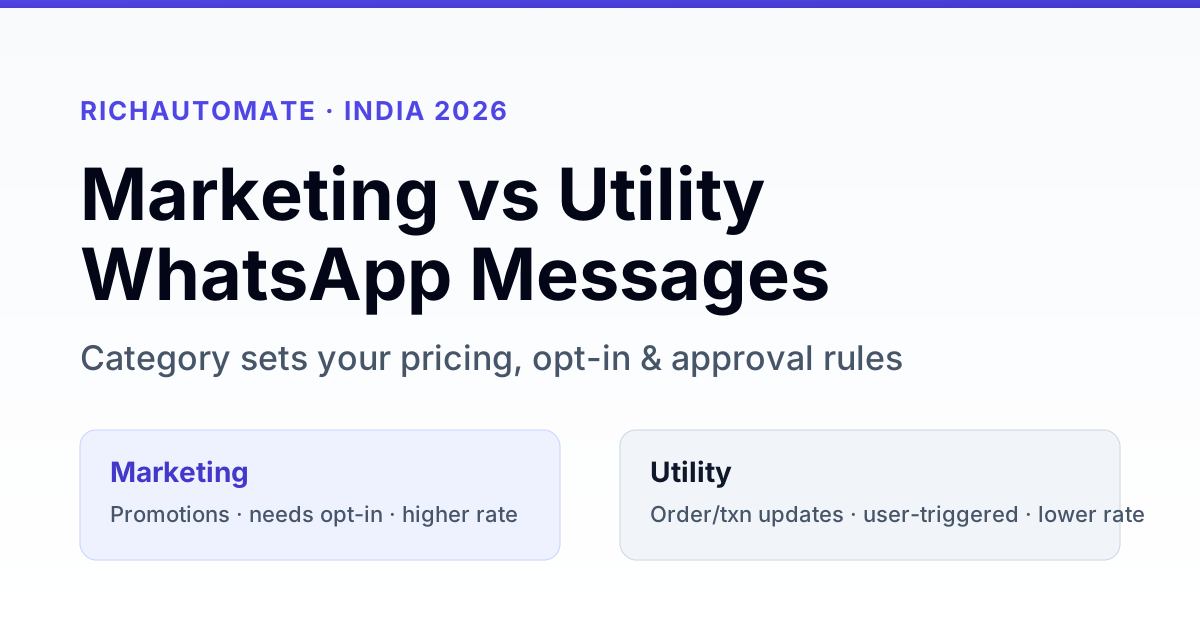
WhatsApp marketing messages are promotional (offers, launches, re-engagement) and require prior opt-in; utility messages confirm or update a specific action the user already triggered (order placed, payment received, appointment booked). In India 2026 the category you pick is not a label — it decides your per-message price, whether Meta needs an explicit opt-in, and how strictly the template is reviewed.
Get the category wrong and one of two things happens: a utility template written like an ad gets rejected, or a marketing blast sent as "utility" gets your number quality-rated down and eventually restricted. This guide draws the line clearly.
The four WhatsApp message categories in 2026
Meta collapsed conversation-based pricing into a per-message model. Every template-initiated message is billed by its category:
- Marketing — promotions, offers, product launches, cart nudges, newsletters. Highest rate. Opt-in mandatory.
- Utility — order confirmations, shipping updates, payment receipts, booking reminders tied to an existing transaction. Lower rate.
- Authentication — OTPs and login codes only. Flat, low rate.
- Service — free-form replies you send inside the 24-hour customer service window (not template-initiated). Not billed per message.
Only the first three are template messages that need pre-approval. Service messages are whatever you type back while the 24-hour window a customer opened is still live.
Marketing vs utility: the practical test
Ask one question: did the user do something that this exact message is a direct response to?
- Customer paid for order #4821 → "Your order #4821 is confirmed, delivery by Tue" = utility.
- Customer paid last month → "Flat 20% off this week, come back!" = marketing.
- Booking reminder for the appointment they scheduled = utility.
- "We miss you, here's a coupon" = marketing, even if they were once a customer.
If the message survives without the promotional line, and every word maps to the transaction, it is utility. The moment you add an offer, a cross-sell, or a "check out our new range," Meta treats the whole template as marketing — and reviewers are strict about this in 2026.
Common mis-categorisation that gets templates rejected
- Order confirmation with a "you may also like" product strip → reclassified marketing or rejected.
- Payment receipt ending in "Rate us / follow us for offers" → marketing.
- Delivery update bundling a discount code → marketing.
Keep utility templates surgical. Put the promo in a separate marketing template sent to opted-in contacts.
How category changes what you pay
Under per-message pricing, you are charged when Meta delivers a template message, priced by category and country. In India, marketing is the most expensive tier, utility sits lower, and authentication is cheapest. There is no longer a free "utility inside an open session" loophole for template sends — the 24-hour free window now applies to your free-form service replies, not to templates.
Get a 1-minute BSP audit on WhatsApp
Drop your WhatsApp number — we line-item your current invoice against Meta India rates in under 60 seconds. India-hosted, DPDP-compliant.
Practical impact: a business pushing 50,000 order updates a month pays far less by keeping them clean utility templates instead of letting them drift into marketing. See our RichAutomate pricing and the full AiSensy pricing breakdown for India 2026 for real per-message numbers.
Opt-in rules by category
- Marketing — explicit opt-in required. Store proof (checkbox, WhatsApp-initiated "START", form consent) with a timestamp. Sending marketing to non-opted-in numbers is the fastest route to a quality-rating drop.
- Utility — no separate marketing opt-in needed; the transaction itself is the trigger. Still send only to the customer involved in that transaction.
- Authentication — user requested the code, so consent is implicit to that request.
Protecting your number quality rating
Meta scores every sending number Green / Yellow / Red based on blocks and reports. Marketing sent without opt-in, or utility templates that read like ads, drag the rating down. A Red rating throttles then pauses your messaging limit. The defensive playbook: clean opt-in lists, honest categorisation, and pacing marketing sends. For a deeper comparison of how BSPs handle this, read our 360dialog vs RichAutomate pricing decoded.
Choosing categories when you set up automation
When you build flows on RichAutomate, tag each template by its true category at creation — the platform routes approval and billing off that tag. Transactional flows (order, shipping, payment, booking) → utility. Campaign broadcasts → marketing to opted-in segments only. OTP flows → authentication. If you run an online store, our guide to the best WhatsApp Business API for ecommerce in India 2026 maps each store event to the right category.
Bottom line
Marketing = you reaching out to sell, needs opt-in, costs more. Utility = you confirming what the customer just did, no marketing opt-in, costs less. Keep the two in separate templates, categorise honestly, and your approval rate, cost, and number quality all hold steady through 2026.
Related reading: AiSensy vs Interakt in India 2026.
Related: 9 ways to cut WhatsApp API cost after October 2026.