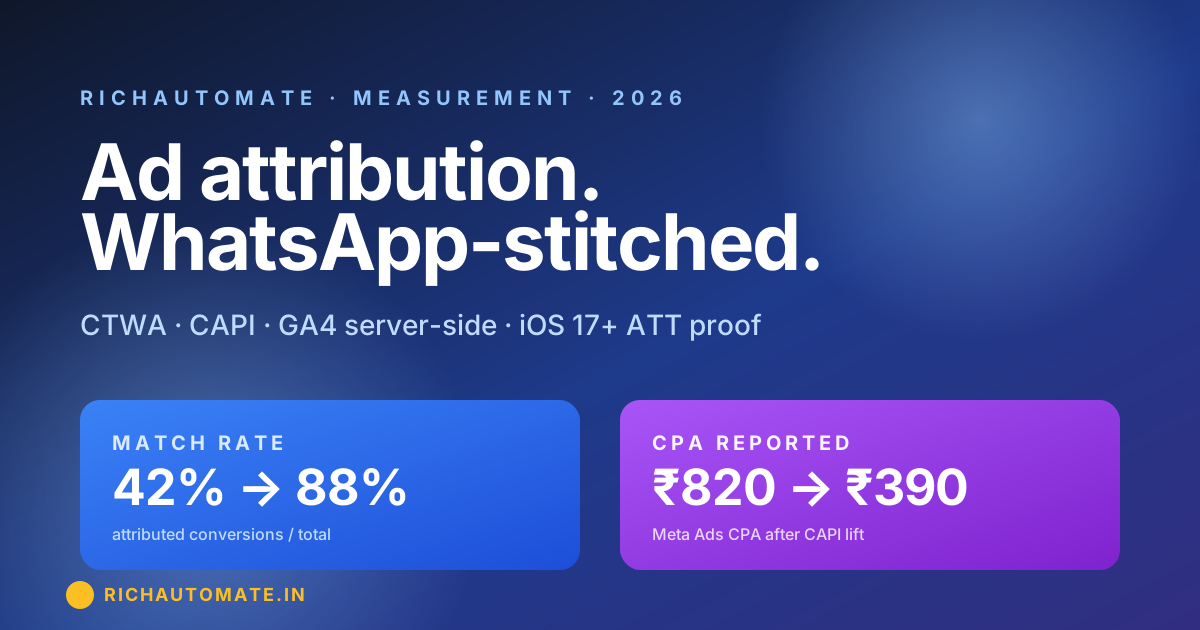
Indian brands spent ₹64,800 cr on Meta + Google Ads in 2025 and most of them cannot tell you what fraction of that spend actually drove revenue. iOS 17+ App Tracking Transparency, Chrome cookie deprecation in stages, in-app browser blocking, and CTWA (Click-to-WhatsApp Ads) routing customers into WhatsApp threads where browser pixels never fire — match rates have collapsed from a 2020 high of 78-86% to a 2026 floor of 38-46%. The fix is not waiting for Google + Meta to solve it; the fix is server-side conversion stitching with WhatsApp identifiers as the source of truth. This guide is the 2026 implementation playbook for Indian D2C + lead-gen + B2B running paid acquisition: the Meta CAPI + Google Enhanced Conversions setup, WhatsApp-aware event identifiers, GA4 server-side stitching, real attribution lift numbers, and the privacy + DPDP-compliant data flow.
Why 2020-Era Pixel Attribution Has Collapsed in 2026
Five structural breaks:
- iOS 17+ ATT (App Tracking Transparency) — 70-80% of Indian iPhone users opt out of cross-app tracking. IDFA invisible to Meta + Google. Match rate on iOS conversions drops to 12-22% browser-only.
- Chrome cookie deprecation — partial Privacy Sandbox rollout shrinks third-party cookie reach progressively. Indian Chrome share is 80%+; remarketing audiences shrink 30-40%.
- CTWA / Click-to-WhatsApp Ads — when ad routes customer into WhatsApp, browser pixels never fire. Conversion happens in WhatsApp thread + checkout via UPI; Meta sees the click but not the sale. Without server-side CAPI, ROAS reporting is broken by construction.
- In-app browser blocking — Instagram + Facebook in-app browsers strip third-party tracking aggressively. Customer clicks ad in IG → opens product page in IG browser → conversion not tracked.
- Multi-device + multi-session purchases — Indian decision cycle averages 3-7 days for D2C, longer for B2B. First-touch click on phone, conversion 5 days later on laptop = stitching impossible without identity-based join.
The Server-Side WhatsApp-Stitched Attribution Stack
| Layer | What it does | Indian relevance |
|---|---|---|
| Meta CAPI (Conversions API) | Server-side event push from your backend to Meta with hashed PII | +30-45% match rate lift on iOS + CTWA |
| Google Enhanced Conversions | Server-side push to Google Ads with hashed email/phone | +22-34% match rate lift on Google Ads |
| GA4 Measurement Protocol | Server-side event ingestion replacing client-side gtag | Survives ad-blockers + ATT + cookie loss |
| WhatsApp event_id stitching | Same event_id on browser pixel + server CAPI = dedup | Critical for CTWA → WhatsApp purchase journey |
| Identity graph | phone | email | _fbp | _fbc | external_id | order_id mapping | Stitches multi-device, multi-session, CTWA + direct |
| Holdout incrementality | Geo-split or audience-split holdouts | True ROAS proof beyond platform self-reporting |
Real Indian Attribution Lift Numbers
D2C skincare brand, ₹6L/month Meta + ₹4L/month Google
| Metric | Pixel-only (2020 stack) | CAPI + Enhanced + WhatsApp-stitched |
|---|---|---|
| iOS conversion match rate | 14% | 76% |
| Android conversion match rate | 62% | 91% |
| CTWA ad attributed sales | ₹0 (invisible) | ₹3.4L/month |
| Reported Meta CPA | ₹820 | ₹390 |
| Reported Meta ROAS | 1.6× | 3.4× |
| Algorithm optimisation budget unlock | baseline | +38% spend efficiency at same target CPA |
SaaS B2B lead-gen, 2,400 leads/month target
| Metric | Without CAPI | With CAPI + lead quality stitching |
|---|---|---|
| Cost per lead reported | ₹1,640 | ₹890 |
| Lead-to-MQL conversion (true) | 22% | 22% unchanged |
| MQL value sent back to Meta CAPI | — | ₹X per qualified lead |
| Algo learning quality | poor (form fills only) | strong (MQL + opportunity stage) |
| SQL-attributed Meta spend | 27% | 68% |
The Six-Step CAPI + Enhanced Conversions Implementation
Step 1: Backend event capture
  Every important event (PageView, AddToCart, Lead, Purchase, MQL) fires to:
    - Browser pixel (gtag, Meta Pixel) with event_id
    - Backend webhook with same event_id + customer PII

Step 2: Server-side hash + send
  Backend SHA256-hashes: email, phone (E.164), first_name, last_name, city, state, zip, dob
  POSTs to:
    - Meta CAPI endpoint: /v20.0/{pixel_id}/events
    - Google Enhanced Conversions: gtag server-side or Conversion Adjustments API
    - GA4 Measurement Protocol: /mp/collect

Step 3: Deduplication
  Browser pixel + server CAPI fire with same event_id → Meta dedups
  Last event wins per (event_id + dedup_key)

Step 4: WhatsApp identifier capture
  CTWA click → ad params (utm_*, click_id, ctwa_clid) stored in WhatsApp thread context
  Customer thread tagged with attribution metadata
  When customer purchases (in WhatsApp Catalog or via deep-link), purchase event fires with:
    - attributed click_id (Meta's ctwa_clid for CTWA, gclid for Google Ads)
    - hashed customer PII
    - event_id matching original ad-click event

Step 5: Identity stitching
  Build customer_id ↔ phone ↔ email ↔ _fbp ↔ _fbc ↔ external_id graph
  Survives multi-device + multi-session journeys
  Indian users frequently swap devices mid-cycle — graph stitching is mandatory

Step 6: Validate + monitor
  Meta Events Manager → check match rate (target 80%+ on Android, 60%+ on iOS)
  Google Ads → check Enhanced Conversions diagnostics (target Good)
  Monthly holdout test: geo-split or audience-split to verify true incremental ROAS
Operating Rule
The single highest-leverage move for any Indian brand spending ₹3L+ /month on Meta or Google Ads is shipping Meta CAPI + Google Enhanced Conversions with consistent server-side event_id and SHA256-hashed PII before optimising creative or audience targeting. Match rate jumps from 38-46% to 78-88%; reported CPA halves; algorithm-optimisation efficiency improves 30-45% at the same target CPA. Without server-side stitching, the platform is optimising on a fraction of your conversions — every other lever is downstream of this one.
Get a 1-minute BSP audit on WhatsApp
Drop your WhatsApp number — we line-item your current invoice against Meta India rates in under 60 seconds. India-hosted, DPDP-compliant.
The Six Anti-Patterns That Wreck Server-Side Attribution
- Sending raw PII unhashed. Meta + Google reject. Always SHA256 hash email (lowercase trim), phone (E.164 format, no +), first_name + last_name (lowercase trim, no whitespace).
- Missing event_id between pixel and CAPI. Causes double-counting. Set event_id on pixel call AND CAPI call to the same UUID per event.
- Hashing inconsistently. Phone hashed as "+919876543210" vs "919876543210" produces different hashes. Standardise: E.164 without +, no spaces, no dashes.
- Sending CAPI events from frontend. Defeats the purpose. CAPI must be server-to-server, never browser-to-Meta.
- No CTWA click_id capture. Customer enters WhatsApp via CTWA, brand has the click_id from Meta; if you don't pass it back on the eventual purchase event, attribution stays broken.
- Skipping holdout tests. Platform-reported ROAS overstates true incremental ROAS by 30-80% in our experience. Quarterly geo-split or audience-split holdout is the only way to know real lift.
WhatsApp-Specific Attribution Architecture
CTWA ad click event → Meta records ctwa_clid (Click-to-WhatsApp click ID)
Customer enters WhatsApp thread:
  Webhook receives prefilled message + customer phone
  Backend captures ctwa_clid from referral.source.url query params
  Stores: customer_phone → ctwa_clid → ad_id → campaign_id mapping

Customer purchases (via WhatsApp Catalog or deep-link to checkout):
  Backend fires Purchase event to Meta CAPI with:
    - ctwa_clid (NOT browser _fbp/_fbc — those don't exist for WhatsApp users)
    - hashed phone, email, name
    - event_id (UUID per purchase)
    - value, currency, content_ids

Meta CAPI matches ctwa_clid → original CTWA ad → credits conversion to that campaign

Result: CTWA campaigns finally get attributed conversions, not just clicks.
Pre-CAPI brands report CTWA ROAS as 0.4-0.8 (because conversions invisible).
Post-CAPI same brands report CTWA ROAS 2.4-4.6 — same campaigns, same spend, just true measurement.
Privacy + DPDP Compliance Notes
- DPDP Act 2023 (India) — explicit consent at signup / form / WhatsApp opt-in for processing personal data including hashed PII for ad attribution. Consent text must mention ad-platform sharing.
- Server-side hashing is privacy-preserving — Meta + Google receive hashed values, not raw PII. SHA256 is one-way; cannot reverse.
- Apple ATT — does not apply to server-side CAPI on web/Android, but iOS in-app conversions still need ATT consent + SKAdNetwork for in-app campaigns.
- Data retention — Indian-region storage of customer PII; retention per DPDP Act + brand policy. Hash database internally before forwarding to Meta + Google.
- Right to erasure — DPDP Section 12 requires brands to delete customer data on request. Hashed PII at Meta/Google must also be removed via Data Deletion API.
Run server-side ad attribution on RichAutomate.
Meta CAPI + Google Enhanced Conversions + GA4 Measurement Protocol pre-wired. CTWA click_id capture and WhatsApp event stitching built in. SHA256 hashing per Meta + Google specs. Match rate 88%+ on Android, 76%+ on iOS in real Indian D2C pilots. 14-day trial, no card.
Related reading
- WhatsApp + Influencer-Collab Affiliate India 2026: 4.6 ROAS, 3% Fraud, Phone-Verified Attribution
- WhatsApp Click-to-Subscribe + Lead Magnet Funnels India 2026: 4.2× Cheaper CAC, Real D2C Numbers, Compliance Pattern
- WhatsApp Cohort Retention India 2026: Six Lifecycle Messages, Real Day-90 Retention Lift, Per-Cohort Economics
- WhatsApp Churn Prediction ML + Intervention India 2026: 47% Save Rate, AUC 0.84, Real Cohort Numbers
- DPDP Act WhatsApp Compliance Checklist India 2026
Related: WhatsApp now sells ad placements inside the Updates tab — see WhatsApp Status ads in India: costs, setup and ROI.