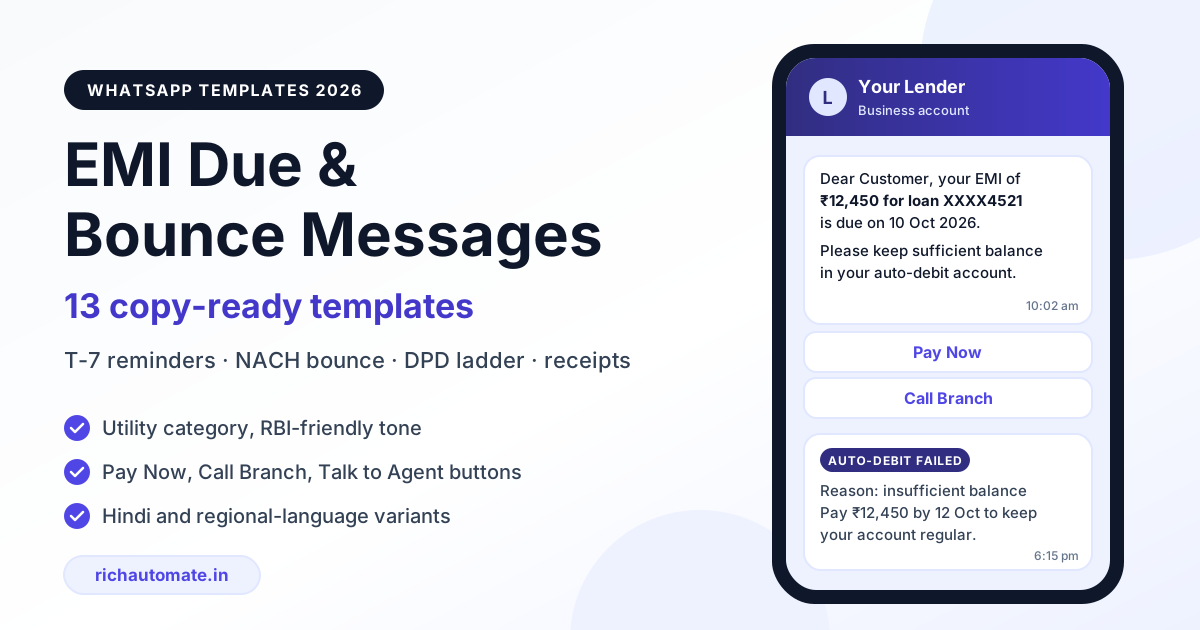
A good EMI due or EMI bounce message on WhatsApp states the borrower's name, masked loan account number, EMI amount and due date, and then gives one clear action: keep balance in the mandate account, or pay the missed amount through a secure Pay Now link. It must be sent as an approved Utility template, stay polite and factual, and never threaten the customer. This guide gives you 13 copy-ready templates for every stage, from the T-7 reminder to the 30 DPD notice, plus timing, cost and setup for Indian lenders in 2026.
Every template uses Meta's numbered variables ({{1}}, {{2}} and so on), so NBFCs, banks, MFIs, BNPL and gold-loan lenders can paste it into a template manager and submit it for approval.
What an EMI reminder message must contain
An EMI reminder message is a transactional WhatsApp notification that tells a borrower the amount, due date and payment route for an instalment on a loan they already hold. An EMI bounce message is the follow-up sent when the auto-debit (NACH, e-NACH or UPI AutoPay) is returned unpaid; it explains what failed and how to clear the dues.
Fields every EMI message needs
- Borrower name as it appears on the loan account.
- Masked loan account number, for example XXXX4521. Never send the full account number, PAN or Aadhaar.
- EMI amount and due date, in a format the borrower recognises (₹12,450 on 10 Oct 2026).
- Reason for failure on bounce messages, in plain language rather than a bank return code.
- Charges, only as disclosed in the loan agreement and Key Fact Statement.
- One clear action: keep balance in the mandate account, or pay through a secure link.
- Lender identity and helpline, so the borrower can verify the message is genuine.
The RBI conduct context
RBI's Fair Practices Code and its August 2022 recovery-agent instructions bar intimidation, harassment and abusive language, and limit calls to 8 am to 7 pm. They are written around calls and visits, but treat them as the floor for WhatsApp too.
RBI's 2023 penal-charges circular requires default charges to be levied as penal charges and disclosed upfront, so a bounce message should quote the charge exactly as disclosed. Formal notices and field visits belong in your recovery process; our guide to WhatsApp debt collection and loan recovery covers that workflow end to end.
Utility or Marketing: getting the template category right
EMI due, bounce, overdue and payment-received messages are Utility templates when they relate to an existing loan account. Meta treats Utility messages as updates about a specific transaction or account the customer already has, while Marketing covers offers, promotions and anything designed to sell. The category matters because Meta prices them very differently.
Under Meta's per-message pricing for WhatsApp, a Utility template sent inside an open 24-hour customer service window is free. Outside the window, India's Utility rate is approx. ₹0.115 per message against approx. ₹0.86 for Marketing (check Meta's current rate card).
Bolting a cross-sell onto a reminder ("You are also pre-approved for a top-up loan") turns it into Marketing, and Meta can reclassify the template. Keep offers in separate Marketing templates for opted-in borrowers. Approval-stage messages such as sanction and disbursal are covered in our loan approval message templates.
EMI due reminder message templates (T-7, T-3 and due day)
Pre-due reminders do most of the work in any collection strategy. A borrower who knows the amount and date in advance is far more likely to keep balance in the mandate account, which avoids a bounce, a charge and a follow-up cycle for you.
Template 1: T-7 upcoming EMI reminder
Category: Utility. Suggested name: emi_due_t7
Dear {{1}},

This is a reminder that the EMI of ₹{{2}} for your loan account {{3}} is due on {{4}}.

Please keep sufficient balance in your bank account linked to the auto-debit mandate before the due date.

For any query, reply to this message or call our helpline.
Buttons: Call Branch (phone), View Loan Details (URL)
Template 2: T-3 reminder with pay option
Category: Utility. Suggested name: emi_due_t3
Dear {{1}},

Your EMI of ₹{{2}} for loan account {{3}} is due in 3 days, on {{4}}.

The amount will be auto-debited from your bank account ending {{5}}. If you prefer to pay now, use the button below.

Thank you for choosing us.
Buttons: Pay Now (dynamic URL), Talk to Agent (quick reply)
Template 3: Due-day reminder
Category: Utility. Suggested name: emi_due_today
Dear {{1}},

Your EMI of ₹{{2}} for loan account {{3}} is due today, {{4}}.

If your auto-debit is active, just keep sufficient balance in the account. If you pay manually, please complete the payment today using the button below.

Please ignore this message if you have already paid.
Buttons: Pay Now (dynamic URL), Call Branch (phone)
EMI bounce message format: NACH and e-mandate failure templates
An EMI bounce happens when the lender's auto-debit is returned unpaid, usually for insufficient balance, an inactive mandate, a closed or frozen account, or a stop-payment. Your NACH bounce message should translate the return code into one of these plain reasons.
Template 4: EMI bounce alert (auto-debit failed)
Category: Utility. Suggested name: emi_bounce_alert
Dear {{1}},

The auto-debit of your EMI of ₹{{2}} for loan account {{3}}, due on {{4}}, could not be processed.

Reason: {{5}}

Please pay the EMI by {{6}} using the button below. If you have already paid, please ignore this message.
Buttons: Pay Now (dynamic URL), Talk to Agent (quick reply)
Template 5: Bounce charges with pay-now link
Category: Utility. Suggested name: emi_bounce_charges
Dear {{1}},

Your EMI for loan account {{2}} was returned unpaid on {{3}}.

EMI amount: ₹{{4}}
Bounce charges as per your loan agreement: ₹{{5}}
Total payable: ₹{{6}}

Paying by {{7}} helps you avoid further penal charges. Pay securely using the button below.
Buttons: Pay Now (dynamic URL), Call Branch (phone)
Template 6: Mandate inactive, set up a new one
Category: Utility. Suggested name: emi_mandate_reregister
Dear {{1}},

Your auto-debit mandate for loan account {{2}} is no longer active, so future EMIs of ₹{{3}} cannot be collected automatically.

To avoid missed EMIs, please set up a new mandate using the button below. You can complete it with net banking, a debit card or a UPI app.
Buttons: Set Up Mandate (URL), Talk to Agent (quick reply)
If you are moving borrowers onto UPI mandates, our guide to UPI AutoPay mandate reminders covers pre-debit notifications and mandate renewal flows.
EMI overdue message ladder: 1, 7, 15 and 30 DPD
Days past due (DPD) is the number of days since an EMI fell due and stayed unpaid. RBI's asset-classification norms tag overdue accounts as SMA-0 (up to 30 days), SMA-1 (31 to 60 days) and SMA-2 (61 to 90 days) before they become non-performing assets beyond 90 days, so the first 30 days are where a polite WhatsApp ladder does the most good.
Keep each step short. The tone moves from reminder to firm, but never to threat.
Template 7: 1 DPD
Dear {{1}}, your EMI of ₹{{2}} for loan account {{3}} was due on {{4}} and is still pending. Please pay today using the button below to keep your account regular. Ignore this message if you have already paid.
Template 8: 7 DPD
Dear {{1}}, your EMI of ₹{{2}} for loan account {{3}} is overdue by 7 days. The total amount now payable is ₹{{4}}, including charges as per your loan agreement. Please pay by {{5}}, or reply to speak with our team about your situation.
Template 9: 15 DPD
Dear {{1}}, the EMI on loan account {{2}} has been overdue since {{3}}. The outstanding amount is ₹{{4}}. Timely repayment helps maintain your credit history. If you are facing difficulty, tap Talk to Agent so we can discuss options.
Template 10: 30 DPD
Dear {{1}}, your loan account {{2}} has an overdue amount of ₹{{3}} pending for 30 days. Please clear the dues by {{4}} to bring your account back to regular status. You can pay online or visit your nearest branch during working hours.
Buttons: Pay Now and Talk to Agent on every step; add Call Branch at 15 and 30 DPD.
The ladder never mentions legal action, police, field visits or informing family or employer. Formal notices go through your legal process, not a template.
Get a 1-minute BSP audit on WhatsApp
Drop your WhatsApp number — we line-item your current invoice against Meta India rates in under 60 seconds. India-hosted, DPDP-compliant.
Payment received, foreclosure and Hindi EMI templates
Closing the loop matters as much as the reminder. A confirmation stops borrowers from paying twice, cuts "did my payment go through?" calls and gives both sides a timestamped record.
Template 11: EMI received confirmation
Category: Utility. Suggested name: emi_payment_received
Dear {{1}},

We have received your payment of ₹{{2}} towards loan account {{3}} on {{4}}. Thank you.

Next EMI: ₹{{5}} due on {{6}}.

Reply HELP if you need an updated statement.
Buttons: Download Statement (URL)
Template 12: Foreclosure and part-prepayment details (on request)
Category: Utility. Suggested name: loan_foreclosure_info
Dear {{1}},

As requested, here are the details for loan account {{2}} as on {{3}}:

Principal outstanding: ₹{{4}}
Foreclosure amount (valid till {{5}}): ₹{{6}}

Part-prepayment is also allowed as per your loan terms. Tap the button below to view the full statement or raise a request.
Buttons: View Statement (URL), Talk to Agent (quick reply)
RBI does not allow foreclosure or prepayment charges on floating-rate term loans to individual borrowers for non-business purposes, so never quote such a charge in that case.
Template 13: Hindi EMI due reminder
Category: Utility. Language: Hindi (hi)
नमस्ते {{1}},

आपके लोन खाते {{2}} की ₹{{3}} की EMI {{4}} को देय है।

कृपया ऑटो-डेबिट से जुड़े अपने बैंक खाते में पर्याप्त बैलेंस रखें। किसी भी सहायता के लिए इस संदेश का जवाब दें।
Buttons: अभी भुगतान करें (Pay Now, URL), शाखा को कॉल करें (Call Branch)
Submit regional templates under the right language code (hi, mr, ta, te, kn, bn, gu) with the same variable order as the English version.
When to send EMI reminders: timing and cadence ladder
Space messages so each carries new information. Repeating a reminder the same day mainly raises block and report rates, which hurt your number's quality rating.
| Stage | When | Template category | Suggested send time | Buttons |
|---|---|---|---|---|
| Pre-due reminder | T-7 | Utility | 10:00 am | Call Branch, View Details |
| Pre-due reminder | T-3 | Utility | 10:00 am | Pay Now, Talk to Agent |
| Due-day reminder | Due date | Utility | 9:00 to 10:00 am | Pay Now, Call Branch |
| Bounce alert | Within hours of the return file | Utility | Before 7:00 pm | Pay Now, Talk to Agent |
| Overdue nudge | 1 DPD | Utility | 11:00 am | Pay Now, Talk to Agent |
| Overdue follow-up | 7 and 15 DPD | Utility | 11:00 am to 5:00 pm | Pay Now, Talk to Agent, Call Branch |
| 30 DPD notice | 30 DPD | Utility | 11:00 am | Pay Now, Call Branch |
| Payment received | When the payment posts | Utility | Immediately; hold overnight credits till morning | Download Statement |
| Top-up or cross-sell offer | Separate campaign | Marketing | Business hours, opted-in borrowers only | Apply Now |
Tie the bounce alert to your NACH return cycle, and stop the ladder the moment a payment posts.
SMS vs WhatsApp vs IVR for EMI reminders, and cost per reminder
Most lenders already use SMS and IVR, so WhatsApp usually joins the mix rather than replacing it.
| Factor | SMS | WhatsApp Business API | IVR / voice call |
|---|---|---|---|
| Cost per contact | Low; varies by vendor and DLT route | Approx. ₹0.115 Meta Utility charge (check rate card) plus platform fee | Higher; billed per call or pulse by the vendor |
| Content | Short plain text | Rich text, buttons, documents, regional scripts | Recorded voice, keypad input |
| Pay Now action | Plain link, often distrusted | Tap-to-pay URL button under your business display name | Agent transfer, or a link sent separately |
| Two-way replies | Limited | Full chat with hand-off to an agent | Keypad options only |
| Proof of delivery | Delivery report | Delivered and read status (where read receipts are on) | Call connected and duration |
| Approval needed | DLT header and template registration | Meta template approval | Internal script review; RBI calling hours apply |
WhatsApp's edge is action: read, tap Pay Now and ask a question in one thread. Keep SMS as fallback.
Cost of one month's reminder cycle on RichAutomate
Example: a lender with 10,000 active loans sends three pre-due reminders and one payment confirmation per borrower each month, and assumes 800 bounced EMIs that each receive five follow-ups (bounce alert plus 1, 7, 15 and 30 DPD). That is 44,000 Utility messages. The bounce figure is an illustrative assumption, not a benchmark.
| Message group | Messages | Client Pay (Meta approx. ₹0.115 + ₹0.10) | SaaS Pay (₹0.50 per Utility message) |
|---|---|---|---|
| Pre-due reminders (T-7, T-3, due day) | 30,000 | approx. ₹6,450 | ₹15,000 |
| Payment-received confirmations | 10,000 | approx. ₹2,150 | ₹5,000 |
| Bounce alert and DPD ladder | 4,000 | approx. ₹860 | ₹2,000 |
| Total | 44,000 | approx. ₹9,460 | ₹22,000 |
RichAutomate charges ₹0 setup and a ₹0 monthly fee. On Client Pay you pay Meta's charge plus ₹0.10 per message; when the borrower has messaged you in the last 24 hours, Meta's Utility charge is zero and only the ₹0.10 applies. SaaS Pay is a flat ₹1.50 per Marketing and ₹0.50 per Utility message. Plans: Starter ₹499, Pro ₹899 and White-label ₹1,199 per month; see RichAutomate pricing for what each includes.
Mistakes that get EMI templates rejected or numbers flagged
- Threatening language. "Legal action", "police" or "we will inform your employer" breach RBI conduct norms and invite blocks and reports.
- Mixing offers into reminders. A top-up pitch inside an EMI reminder invites recategorisation to Marketing.
- Badly placed variables. Meta rejects templates that start or end with a variable, place variables back to back, or carry too many variables for the amount of text. Always keep a fixed sentence after the last variable.
- Missing or unrealistic samples. Submit real-looking sample values (₹12,450, XXXX4521, 10 Oct 2026) so the reviewer can see the message makes sense.
- No opt-in. Record WhatsApp consent in the loan application or at onboarding.
- Sharing sensitive data. Full account numbers, PAN, Aadhaar or bank balances do not belong in a WhatsApp template.
- Messaging third parties. Send dues only to the borrower and consenting co-borrowers or guarantors, never to references.
Even with clean templates, no provider can guarantee that a number will never be restricted; quality depends on consent, relevance and how borrowers respond. The same rules apply to card dues, and our credit card payment reminder messages guide follows an almost identical structure.
How to set up EMI reminders on RichAutomate
- Connect your WhatsApp Business API number. Going live needs a verified Meta Business account and GST registration; you can build and test on the free trial first.
- Create the templates above in the template manager, choose the Utility category, set the language and add sample values for every variable.
- Import borrowers with name, masked loan account, EMI amount, due date and payment link, or push them from your loan management system through the developer API.
- Schedule the ladder: T-7, T-3 and due-day campaigns, plus API-triggered bounce and payment-received messages driven by your NACH return and payment files.
- Route replies to your team in the shared inbox, so a borrower who taps Talk to Agent reaches a person during working hours.
- Review delivery and read status against your payment file.
If you are still comparing providers, our shortlist of the best WhatsApp Business API for NBFCs covers what lenders should check before signing up.
Ready to move EMI reminders to WhatsApp? Start your 14-day free trial with 100 credits. There is ₹0 setup and a ₹0 monthly fee, and you pay per message once you go live.