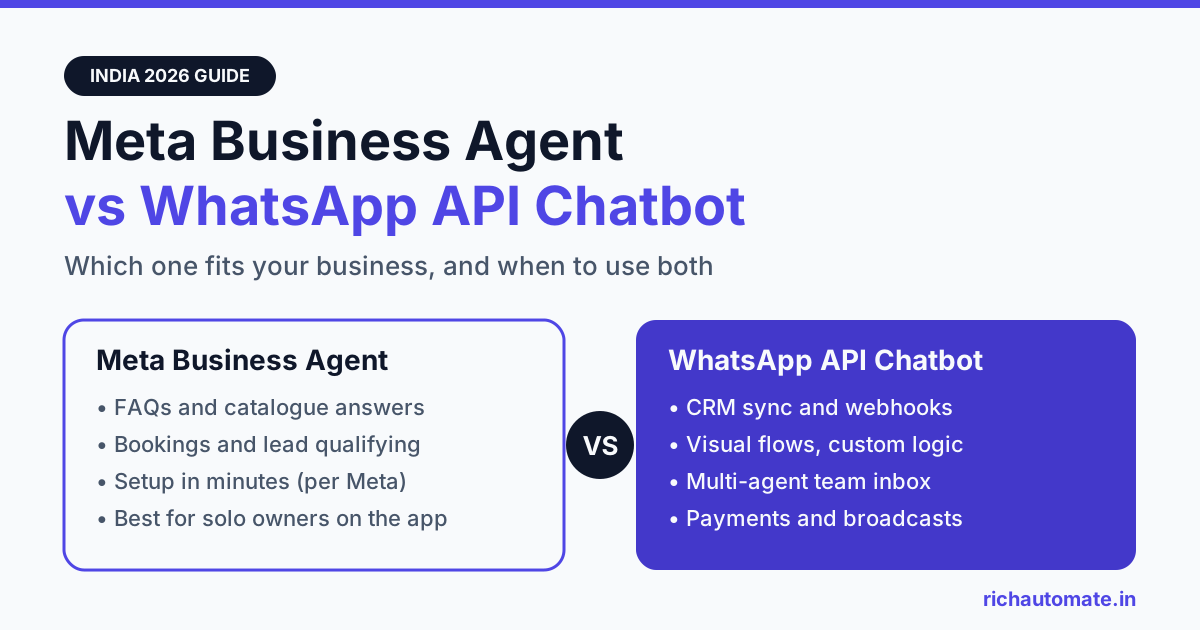
Meta Business Agent is Meta's own AI assistant that answers FAQs, recommends catalogue products, books appointments and qualifies leads inside WhatsApp, with setup Meta describes as taking minutes. A WhatsApp API chatbot built on a platform such as RichAutomate is the better fit when you need CRM sync, webhooks, multi-step flows, a multi-agent team inbox, payments and data you control, and many Indian businesses will end up using both.
Meta brought Business Agent to Indian WhatsApp Business users at its Business Summit in Mumbai in July 2026, according to reports at the time. That raises a fair question for every founder already paying for, or evaluating, a WhatsApp Business API chatbot: do you still need one? This guide compares the two honestly, using only what Meta and the news coverage actually say, and ends with a decision table you can use today.
What is Meta Business Agent?
Meta announced Meta Business Agent globally on 3 June 2026 at its Conversations event in London. In its own announcement on the WhatsApp Business blog, Meta says the agent:
- answers questions specific to your business;
- makes product recommendations from your catalogue;
- books appointments and qualifies incoming leads;
- helps close sales;
- lets you decide when a team member steps in to provide additional support;
- responds in the customer's local language using your tone.
Meta also describes a personal-assistant side: a morning briefing that catches the owner up on chats missed overnight, with insights on the threads. Meta says the agent can be "set up in minutes or plugged directly into your existing enterprise infrastructure", and that it is starting with a select number of businesses on the WhatsApp Business app, alongside Instagram, Messenger and Meta Business Suite.
For larger companies, Meta launched a separate Meta Business Agent Platform. Meta describes it as infrastructure for enterprises to build, customise and deploy agents at scale, connecting to "hundreds of systems like Shopify and Zendesk", with enterprise controls, guardrails and measurement built in. For businesses using WhatsApp, Meta says this "works alongside our Business Platform", meaning the WhatsApp Business Platform (the API).
The India launch
Deccan Herald reported that on 7 July 2026, at Meta's annual Business Summit in Mumbai, Meta launched Business Agent for Indian WhatsApp Business clients, rolled out in phases with a waitlist. The same report said Flipkart, Swiggy, Shopify, Zendesk and Shopee were among those signed up for the Business Agent Platform. India TV similarly reported the launch alongside new business discovery features, such as searching for a business by name inside WhatsApp. Meta has also said more than one million businesses have started using a Meta Business Agent on WhatsApp and Messenger. These are Meta's own figures as reported at launch, and we have not independently verified them.
What is a WhatsApp API chatbot?
A WhatsApp API chatbot runs on the WhatsApp Business Platform (Meta Cloud API), usually through a Business Solution Provider (BSP) or a SaaS layer on top of it. Instead of a single assistant inside the WhatsApp Business app, you get a programmable number: incoming messages arrive by webhook, your bot or flow decides what to send back, and every conversation can be routed to a shared inbox where several agents work from one number.
On a platform like RichAutomate, that means a visual drag-and-drop flow builder with branching, delays and API calls, a shared team inbox with assignment and take-over, template broadcasts with delivery and read reporting, and a public developer API with webhooks. If you are comparing builders, our guide to the best WhatsApp chatbot builder in India walks through what to test.
Meta Business Agent vs WhatsApp API chatbot: side-by-side
The table below sticks to what Meta has published and what an API platform structurally provides. Where Meta has not published a detail, we say so instead of guessing.
| Factor | Meta Business Agent | WhatsApp API chatbot (e.g. RichAutomate) |
|---|---|---|
| Who builds it | Meta. You supply business info, catalogue and tone | You or your team, with a visual flow builder or code |
| Setup effort | Meta says minutes | Hours to days, depending on how many flows and integrations |
| Where it runs first | WhatsApp Business app (select businesses first), plus Messenger, Instagram, Business Suite | WhatsApp Business Platform (Meta Cloud API) |
| Core strengths | FAQs, catalogue recommendations, bookings, lead qualification, local-language replies | Deterministic flows, CRM sync, webhooks, broadcasts, team routing, custom logic |
| Human handoff | You decide when a team member steps in | Rules-based assignment to named agents in a shared inbox |
| Integrations | Agent Platform connects to systems like Shopify and Zendesk (enterprise tier) | Any system with an API via webhooks; on RichAutomate, built-in Zoho CRM, Razorpay, Google Sheets and booking |
| Your data | Lives in Meta's surfaces; export options not detailed in the launch sources | Messages, contacts and events flow into your own systems by webhook |
| Pricing | Free to start; Meta says paid subscription offerings will follow. India pricing was not published in the sources we reviewed | Meta's per-message charges plus the platform's fee (RichAutomate figures below) |
Where Meta Business Agent is the right call
To be fair to Meta, its agent solves a real problem well. Most Indian small businesses on WhatsApp are a single owner and a phone, answering the same ten questions at 11 pm. For them, an assistant that reads the catalogue, replies in Hindi or Tamil in the owner's tone, books a slot and flags hot leads is a big step up from away messages.
Meta Business Agent is likely the better first move if:
- you run on the WhatsApp Business app and have no plans to move to the API yet;
- your questions are mostly product, price, timing and availability;
- you have one or two people replying, not a team that needs routing;
- you have no CRM, ERP or payment link that must update when a chat happens;
- you want something running this week with no build effort.
The morning briefing is also a genuinely useful idea for owner-operators who cannot read every thread. If that is your situation, start there, and come back to the API when you outgrow it.
Where a WhatsApp API chatbot wins
The gap opens once WhatsApp becomes part of a business process rather than just a conversation. These are the areas where an API chatbot is structurally stronger, whichever vendor you use.
1. CRM sync and webhooks
On the API, every inbound message, status update and button tap can fire a webhook into your stack. A lead captured on WhatsApp can create a record in your CRM, update a Google Sheet, or trigger a sales sequence. RichAutomate has built-in Zoho CRM and Google Sheets integrations, and other tools such as Shopify or WooCommerce connect through the public developer API and webhooks, or via Zapier, Make or Pabbly.
Get a 1-minute BSP audit on WhatsApp
Drop your WhatsApp number — we line-item your current invoice against Meta India rates in under 60 seconds. India-hosted, DPDP-compliant.
2. Multi-step flows you control
An AI assistant is good at open questions. It is less suited to processes that must happen in a fixed order every time: KYC document collection, a loan eligibility check, a test-drive booking that needs a branch, date and slot, or a returns flow with order lookup. A visual flow builder lets you design exactly those steps, with buttons, list menus, branching and delays, and know that every customer gets the same path.
3. A multi-agent team inbox
Once five or fifty people answer from one number, you need assignment, take-over, internal notes and response-time visibility. The API is built for that model. On RichAutomate, multiple agents work the same WhatsApp numbers with assignment, take-over and SLA badges, and quick replies are inserted with a "/" shortcut.
4. Data ownership and reporting
With an API setup, your conversation history, contact attributes and campaign results can be stored in systems you control and joined with your sales data. That matters for attribution, audits and compliance reviews. The launch sources for Meta Business Agent did not describe export or data-portability options, so check Meta's current terms if this matters to you.
5. Payments inside the chat
Collecting a booking fee or an order payment is a common Indian WhatsApp use case. RichAutomate has a built-in Razorpay integration, so a flow can send a payment link and react when it is paid.
6. Custom logic and broadcasts
API calls inside flows let the bot check stock, look up an order or fetch a quote from your own system before replying. And outbound template broadcasts to opted-in segments, with delivery and read reporting, are an API capability that sits outside what Meta has described for Business Agent.
Cost: what each option actually charges
On Meta Business Agent, Meta's announcement says getting started is free and that "in the coming months, businesses will access the agent through our paid subscription offerings". Some vendors have since written about token-based billing for Meta's AI, but Meta's India pricing for Business Agent was not published in the sources we reviewed, so we are not quoting a number. Check Meta's own pages before you budget.
On the API side, you pay Meta's per-message charges for template messages, plus whatever your platform charges. Here is how RichAutomate's model works:
| Item | RichAutomate |
|---|---|
| Setup fee | ₹0 |
| Monthly fee (pay-as-you-go) | ₹0 |
| Client Pay | Meta bills you directly for messages; RichAutomate charges ₹0.10 per message |
| SaaS Pay | ₹1.20 per marketing message, ₹0.30 per utility message, all billed by RichAutomate |
| Optional plans | Starter ₹499 · Pro ₹899 · White-label ₹1,199 |
See the full breakdown on our WhatsApp API pricing page. If you are also weighing AI usage costs across vendors, our WhatsApp AI agent and chatbot pricing guide for India explains how per-message and AI charges stack up.
Should you use both? A decision table
These are not mutually exclusive in principle. Meta says the agent works alongside its Business Platform, and many businesses run a WhatsApp Business app number and an API number for different jobs. Use this table to decide.
| Your situation | Best fit | Why |
|---|---|---|
| Solo owner on the WhatsApp Business app, mostly FAQs and catalogue questions | Meta Business Agent | Fastest setup, nothing to build, replies in the customer's language |
| Team of 3+ answering from one number | API chatbot | Shared inbox, assignment and take-over |
| Leads must land in Zoho CRM or Google Sheets automatically | API chatbot | Built-in integrations and webhooks |
| Fixed processes: KYC, bookings with slots, order status, returns | API chatbot | Visual flows give the same path every time |
| You collect payments in chat | API chatbot | Razorpay inside the flow |
| You send template broadcasts to opted-in lists | API chatbot | Campaigns with delivery and read reports |
| Enterprise with its own engineering team and Shopify or Zendesk stack | Evaluate Meta Business Agent Platform and an API stack together | Meta's enterprise platform plus your own integrations |
| Small shop now, team and campaigns in six months | Both, in sequence | Start on the app with Meta's agent, move the main number to the API when routing and CRM matter |
How to evaluate before you commit
Whichever route you lean towards, run the same test. Write down your twenty most common customer questions and five processes that must happen in order. Then check:
- Accuracy: does the bot answer from your content, and what does it do when it does not know?
- Handoff: how does a human take over, and does the customer notice the switch?
- Integrations: where does the lead go after the chat ends?
- Control: can you see, edit and audit every automated reply?
- Cost at scale: what do 10,000 conversations a month cost, all in?
Our WhatsApp AI agent evaluation checklist turns this into a scorecard you can use with any vendor, Meta included.
Where RichAutomate fits
RichAutomate is a WhatsApp Business API platform for Indian businesses on the official Meta Cloud API. Live today: the visual chatbot flow builder, shared team inbox, quick replies, template broadcasts, the public developer API with webhooks, and built-in Zoho CRM, Razorpay, Google Sheets and booking. Our own WhatsApp AI agent is in development with an early-access waitlist. It is being designed to answer from your knowledge base, qualify leads and hand off to a human in the shared inbox when it is not confident.
That is the honest split: if you want an AI assistant on the WhatsApp Business app today, Meta's agent is a reasonable thing to try. If you need WhatsApp wired into your CRM, payments and team, the API is where that work happens.
Start free on RichAutomate with ₹0 setup and ₹0 monthly fee, build your first flow, and connect your number to the official API.
Bottom line
Meta Business Agent vs chatbot is not a winner-takes-all choice. Meta's agent lowers the barrier for small businesses to get useful AI replies on WhatsApp with very little effort, and Meta is also courting enterprises through its Agent Platform. A WhatsApp API chatbot remains the stronger option when WhatsApp has to drive a process: CRM updates, structured flows, many agents on one number, payments, broadcasts and data you own. Pick by workload, not by hype, and expect to revisit the decision as Meta publishes pricing and expands the rollout.
Sources: Meta's WhatsApp Business blog, "Conversations 2026: Introducing Meta Business Agent on WhatsApp" (3 June 2026); Meta newsroom (Latin America edition), Conversations 2026 announcement; Deccan Herald (7 July 2026); India TV (8 July 2026); Business Today (3 June 2026). Product details reflect those reports at launch and may have changed since.