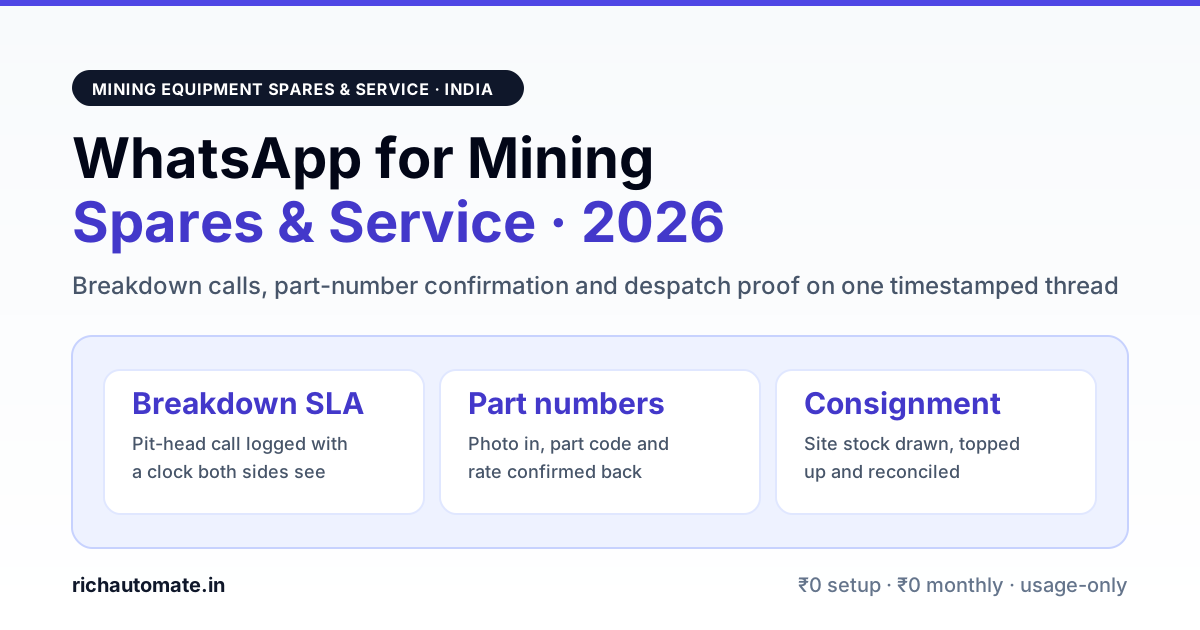
Mining equipment spares and service businesses in India use the WhatsApp Business API for three jobs a phone call keeps losing: the breakdown call from a pit-head that needs a timestamp both sides accept, the part-number confirmation that starts as a blurry photo of a worn component, and the despatch proof that tells a mine manager the part is actually moving. The setup is a verified business number, six to eight approved templates and a shared inbox — no per-seat licence, no setup fee and no monthly minimum.
This guide is written for the people who keep Indian mines running: the dealer stocking undercarriage, GET and filtration for a fleet of excavators and dumpers, the authorised service franchise covering three districts with four field engineers, the hydraulic and transmission rebuild shop, and the OEM regional office holding consignment stock at a customer site. The enquiries already arrive on WhatsApp — usually on a service engineer's personal phone. What is missing is the discipline: a business number that survives a resignation, templates that say the same thing every time, and a thread you can open eight months later when a warranty claim or a downtime penalty is argued.
Why mining spares enquiries already live on WhatsApp
The economics of this trade push every conversation onto a phone. A single dumper or shovel carries thousands of serviceable part numbers across undercarriage, ground-engaging tools, filters, hoses, seals, electricals and wear liners. The person who notices the failure is a shift operator or a site mechanic standing in dust with gloves on, not a buyer in front of a procurement portal. They photograph the part, send it, and expect a number back.
Distance makes it worse. Most Indian mining clusters — the coal belts of Jharkhand, Odisha and Chhattisgarh, the iron-ore districts of Karnataka and Odisha, the limestone and aggregate belts feeding cement plants across Rajasthan and Andhra Pradesh — sit hours from the dealer's warehouse and further from the OEM depot. A voice call at a pit-head is frequently unusable: engine noise, a drop to 2G, a shift change mid-sentence. A message survives all three. It also survives the thing voice never does — it is still there tomorrow, with a time on it.
The same pattern shows up next door in the aggregates trade. Operators running fixed and mobile crushing plants already handle WhatsApp for stone crusher and quarry aggregates enquiries this way, and equipment rental desks running the same customer base do it for crane, hydra and earthmoving equipment rental. Spares and service is the harder version of both, because the clock is running while the conversation happens.
The breakdown call: what a pit-head message must carry
A breakdown message that arrives as “dumper down, send man” costs the dealer a day. The fix is not a longer form, it is four fields asked once, in the first reply, as an interactive list or a short flow inside WhatsApp rather than free text.
Ask for the machine model and serial or fleet number, the symptom in one line, whether the machine is stopped or derated, and the site location with a shift contact. That is enough for a service coordinator to decide between three responses: a part goes out today, an engineer travels tomorrow morning, or this is a warranty case that needs an OEM claim opened first. Everything else can be asked after that decision, not before it.
The part that changes behaviour is the acknowledgement. When the customer receives a written confirmation carrying a ticket reference, a named coordinator and the response the dealer has actually committed to, the follow-up calls stop. Most of the noise in a service desk is not customers asking for help — it is customers checking whether the first message was seen.
Confirming part numbers without a catalogue portal
Almost no site mechanic in India knows the OEM part number for the item in their hand. They know what it does and roughly where it sits. So the practical workflow is photo-in, number-out: the customer sends an image and the machine serial, the parts desk identifies it against the catalogue, and replies with the confirmed number, the description, availability and the landed rate.
The rule that prevents disputes is simple: never let a part number travel by voice. Read back every number in writing before it is picked. A transposed digit on a filter element is a cheap mistake; the same slip on a travel motor seal kit means a second machine-day lost, and by then the customer remembers a promise nobody can produce.
| What arrives | What the desk must confirm back in writing |
|---|---|
| Photo of a worn part, no number | Part number, description, machine model it fits, and the serial range it was matched against |
| Part number typed by the customer | Whether it supersedes to a newer number, and the superseded number in full |
| “Same as last time” | The exact part number and quantity from the previous invoice, restated — never assumed |
| Urgent breakdown requirement | Stock location, despatch cut-off time today, and the transporter or courier route |
| Genuine-versus-aftermarket query | Which one is being quoted, the warranty that applies to it, and the price difference stated plainly |
Dealers who already run this loop for road fleets will recognise the shape of it — it is the same discipline described in the WhatsApp Business API guide for auto spare parts dealers, scaled up to parts that cost lakhs and machines that bill by the hour.
Breakdown SLA at remote pit-heads
Service contracts in mining are usually written around response and restoration times, and the gap between them is where relationships break. Response is when your engineer or part starts moving. Restoration is when the machine works again. Customers remember the second number; contracts often only measure the first.
A messaging thread makes both measurable without any new software, because every event on it carries a timestamp neither side controls. Log the call received, the diagnosis committed, the part despatched, the engineer at site and the machine released — five messages on one thread. At month end that thread is the service review. It is also the only defensible position when a customer claims eleven hours of downtime and your records show the part left the warehouse ninety minutes after the first message.
Be careful about what you promise in that acknowledgement template. A response window you can hold in the monsoon, on a road that floods, with one engineer already committed elsewhere, is worth more than an aggressive number you miss twice. Field-service desks in other trades hit the same wall — air compressor dealers running AMC contracts land on the same conclusion about promising what the rota can actually deliver.
Consignment stock at the mine site
Large mines increasingly ask the dealer to hold consignment stock on site — fast-moving filters, hoses, GET, belting clips and common electricals sitting in the customer's store, owned by the dealer until drawn. It removes the transit day from the most common failures. It also creates a reconciliation problem that spreadsheets lose.
The workable pattern is a weekly draw statement on the same thread: what was consumed, what remains, what is being topped up, and what needs a purchase order raised against it. Send it as a document on a scheduled day, to the store in-charge and the maintenance head together, and keep the consumption confirmation in writing. When the quarterly reconciliation happens, the argument is settled by the thread rather than by memory.
Get a 1-minute BSP audit on WhatsApp
Drop your WhatsApp number — we line-item your current invoice against Meta India rates in under 60 seconds. India-hosted, DPDP-compliant.
Two failure modes are worth naming. Stock that nobody draws is a financing cost the dealer carries silently, so review slow lines every quarter and pull them back. And consignment without a written top-up trigger means the shelf runs empty exactly when a machine stops — agree the reorder level per line, in writing, when the arrangement starts.
Safety, statutory paperwork and what not to claim
Mining in India is a regulated workplace, and equipment vendors are pulled into that paperwork whether they want to be or not. Site entry usually requires worker documentation, safety induction records and equipment or tool clearances before an engineer is allowed near a working face, and the specifics vary by mine, by mineral and by the operator's own safety management plan.
Treat the statutory detail carefully. Requirements administered under India's mine-safety regime through the Directorate General of Mines Safety change over time and are applied differently across mines, so the honest position for a spares and service business is to hold the customer's actual site requirements on file rather than quoting a clause. Do not let a template assert a legal obligation, a test interval or an approval status you have not verified against the current rules or the specific mine's own policy — ask the site, record the answer, and repeat it back.
What WhatsApp does well here is document custody. Induction certificates, engineer identity documents, test certificates for lifting tackle, calibration records and job completion reports all arrive as files and stay attached to a dated thread. When a site audit asks who was on site on which date with which clearance, that thread answers faster than an email archive nobody has kept.
The templates worth approving first
Most dealers over-build here. Six to eight templates cover the entire service cycle; the rest of the conversation happens inside the twenty-four-hour window and needs no approval at all.
| Template | Category | When it fires |
|---|---|---|
| Breakdown call acknowledged | Utility | Immediately on a new service request, carrying ticket number and coordinator name |
| Quote issued | Utility | Part number, rate, availability and validity sent for approval |
| Order confirmed | Utility | On purchase order or written approval received |
| Despatch notice | Utility | Invoice, e-way bill reference, transporter and expected arrival |
| Engineer assigned | Utility | Name, contact and travel plan, sent to the site contact |
| Job completion report | Utility | Work done, parts consumed, machine released, signature captured |
| Service due reminder | Utility | Hour-meter or calendar based, ahead of the scheduled interval |
| New product or scheme circular | Marketing | Opted-in contacts only, with a working opt-out |
Keep the marketing template rare and genuinely useful. A parts desk that broadcasts monthly offers to every site contact it has ever messaged trains people to block the number, and a blocked number is a breakdown call you never receive. If you are unsure where a message sits, the practical test is whether the customer asked for it — a despatch notice they are waiting on is utility, a scheme they did not request is marketing.
What it costs to run
Pricing is usage-only. There is no setup fee and no monthly platform charge on RichAutomate, so a small dealer running a few hundred conversations a month pays a small number and a regional OEM office running thousands pays proportionally more.
| Item | Client Pay | SaaS Pay |
|---|---|---|
| Setup | ₹0 | ₹0 |
| Monthly platform fee | ₹0 | ₹0 |
| Platform charge per message | ₹0.10 | Included |
| Marketing message | Meta rate billed to your own account, plus ₹0.20 per conversation window | ₹1.20 |
| Utility message | Meta rate billed to your own account, plus ₹0.20 per conversation window | ₹0.30 |
Client Pay means you hold the Meta billing relationship and pay Meta's India rates directly, with a platform charge on top. SaaS Pay is a single all-in per-message rate with nothing to reconcile. A service business sending mostly utility messages — acknowledgements, despatch notices, completion reports — usually lands in the low hundreds to low thousands of rupees a month, which is less than the fuel for one avoidable site visit.
One compliance point that is not optional: a GST registration is required to take a WhatsApp Business API number live. You can trial without one, but going live needs it. Anyone telling you otherwise is describing a setup that will stall at verification.
A thirty-day rollout that actually finishes
Week one is the business number and verification. Use a number the company owns, not an engineer's personal SIM — the whole point is that the thread outlives the person. Complete Meta business verification and get the display name approved before building anything else, because a rejected display name blocks everything downstream.
Week two is the six utility templates above, written in plain English, with variables for ticket number, part number, machine serial and dates. Get them approved before you write any automation; template rejections are the single most common reason a rollout drifts from four weeks to four months.
Week three is the shared inbox and the routing rules. Decide who owns a new breakdown thread, what happens when they are on leave, and how a thread moves from the parts desk to the service coordinator without the customer repeating themselves. This is an operations decision, not a software one, and skipping it is why most deployments quietly revert to personal phones.
Week four is migration. Move your live customers across in batches, tell them the new number in advance, and keep the old phone answering for a month with a message pointing at the business number. Contractors running mobile fleets do this constantly — the same sequence appears in the WhatsApp playbook for borewell drilling contractors, where the field team and the office share one customer thread.
Where this goes wrong
Three failure modes account for nearly every stalled rollout. The first is a template library that grew to thirty entries, half of them near-duplicates, which means nobody knows which to send and staff go back to typing free text. Keep it under ten and delete aggressively.
The second is promising a response time the rota cannot hold. One missed acknowledgement teaches a mine manager that the thread is decoration. Promise what you can hold in the worst week of the year, not the best.
The third is broadcasting. Bulk sends to contacts who never opted in get reported, and enough reports degrade the quality rating on the number your service desk depends on. No vendor can promise immunity from that — the only real protection is sending messages people actually want, keeping the opt-out working, and treating the breakdown thread as the asset it is.
Get those three right and the outcome is unglamorous and valuable: fewer follow-up calls, part numbers that do not have to be re-confirmed, a downtime record both sides accept, and a service history that stays with the company rather than walking out with an engineer.