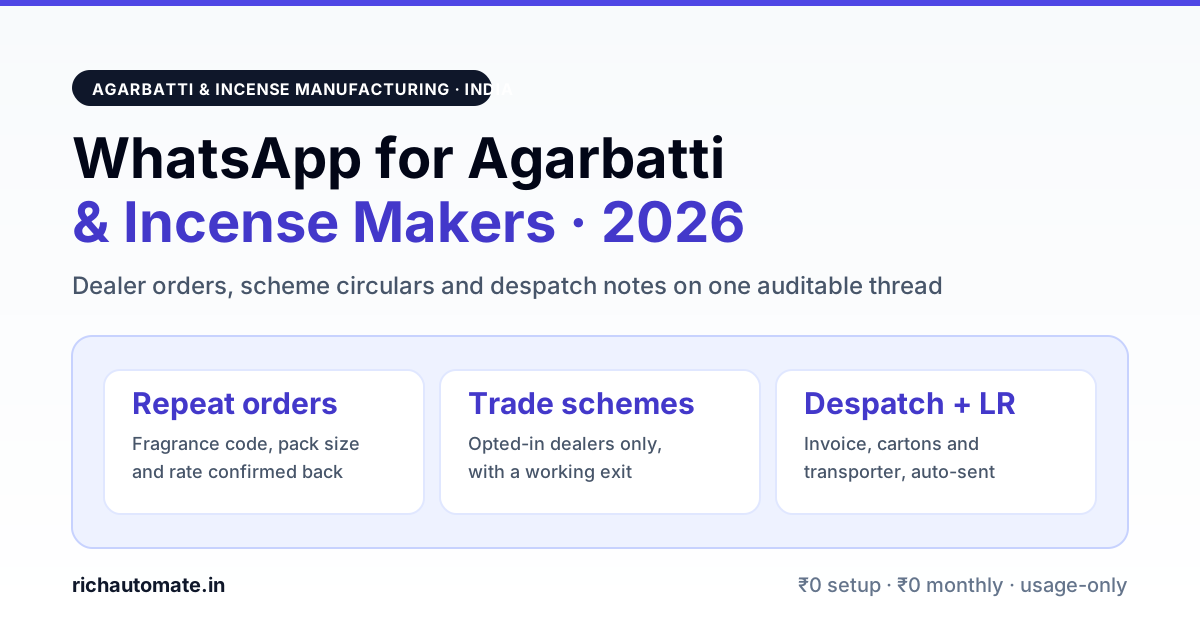
Agarbatti and incense manufacturers in India run three things on the WhatsApp Business API that phone calls and paper keep losing: the distributor's repeat order with the right fragrance code and pack size, the monthly scheme circular that has to reach four hundred dealers without becoming spam, and the packing-and-label query that arrives as a photo an hour before a despatch. The setup is a verified business number, six to eight approved templates and a shared inbox — no per-seat licence, no setup fee and no monthly minimum.
This guide is written for the people who actually make and move incense: the mid-sized roller in Bengaluru or Ahmedabad running contract labour, the dhoop and cone unit selling through a two-tier distributor network, the exporter shipping to the Gulf and the US, and the house brand that sells on WhatsApp direct to shopkeepers. The enquiries already arrive on WhatsApp. What is usually missing is the discipline: a business number instead of the sales manager's personal SIM, templates that survive a staff change, and a thread you can pull up six months later when a dealer disputes a scheme.
Why agarbatti orders already live on WhatsApp
Incense is a high-SKU, low-ticket, high-frequency business. A single brand can carry sixty fragrances across zipper packs, boxes, hex packs and economy bundles, and a kirana dealer reorders every ten to fifteen days in quantities that never justify a formal purchase order. Nobody is raising a PO for eight cartons of sandal and four of mogra. They send a message.
That message usually goes to a personal number. When the area sales officer changes territory, resigns or simply stops answering on a Sunday, the order history, the negotiated rate and the relationship all leave with them. On a WhatsApp Business API number the same conversation lands in a shared inbox that your order desk, your despatch clerk and your accounts person can all open — and it stays with the company.
The second reason is the scheme. Incense runs on trade schemes: buy ten cartons get one, festival-season slabs, a new fragrance push with a display allowance. Those announcements go out as broadcasts, and doing that badly is how numbers get reported and restricted. Doing it properly means opt-in, template approval and a working exit — the same discipline any FMCG distribution network on WhatsApp has to build before it scales.
The six conversations that run an incense business
Map your automation to these six and you have covered most of the daily volume. Everything past this is decoration.
| Conversation | Who starts it | What must go back | Automatable? |
|---|---|---|---|
| Repeat order from a dealer | Dealer, often as a voice note or a photo of the last bill | Line-by-line confirmation with pack size, rate and despatch date | Partly — auto-acknowledge, human confirms stock |
| Price list and fragrance catalogue | New or existing dealer | Current list with pack sizes and MRP, dated | Yes — template plus PDF or catalogue |
| Scheme and festival offer | You, on a cycle | Slab, validity dates, how to claim | Yes — marketing template to opted-in dealers |
| Despatch and LR details | You, at despatch | Invoice number, carton count, transporter and LR number | Yes — utility template fired from despatch |
| Packing, label or quality query | Dealer or QC, usually a photo | A human answer, often with an internal check first | No — acknowledge only |
| Payment and outstanding reminder | You, on ageing | Amount, invoice reference, a way to respond | Yes — utility template, never aggressive |
Notice the split. The four that are fully automatable are all events your own system already knows about — an invoice was raised, a consignment left, a payment is overdue, a scheme went live. The two that are not are the ones where a wrong answer costs you a dealer.
Distributor and dealer ordering, done properly
The single biggest win is turning the repeat order from a voice note into a structured message. Most incense units start by sending a numbered fragrance list and asking dealers to reply with codes and quantities: SND-12 x 4, MOG-08 x 2. It is unglamorous and it works, because the dealer is standing in a shop and will not open a portal.
Once that habit sticks, an interactive list or a simple ordering flow inside WhatsApp reduces the typing further. Keep the list short — your top fifteen SKUs cover most reorders, and the long tail can stay a conversation. A catalogue with photos helps for new fragrances, where the dealer is deciding on packaging appeal rather than reordering a known seller.
Three rules save arguments later. Confirm every order back in writing with rate and pack size, because "the usual rate" means different things to a dealer and to your accounts team. Put the despatch date in the confirmation, not a vague "soon". And keep the confirmation on the business number, so the thread survives your area manager's next transfer.
Schemes, price lists and the broadcast that does not get you reported
Scheme announcements are marketing-category messages, and marketing is where numbers get into trouble. The failure mode is always the same: someone exports a list of dealer numbers collected over years, blasts a festival offer, and a handful of recipients who never asked for it hit "Block" or "Report". Enough of those and quality rating drops, then messaging limits tighten.
What actually keeps a number healthy is boring. Collect opt-in explicitly — a dealer who messages you first, or ticks a box on your dealer form, is opted in; a number on an old visiting card is not. Keep the send list to people who transact with you. Make the exit obvious and honour it immediately, which is the whole of opt-out and STOP keyword handling. And understand your sending tier before a festival push, because broadcast limits and tiers decide how many unique dealers you can reach in a rolling day.
One honest caution: no provider can promise you will not be restricted for unsolicited bulk sends. Anyone who does is selling you something. The protection is consent and relevance, not a clever workaround.
Packing, labelling and the claims you should not make on chat
Incense is a packaged consumer good, and packaged goods in India carry declaration requirements on the retail pack — things like the manufacturer or packer identity, net quantity, the retail sale price and consumer-care contact details. The exact wording, the exemptions for small packs and the way net quantity has to be expressed are governed by the packaged-commodities rules and are revised periodically, so treat your packaging artwork as a question for your compliance consultant or lawyer rather than something to settle in a WhatsApp thread. We have written separately about the operational side of Legal Metrology packaged-goods compliance on WhatsApp.
Get a 1-minute BSP audit on WhatsApp
Drop your WhatsApp number — we line-item your current invoice against Meta India rates in under 60 seconds. India-hosted, DPDP-compliant.
What WhatsApp genuinely helps with is the evidence trail. When a dealer sends a photo saying the MRP on a carton does not match the invoice, or that a batch has a smudged declaration panel, that photo, the time it arrived, and what you told the dealer to do are all sitting in one thread attached to one number. In a dispute six months later, that is worth more than anyone's memory of a phone call.
Two things to keep off chat. Do not let staff improvise claims about a fragrance being natural, herbal, charcoal-free or safe in ways your pack does not already state — product claims belong on approved packaging, not in a sales rep's message. And do not quote GST rates, HSN classifications or export-incentive eligibility from memory; route those to your CA and send the dealer the invoice, which carries the authoritative number anyway.
Export enquiries and the overseas buyer
A large share of Indian incense output goes abroad — Gulf markets, the US, Southeast Asia, parts of Africa — and the first contact from an importer is very often WhatsApp, because it is cheaper and faster than international calls and leaves a written record both sides can re-read.
Export threads have a different shape from domestic ones. The buyer wants a specification sheet, a sample despatch, a price on an agreed incoterm, and clarity on minimum order quantity and lead time. The mistake units make is answering these ad hoc, so three enquiries get three slightly different MOQs. Fix it by keeping one current export enquiry response — product range, MOQ, lead time, sample policy, documentation you can provide — and sending that same block every time, then negotiating from it.
Do keep the commercial commitments deliberate. An importer screenshotting "yes we can do that price" is a negotiating position you may not want to hold. Confirm price and terms in a proforma invoice, and use WhatsApp for the speed of the conversation, not as the contract.
Coordinating rollers, contract units and home-based workers
Most agarbatti production is not one factory floor. It is a core unit plus contract rollers, self-help groups and home-based workers who collect raw batti and masala, work, and return finished stock. Coordinating that on individual phone calls is how units lose a day a week.
A group or a broadcast to the coordinators handles most of it: raw material is ready for collection, this week's rate for a given count, the collection date, the payment run. Keep worker communication on a separate list from dealer communication — different content, different frequency, and mixing them is how a trade scheme ends up in front of the wrong audience.
Be careful with two things here. Payment and rate conversations touch people's livelihoods, so send them from the business number with a named human behind it, not an anonymous automation. And do not collect more personal data than you need in chat; a name, a number and a worker code is plenty for coordination.
What it actually costs
The pricing that matters is per-conversation, set by Meta, plus whatever your provider charges on top. India rates as of this writing sit at roughly ₹0.8631 for a marketing conversation and about ₹0.115 for utility and authentication. Meta revises these periodically, so check the current India rate card before you budget a year ahead.
| Item | Client Pay (your own Meta billing) | SaaS Pay (we bill you all-in) |
|---|---|---|
| Setup fee | ₹0 | ₹0 |
| Monthly platform fee | ₹0 | ₹0 |
| Per message | ₹0.10 platform fee | ₹1.20 marketing / ₹0.30 utility |
| 24-hour service window | ₹0.20 window charge, once per window | Included in the per-message rate |
| Meta conversation charge | Billed by Meta to your card | Included |
| Users in the shared inbox | No per-seat charge | No per-seat charge |
For a unit sending despatch notices, order confirmations and a monthly scheme circular to a few hundred dealers, the realistic monthly bill lands in the low hundreds to low thousands of rupees depending on how much of it is marketing rather than utility. The lever is category: keep operational messages in the utility category and save marketing sends for the schemes that actually move stock. Fuller numbers, including how the window charge behaves, are in our breakdown of WhatsApp Business API pricing in India.
The templates to get approved first
Submit these together rather than one at a time — a batch tends to clear faster than a trickle, and you want them live before your first festival cycle, not during it.
| Template | Category | Fires when |
|---|---|---|
| Order received acknowledgement | Utility | Dealer order logged at the desk |
| Order confirmed with rate and date | Utility | Stock checked and allocated |
| Despatch with LR and carton count | Utility | Consignment handed to the transporter |
| Payment reminder with invoice reference | Utility | Invoice crosses agreed credit days |
| Monthly price list or catalogue update | Marketing | Price revision or new fragrance launch |
| Festival or trade scheme announcement | Marketing | Scheme window opens |
| New dealer welcome and terms | Utility | Dealer onboarded |
Write them plainly and keep the variables few. Templates fail approval most often for promotional language dressed up as utility, or for placeholders that could be filled with anything. A despatch template that says the invoice number, the carton count, the transporter and the LR number will clear; one that adds "order more today for the best rates" will not clear as utility.
Getting live in a week
The sequence is short. Pick a number that is not already running on the consumer WhatsApp app, or migrate it and accept the brief downtime. Complete Meta Business verification with your registration documents — and note that GST registration is required to go fully live on the WhatsApp Business API in India, even though a trial can start without it. Draft the seven templates above and submit them as a batch. Connect the number, put your order desk and despatch clerk in the shared inbox, and run one full week of real dealer traffic before automating anything.
Then measure one number: what share of dealer messages got a reply inside thirty minutes during working hours. In a business where a dealer can reorder from the brand next to yours on the same shelf, response time is the metric that quietly decides repeat volume. Everything else on the dashboard is commentary.
If you already run adjacent categories through the same office — pooja items, camphor, home fragrance, packaged foods — the same number and the same inbox usually absorb them without a second setup, which is the point at which the shared-record argument stops being theoretical and starts saving your team an hour a day.