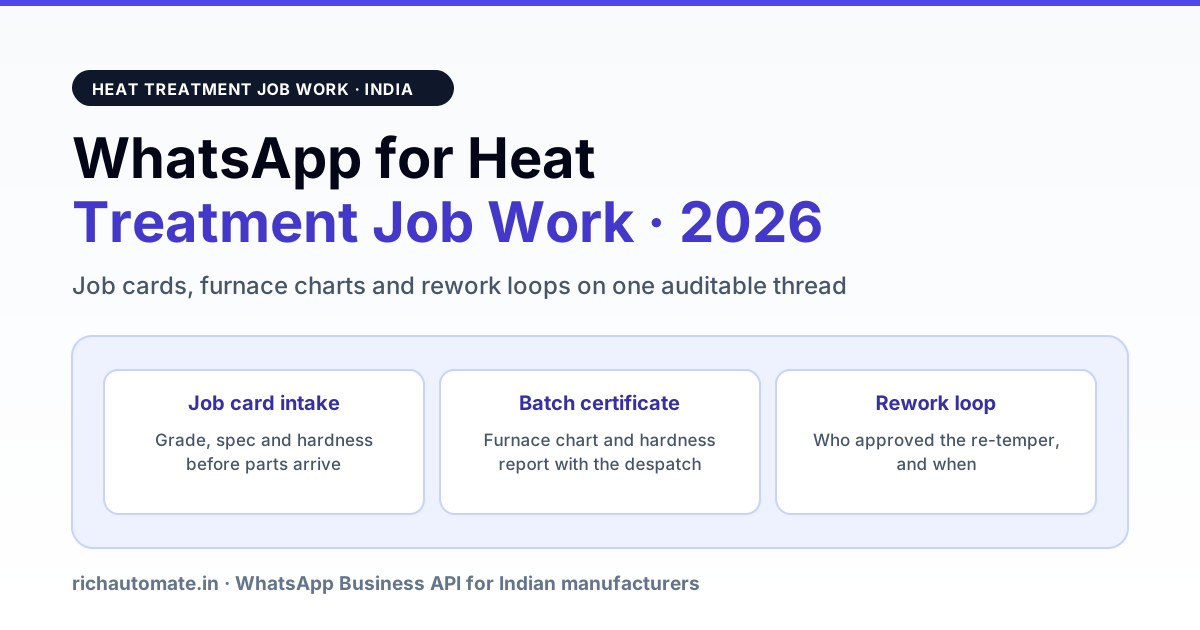
Heat treatment and metal-finishing job shops in India run on the WhatsApp Business API for three things a phone call keeps losing: taking a job card with the right grade and hardness spec before the parts turn up, sending the furnace chart and hardness report with the despatch, and recording who approved a re-temper when a batch comes back. The setup is a verified business number, six to eight approved templates and a shared inbox — no per-seat licence, no setup fee and no monthly minimum.
This is a working guide for shops running sealed-quench, pit, box or vacuum furnaces, induction hardening lines, nitriding and carburising cells, or the finishing bays around them. If your customer is a forging house, a CNC shop, an auto-component tier-2 or a gear manufacturer, the enquiry already arrives on WhatsApp. The gap is discipline: a business number instead of the supervisor's personal SIM, templates that survive a shift change, and a thread you can pull up nine months later when a customer disputes a case depth.
Why heat treatment enquiries already live on WhatsApp
Job work is a trust business conducted in a hurry. A customer's production line is waiting on a batch, so the person chasing you is a planner or a store in-charge who wants an answer in minutes, not a purchase-order thread that takes two days. They send a photo of the challan, ask whether you can take 400 pinion blanks by Thursday, and expect a yes or no.
On a personal number, that conversation belongs to one supervisor. When the supervisor is on night shift, on leave or resigns, the thread and the relationship leave with them. On a WhatsApp Business API number the same conversation lands in a shared inbox that your commercial staff, your metallurgist and your despatch clerk can all open — and it stays with your company, not with an individual.
That is the honest reason most job shops move. It is the same shift that electroplating and powder-coating job shops and CNC machining job work shops made first, and for the same reason: the customer relationship should not be sitting on a private phone.
The five conversations that decide a heat treatment job
Map your automation to these five and you have covered most of the daily volume. Anything past this is decoration.
| Conversation | Who starts it | What must go back | Automatable? |
|---|---|---|---|
| Capacity and slot enquiry | Customer planner, often with a photo of the part | Yes or no on the date, plus the cut-off time for material inward | Partly — auto-acknowledge, human confirms the slot |
| Job card confirmation | You, once the enquiry is real | Grade, process, target hardness or case depth, quantity, challan number | Yes — utility template with variables |
| Material inward acknowledgement | You, at the gate | Received quantity, visible condition, batch number assigned | Yes — triggered from the gate entry |
| Despatch with certificate | You, on completion | Furnace chart, hardness report, batch and challan reference | Yes — document template |
| Rework or deviation | Either side, after testing | What failed, what is proposed, explicit customer approval | No — human only, but log it on the thread |
Notice the last row. The rework conversation is the one that costs money and the one nobody documents, which is exactly why it belongs on a channel with a permanent record.
Job card intake: get the spec before the parts arrive
Most disputes in heat treatment trace back to an incomplete job card. The part arrives with a challan that says "hardening" and nothing else, the shop assumes a grade, and the argument starts after testing. A first-touch template that asks for the four things you cannot proceed without solves more problems than any workflow automation downstream.
Those four are the material grade, the process required, the acceptance criterion, and the quantity with the challan reference. Ask for them in one message, with numbered slots the customer can fill in a single reply. If the customer sends a drawing or a specification PDF instead, that attachment lands on the same thread and stays there.
A practical detail: ask for the target as the customer's own acceptance criterion, not as your process parameter. "Target 58–62 HRC at case, effective case depth 0.6–0.9 mm" is a criterion you can be measured against. "Carburise and temper" is not.
Furnace charts, hardness reports and the certificate problem
Your customer's quality department wants evidence, and increasingly wants it before the parts reach their gate. Emailing a scanned chart to a generic ID is where evidence goes to die. Sending the same PDF on the thread the job was booked on means it is attached to the batch conversation permanently, and anyone in your shop can retrieve it.
Keep the despatch message boring and complete: batch number, customer challan reference, quantity, process run, and the attached chart plus test report. If you run destructive tests on sample pieces, say which piece and how many. A shop that sends the same five fields every time gets fewer follow-up calls than a shop that writes a friendly paragraph.
| Document | When it goes out | Template type | Common mistake |
|---|---|---|---|
| Furnace chart or cycle record | With despatch | Utility, document attachment | Sent later, on request, from a personal phone |
| Hardness or case-depth report | With despatch | Utility, document attachment | Missing the sample identification |
| Deviation or concession note | Before despatch, always | Human reply on the thread | Verbal approval, never written down |
| Job-work delivery challan | On return of goods | Utility, document attachment | Challan reference not matched to the inward one |
The rework loop, and why it belongs on the record
A batch comes back under-hard, or a customer's own lab reports a case depth outside band. What happens next is a negotiation: re-temper, re-run, scrap, or accept under concession. Every one of those outcomes has a cost, and the argument about who agreed to what is the single most expensive conversation in job work.
Get a 1-minute BSP audit on WhatsApp
Drop your WhatsApp number — we line-item your current invoice against Meta India rates in under 60 seconds. India-hosted, DPDP-compliant.
Do not automate this. Do keep it on the thread. A human writes what was found, what is proposed, what it costs in time, and asks for an explicit yes. The customer's yes then sits in the same conversation as the original job card, the inward acknowledgement and the certificate. Nine months later that thread is the whole story in one scroll.
The same audit-trail logic is why foundry and metal casting job work shops keep pour records and rejection notes on the customer thread rather than in a supervisor's diary.
Paperwork: job-work challans and returns
Goods sent for job work move on a delivery challan rather than a tax invoice, and the movement has to be reconciled when the goods come back or move on to another processor. There is also a periodic return covering goods sent to and received from job workers. The details — the form in force, its periodicity, the turnover threshold that decides who must file, and the applicable rate on job-work services for your specific process — change with notifications, so confirm the current position with your CA or against the operative CBIC notification rather than taking a number from an article.
What WhatsApp does here is narrow and useful: it makes the challan reference travel with the conversation. When your accounts team reconciles inward and outward challans at month end, the thread already carries both numbers, the dates and the quantities, with photographs of the physical documents. That is a reconciliation aid, not a compliance system, and it should not replace your books.
If your shop also supplies finished parts rather than only processing them, the marking and documentation obligations on the product itself are a separate question — see the guide to BIS and Quality Control Order compliance before assuming a job-work exemption applies to you.
The templates you actually need
Six to eight templates cover a heat treatment shop. Meta approves templates by category, and the category decides what you pay, so keep transactional messages in the utility category and do not dress up an operational update as a promotion.
| Template | Category | Trigger | Variables |
|---|---|---|---|
| Enquiry acknowledgement | Utility | First inbound from a new contact | Contact name |
| Job card confirmation | Utility | Slot booked | Grade, process, criterion, quantity, batch |
| Material inward | Utility | Gate entry | Quantity, challan reference, batch |
| In-process delay notice | Utility | Slot slipped by more than a shift | Batch, revised date, reason |
| Despatch with documents | Utility | Gate exit | Batch, challan, quantity, attachment |
| Payment or account reminder | Utility | Due date reached | Invoice number, amount, due date |
| Capability or capacity update | Marketing | New furnace, new process, opt-in list only | Contact name |
Send the marketing one to customers who asked to hear from you and nobody else. Bulk sending to scraped or purchased lists gets a number rate-limited and quality-rated down, and no vendor can promise otherwise.
What it costs for a job shop
Traffic in this sector is low-volume and high-value. A shop with two hundred active customer contacts, running twenty to forty batches a day, typically sends a few thousand messages a month. On RichAutomate pricing there is no setup fee and no monthly platform charge — you pay for what you send.
| Line item | Client Pay (your own Meta account) | SaaS Pay (billed through us) |
|---|---|---|
| Setup | ₹0 | ₹0 |
| Monthly platform fee | ₹0 | ₹0 |
| Platform fee per outgoing message | ₹0.10 | Included |
| New 24-hour conversation window | ₹0.20 platform charge, plus Meta's own charge | Included |
| Utility message | Meta bills you directly (India utility and authentication currently ₹0.115) | ₹0.30 |
| Marketing message | Meta bills you directly (India marketing currently ₹0.8631) | ₹1.20 |
Because almost everything a job shop sends is utility — job cards, inward notes, despatch documents, reminders — the monthly bill for a busy shop usually lands in the low hundreds of rupees, not thousands. Meta's own rates are set by Meta and revised periodically; check the current India rate card before budgeting a year ahead.
Getting live in a week
The sequence is short. Pick a number that is not already on the consumer WhatsApp app, or migrate it and accept the downtime. Complete Meta Business verification with your registration documents — note that GST registration is required to go fully live on the WhatsApp Business API in India, even though a trial can start without it. Draft your seven templates and submit them together, because approval is faster than a trickle of one-offs. Connect the number, put two people in the shared inbox, and run a week of real traffic before you automate anything.
Then measure one thing: how many enquiries arrived, and how many got a reply inside fifteen minutes. In job work that single number predicts conversion better than anything else, because the customer with a stalled line calls the next shop on the list at minute sixteen.
Shops running adjacent processes — sheet metal fabrication and laser cutting among them — usually end up sharing the same inbox across processes once the first line is live, which is the point at which the shared-record argument stops being theoretical.