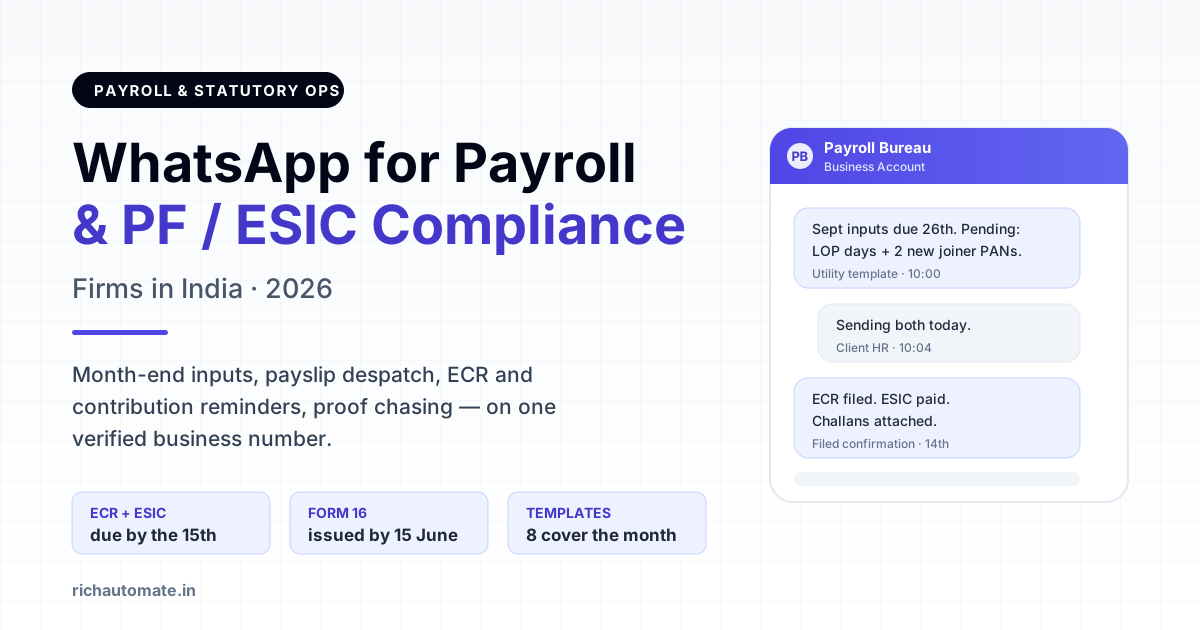
Payroll outsourcing and PF/ESIC compliance firms in India use the WhatsApp Business API for three jobs email quietly fails at: getting monthly inputs out of a client's HR before the cut-off, delivering payslips to staff who never open a work inbox, and chasing investment proofs and KYC documents without a single person making follow-up calls. The setup is a verified business number, seven or eight approved templates and a shared inbox mapped to your client teams — no per-seat licence, and it pays for itself on the document chase alone.
This is a working guide, not a pitch. If you run payroll for twenty or two hundred client companies, file ECRs and ESIC returns, issue Form 16s every June and spend the first week of every month asking the same four questions of the same distracted HR executive, the operational pain is not the calculation. It is the chase. The calculation engine has been solved for a decade. The inputs have not.
Why payroll firms already run on WhatsApp, badly
Walk into any mid-sized payroll bureau in Pune, Gurugram or Coimbatore and you will find the process already living on WhatsApp — on personal numbers. The client's HR sends a photo of a leave register at 11pm. The payroll executive replies from her own phone. An employee whose PF did not credit messages a number she got from a colleague. None of it is logged anywhere your practice controls.
That is a problem on three axes. First, continuity: when that executive resigns, four years of client correspondence leaves with her handset. Second, evidence: when a client disputes that they sent the arrear sheet late, you have nothing. Third, and increasingly, exposure — salary data is personal data, and a bureau handling it on unmanaged personal devices is carrying a risk it has not priced.
Moving the same conversations onto a business number does not change how clients behave. It changes who owns the record. Everything below assumes that shift has been made.
The compliance calendar is the message calendar
Payroll messaging is not a campaign. It is a calendar, and the calendar is fixed by statute. Almost every recurring send maps to a date somebody else set:
- Month-end inputs. Attendance, LOP days, new joiners, exits, arrears, one-off incentives. Your internal cut-off is usually the 25th to 28th; the client treats it as a suggestion.
- TDS on salary. Deposit by the 7th of the following month. Miss it and interest runs on the client's account, with your name attached to the lapse.
- EPF ECR and ESIC contribution. Both due by the 15th of the following month. The upload is your job; the funding is the client's, and the gap between those two facts is where most escalations are born.
- Professional tax. State-specific, and that is the trap — a client with offices in three states has three different due dates and three different treatments. Karnataka, Maharashtra and West Bengal agree on almost nothing.
- Form 24Q quarterly returns. Filed each quarter, with the final-quarter return carrying the annexure your Form 16s are generated from.
- Form 16 issue. By 15 June, which means the last week of May is your worst week and the first week of June is your second worst.
- Regime declaration and investment proofs. A declaration window in April and a proof window in December-January, both consisting almost entirely of chasing individuals who are not your customers.
Every one of those has a natural template. None needs a human to initiate. The value of automating this layer is not saved typing — it is that a missed 15th stops depending on whether one person remembered.
Eight templates that carry most of the load
Approved templates are how you send first. Keep the set small enough that a new joiner learns it in a day:
- Monthly input request. Fired to the client's HR contact on a fixed day, naming the cut-off date and listing exactly what is needed. One message, not a thread.
- Input reminder with gap list. Sent before cut-off, and crucially it names what is still missing rather than repeating the full ask. The generic reminder is ignored; the specific one gets a reply.
- Payroll-locked confirmation. Sent when the register is frozen. This is your evidence template — it timestamps the moment changes stop being free.
- Funding request. Net salary, PF, ESIC and TDS amounts with the date each must hit the respective account. Separate from the payroll confirmation, because the person who funds is rarely the person who sends inputs.
- Statutory filed confirmation. ECR filed, ESIC paid, challan attached. The client's auditor will ask for this in October; sending it in May costs you nothing.
- Payslip despatch. To the employee, not the client. Covered in its own section below, because the rules are different.
- Document chase. Investment proofs, Form 12BB, PAN corrections, Aadhaar-UAN seeding, bank detail mismatches. Highest-volume template you will run and the one that saves the most labour.
- Exit and full-and-final. Settlement summary, PF withdrawal or transfer guidance, Form 16 availability. Exits generate the angriest inbound messages in the practice; answering before being asked removes most of it.
Note what is not on that list: nothing promotional, nothing about your other services, no newsletters. A payroll number that starts marketing gets blocked by the exact people whose replies you depend on.
Payslips on WhatsApp: what DPDP actually asks of you
Sending a payslip to an employee's WhatsApp is legitimate and increasingly expected, particularly for factory, retail and field workforces with no company email address at all. But it is a processing activity on sensitive financial data, and under the Digital Personal Data Protection framework the bureau acts on the client's instructions — which means the obligations are contractual before they are technical.
- The client is the fiduciary, you are the processor. Get it written into the engagement letter, including the instruction to deliver payslips over WhatsApp. Do not improvise this channel on a client's behalf.
- Notice and consent belong to the employer. The employee's agreement to receive salary documents on a personal number should be collected by the employer at onboarding, with the payroll bureau named.
- Password-protect the PDF. Standard practice is a PAN-plus-date-of-birth combination communicated separately at onboarding. An unprotected payslip sitting in a shared family phone gallery is a real complaint, not a theoretical one.
- Retention has to be finite. Decide how long delivery records and message media are kept, and enforce it. "Forever, because the platform keeps it" is not a retention policy.
- Exits must revoke. An ex-employee's number stops receiving anything the day the full-and-final closes, and that has to be a step in the exit checklist, not a memory.
Firms that also handle secretarial and audit work will recognise the shape from their ROC compliance workflows — same channel, same evidentiary logic, different statute.
What it actually costs in 2026
Payroll messaging is overwhelmingly utility traffic: reminders, confirmations, document requests, payslip despatch. That matters, because utility templates are the cheapest category and messages sent while a customer-initiated window is already open are not charged as templates at all. The practical effect for a bureau is that your cost sits far closer to the floor than a marketing-heavy business would assume.
Get the India 2026 WhatsApp BSP price comparison
Wati vs AiSensy vs Interakt vs RichAutomate: Meta rates, platform fees and hidden costs, side by side. We send it to your WhatsApp in a minute.
Do the arithmetic on your own book rather than a vendor's slide. A bureau running payroll for 60 client companies covering 9,000 employees might send, in a normal month, one input request and two reminders per client, one funding request, one filed-confirmation, 9,000 payslips and perhaps 600 document-chase messages. Roughly 9,900 sends — large in count, small in rupees, concentrated in the cheapest tier. December and January roughly double it on proof-chasing; May and June spike on Form 16.
The number that decides the business case is not the per-message rate. It is the executive-hours the chase currently consumes. If two people spend a combined week per month on follow-up calls, the channel pays for itself several times over before you count a single retained client. Rates and categories do move — the recent service message charge changes are worth reading before you budget a full year.
Multi-client routing without cross-client leakage
This is the part payroll bureaus get wrong, and the one that loses clients. You handle several employers on one number, and the failure mode is an employee of Client A receiving something about Client B, or a client HR seeing a thread that is not theirs.
- Tag every contact with a client code at import. Not in a spreadsheet somewhere — on the contact record, so routing and reporting both key off it.
- Restrict inbox visibility by client. The executive who runs Client A's payroll should not be browsing Client B's threads. Most shared-inbox implementations support this and most firms leave it switched off.
- Never bulk-send across client boundaries. Every broadcast scoped to one client code, every time, with no exception for "quick" announcements.
- Watch for duplicate numbers. Contract staff working for two of your clients will appear twice. Decide the rule before it happens, because the first time it happens will be during a salary query.
Firms that also supply staff already run a version of this discipline for labour contractors and manpower suppliers, where the same worker legitimately belongs to two principal employers at once.
Where the document chase actually breaks
Everyone automates the reminder. Almost nobody automates the part after it, which is where the time goes.
An employee sends a photo of an insurance premium receipt. It is blurred, or last year's, or in a family member's name, or a renewal notice rather than a paid receipt. Someone has to look at it, decide, and reply. That triage is the real cost of the December-January window, and no template removes it.
What does help: make the ask so specific that the wrong thing arrives less often. "Send your 80C proofs" produces chaos. "Send the LIC premium receipt showing the policy number, the amount paid and a date inside this financial year" produces a usable document most of the time. Name the document, the fields you need visible, and the period. It feels pedantic in the template and it halves the rework.
Second: reply with a rejection reason, not a rejection. "Not acceptable" starts a phone call. "This is the renewal notice, not the paid receipt — please send the one with the receipt number" ends the exchange in one more message.
Setting it up without a three-month project
The technical path is short. A verified business number that is not anyone's personal SIM, a WhatsApp Business Account tied to your firm's legal entity, and templates submitted in the right category — utility for everything transactional, and resist the temptation to dress a reminder up as marketing. GST registration is required to go live properly, which for a payroll bureau is a non-issue since you already have one.
Then the integration question. Most payroll engines in this market expose either a CSV export or an API, and either is enough to trigger sends on a schedule. Start with the schedule-driven messages — input requests, reminders, filed confirmations — because they need no data from the payroll run itself. Add payslip despatch second, once delivery-failure handling is actually written. Leave the exit workflow for last; it touches the most systems.
Budget a fortnight, not a quarter. The constraint is template approval turnaround and your own willingness to standardise wording across clients, not engineering. Practices that have already put CA firm workflows on the channel usually reuse most of the setup, since the client contact list overlaps heavily.
What not to automate
Salary disputes. An employee who believes they were underpaid will not be satisfied by a template, and an automated reply to that message reads as contempt. Route it to a named person with a stated response time.
Anything touching a client's funding shortfall. If the client has not funded the PF account by the 13th, that is a phone call from a partner, not a scheduled nudge. The relationship cost of automating an awkward conversation is higher than the labour saved.
Statutory advice. Employees will ask whether to opt out of PF, which regime to pick, how to withdraw. Answer through the employer's HR, not directly, and never in a template. The bureau giving individual tax advice over WhatsApp is acquiring liability it is not being paid for.
Firms recruiting their own staff into this workload should note the same boundary applies to offer-letter and candidate funnels — automate the movement of documents, never the judgement.
The labour codes shift the inputs, not the channel
As India's consolidated labour codes phase in, the fields a payroll bureau has to collect change more than the way it collects them — wage-definition effects on the PF base, gratuity accrual for shorter tenures, and expanded coverage for categories of worker that historically sat outside the register. Each of those lands on you as a new question to ask the client, which is to say a new template line, not a new system.
The practices that handle it cleanly are the ones that already have a structured input request. If your month-end ask is a paragraph of free text in a chat, every definitional change becomes a fire drill. If it is a fixed list, it becomes one edit. Where the codes bite is worth reading separately alongside labour codes and gig-worker compliance.
Numbers worth tracking
- Percentage of clients whose inputs arrive before cut-off. The single number that predicts whether your month is calm. If it is not climbing after two cycles, the reminder is too generic.
- Document-chase rounds per employee in the proof window. Target is one. Two means the ask is vague. Three means you are effectively doing the employee's filing for them.
- Payslip delivery failure rate. Bad numbers in the master are invisible until you start sending. Expect an ugly first month and a near-zero third month.
- Inbound queries per hundred employees per cycle. Falls sharply once payslips and filed-confirmations go out proactively. If it is not falling, you are sending after people have already asked.
None of this needs a large team. A bureau with four payroll executives and one compliance lead can run the entire workflow, because the channel absorbs the repetitive sends and the humans keep the judgement — which is, in the end, the only part of payroll a client is actually paying for.