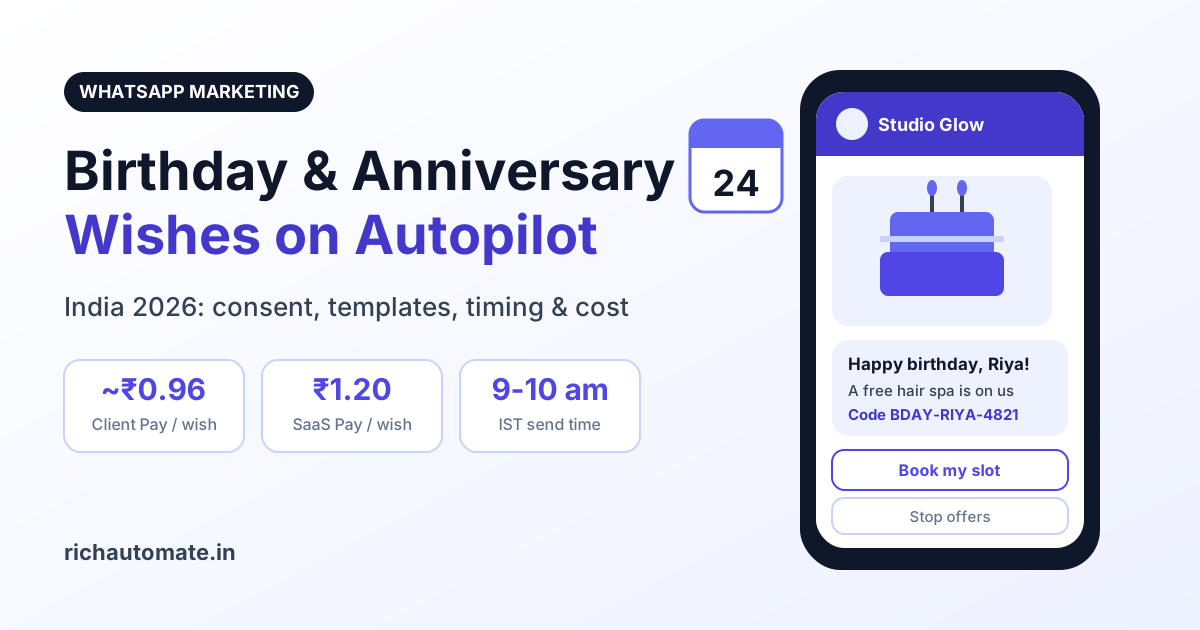
You automate WhatsApp birthday wishes in India by collecting each customer's birthday or anniversary date with clear consent, getting one marketing template approved on the WhatsApp Business API, and letting a scheduler send it around 9-10 am IST on the day. Each wish costs roughly ₹0.96 (Meta's ~₹0.86 marketing rate plus a ₹0.10 platform fee) to ₹1.20 all-inclusive, so a 5,000-customer salon or jeweller spends only a few thousand rupees a year on the entire programme.
This guide covers what Indian businesses such as salons, jewellers, restaurants, clinics, gyms, retailers, LIC and insurance agents, and banks or NBFCs need to know: how Meta categorises greetings, how to collect dates under the DPDP Act 2023, what each wish really costs, how to design the offer, and how to keep block and report rates low enough to protect your number.
Why birthday and anniversary wishes still work on WhatsApp
Most Indian customers already use WhatsApp every day, and a personal message on a personal date feels very different from a generic sale broadcast. A birthday or anniversary wish is one of the few marketing messages the customer half-expects, because they gave you the date themselves. That expectation is exactly why these messages tend to get read and replied to more than routine promotions.
The occasion also gives you a natural, time-bound reason to make an offer: a complimentary hair spa this week, a discount on making charges for an anniversary piece, a free dessert with a family dinner. The customer has a reason to visit, and you have a clean way to measure whether they did.
The catch is scale. Wishing 20 regulars by hand is easy. Wishing 5,000 customers, each on the right day, with the right name and a trackable code, is not something a front-desk team can do reliably from a phone. That is where the API and a scheduler come in.
Template category reality: a birthday wish is a marketing message
Every business-initiated message on the WhatsApp Business API, sent outside a 24-hour customer service window, must use a pre-approved template. Meta sorts templates into categories, mainly marketing, utility and authentication, and each is priced differently. It is worth being honest about where birthday messages fall.
- A birthday wish with an offer or coupon is marketing. There is no ambiguity here.
- A pure greeting with no offer ("Happy birthday, Riya! Wishing you a wonderful year from all of us at Studio Glow") is also marketing under Meta's rules. Greetings, wishes and relationship-building messages are not tied to a transaction the customer initiated.
- Utility is not allowed for greetings. Utility is reserved for messages about a specific, agreed transaction, such as an order update, appointment confirmation or payment receipt. Submitting a birthday wish as utility usually leads to rejection or automatic recategorisation to marketing, and repeated miscategorisation can create problems for your account.
If you want the fuller picture of how Meta draws these lines, read our breakdown of WhatsApp marketing vs utility message categories in India. The practical takeaway is simple: budget every wish at marketing rates, and write it to be genuinely welcome rather than trying to disguise it.
Meta's per-user marketing limits
Meta also limits how many marketing messages a single WhatsApp user receives from businesses in a given period. If a customer has already received many marketing messages, your wish may not be delivered, and the API returns an error instead. You are not charged for undelivered messages, but it means you should never assume 100% delivery, and it is one more reason to keep your own marketing volume modest.
Collecting birthday and anniversary dates with DPDP Act 2023 consent
The Digital Personal Data Protection Act 2023 requires consent that is free, specific, informed, unambiguous and given through a clear affirmative action. The customer must be told what data you are collecting and why, and withdrawing consent must be as easy as giving it. As the Act's rules phase in, it makes sense to build these habits now rather than retrofit them later.
Practical ways to collect the date
- At the billing counter: a QR code that opens a WhatsApp chat, where a short form asks for day and month of birth and an optional anniversary date, with a clearly worded consent checkbox.
- During appointment booking: salons, clinics and gyms can add an optional date field in the booking flow, labelled with its purpose.
- Loyalty sign-up: jewellers and retailers often already capture dates on loyalty forms; add explicit WhatsApp consent to the same form.
- Existing records: if you already hold dates from old registers, send a one-time consent request before adding those customers to the automation. Do not assume consent from a paper register filled in years ago.
Good consent hygiene
- Ask for day and month only. You rarely need the birth year, and not collecting it is data minimisation in practice.
- Use purpose-specific wording, for example: "Yes, send me birthday and anniversary wishes and offers from Studio Glow on WhatsApp. I can reply STOP anytime."
- Record the timestamp, channel and wording shown when consent was given.
- Keep occasion wishes as a separate consent flag from general promotions, so a customer can keep one and drop the other.
- Delete the date when a customer withdraws consent or asks for erasure.
Manual vs WhatsApp Business app vs API automation
Many small businesses start by wishing customers from the WhatsApp Business app. That works for a handful of regulars, but it breaks down quickly. The comparison below shows why most businesses with more than a few hundred customers move to the API.
| Approach | Scale | Personalisation | Tracking | Main risk |
|---|---|---|---|---|
| Manual wishes from a staff phone | A few per day | High, but inconsistent | None | Missed dates, staff dependency, number tied to one person |
| WhatsApp Business app broadcast lists | Up to 256 contacts per list, only those who saved your number | Limited | Basic read ticks only | No scheduling, no per-customer coupon, poor reach |
| Unofficial bulk-sender tools | High | Varies | Unreliable | Violates WhatsApp terms and puts your number at real risk of being banned |
| WhatsApp Business API with a platform | Thousands per day | Name, occasion and unique code per customer | Delivered, read, replied, redeemed | Quality rating drops if messages feel unwanted |
The API route is the only one that combines scheduling, per-customer variables and reporting while staying within Meta's rules. It does not remove risk entirely: if customers block or report your messages, your quality rating falls and Meta can restrict your sending.
What each birthday wish costs in India
Meta bills marketing templates per delivered message. In India the marketing rate is roughly ₹0.78-0.88, currently about ₹0.86 per delivered message, and Meta revises its rates periodically, so treat all figures here as estimates to recheck. On top of Meta's charge, your platform adds its own fee.
RichAutomate is usage-only, with ₹0 setup fee and ₹0 monthly fee. You choose between two ways to pay, described on our RichAutomate pricing page:
- Client Pay: Meta's charge is billed to your own card, and RichAutomate adds a ₹0.10 per message platform fee.
- SaaS Pay: a single all-inclusive rate of ₹1.20 per marketing message and ₹0.30 per utility message.
| Scenario | Client Pay (approx.) | SaaS Pay |
|---|---|---|
| 1 birthday wish (marketing template) | ₹0.86 + ₹0.10 = about ₹0.96 | ₹1.20 |
| Wish plus one reminder to customers who replied but have not redeemed | about ₹1.92 | ₹2.40 |
| Wish, then appointment confirmation after booking (utility) | about ₹0.96 + Meta's utility rate + ₹0.10 | ₹1.20 + ₹0.30 = ₹1.50 |
| Free-form replies while the customer is chatting within 24 hours | No template charge from Meta; check platform fee terms | No template charge |
Worked example: a 5,000-customer salon or jeweller
Assume a salon in Indore or a jeweller in Coimbatore has 5,000 customers with consented birthday dates, and about 2,000 of them also shared an anniversary date. That is roughly 7,000 occasion wishes a year, or about 19 a day on average, with natural peaks and dips across months.
Get a 1-minute BSP audit on WhatsApp
Drop your WhatsApp number — we line-item your current invoice against Meta India rates in under 60 seconds. India-hosted, DPDP-compliant.
- Client Pay: 7,000 × about ₹0.96 = about ₹6,720 a year, or roughly ₹560 a month, if every message is delivered.
- SaaS Pay: 7,000 × ₹1.20 = ₹8,400 a year, or ₹700 a month.
Because Meta charges only for delivered messages and some wishes will not be delivered, the real figure should come in somewhat lower. Now look at the other side. If, as an illustrative estimate, 3% of wishes lead to a visit, that is about 210 visits a year. At an average salon bill of ₹1,200 that is roughly ₹2.5 lakh in revenue; for a jeweller, even a handful of anniversary purchases can cover the year's messaging cost many times over. Your actual redemption rate depends on your offer, your customer base and your service, so measure it rather than rely on anyone's benchmark, including this one.
Send time, offer mechanics and frequency caps
When to send
- Birthdays: 9-10 am IST on the day. Early enough to be seen first thing, late enough not to disturb.
- Anniversaries for restaurants and jewellers: one or two days before, so the couple can book a table or plan a purchase.
- Avoid: before 8 am, after 9 pm, and stacking the wish on the same morning as a big sale broadcast.
Designing the offer
- Use a unique coupon code per customer, for example BDAY-RIYA-4821, so it cannot be forwarded to a whole family group and so redemptions can be traced.
- Give a clear validity window, usually 7 days for salons and restaurants, and up to 15-30 days for jewellers and larger purchases.
- Prefer experiences over deep discounts: a complimentary add-on, free dessert or waived making charges on a small item protects margin better than a flat 30% off.
- Add a quick-reply button such as "Book my slot" so the customer can act without typing.
Frequency caps
Set hard rules in your automation: one wish per occasion, at most one reminder and only to customers who engaged, and a ceiling on total marketing messages per customer per month across all campaigns. If a customer's birthday falls during a festival campaign, the wish should replace the festival broadcast for that customer rather than add to it. Our WhatsApp festival commerce playbook for India explains how to plan these overlapping calendars.
Opt-out handling and keeping block and report rates low
Every wish should make it easy to stop. A "Stop offers" quick-reply button or a line such as "Reply STOP to stop birthday messages" costs nothing and protects your number. When someone opts out, the change must apply immediately and to every campaign, not just the next birthday run. The mechanics are covered in our guide to WhatsApp opt-out and STOP keyword handling in India.
Blocks and reports are what really hurt. Meta assigns your number a quality rating based on recent customer feedback, and a spike in blocks can push it from green to yellow or red and restrict your messaging limits. No setup can promise zero blocks, but these habits keep the rate low:
- Only message customers who explicitly consented to occasion wishes.
- Use your recognisable business name and display photo so the message is instantly familiar.
- Personalise with the customer's name and keep the wish warm and short, with the offer as a secondary line.
- Clean your list: remove numbers that failed repeatedly or customers who have not visited in several years.
- Watch the block count after each send and pause the automation if it jumps.
For a deeper checklist, see our guide on how to lower your WhatsApp block and report rate in India.
Industry playbook: birthday and anniversary offer ideas
The right offer depends heavily on the business. The table below lists sensible starting points; adjust them to your margins and customers.
| Industry | Occasion message idea | Watch out for |
|---|---|---|
| Salon and spa | Complimentary hair spa or head massage with any service this week | Slot capacity on weekends |
| Jeweller | Anniversary wish with waived making charges on a small piece within 30 days | Keep the wish elegant; avoid gold price claims |
| Restaurant or cafe | Free dessert or cake for a table booked on the birthday week | Send anniversary wishes a day or two early |
| Clinic or diagnostic lab | Warm wish plus an invitation to book an annual health check | Never mention diagnoses or health details in the message |
| Gym or fitness studio | Free personal training session or guest pass for a friend | Do not pressure lapsed members aggressively |
| Retail and fashion | Birthday voucher on the next purchase, valid for 7 days | Avoid overlapping with sale broadcasts |
| LIC and insurance agents | A pure greeting with an offer to review cover at the client's convenience | Follow IRDAI conduct rules; no misleading benefit claims |
| Bank or NBFC | Greeting from the relationship team; no unsolicited loan pitches | Follow RBI fair practice guidance and internal compliance review |
Regulated sectors should get template wording reviewed by their compliance team before submission. A greeting that quietly turns into a product pitch is exactly the kind of message that draws complaints.
Measuring redemption and ROI
Automation without measurement is just spending. Track these numbers every month:
- Sent and delivered: the gap tells you about invalid numbers and Meta's per-user limits.
- Read and replied: an indication of whether the wish felt personal.
- Redeemed: unique codes used at the POS or billing counter within the validity window.
- Revenue per redemption: the bill value attached to each code.
- Blocks and opt-outs: your early warning signal.
To separate real impact from customers who would have come anyway, keep a small holdout group, for example 10% of birthdays each month, that receives no wish. Compare their visit rate with the group that did. Once a customer redeems, a follow-up feedback request helps close the loop; our guide to WhatsApp post-purchase NPS and review requests shows how to do that without over-messaging.
Step-by-step setup checklist
- Connect your number to the WhatsApp Business API and complete business verification.
- Add a consented date capture flow at billing, booking or loyalty sign-up.
- Import existing dates only after a fresh consent request.
- Write one birthday and one anniversary marketing template with name and coupon variables, plus a "Stop offers" button.
- Submit templates under the marketing category and wait for approval.
- Set the scheduler to 9-10 am IST, with frequency caps and opt-out suppression switched on.
- Generate unique coupon codes and connect redemption tracking to your POS or a simple sheet.
- Run a pilot on one month of birthdays, review delivery, blocks and redemptions, then scale.
Ready to wish every customer on the right day without a single missed date? Create your RichAutomate account and set up birthday and anniversary automation with ₹0 setup fee and ₹0 monthly fee, paying only for the messages you send.