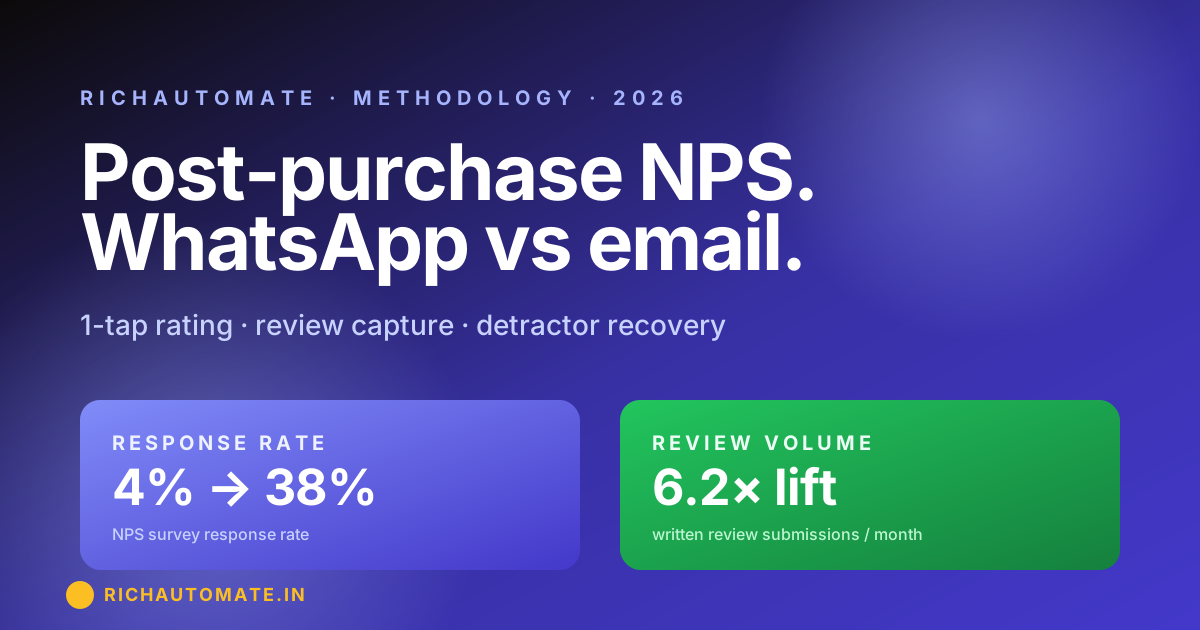
Indian D2C and SaaS brands run two of the most important data-collection programmes badly: post-purchase NPS surveys and review / UGC capture. Email NPS averages 4% response rate; review-link emails average 1.4-2.8% submission rate. Most product / CX dashboards are built on the loudest 4% — biased toward extremes (very-happy / very-angry), invisible to the silent middle. WhatsApp post-purchase NPS hits 38% response rate and triples written-review volume. The brands compounding fastest in 2026 also wire detractor recovery + promoter amplification directly into the same WhatsApp thread, turning the survey from data extraction into a closed feedback loop. This guide is the 2026 implementation playbook for Indian brands: timing, surface choice, detractor flow, promoter flow, integration with Trustpilot / Google Reviews / Amazon, real cohort numbers, and the compliance pattern.
Why Email NPS Is a Broken Methodology in 2026
Three structural problems:
- Sample bias. 4% email response rate skews to extremes — very-happy customers (rating 9-10) and very-angry detractors (rating 1-3). Indian customers especially: silent-middle (4-7) almost never responds to email. NPS calculated from this base over-states polarity by 30-50%.
- Latency. Email sent D+5 post-delivery; opened D+9; rated D+11; reviewed D+14 if at all. By the time you see a detractor signal, customer has churned, told friends, or written a review elsewhere.
- No closed loop. Detractor sends 2/10, you reply via email, customer doesn't see it for days. Recovery window collapses.
The WhatsApp NPS + Review Architecture
| Stage | Trigger | WhatsApp surface |
|---|---|---|
| Stage 1: NPS prompt | D+3 post-delivery (D+0 for digital) | Reply-button: Promoter (9-10) / Passive (7-8) / Detractor (0-6) — 3-button compact UI |
| Stage 2A: Promoter (9-10) | Customer taps 9-10 | Thank + 1-tap review-share to Google / Trustpilot / Amazon + referral nudge |
| Stage 2B: Passive (7-8) | Customer taps 7-8 | "What would have made it 9?" free-text + suggestion-style flow |
| Stage 2C: Detractor (0-6) | Customer taps 0-6 | Immediate apology + 1-tap escalation to support agent + remedy offer |
| Stage 3: Review write | Promoter post-thanks | Voice-note review (Indian preference) OR text + 1-tap rating publish |
| Stage 4: Detractor recovery | Issue identified | Resolution + follow-up CSAT 7 days later |
| Stage 5: Promoter amplification | Review published | Bonus loyalty points + referral link |
Real Indian D2C + SaaS NPS Numbers
D2C beauty brand, 18,000 monthly orders, ₹780 AOV
| Metric | Email NPS | WhatsApp NPS |
|---|---|---|
| Survey response rate | 4% | 38% |
| NPS score (calculated) | 62 (over-stated) | 54 (true) |
| Median response latency | 11 days | 4 hours |
| Detractor identification window | D+11 | D+3 |
| Detractor recovery rate | 14% | 62% |
| Written review volume / month | 340 | 2,108 (6.2× lift) |
| Voice-note reviews (used as UGC) | — | 820 / month |
SaaS B2B, 3,200 customers, quarterly NPS programme
| Metric | Email-only | WhatsApp + email hybrid |
|---|---|---|
| Quarterly NPS response rate | 14% | 62% |
| Detractor identification → escalation | 3-7 days | under 2 hours |
| NRR impact (vs control cohort) | baseline | +8 percentage points |
| Promoter-driven referrals / quarter | 22 | 148 |
Timing: When to Send the NPS Prompt
| Vertical | Optimal trigger | Why |
|---|---|---|
| D2C physical product | D+3 post-delivery | Customer has tried product; not so late they've forgotten |
| D2C consumable / beauty | D+10 post-delivery | Product use cycle reached; results visible |
| SaaS B2B onboarding | D+30 first use | Past initial friction; in steady-state usage |
| Service / experience (salon, hotel, restaurant) | D+0 within 3 hours of completion | Memory fresh; voice-note review easy |
| Healthcare / clinic visit | D+1 | After patient has seen results / gone home |
| Auto purchase | D+30 + D+90 | Initial honeymoon then steady-state |
| Insurance / financial product | D+30 post-policy + post-claim event | Two distinct emotional moments |
Operating Rule
The single highest-leverage move for any Indian D2C / SaaS brand is migrating post-purchase NPS from email to WhatsApp 3-button reply (Promoter / Passive / Detractor). Response rate climbs from 4% to 38%; detractor identification window shrinks from D+11 to D+3; detractor recovery rate climbs from 14% to 62%. The data is more representative (less extreme-skewed), faster to act on, and feeds directly into a closed-loop recovery flow. Build this single pattern first; layer review amplification + voice-note UGC + integration with Trustpilot / Google Reviews / Amazon over the next 60 days.
Get a 1-minute BSP audit on WhatsApp
Drop your WhatsApp number — we line-item your current invoice against Meta India rates in under 60 seconds. India-hosted, DPDP-compliant.
The Six Anti-Patterns That Wreck NPS + Review Capture
- 0-10 scale via free-text. "Reply with a number 0-10" gets typo-ridden answers + low completion. Use 3-button reply (Promoter / Passive / Detractor) inside WhatsApp; 0-10 granularity captured via follow-up Flow if needed.
- Sending NPS too early or too late. Day-of-delivery is too early (customer hasn't tried); 30 days post is too late (memory fades). Vertical-specific timing matters.
- No detractor recovery flow. Customer rates 2/10, brand says "thanks for the feedback", customer fumes. Auto-escalate detractors to support agent within 5 minutes with apology + remedy offer.
- Asking for review on Google / Amazon before resolving complaint. Worst possible move — angry customer goes write 1-star public review. Always check sentiment first; route detractors to private recovery, not public review platforms.
- Marketing template for NPS prompt. Post-purchase NPS triggered by delivery event = utility (₹0.115/msg). Sending as marketing burns 8× cost + lower deliverability.
- Skipping voice-note review capture. Indian customers (especially Tier-2 + Tier-3) prefer voice over text for unstructured opinion. Voice notes work as raw UGC — testimonials, social proof, training data for sentiment ML.
Trigger + Routing Architecture
order.delivered event → schedule NPS at vertical-specific delay (D+3 typical)
At delay:
  Send utility template with 3-button reply (Promoter / Passive / Detractor)

Customer taps Promoter (9-10):
  Thank message
  Carousel: rate-on-Google / rate-on-Trustpilot / rate-on-Amazon
  Referral incentive prompt
  If rate clicked: deep-link with pre-filled rating; tracking via UTM

Customer taps Passive (7-8):
  "What would have made it 9-10?" free-text or list of common improvements
  Capture suggestion + tag conversation
  Send appreciation + small loyalty bonus

Customer taps Detractor (0-6):
  Immediate apology + "A specialist is reaching out"
  Escalation event: route to support agent within 5 minutes
  Agent context payload: order, last-3-touchpoints, NPS score, suggested remedy
  Remedy offer based on issue category (refund / replacement / discount / personal call)
  Follow-up CSAT 7 days post-resolution

Voice-note review:
  After Promoter rating, prompt: "Tell us in your words — voice or text"
  Customer records 30-90 sec voice note OR types text
  Brand uses voice-notes as UGC (testimonials, social proof, sentiment training data)
  Top voice notes published with consent

Integration:
  Promoter ratings auto-pushed to Google Reviews / Trustpilot / Amazon via API or deep-link
  Passive suggestions feed product-team Trello / Linear / Jira
  Detractor data feeds churn-prediction ML retraining
  Voice notes archived in MinIO / S3 with consent metadata

Quarterly:
  NPS trend analysis by segment, AOV tier, geography, vertical
  Detractor pattern clustering (top complaint categories)
  Promoter amplification ROI (review CTR → traffic → conversion)
Compliance + Operational Notes
- DPDP Act 2023 — survey responses + voice notes are personal data; explicit consent + storage controls. Voice consent capture before recording (utility template).
- Meta categorisation — post-purchase NPS triggered by delivery event = Utility (₹0.115/msg). Promotional review-amplification campaigns to existing customers = Marketing (₹0.96/msg).
- Review platform compliance — Google Reviews / Trustpilot / Amazon have anti-incentive policies. Loyalty points for promoter must not be conditional on positive review; offer rewards for any review (regardless of star rating) to comply.
- Voice-note UGC publication — separate consent for using voice notes as marketing material (testimonials, social proof). Provide opt-out + deletion mechanism.
- Indian-region storage — survey responses, voice notes, escalation transcripts stored in Indian region per DPDP Act. Retention 12-24 months for analytics + audit.
Run post-purchase NPS + reviews on RichAutomate.
3-button NPS reply at vertical-specific timing. Auto-escalation for detractors with 5-minute SLA. Voice-note review capture + UGC publishing pipeline. Google Reviews / Trustpilot / Amazon integration. Pre-approved utility templates for full feedback lifecycle. Lifts response rate 4% → 38% and review volume 6.2× on real Indian D2C + SaaS pilots. 14-day trial.
Run your figures through the WhatsApp ROI calculator before committing to a monthly spend.
Related reading
- WhatsApp Churn Prediction ML + Intervention India 2026: 47% Save Rate, AUC 0.84, Real Cohort Numbers
- WhatsApp Loyalty Programme Architecture India 2026: 62% Redemption Rate, 2.4× Member ARPU, Tier + Points Engine
- WhatsApp Tiered Onboarding by Expertise Level India 2026: 82% Completion, 2.6× LTV Lift, Three-Tier Architecture
- WhatsApp Cohort Retention India 2026: Six Lifecycle Messages, Real Day-90 Retention Lift, Per-Cohort Economics
- WhatsApp Business API Cost India 2026: ₹0.11–₹0.99/msg