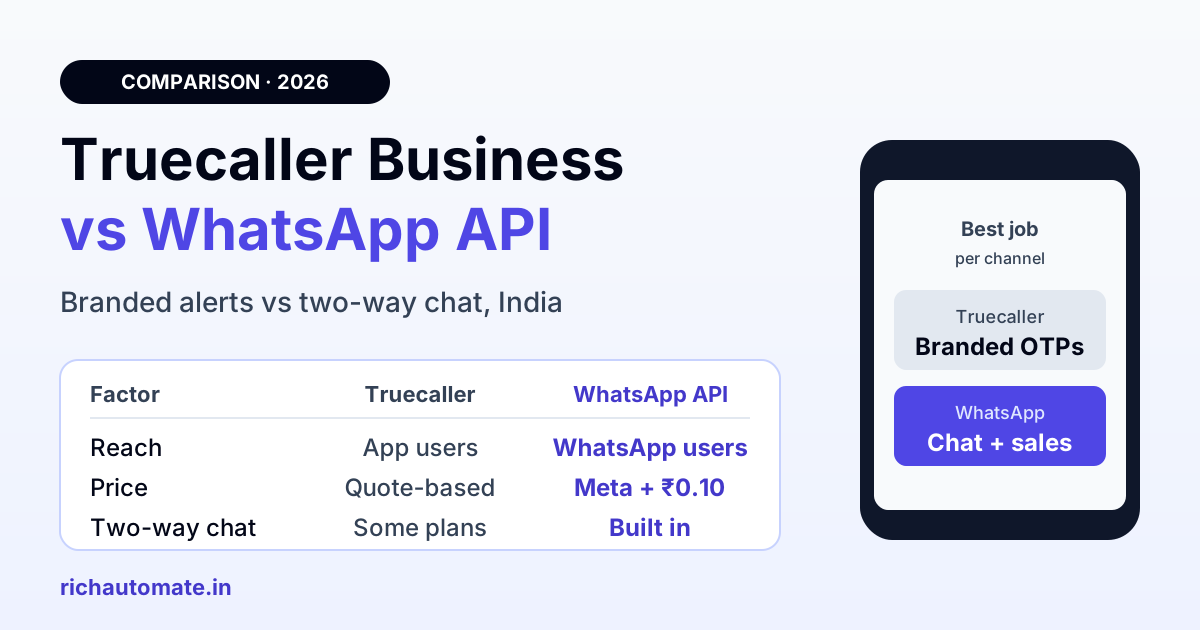
Truecaller Business Messaging and the WhatsApp Business API solve different problems for Indian businesses: Truecaller puts a verified, branded message inside the Truecaller app, mostly for OTPs and alerts that would otherwise go by SMS, while WhatsApp is a two-way chat channel for support, sales and automation. Truecaller pricing is quote-based through partners, while WhatsApp on RichAutomate costs Meta's published rate plus ₹0.10 per message, from ₹0 a month.
Truecaller's business chat became much easier to buy in 2026. Gupshup announced a partnership on 4 June 2026 to offer Verified Business Chat in India and other markets, and Tanla and Onextel also sell it. Gupshup's homepage now leads with it. So if a vendor has pitched it to you this month, this guide explains what it is, where it fits next to WhatsApp and SMS, and how to decide which channel gets which message.
What Truecaller Business Messaging is
Truecaller Business Messaging, also sold as Verified Business Chat, lets a verified business send messages that appear inside the Truecaller app with the company name, logo and a green verified badge. It is built to replace plain SMS for messages where trust matters. The features partners list in 2026 are:
- Verified sender identity with business name, logo and a verified badge, which helps people tell a real bank or airline from a spoofed SMS header.
- Rich messages with images and call-to-action buttons such as copy OTP, track order or web check-in.
- Sticky notifications that keep an OTP or important alert at the top of the screen until the user acts on it.
- Two-way chat on some partner plans, with conversational AI from partners such as Gupshup.
The catch is reach. A Truecaller message only arrives as a rich chat for people who have the Truecaller app installed. Everyone else has to be reached another way, usually SMS, so in practice it is an upgrade layer on top of SMS rather than a replacement for your main customer chat channel.
What the WhatsApp Business API does differently
The WhatsApp Business API is Meta's official channel for businesses on WhatsApp, the messaging app most Indian customers already use every day. It is built for conversations, not one-way alerts. A business can send approved templates to opted-in customers, and when a customer writes in, the business can reply freely for 24 hours.
That two-way window is what makes WhatsApp useful for more than alerts. On a platform such as RichAutomate you get a visual chatbot flow builder, Meta WhatsApp Flows for in-chat forms, a shared team inbox, broadcast campaigns with delivery and read status, and a developer API with webhooks for alerts from your own software. Our guide to WhatsApp green tick verification covers the WhatsApp equivalent of Truecaller's verified badge.
Truecaller vs WhatsApp API vs SMS and RCS: side by side
The table below uses published information from Meta, partner product pages and RichAutomate's own pricing as of November 2026. Truecaller does not publish a rate card, so we do not guess one.
| Factor | Truecaller Business Messaging | WhatsApp Business API | SMS / RCS |
|---|---|---|---|
| Who sees a rich message | Truecaller app users only | Anyone with WhatsApp | SMS: every phone. RCS: supported Android phones |
| Verified identity | Name, logo, verified badge | Display name, Meta-verified green tick for eligible brands | SMS: DLT header only. RCS: verified sender |
| Two-way chat | On some partner plans | Yes, free-form replies for 24 hours after the customer writes | SMS: limited. RCS: yes |
| Chatbots and in-chat forms | Through partner AI tools | Flow builders and Meta WhatsApp Flows | RCS: basic suggested replies |
| Published price | Quote-based, not published | Meta rate card: marketing ₹0.8631, utility and authentication ₹0.115, service replies free | Jio RCS, as reported by Inc42: OTP ₹0.11–0.16, transactional ₹0.25, marketing ₹0.27–0.30 |
| Best use | Branded OTPs and alerts for Truecaller users | Support, sales, order updates and automation | Fallback that reaches every number |
On RichAutomate Client Pay you pay Meta's rate directly plus a ₹0.10 platform fee per message. A service reply inside an open 24-hour window costs only the ₹0.10 fee, because Meta charges nothing for it.
Where Truecaller Business Messaging fits
Truecaller makes the most sense for businesses that already send high volumes of SMS and lose money to fraud or ignored messages:
Get the India 2026 WhatsApp BSP price comparison
Wati vs AiSensy vs Interakt vs RichAutomate: Meta rates, platform fees and hidden costs, side by side. We send it to your WhatsApp in a minute.
- Banks, NBFCs and fintech apps sending OTPs and transaction alerts, where a branded sender reduces phishing risk.
- Airlines and travel portals sending web check-in and boarding alerts that benefit from buttons and sticky notifications.
- Large consumer brands that buy messaging through an aggregator already and can add Truecaller as one more channel on the same contract.
Partners make strong claims for it. Tanla, for example, says verified two-way business messages can improve response rates by up to 30 percent. That is a vendor figure, not an independent study, so ask for a pilot on your own traffic before you commit.
Not sure what WhatsApp would cost for your volume? Put your monthly marketing, utility and service messages into the WhatsApp API cost calculator and compare it with your current SMS bill.
Where WhatsApp wins
For most small and mid-sized Indian businesses, WhatsApp is the channel to set up first, because it is where customers already reply:
- Conversations, not just alerts. A lead can ask about a product, get an automated answer and be handed to a salesperson in the same chat.
- Published, predictable pricing. Meta's rate card is public, so you can model a month's bill before you start. Our WhatsApp Business API cost guide walks through it line by line.
- Free service replies. Answering customers inside the 24-hour window has no Meta charge, which keeps support cheap.
- Self-serve setup. You can connect a number through Meta's embedded signup and start a trial in a day, without negotiating an enterprise contract.
WhatsApp has limits too. Business-initiated messages need approved templates and customer opt-in, and a number's quality rating drops if people block or report it. No provider can protect a number that sends unsolicited bulk messages.
A realistic split for an Indian D2C brand
Most businesses do not have to pick only one. Here is how a mid-sized D2C brand sending about 20,000 messages a month might split traffic on RichAutomate Client Pay, keeping SMS for customers who cannot be reached on WhatsApp.
| Message type | Channel | Volume | Rate per message | Monthly cost |
|---|---|---|---|---|
| Login OTPs | WhatsApp authentication template | 5,000 | ₹0.115 + ₹0.10 | ₹1,075 |
| Order and shipping updates | WhatsApp utility template | 8,000 | ₹0.115 + ₹0.10 | ₹1,720 |
| Support replies | WhatsApp service window | 5,000 | ₹0 + ₹0.10 | ₹500 |
| Festive offer broadcast | WhatsApp marketing template | 2,000 | ₹0.8631 + ₹0.10 | ₹1,926 |
| Starter plan | — | — | — | ₹499 |
| Total | ₹5,720 |
The ₹499 Starter fee is credited back to the wallet as message credits, so it is not an extra cost on top of messaging. If your OTP volume runs into lakhs a month and fraud is a real problem, that is when it is worth asking a Truecaller partner to quote an OTP layer and comparing it with these numbers. Our WhatsApp OTP vs SMS OTP guide covers delivery and fallback in more detail.
How Truecaller compares with RCS
Truecaller and RCS chase the same opportunity: making SMS-style messages richer and more trusted. RCS works inside the phone's default messaging app on supported Android phones, while Truecaller needs its own app. Both are strongest for one-way alerts and OTPs, and both sit alongside WhatsApp rather than replacing it. For the full RCS picture, read our RCS vs WhatsApp Business comparison and the WhatsApp API vs SMS cost breakdown.
Questions to ask a Truecaller partner
- What is the price per message for OTPs, alerts and promotional messages, and is there a monthly minimum?
- What share of my customer list actually has Truecaller installed and active?
- What happens to a message when the recipient does not have Truecaller, and how is the SMS fallback billed?
- Can customers reply, and who handles those replies?
- Will you run a two-week pilot on my real traffic before I sign?
If the answers point to a premium OTP layer for a large SMS program, Truecaller is worth testing. If you mainly want customers to message you, get answers and buy, start with WhatsApp.
Getting started with WhatsApp on RichAutomate
You can start a 14-day trial without documents and stay on pay-as-you-go at ₹0 a month. Paid plans are Starter at ₹499, Pro at ₹899 and White-label at ₹1,199 a month, with extra team members at ₹199 each. To go live you need a GST certificate or MSME (Udyam) registration in your business name for Meta verification. See every plan on the pricing page, or book a demo and bring your current SMS or OTP bill so we can compare it with a WhatsApp setup.