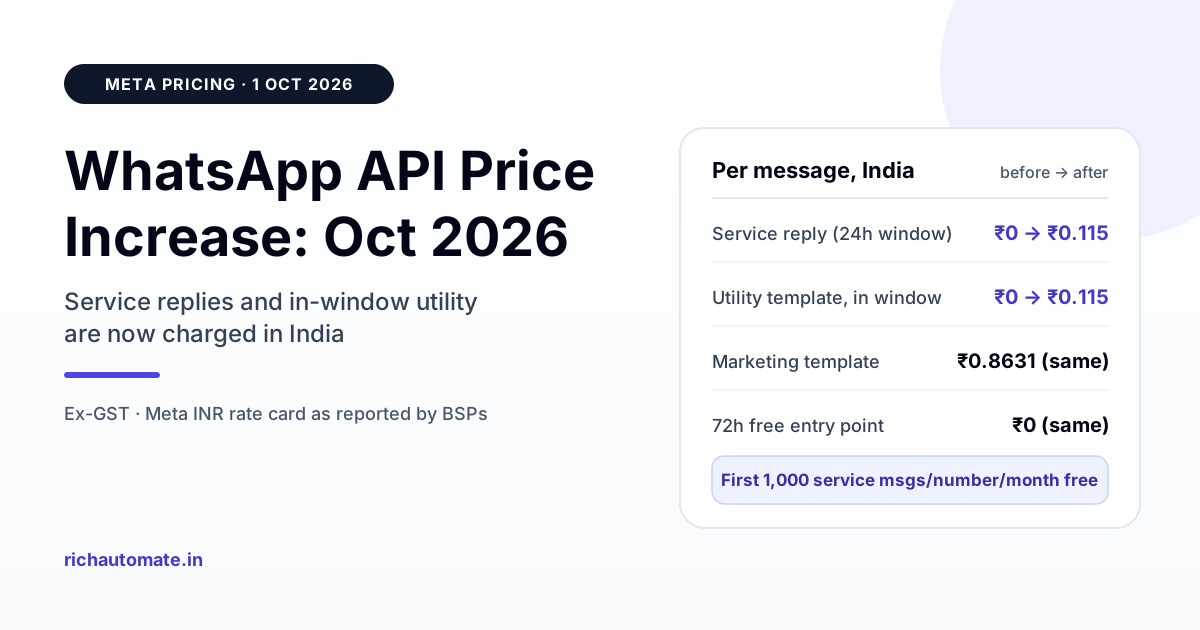
From 1 October 2026, Meta charges for WhatsApp service messages (your free-form replies inside the 24-hour customer service window) and for utility templates sent inside that window. Both are billed per delivered message at the utility rate, which in India is ₹0.115 plus 18% GST. BSPs report that the first 1,000 service messages per business phone number each month stay free. Marketing (₹0.8631) and authentication (₹0.115) rates for India did not change on this date.
Updated: 2 Oct 2026. This post explains what changed against the old rules, who pays more, worked rupee examples for a cafe, a clinic and a D2C store, and how to keep the new line on your bill small. Each fact names its source, and where Meta's own pages and BSP reports disagree, we say so.
TL;DR: the 1 October 2026 WhatsApp price change
- Service replies are no longer free. Meta charges each free-form reply in the 24h window at the utility rate, about ₹0.115 + GST in India. Source: Meta, non-template message pricing.
- The first 1,000 service messages per phone number per month are free, as reported by 360dialog and respond.io. We could not find this allowance on Meta's own pricing pages.
- Utility templates inside an open window are charged again, at ₹0.115 in India. They had been free since 1 July 2025 (Meta).
- Unchanged: India marketing ₹0.8631, authentication ₹0.115, inbound messages free, and the 72-hour free entry point window from Click-to-WhatsApp ads and Facebook Page buttons.
What changed on 1 October 2026?
Two charges came back. Since 1 November 2024 Meta had not charged for service conversations, and since 1 July 2025 it had not charged for utility templates delivered inside an open customer service window. Meta's non-template pricing page now says: "Effective October 1, 2026, Meta will charge for service messages, which have not been charged since November 2024." The same page confirms the utility change: Meta "will charge for utility messages sent in response to users within an open 24-hour customer service window. These messages have not been charged since July 1, 2025." (Meta developer docs).
Three details from Meta's page decide how big the bill gets:
- Service messages are billed per message, not per conversation. Ten replies in one chat are ten billable messages.
- The rate is the market's utility rate. Meta: "By market, rates for service messages are the same as the rates for utility and authentication messages."
- Service messages get no volume tiers. Meta: "Meta does not offer volume tiers for service messages." Utility and authentication still get tiered discounts at high monthly volume.
Meta also confirms that the 72-hour free entry point window is unchanged. A chat that starts from a Click-to-WhatsApp ad or a Facebook Page call-to-action button is still free for 72 hours, templates included.
Before vs after: WhatsApp API rates in India
All rates are per delivered message, in INR, before 18% GST. They come from Meta's India INR rate card as reported by BSPs, because Meta's INR CSV could not be opened directly when we checked.
| Message type | Until 30 Sep 2026 | From 1 Oct 2026 | Change |
|---|---|---|---|
| Service reply (free-form, inside 24h window) | ₹0, unlimited | First 1,000 per number per month ₹0 (BSP-reported), then ₹0.115 | New charge |
| Utility template inside an open 24h window | ₹0 | ₹0.115 | New charge |
| Utility template outside a window | ₹0.115 | ₹0.115 | No change |
| Authentication (OTP) template | ₹0.115 | ₹0.115 | No change |
| Authentication-international (India) | ₹2.4971 | ₹2.4971 | No change (last raised 1 Apr 2026) |
| Marketing template | ₹0.8631 | ₹0.8631 | No change (last raised 1 Jan 2026) |
| Anything in the 72h free entry point window | ₹0 | ₹0 | No change |
| Inbound messages from customers | ₹0 | ₹0 | No change |
The last increase to the India marketing rate was on 1 January 2026, from ₹0.7846 to ₹0.8631. It is covered in our January 2026 marketing rate hike analysis and the January 2026 rate hike impact calculator. The October 2026 change is a different change: it adds charges for service replies and in-window utility, and leaves template prices where they were.
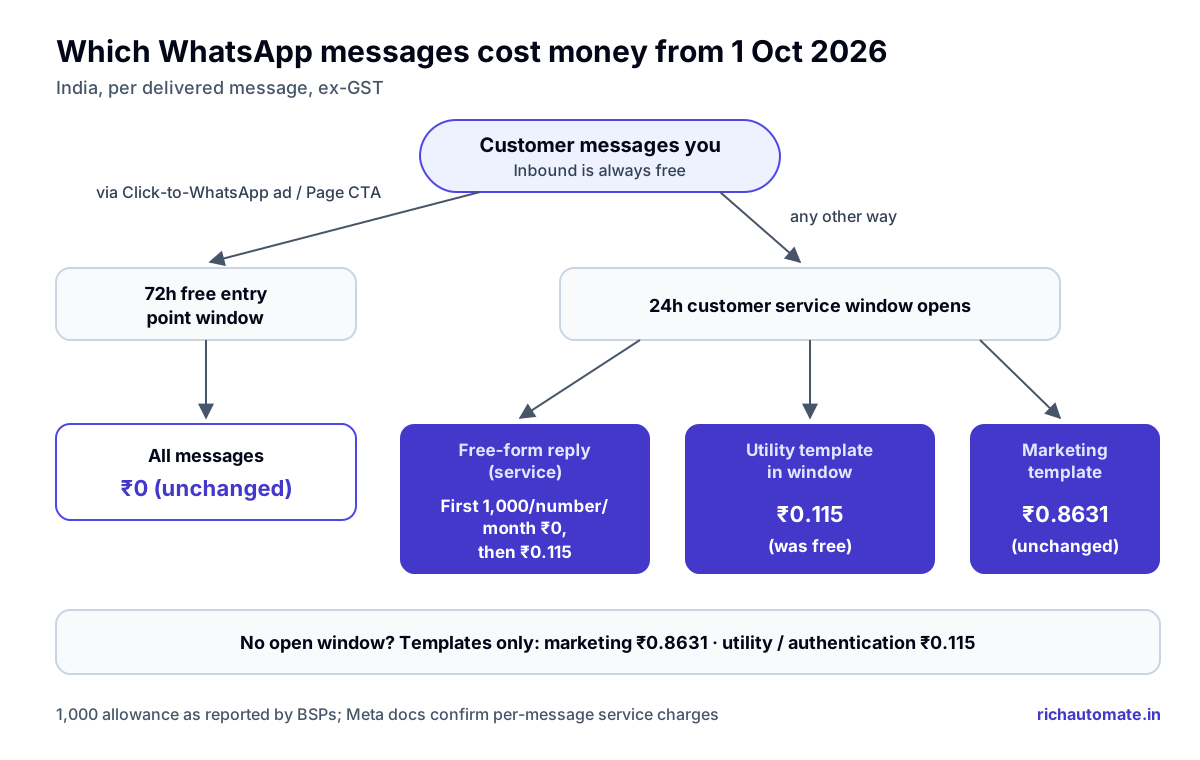
Is the first 1,000 service messages free?
Yes, according to BSPs, with one caveat. 360dialog reports "1,000 free service messages each month" per business phone number, with no rollover. respond.io says "the first 1,000 service messages sent from each business phone number each month are free." Tech-ish points out that the allowance counts individual replies, not 1,000 customer chats.
The caveat is that Meta's developer pricing pages did not mention the 1,000 allowance when we checked on 2 October 2026, and Wati's help centre describes it per WhatsApp Business Account rather than per phone number. If you run several numbers under one account, budget as if the allowance were per account until your first October invoice shows which applies. Only service messages count toward it. Utility templates in the window are charged from the first one.
How much is a WhatsApp service message in India now?
A WhatsApp service message in India costs ₹0.115 plus 18% GST (about ₹0.136) after the free monthly allowance, from 1 October 2026. The rate equals India's utility rate because Meta prices service messages at each market's utility rate. With no volume tiers on service messages, a large support desk pays the same per-reply rate as a small one. 360dialog lists the India USD equivalent as $0.0014 per service message. INR-billed accounts pay the INR rate.
Who pays more after 1 October 2026?
The more you chat, the bigger the increase. Template-heavy senders barely notice. Businesses with long human support threads see a new line on the bill.
- Support-heavy businesses (clinics, coaching institutes, service desks, logistics). Each agent reply is billable after the first 1,000, and agents often send several short messages per query.
- Businesses that send utility templates during a chat, for example an order confirmation template right after the customer asks about their order, or an appointment confirmation template while the booking chat is still open. These cost nothing in September and ₹0.115 each from October.
- Multi-number setups, if the allowance turns out to be per account rather than per number.
Mostly unaffected: low-volume businesses that reply to a few hundred chats a month, marketing-led senders whose bill is dominated by ₹0.8631 marketing templates, and anyone whose conversations mostly start from Click-to-WhatsApp ads.
Worked INR examples: cafe, clinic, D2C store
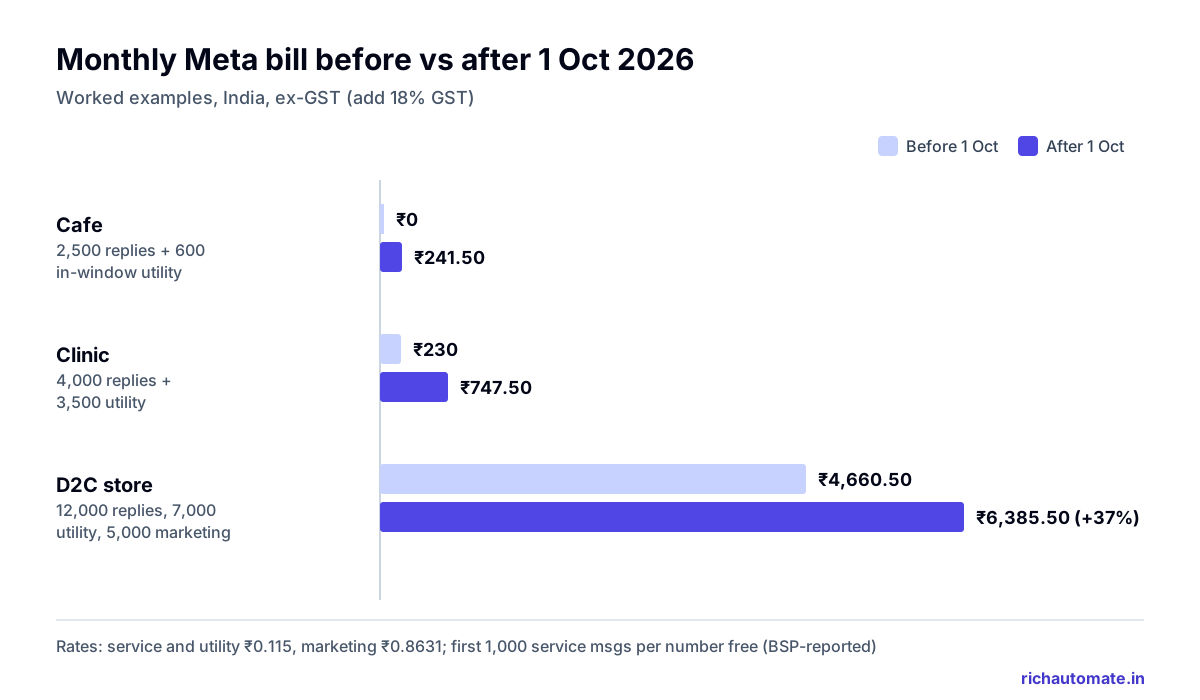
These are illustrative models, not client data. They use ₹0.115 for service and utility, ₹0.8631 for marketing, and the first 1,000 service messages per number free. All figures are monthly, before GST unless stated.
Get a 1-minute BSP audit on WhatsApp
Drop your WhatsApp number — we line-item your current invoice against Meta India rates in under 60 seconds. India-hosted, DPDP-compliant.
| Business | Monthly sends | Before 1 Oct | After 1 Oct | Increase (incl. GST) |
|---|---|---|---|---|
| Cafe (orders on WhatsApp) | 2,500 service replies; 600 in-window utility (order-ready, receipts) | ₹0 | ₹241.50 | +₹284.97 |
| Clinic | 4,000 service replies; 1,500 in-window utility (booking confirmations); 2,000 reminders outside the window | ₹230 | ₹747.50 | +₹610.65 |
| D2C store | 12,000 service replies; 4,000 in-window utility; 3,000 out-of-window utility; 5,000 marketing | ₹4,660.50 | ₹6,385.50 | +₹2,035.50 |
How the numbers add up:
- Cafe: (2,500 − 1,000) × ₹0.115 = ₹172.50 for service, plus 600 × ₹0.115 = ₹69 for in-window utility, so ₹241.50, or ₹284.97 with GST. Before October the same month cost ₹0.
- Clinic: the 2,000 out-of-window reminders were already charged (₹230). New charges are 3,000 × ₹0.115 = ₹345 for service and 1,500 × ₹0.115 = ₹172.50 for in-window utility. The total rises from ₹230 to ₹747.50, an extra ₹517.50, or ₹610.65 with GST.
- D2C store: before October, 3,000 × ₹0.115 + 5,000 × ₹0.8631 = ₹4,660.50. New charges are 11,000 × ₹0.115 = ₹1,265 for service and 4,000 × ₹0.115 = ₹460 for in-window utility, so ₹6,385.50 in all. That is 37% more, or about ₹2,036 a month with GST.
To check your own numbers, enter your monthly service, utility and marketing volumes in the WhatsApp API cost calculator and compare with your September bill.
How to reduce your WhatsApp bill after the October 2026 change
Most of the increase can be avoided by changing how you message rather than how much. Six levers, in order of impact:
- Start more chats through free entry points. Meta says the 72-hour free entry point window is unchanged. Chats that start from a Click-to-WhatsApp ad or a Facebook Page CTA are free for 72 hours, service replies and in-window utility included. Our free entry point conversations guide covers setup. Some BSPs report that this window is growing to 7 days, but Meta's page still says 72 hours, so plan around 72.
- Send one complete reply, not several short ones. Billing is per message, so "Hi", "Checking" and "Here's your link" cost three times what one full answer costs. Rewrite agent macros so each reply carries the answer, the link and the next step.
- Use buttons and list messages. Interactive menus resolve "track order" or "book slot" in fewer turns than open text, and fewer turns means fewer billable messages.
- Batch in-window updates. If a customer is mid-chat, put the order status, invoice link and delivery estimate in one reply rather than sending a separate utility template for each.
- Choose between free-form and template on cost. Inside the window a free-form reply and a utility template now cost the same ₹0.115, but free-form replies use the free 1,000 allowance and utility templates do not. Inside the window, reply in free-form text. Keep utility templates for when the window is closed.
- Classify templates correctly. Marketing costs about 7.5 times utility in India (₹0.8631 against ₹0.115). Order updates, payment reminders and appointment confirmations should stay purely transactional so Meta approves them as utility. A single promotional line can get a template re-categorised as marketing. See our template categories guide for wording that stays utility.
For more, see our nine-tactic checklist on how to reduce WhatsApp API cost after October 2026 and the original service message charges explainer.
Utility or marketing: which to use after October 2026?
Use utility for anything the customer is waiting for: order confirmations, shipping updates, payment receipts, appointment reminders, account alerts. It costs ₹0.115 inside or outside the window. Use marketing only for messages that sell: offers, launches, re-engagement, abandoned-cart nudges with a discount. They cost ₹0.8631 and are charged on every delivery. Sending a sales message as a utility template does not save money for long. Meta re-categorises templates whose content does not match the category, so write genuinely transactional utility copy.
What else changed in 2026, and what didn't
- Meta Business Agent (from 1 Aug 2026): Meta's own AI agent is billed at a global $2.00 per 1 million tokens, which Meta puts at about 4–5 US cents per message. These messages are billed as tokens, not also as service messages (Meta).
- Other markets on 1 Oct 2026: Meta's pricing page lists lower utility and authentication rates for Bangladesh, Iraq, Nepal and Sri Lanka, and higher ones for Kazakhstan, Kuwait, Morocco, Oman and Ukraine. India is not on the list.
- INR billing: eligible Indian businesses can be billed in rupees, and Meta asks eligible customers to move all their WhatsApp Business Accounts to INR by 31 December 2026 (Meta pricing).
- Volume tiers: utility and authentication discounts still apply by monthly volume across your business portfolio. Only charged messages count toward the tiers, and service messages get no tier discount.
To see what can still be free on WhatsApp after this change, read is the WhatsApp Business API free in India.
What we could not verify
Three points are unsettled as of 2 October 2026, and you should not budget against them as certain:
- The 1,000 free service messages is reported by several BSPs but did not appear on Meta's developer pricing pages when we checked. Meta's main pricing overview also still carries older wording saying non-template messages are free, which conflicts with its own non-template page.
- Allowance scope: most sources say per phone number; Wati says per WhatsApp Business Account.
- A 7-day Click-to-WhatsApp window is reported by some BSPs, while Meta's page says the 72-hour window is unchanged.
Your first October invoice in WhatsApp Manager will settle all three. We will update this post when Meta's pages do.
Where RichAutomate fits
RichAutomate does not change Meta's rates. On Client Pay, Meta bills your own card directly at Meta's rate, and RichAutomate charges a flat ₹0.10 per message platform fee, with ₹0 setup and no monthly floor on pay-as-you-go. The October increase therefore reaches you exactly as Meta prices it, with no extra markup on top. The inbox, chatbot builder and interactive buttons help with the levers above: fewer, fuller replies and more chats started from free entry points. Current rates are on the RichAutomate pricing page.
See your post-October WhatsApp bill before it arrives
Enter your monthly service, utility and marketing volumes in the cost calculator, or start a 14-day trial with 100 free credits and see exactly what each message costs. Create a free RichAutomate account.
Sources: Meta for Developers, non-template message pricing and pricing overview; 360dialog; respond.io; Wati help centre; ChatMaxima India rate card. Rates exclude 18% GST. Updated 2 Oct 2026.