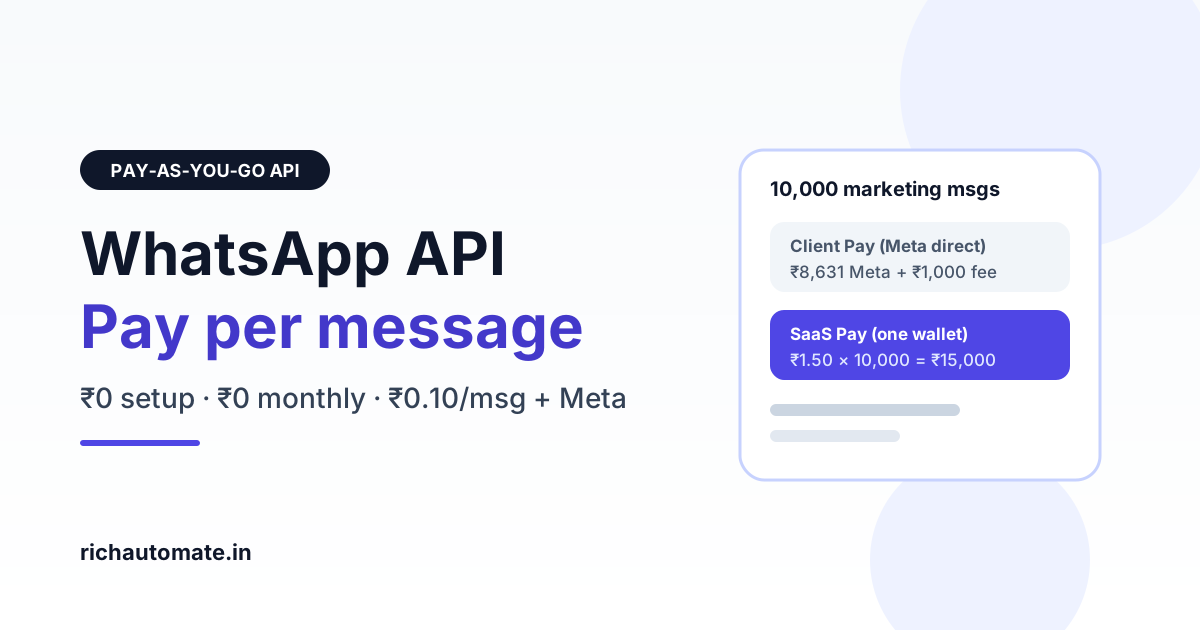
A pay-as-you-go WhatsApp API charges you only for the messages you send: no setup fee, no monthly subscription, no per-seat licence. In India in 2026 the cheapest way to run one is RichAutomate Client Pay: ₹0 setup, ₹0 monthly, and a ₹0.10 platform fee per message on top of Meta's own rate, which Meta bills to you directly.
This guide breaks down how pay-as-you-go (PAYG) WhatsApp Business API pricing works, how it compares with monthly-plan and per-seat models, what you will actually pay at 1,000 to 1,00,000 messages a month, and when a fixed plan starts to make sense instead.
What "Pay-As-You-Go" Means for the WhatsApp Business API
Every WhatsApp Business API bill in India has two layers. The first is Meta's per-message charge, which depends on the template category: marketing, utility or authentication. The second is the platform layer your provider adds for the inbox, chatbot builder, broadcasts and API access.
Most providers charge the platform layer as a fixed monthly subscription, often with a cap on agents or contacts. A PAYG provider turns that layer into a per-message fee, so your platform cost scales with usage and falls to ₹0 in a quiet month. For the Meta layer, see our breakdown of Meta's WhatsApp per-message pricing in India.
Because Meta's rate is identical whichever provider you choose, the platform layer is the only part of the bill you can really shop around on. That is why the pricing model — fixed fee versus per-message — matters more than headline discounts.
Three things are always free regardless of model:
- Service replies — free-form replies inside the 24-hour window after a customer messages you carry no Meta charge.
- Inbound messages — customers messaging you never costs you anything.
- Utility templates sent inside an open customer-service window are free under Meta's per-message model.
RichAutomate PAYG Pricing: Client Pay vs SaaS Pay
RichAutomate offers two usage-only billing modes. Both have ₹0 setup and ₹0 monthly fees, and both include the shared team inbox, visual flow builder, broadcasts, API access and webhooks.
| Billing mode | Who pays Meta | Marketing message | Utility / authentication | Best for |
|---|---|---|---|---|
| Client Pay | You, directly to Meta | Meta ₹0.8631 + ₹0.10 platform | Meta ₹0.13 + ₹0.10 platform | Lowest unit cost; businesses with a card on Meta |
| SaaS Pay | RichAutomate (one wallet) | ₹1.50 all-in | ₹0.50 all-in | One invoice, no Meta payment setup |
Client Pay is the cheapest unit cost in the market because the platform layer is a flat ₹0.10 and Meta's rate is passed through at cost. SaaS Pay costs more per message but removes Meta billing setup entirely: you top up one prepaid wallet and every message is debited from it. Full details are on the RichAutomate pricing page. All figures exclude GST.
PAYG vs Monthly Plan vs Per-Seat: Model Comparison
Here is how the three common pricing models behave for an Indian business. The comparison is about the model, not any one vendor — always check each provider's current public pricing page.
| Factor | Pay-as-you-go (usage-only) | Monthly subscription + Meta | Per-seat / per-user CRM |
|---|---|---|---|
| Fixed monthly fee | ₹0 | Yes, every month | Yes, multiplied by seats |
| Cost in a quiet month | Near ₹0 | Full plan fee | Full seat fees |
| Adding agents | No extra platform cost | Often needs a higher tier | Each seat adds cost |
| Predictability | Scales with sends | Fixed + variable Meta | Fixed + variable Meta |
| Lock-in | None; stop anytime | Monthly or annual commitment | Usually annual |
| Best fit | SMBs, seasonal senders, pilots | Steady high-feature use | Large sales teams already on that CRM |
The pattern is simple: PAYG wins whenever your volume is uneven or you are still testing WhatsApp as a channel. A fixed plan only wins once you need extra seats, numbers or premium support every month. We go deeper on this trade-off in platform fee vs per-message pricing.
Estimate your real monthly bill
Plug your marketing and utility volumes into the WhatsApp API cost calculator — it shows the Meta charge and platform fee side by side, in rupees.
Get a 1-minute BSP audit on WhatsApp
Drop your WhatsApp number — we line-item your current invoice against Meta India rates in under 60 seconds. India-hosted, DPDP-compliant.
What You Actually Pay: Worked Examples
Using the published rates above (excluding GST), here is what a month of sending costs on each RichAutomate mode:
| Monthly volume | Client Pay (Meta + ₹0.10) | SaaS Pay (all-in) |
|---|---|---|
| 1,000 marketing | ₹963 (₹863 Meta + ₹100 platform) | ₹1,500 |
| 10,000 marketing | ₹9,631 (₹8,631 Meta + ₹1,000 platform) | ₹15,000 |
| 10,000 utility | ₹2,300 (₹1,300 Meta + ₹1,000 platform) | ₹5,000 |
| 1,00,000 marketing | ₹96,310 (₹86,310 Meta + ₹10,000 platform) | ₹1,50,000 |
| Only service replies | ₹0 | ₹0 |
Two takeaways. First, on Client Pay the platform layer is roughly 10% of a marketing-heavy bill — Meta's rate is the real driver, so template category matters more than provider. Second, a business that mostly answers inbound chats pays close to nothing, which no fixed-fee plan can match. For a ranked list of low-cost options see the cheapest WhatsApp Business API in India.
How to Keep a PAYG WhatsApp Bill Low
- Use utility templates for transactional updates. Order, booking and payment updates are utility, not marketing — roughly 6× cheaper at Meta's rate.
- Answer inside the 24-hour window. Free-form service replies are free, so fast human or chatbot replies cost nothing.
- Segment broadcasts. Sending to engaged contacts only cuts marketing spend and protects your quality rating.
- Let a chatbot handle FAQs. A flow that resolves common questions inside the open window keeps service cost at ₹0.
- Review spend weekly. Usage pricing rewards attention; the wallet ledger shows every debit.
When a Fixed Plan Beats Pure PAYG
PAYG covers sending. Optional RichAutomate plans (Starter ₹499/month, Pro ₹899/month, White-label ₹1,199/month) exist for teams that need more seats, extra numbers or white-label branding every month, and add-ons such as an extra number (₹399) or seat (₹199) can be bolted on individually. If you only need one number and a small team, stay on usage-only — there is no monthly fee to justify.
A quick rule of thumb: add up the plan fee you would pay elsewhere and divide it by the RichAutomate platform fee. At ₹0.10 per message, a ₹2,500 monthly subscription equals 25,000 messages of platform fee. If you send fewer than that in a typical month, usage-only is cheaper; if you send far more and need many agents, compare a fixed plan carefully. Seasonal businesses — coaching institutes at admission time, retailers around festival sales, travel agents in peak season — benefit most from PAYG, because their quiet months cost almost nothing.
Going live on the WhatsApp Business API needs a verified business with GST registration; you can trial without it. Every new account starts with a 14-day free trial and 100 free credits.
Start pay-as-you-go today
₹0 setup, ₹0 monthly, ₹0.10 per message on Client Pay. 14-day trial with 100 free credits.
Frequently Asked Questions
Is there a WhatsApp Business API with no monthly fee in India?
Yes. RichAutomate is usage-only: ₹0 setup and ₹0 monthly. On Client Pay you pay Meta's per-message rate directly plus a ₹0.10 platform fee per message.
How much does one WhatsApp marketing message cost on PAYG?
On RichAutomate Client Pay it is Meta's India marketing rate of ₹0.8631 plus ₹0.10, about ₹0.96. On SaaS Pay it is ₹1.50 all-in. GST is extra.
Are customer replies charged on a pay-as-you-go plan?
No. Inbound messages and free-form service replies inside the 24-hour customer-service window carry no Meta charge and no RichAutomate platform charge on service replies.
What is the difference between Client Pay and SaaS Pay?
Client Pay passes Meta's rate through at cost and Meta bills you directly, plus ₹0.10 per message. SaaS Pay bundles everything into one wallet at ₹1.50 marketing and ₹0.50 utility or authentication.
Do I need GST to use a pay-as-you-go WhatsApp API?
You can start the 14-day trial without GST. To go live on the WhatsApp Business API, a GST-registered, verified business is required.