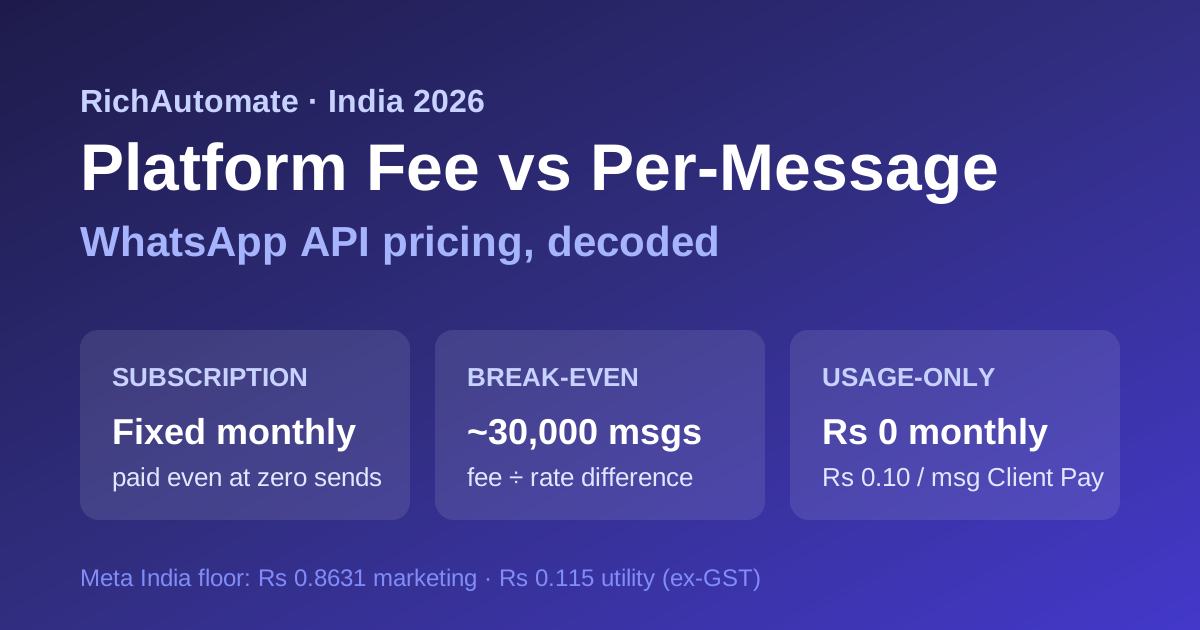
In short: Pure per-message pricing is cheaper for almost every Indian business sending under about 30,000 WhatsApp messages a month. A platform fee only pays off if the plan also cuts your per-message rate by more than the fee divided by your monthly volume. Meta's own template charges apply under both models.
Pure per-message pricing wins for almost every Indian business under roughly 30,000 messages a month; a platform fee only pays for itself if the fixed plan also cuts your per-message rate by more than the fee divided by your volume. Most Indian WhatsApp Business API vendors charge a platform fee and a markup on Meta's rates, which means the fee buys you nothing on the unit economics at all.
This page works through both models with 2026 India numbers, gives you the break-even formula, and shows where each model genuinely wins. If you want the underlying rate card first, start with our WhatsApp Business API pricing breakdown for India.
Key facts at a glance (checked October 2026 against the named primary source):
| Fact | Figure | Source |
|---|---|---|
| How Meta bills the WhatsApp Business API | Per message, effective 1 July 2025 | Meta developer docs: Pricing |
| Charged template categories | Marketing, Utility, Authentication | Meta developer docs: Pricing |
| When a template message is charged | Only when it is delivered | Meta developer docs: Pricing |
| What a customer message opens | A 24-hour customer service window | Meta developer docs: Pricing |
The two pricing models, stated plainly
Platform-fee (subscription) pricing. You pay a fixed amount every month or year for access to the software — inbox, broadcast tool, chatbot builder, dashboards — and you pay for messages separately. The fee is charged whether you send one message or a million. Variants include per-agent seat licences, tiered contact limits, and annual-only contracts.
Per-message (usage-only) pricing. There is no fixed fee. You pay a small platform charge per message on top of what Meta charges, or a single all-in rate per message. Send nothing in a month and the bill is zero.
The confusion in the Indian market is that these are not mutually exclusive. Plenty of vendors run both at once: a monthly plan plus a markup on Meta's published rates. That stacking is what makes side-by-side pricing pages so hard to read, and it is covered in detail in our note on how BSPs mark up Meta's rates.
What Meta charges, before any provider touches it
Meta bills the conversation categories directly and publishes the India rates. For 2026 the figures to anchor on are Rs 0.8631 per marketing message and Rs 0.115 per utility or authentication message, both exclusive of GST. Service conversations — where the customer messages you first and you reply inside the 24-hour window — carry no Meta charge.
That floor is the same for every business in India regardless of which provider you sign with. Anything above it is your provider's software revenue, in whichever shape they choose to collect it.
The break-even formula
You only need one line of arithmetic:
Break-even volume = monthly platform fee ÷ (per-message rate difference between the two vendors)
Worked through with an illustrative Rs 2,999 per month plan, against a usage-only vendor charging Rs 0.10 per message as its platform charge:
- If the subscription vendor charges the same per-message rate, the break-even is infinite. The fee is pure cost. You never catch up.
- If the subscription vendor charges Rs 0.05 less per message, break-even is 2,999 ÷ 0.05 = 59,980 messages a month.
- If it charges Rs 0.10 less per message — that is, zero platform charge on messages — break-even is 2,999 ÷ 0.10 = 29,990 messages a month.
Now put that against real Indian send volumes. A 5,000-contact D2C brand running two campaigns a month sends about 10,000 marketing messages. A 30-seat services firm sending order and appointment utilities might touch 15,000. Both sit well under every break-even above. For them the subscription is a straight loss — Rs 35,988 a year for software they could have on usage.
Send these messages on WhatsApp, from your own number
We get your templates approved on the official WhatsApp API and set up your first broadcast with you. ₹0 platform fee, you pay only Meta's per-message rate.
Run your own numbers with the WhatsApp API cost calculator rather than trusting a vendor's own example volumes, which are usually chosen to flatter the plan.
Where platform-fee pricing genuinely wins
It is not always the wrong answer. Three cases where a fixed fee is defensible:
- Very high, very steady volume. Above a few lakh messages a month, a fee that buys a materially lower per-message rate does clear break-even — provided the rate cut is real and written into the contract, not a sales-call promise.
- Budget predictability is a hard requirement. Some finance teams need a fixed line item more than they need the lowest total. A flat fee is easier to approve than a variable one, even when it costs more. That is a procurement constraint rather than an economic argument, and worth naming honestly.
- The fee includes something you would otherwise buy separately — a dedicated account manager, a custom integration build, a guaranteed SLA with penalties. Check that these are contractual, not marketing copy.
Where per-message pricing wins
- Seasonal businesses. A wedding-wear retailer or an exam-coaching institute sends heavily for three months and barely at all for the rest. A subscription bills all twelve.
- You are still testing. Nobody knows their real WhatsApp volume before running it for a quarter. Usage-only lets the volume discover itself without a sunk fee.
- Multi-brand or agency setups. Fixed fees multiply per WABA. Usage-only does not.
- Any month you pause. Campaign freeze, festival lull, a Meta template rejection that stalls a launch — on usage-only those months cost nothing.
The costs neither pricing page shows
Comparing the headline model alone will still mislead you. Ask about all six:
- Setup or onboarding fee — a one-time charge that quietly restores the fixed cost you thought you had avoided.
- Per-agent seat charges — the plan looks cheap until you add your eighth agent. We cover the seat trap in per-agent seat pricing for WhatsApp API.
- Contact or MAU caps — a limit on unique contacts per month, which forces an upgrade as your list grows even if sends stay flat.
- Who holds the Meta bill — whether Meta charges your own payment method directly or your provider resells the conversation to you. This single choice changes both the invoice and the audit trail; see Client Pay vs SaaS Pay billing.
- GST treatment — Meta's published India rates are exclusive of GST, and provider charges carry their own. Confirm the final landed rate with your CA, not with a sales deck.
- Exit terms — annual lock-in, notice periods, and whether your WABA and phone number leave with you.
How to run the comparison properly
- Pull your last three months of actual volume, split into marketing, utility and authentication. Do not estimate.
- For each vendor compute: fixed fee × 12, plus (volume × 12 × per-message rate for each category), plus setup, plus seat charges at your real headcount.
- Add GST to both sides so the comparison is landed cost, not list price.
- Re-run step 2 at half your current volume and at triple it. A model that only wins at one exact volume is a model that will stop winning.
- Ask each vendor, in writing, which of the six hidden costs above apply.
What RichAutomate charges
RichAutomate runs usage-only. Rs 0 setup, Rs 0 monthly, no per-agent seat charge and no contact cap. On Client Pay your Meta conversation charges go to your own payment method at Meta's published rates, and RichAutomate adds Rs 0.10 per message as the platform charge. On SaaS Pay, where we carry the Meta bill, the all-in rate is Rs 1.50 per marketing message and Rs 0.50 per utility message.
That is the whole rate card. A month with no sends costs nothing. If you want the wider list of providers who avoid a monthly fee, see WhatsApp Business API without a monthly fee, and for a broader shortlist our best WhatsApp Business API providers in India comparison.
The one-line rule
Divide the annual platform fee by your actual annual message volume. If the result is larger than the per-message saving the plan offers, you are paying a subscription for the privilege of also paying per message — and in the Indian market in 2026 that is the common case rather than the exception.
See real monthly bills at 1,000 to 1,00,000 messages in the pay-as-you-go WhatsApp API India 2026 guide.