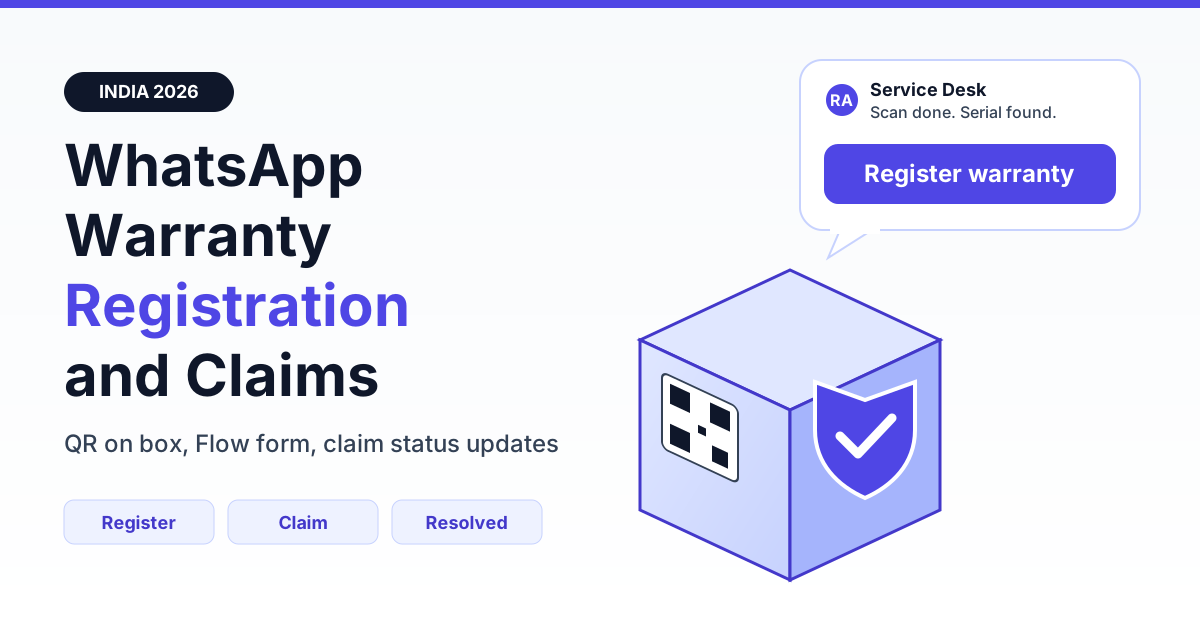
To run warranty registration and claims on WhatsApp, print a QR code on the box or warranty card that opens a click-to-WhatsApp chat, collect the serial number, invoice photo, purchase date, dealer and pincode through a WhatsApp Flow form, and then handle claims in the same thread with photo or video intake, triage and technician assignment. Every status change after that (registered, claim received, technician assigned, part ordered, resolved) goes out as a low-cost utility template, so the customer never has to call a toll-free number to ask "what is happening with my complaint?"
This guide is written for Indian brands, distributors and dealers selling appliances, consumer electronics, mobiles, two-wheelers and EVs, furniture, mattresses, water purifiers, solar panels and inverters. It covers the full lifecycle: registration, claim intake, triage, service-centre routing, status updates, extended-warranty and AMC upsell near expiry, fraud and duplicate-serial checks, and how long to keep the data. It also explains what each message costs, so you can budget before you print a single QR sticker.
Warranty vs AMC vs refund: get the definitions right first
Most service teams mix these three up in their messaging, and customers then argue about what they were promised. Before you design a single WhatsApp flow, separate them clearly, because each one needs different wording, different templates and different escalation rules.
- Warranty is the manufacturer's promise that the product will be free of defects for a set period. Repairs or replacements for covered defects are free to the customer. It comes with the product; the customer does not pay extra for it.
- AMC (annual maintenance contract) is a paid service contract, usually bought after the warranty ends, covering periodic servicing and sometimes parts. It is a separate sale with its own terms.
- Refund is money returned for a purchase, typically within a return window or when a repair or replacement is not possible. It is a commercial transaction, not a service visit.
| Aspect | Warranty | AMC | Refund |
|---|---|---|---|
| Who pays | Manufacturer or brand | Customer, upfront | Brand or seller returns money |
| Typical duration | 1-2 years standard; longer on compressors, panels or batteries | 1-3 years, renewable | One-time event |
| What it covers | Manufacturing defects, free repair or replacement | Scheduled servicing, labour, sometimes parts | Purchase price, fully or partly |
| WhatsApp trigger | Registration QR, claim request | Near-expiry reminder (opt-in only) | Rejected claim or return request |
| Template category | Utility | Marketing for the offer, utility for renewals already purchased | Utility |
If you already run paid service contracts, our guide on AMC and home-appliance repair on WhatsApp goes deeper into renewal and visit scheduling. For refunds, the patterns in refund status updates apply directly when a claim ends in money back rather than a repair.
A general legal note: India's consumer protection framework, legal metrology rules for packaged goods and e-waste rules for electronics all touch warranty terms, labelling and product disposal. We describe them only in general terms here. Confirm your warranty wording, claim-rejection language and data practices with your legal counsel before going live.
Why warranty registration fails on paper, SMS and apps
In our experience across Indian service teams, the paper warranty card is the weakest link in after-sales. Customers lose it, dealers forget to stamp it, and the brand never learns who actually owns the product. When a claim finally arrives, the service team spends the first call just establishing purchase date and dealer.
Brand apps and website forms were supposed to fix this, but they ask the customer to download something or type a long URL for a one-time task. SMS links convert better, but you cannot collect an invoice photo over SMS. WhatsApp removes most of that friction: the customer already has it installed, scanning a QR opens a chat instantly, and photos are native.
| Channel | Typical registration completion | Can collect invoice photo | Approx cost per registration | Claim follow-up in same place |
|---|---|---|---|---|
| Paper warranty card | Low; often under 10-15% returned | Only by post | Printing plus postage, data entry | No |
| SMS with link | Low to moderate | Only via web form | SMS charge plus form hosting | No |
| Brand app | Low outside loyal buyers; app install is the barrier | Yes | High build and maintenance cost | Yes, if installed |
| Website form | Moderate when QR is on the box | Yes, upload | Low, but mobile drop-off is high | Usually no |
| WhatsApp QR plus Flow | Typically the highest of these; 2-4x paper in many rollouts | Yes, native camera | Often free inside the customer-opened 24-hour window; small utility fee for confirmations outside it | Yes, same chat |
These ranges are directional and vary by category and how prominently the QR is placed. A mattress brand with the QR on the law label will see different numbers from a mobile brand with the QR inside the box lid. Measure your own baseline before and after.
Step 1: QR on the box, click-to-WhatsApp, and a Flow form
The registration journey should take under two minutes. Here is the pattern that works across categories.
Place the QR where the customer looks at unboxing
Print the QR on the warranty card, the inside of the box lid and, for large goods like ACs, inverters and solar kits, on a sticker the installer hands over. Encode a click-to-WhatsApp link with a prefilled message such as "Register warranty" plus a hidden product-line code. That code tells your system which Flow to open, so an EV scooter buyer and a water purifier buyer see different fields.
Open a WhatsApp Flow instead of question-by-question chat
Asking seven questions one message at a time is slow and error-prone. WhatsApp Flows in-chat forms let you collect everything on one or two native screens inside WhatsApp. A typical warranty Flow collects:
- Serial number or IMEI with a format check (length, prefix), plus an option to photograph the label instead of typing.
- Invoice photo uploaded from the gallery or camera.
- Purchase date via a date picker, so you never get "last Diwali".
- Dealer or store name from a dropdown filtered by city, with an "Other" option.
- Pincode, which later drives service-centre routing.
- Consent checkboxes: one for service updates, a separate optional one for offers such as extended warranty and AMC.
Keep the marketing consent separate and unticked by default. It protects your quality rating later, and it gives you a clean list of customers who genuinely want renewal offers.
Confirm registration immediately
Because the customer messaged you first, you are inside a customer-opened 24-hour service window. The confirmation ("Your warranty for serial XXXX is registered until 14 March 2028") can go as a free-form reply at no Meta charge. Send the digital warranty certificate as a PDF in the same message so the customer never needs the paper card again.
Step 2: claim intake, triage and technician assignment
Photo and video intake
When something breaks, the customer returns to the same chat. The registration record is already linked to their number, so the bot can greet them with the product and warranty end date and ask what went wrong.
- Select the product if they have registered more than one (common for families with several appliances).
- Choose a symptom from a short list per category: "not cooling", "water leakage", "battery not charging", "display lines", "motor noise", "panel output low".
- Share a photo or a 15-30 second video. For intermittent faults such as noise or error codes, video is far more useful than a description.
- Confirm address and preferred visit slot, prefilled from the registration pincode.
Every claim gets a ticket ID in the first reply. That single ID is what the customer, the call centre and the technician quote from then on.
Triage into repair, replace or reject
Triage is where WhatsApp saves the most money, because a good share of claims can be resolved without a truck roll. In our experience across Indian service teams, a meaningful portion of "defect" complaints turn out to be installation, usage or power-supply issues that a guided video or a call can fix.
Get a 1-minute BSP audit on WhatsApp
Drop your WhatsApp number — we line-item your current invoice against Meta India rates in under 60 seconds. India-hosted, DPDP-compliant.
- Self-fix: known issues (remote pairing, filter reset, inverter mode setting, app reconnect) get a short guide or video. Ask "Did this solve it?" with Yes/No buttons.
- Repair: covered defect, in warranty, needs a visit or carry-in. Move to assignment.
- Replace: dead-on-arrival within the brand's replacement window, or repeat failure. Route to the dealer or warehouse with approval.
- Reject or chargeable: out of warranty, physical or liquid damage, tampered seal, or non-authorised installation. Explain the reason politely, attach the relevant policy line, and offer a paid repair estimate.
Rejections generate the most anger, so write that template carefully, keep a human reviewer on every rejection, and give a clear route to escalate. A defined complaint escalation matrix (L1 agent, L2 service manager, L3 brand nodal officer with time limits) keeps disputes from spilling onto social media and consumer forums.
Service-centre and technician assignment
The pincode captured at registration maps each claim to the nearest authorised service centre or franchisee. Once assigned:
- The service centre receives the ticket with photos, video, serial, invoice and address, so the technician arrives knowing the likely part.
- The customer receives technician name initials, a masked contact option and the visit window.
- After the visit, the technician marks the job closed with a job-sheet photo and, where relevant, the replaced part's serial number.
For two-wheeler and EV brands, "technician assignment" usually means a workshop appointment rather than a home visit. For solar and inverter installers, it may be a site visit that needs the customer's roof access confirmed. Same pattern, different template wording.
Step 3: status updates with utility templates, and what they cost
Once the customer's 24-hour window closes, every outbound update needs an approved template. Status updates tied to an existing claim belong in the utility category, which Meta prices far lower than marketing. If you are unsure where the line sits, read our breakdown of marketing vs utility template categories; a status update that sneaks in a discount offer can be reclassified as marketing.
| Claim stage | Template category | Meta charge (approx, India) | RichAutomate SaaS Pay (all-inclusive) |
|---|---|---|---|
| Warranty registered (reply to QR scan) | Service reply inside 24-hour window | Free | No per-message template charge |
| Claim received, ticket ID | Service reply if in window, else utility | Free, or about ₹0.11-0.15 | ₹0.30 if a utility template is used |
| Technician assigned, visit slot | Utility | About ₹0.11-0.15 | ₹0.30 |
| Part ordered, expected date | Utility | About ₹0.11-0.15 | ₹0.30 |
| Resolved, feedback request | Utility | About ₹0.11-0.15 | ₹0.30 |
| Extended warranty or AMC offer | Marketing (opt-in only) | About ₹0.78-0.88 | ₹1.20 |
Meta rates change periodically, so check the current Meta rate card before you budget. As a rough worked example: a claim that needs four utility updates outside the service window costs well under a rupee in Meta fees, compared with a support call that typically costs a brand several rupees per minute of agent time. Many updates will also land inside a window the customer reopened by replying, which makes them free from Meta.
On RichAutomate there is no setup fee and no monthly fee; you pay only for usage. In Client Pay mode you pay Meta directly for its charge and a ₹0.10 platform fee per message. In SaaS Pay mode you pay ₹0.30 per utility message and ₹1.20 per marketing message, all-inclusive. Full details are on the RichAutomate pricing page.
Step 4: extended warranty and AMC upsell near expiry
The warranty end date you captured at registration is your most valuable renewal signal. Thirty to sixty days before expiry is typically the window where extended warranty or AMC offers convert best, because the customer still remembers the product working and does not want to pay for a surprise repair.
- Only send to customers who ticked the offers consent. This is a marketing template and is charged as marketing.
- Personalise with the product and end date: "Your purifier warranty ends on 10 November. Extend protection for 2 years."
- Include a quick-reply "Not interested" and honour it permanently for that product.
- Send once, perhaps one reminder. Repeated pushes lead to blocks and reports, which lower your quality rating and can restrict your messaging limits.
No platform or BSP can guarantee your number will never be restricted. What protects you is clean opt-in, relevant timing and low block rates. Watch your quality rating in WhatsApp Manager after every renewal campaign and pause if it drops.
Step 5: fraud and duplicate-serial checks
Warranty fraud in India usually takes a few familiar forms: the same serial registered by multiple numbers, invoices edited to shift the purchase date, grey-market or imported units claiming Indian warranty, and dealers registering unsold stock to extend coverage. Build checks into the Flow and the back office:
- Duplicate serial: if a serial is already registered to another number, do not overwrite it. Flag for manual review and ask for the invoice.
- Serial validity: match against your manufacturing or dispatch list; unknown serials go to review.
- Date sanity: purchase date cannot be before the dispatch date for that serial, or in the future.
- Invoice review: spot-check invoices where the dealer is not in your authorised list or the amount looks off.
- Claim frequency: repeated claims on one serial, or many claims from one pincode for one part, are worth a look.
- Transfer of ownership: for resale-friendly goods such as two-wheelers and mobiles, offer a formal transfer flow instead of letting a second owner re-register.
Keep the tone neutral. Most flagged cases are honest mistakes, such as a family member registering from a different phone, so "we need one more detail" works better than an accusation.
Data retention, consent and security
Warranty data includes names, phone numbers, addresses, invoice images and sometimes home photos. Treat it carefully:
- Keep what the warranty needs: registration details for the warranty period plus a reasonable buffer for disputes and accounting, as advised by your counsel.
- Purge or archive media such as claim photos and videos after the claim is closed and any dispute period has passed.
- Restrict access so service centres see only their own tickets, not your whole customer base.
- Record consent separately for service updates and for marketing, with timestamps.
India's data protection framework expects purpose limitation and deletion when the purpose is served. Our guide on chat data retention covers practical retention schedules; confirm the final policy with your legal team.
Category notes: appliances, mobiles, EVs, solar and more
- Large appliances (AC, refrigerator, washing machine): installation often triggers warranty validity, so capture the installation date and installer in the Flow.
- Mobiles and electronics: use IMEI or serial and expect higher duplicate and grey-market attempts.
- Two-wheelers and EVs: battery and motor warranties often run separately from the vehicle; register each component serial.
- Furniture and mattresses: long warranties (5-10 years are common on mattresses) make the digital certificate especially valuable, since paper cards rarely survive that long.
- Water purifiers: warranty and filter-change schedules overlap, a natural bridge to AMC with consent.
- Solar panels and inverters: performance warranties run for many years; capture installer, site pincode and system size for future claims.
Start free on RichAutomate
RichAutomate gives Indian brands and dealers the WhatsApp Business API, WhatsApp Flows, a visual flow builder for triage, template management and a shared team inbox for service centres, with ₹0 setup and ₹0 monthly fee. Build your QR-to-registration flow, connect claim intake and send utility status updates from one place. Start free on RichAutomate and have your first warranty registration flow running this week.