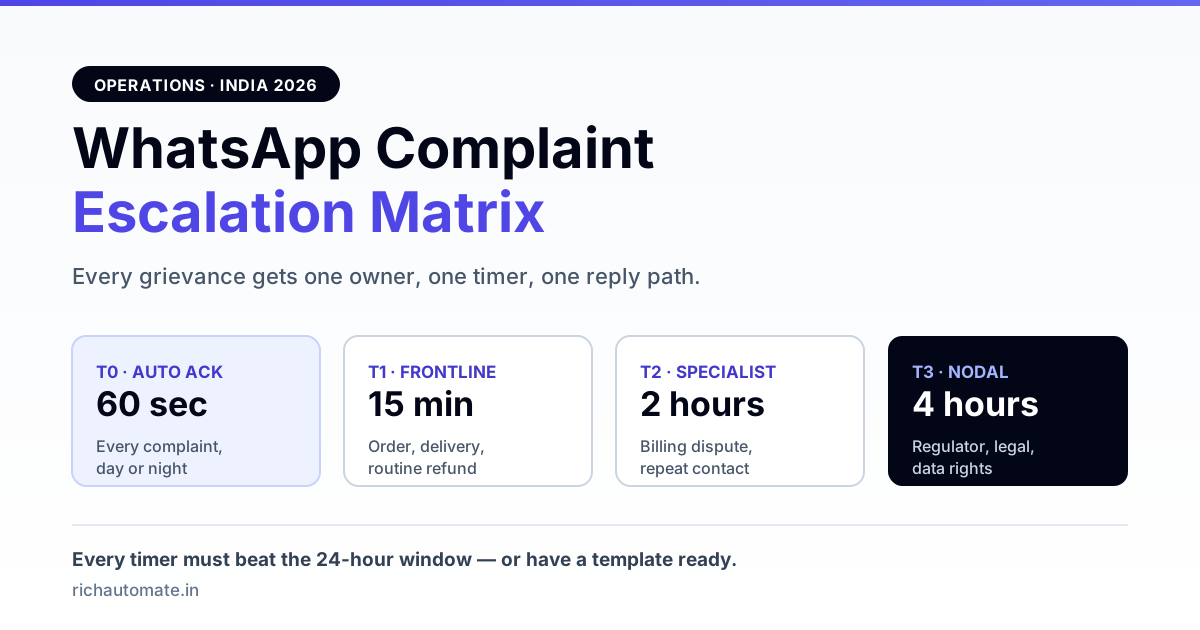
A WhatsApp complaint escalation matrix is a written table that maps every kind of grievance arriving on your WhatsApp Business API number to one owner, one first-response timer and one resolution timer. You need it because WhatsApp complaints do not queue politely like email — the 24-hour customer service window shuts on them, and once it shuts the reply stops being free and starts needing an approved template.
Most Indian teams running WhatsApp support have an escalation process in someone's head and nothing on paper. That works at forty chats a day. At four hundred it produces the pattern every ops lead recognises: the angry customer gets answered fast because they shouted, the quiet one with a genuine billing error waits three days, and the one who mentioned a regulator gets treated exactly like the one asking where the parcel is.
What an escalation matrix actually is
It is four columns, not a flowchart. Trigger, owner, first-response clock, resolution clock. Everything else — the tooling, the tags, the dashboards — exists to make those four columns true. If you cannot write the matrix on one page, your agents will not follow it at 9pm on a Saturday.
The matrix is not the same thing as a bot-to-human handoff. Handoff is the mechanism that moves a chat from automation to a person. The matrix is the policy that decides which person, how fast, and what happens when that person does not answer in time. You need both, and teams that build only the handoff end up with every complaint landing in one undifferentiated queue.
The four tiers that work for Indian WhatsApp support
T0 — automated acknowledgement
Every inbound that looks like a complaint gets an acknowledgement inside sixty seconds, day or night. Not a resolution. An acknowledgement with a reference number and an honest timeline. This tier is pure automation and it is the single highest-leverage thing on this page, because an acknowledged customer stops re-sending and stops escalating to Twitter.
T1 — frontline agent
Order status, delivery delay, wrong item, login trouble, refund not received, appointment change. Anything with a known answer and a known fix. T1 owns it end to end and closes it. If T1 cannot close it inside its resolution clock, the matrix — not the agent's judgement — pushes it up.
T2 — specialist or supervisor
Billing disputes, quality claims, anything involving money moving backwards, repeat contacts on the same reference, and anything a T1 agent has already failed once. T2 has authority T1 does not: issue a credit, approve a replacement, override a policy.
T3 — nodal, compliance or legal
Mentions of a regulator, a consumer forum, a lawyer, the press, or a data-rights request. Also: anything involving a minor, a safety incident, or an allegation of fraud by your own staff. T3 is a named human with a name and a designation, not a team. Nothing in T3 gets answered by automation, and nothing in T3 gets a templated apology.
The matrix, filled in
| Tier | Typical trigger | Owner | First response | Resolution target |
|---|---|---|---|---|
| T0 | Any inbound classified as a complaint | Automation | 60 seconds | n/a — acknowledgement only |
| T1 | Order, delivery, access, routine refund | Frontline agent | 15 min in hours, 8 hours overnight | Same business day |
| T2 | Billing dispute, repeat contact, T1 failure | Supervisor or specialist | 2 hours | 72 hours |
| T3 | Regulator, legal, press, data rights, safety | Named nodal officer | 4 hours | Per the applicable statutory clock |
Those numbers are a starting point, not gospel. Set them from what you can actually staff, then tighten. A matrix with timers you miss every day is worse than no matrix, because it teaches the team that the timers are decorative.
The 24-hour window is the real constraint
On the WhatsApp Business API, a business can send free-form messages to a customer only inside a 24-hour customer service window that opens when the customer messages you. Outside it, you can only send an approved template, and you pay for it.
This turns every escalation timer into a billing decision. A T2 complaint that sits for 30 hours has not just annoyed a customer — it has fallen out of the free window, so the reply now costs a utility template send, and the customer sees a stiff templated message instead of a normal chat. Multiply that across a month and it is a real line item. The mechanics of that arithmetic are worked through in our piece on 24-hour window cost optimization.
The practical rule: every tier's resolution target must be shorter than 24 hours, or the tier must have an approved template ready. T2 at 72 hours cannot rely on the free window. It needs a pre-approved status-update template that fires at hour 20, hour 44 and hour 68 — otherwise the customer hears nothing for three days and you have manufactured a T3.
Detecting a complaint before a human reads it
T0 only works if classification works. Three signals, in order of reliability:
- Explicit keywords. Complaint, refund, not received, damaged, wrong, cancel, worst, cheat, fraud, legal, consumer court, and the Hindi and regional equivalents your customers actually type. Maintain this list from real transcripts, not from a blog post — including this one.
- Structural signals. Third message in a thread with no outbound between them. Repeat contact on the same order reference within seven days. A chat re-opened after being marked resolved. These catch the polite complainer your keyword list will always miss.
- Sentiment or intent classification. Useful as a tiebreaker, dangerous as a primary gate. Route on it, never auto-close on it.
Classification also has to run on chats nobody opened. The complaints that become regulator complaints are usually the ones that were never read at all — which is the same failure mode covered in missed WhatsApp messages. A matrix that only governs chats an agent has already opened governs the easy half of the problem.
Routing: who the chat actually lands on
Escalation is worthless if the escalated chat lands in the same shared inbox it came from. You need assignment that survives shift changes, which in practice means running multiple agents on one number with real ownership per conversation rather than a free-for-all.
Three routing rules that prevent most of the damage:
Get a 1-minute BSP audit on WhatsApp
Drop your WhatsApp number — we line-item your current invoice against Meta India rates in under 60 seconds. India-hosted, DPDP-compliant.
- Escalation transfers ownership, it does not add a watcher. Two owners means no owner.
- The escalating agent writes one line of context before the transfer. What was tried, what the customer wants, what is blocking. Without it T2 restarts the conversation and the customer repeats themselves — the single most reliable way to turn a T2 into a T3.
- Unclaimed escalations bounce up, not sideways. If T2 does not claim inside the first-response clock, it goes to T3's queue automatically. Silence is never an acceptable state.
Timers that survive nights, Sundays and Diwali
Indian WhatsApp traffic does not respect business hours. Evening is peak for retail, Sunday is peak for services, and festival weeks are peak for everything. If your matrix runs on business-hour clocks only, the customer who complained at 9pm Friday gets their T0 acknowledgement immediately and then hears nothing until Monday — by which point the window has shut twice.
The workable pattern:
- T0 runs on a wall clock, always, with no business-hour exception.
- T1 gets a separate overnight clock that is honest — eight hours, not fifteen minutes — and the T0 acknowledgement states it.
- T3 triggers page a human regardless of hour. A regulator mention at 2am is still a regulator mention at 9am, but a nine-hour delay on the timestamp is what an adjudicating officer will read.
- Festival and holiday calendars get loaded in advance, with the acknowledgement text changed to match. "We are closed for Diwali and will reply on the 12th" beats silence and beats a promise you will miss.
Evidence: what you must be able to produce later
For any complaint that goes external — consumer forum, regulator, ombudsman — you will be asked to produce the conversation. What matters is not that you have it, but that you can produce it in a fixed, readable form with timestamps that match your matrix.
Keep, at minimum: inbound and outbound bodies, message timestamps in a single declared timezone, delivery and read receipts, the agent identity on every outbound, and the tier and owner at each transition. Store it inside your own stack rather than relying on the WhatsApp app — retention on the API side is not designed as your system of record, which is the thrust of our note on WhatsApp chat data retention.
Where Indian regulation actually bites
The matrix is an operations document, but three regimes put hard edges on it. Confirm the current text with your counsel before you hard-code any timer — these change.
- Consumer Protection (E-Commerce) Rules, 2020. E-commerce entities must appoint a grievance officer and display the officer's name and contact, acknowledge a consumer complaint within a short fixed period, and redress it within a month. That acknowledgement duty is what your T0 tier is really satisfying, and the display duty means the officer's details must be findable outside WhatsApp too.
- Sectoral grievance regimes. Regulated entities — banks, NBFCs, insurers, payment aggregators — carry their own redress timelines and internal-ombudsman escalation ladders. If you are one, your T3 tier must map onto the ladder your regulator already prescribes rather than inventing a parallel one.
- Digital Personal Data Protection Act, 2023. A data-rights request is not a customer complaint and must not be routed as one. Access, correction and erasure requests have their own path and their own grievance route, covered separately in our piece on DPDPA grievance and data portability. Route them to T3 and then out of this matrix entirely.
What to measure
| Metric | Why it matters | Reasonable starting target |
|---|---|---|
| T0 coverage | Share of complaint-classified inbound acknowledged inside 60s | Above 98% |
| First response time by tier | Catches a tier that is quietly understaffed | Meets the matrix on 90% of chats |
| Escalation rate T1 to T2 | Rising means T1 lacks authority or training | Under 15% |
| Window expiry rate | Complaints that fell out of the free 24-hour window | Under 5% |
| Reopen rate | Closed too early is the most common hidden failure | Under 8% |
| T3 volume | Any increase is a leading indicator of an upstream product problem | Flat or falling |
Track window expiry rate first if you track nothing else. It is the one metric that is simultaneously a customer-experience number, a cost number and an early warning that a tier's timers are fiction.
A 30-day rollout
- Days 1-5. Pull 300 real complaint transcripts. Build the keyword list from them. Write the four-row matrix on one page and get the nodal officer's name onto it.
- Days 6-12. Ship T0 only. Acknowledgement inside 60 seconds with a reference number and an honest overnight timeline. Measure T0 coverage daily.
- Days 13-20. Add ownership and transfer-with-context for T1 and T2. Turn on the auto-bounce to T3 for unclaimed escalations.
- Days 21-25. Get the status-update templates approved before you need them. A template submitted the day you need it is a template you do not have.
- Days 26-30. Turn on the dashboard, review window expiry rate, and tighten exactly one timer. One, not four.
Five mistakes that keep recurring
- Tiers defined by customer anger rather than by resolution authority. The loud customer gets T2 and the quiet billing error gets T1 forever. Tier on what it takes to fix the problem.
- A T0 acknowledgement that promises a timeline nobody staffed. "We will respond in 15 minutes" at 11pm is a second complaint waiting to happen.
- Escalation by forwarding a screenshot to a WhatsApp group. No ownership, no timer, no audit trail, and the customer's data now lives on six personal phones.
- No template ready for tiers slower than 24 hours. The window shuts and the escalation goes silent precisely when the customer is most sensitive.
- Auto-closing on sentiment. Route on classification, close on a human. Every false auto-close becomes a reopen and often a tier jump.
The short version
Write four rows. Give each one an owner with a name, a first-response clock and a resolution clock. Make every clock shorter than the 24-hour window or pair it with an approved template. Acknowledge everything inside a minute, all night, every night. Then measure window expiry rate and fix whichever row is producing it.