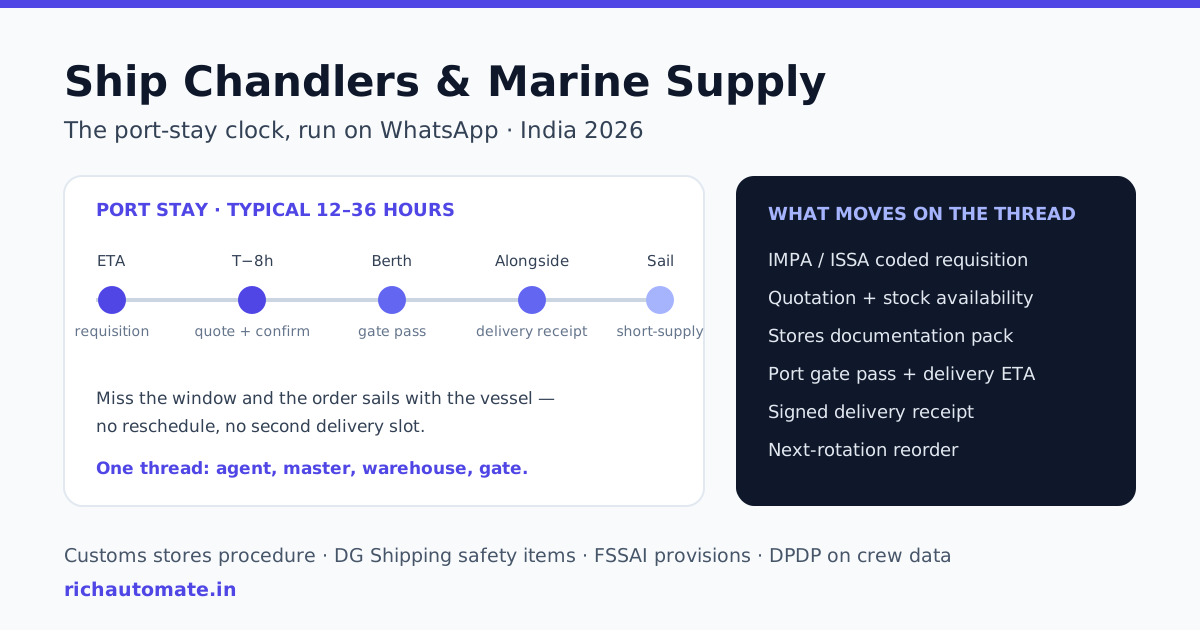
Ship chandlers are judged on one number: whether the stores reached the gangway before the vessel sailed. WhatsApp works for chandlery because the entire order — the agent's requisition, the IMPA-coded quote, the port gate pass, the delivery receipt signed by the Chief Officer — moves inside the same thread the ship agent already checks every ten minutes, on a port stay that is often shorter than 24 hours.
This is a deep-research operations guide for Indian ship chandlers and marine supply firms serving vessels at Mumbai, JNPT, Kandla, Mundra, Chennai, Ennore, Tuticorin, Cochin, Visakhapatnam, Paradip, Haldia, Kolkata, Kattupalli, Krishnapatnam, New Mangalore and Kamarajar. It maps the regulatory spine you already live inside, then rebuilds the requisition-to-reorder cycle as a six-stage WhatsApp lifecycle. Every regulatory reference below is directional — verify against the current notification and your own customs broker before you change a procedure.
Why chandlery is a messaging problem, not a catalogue problem
Most B2B supply businesses have a demand problem. Chandlery has a synchronisation problem. The order is usually won before the enquiry lands — the fleet has a chandler on the rotation, or the local agent has a shortlist. What decides whether you get paid in full, get a short-supply deduction, or get dropped from the rotation is coordination across four parties who are never in one room:
- The ship agent, who owns the ETA and the berth allocation and changes both without warning.
- The vessel — Master, Chief Officer, Chief Engineer, Cook — who raise the requisition and sign the receipt, usually over patchy connectivity at anchorage.
- Your warehouse and bonded stock, where availability decides whether you quote or decline.
- The port and customs interface: entry passes, vehicle passes, the stores documentation, the escort at the gate.
A phone call synchronises two of those four for ninety seconds and leaves no record. Email synchronises none of them at anchorage. WhatsApp is the only channel where the agent, the vessel and your own dispatch desk are all already present — which is why the discipline is worth building properly instead of running it from four personal handsets.
The regulatory spine (verify each line)
Chandlery in India sits at the intersection of customs, shipping, food safety and, increasingly, data protection. None of this is optional context — it dictates what documents ride on the thread.
Worth knowing the scale of the risk, and the DPDP penalty calculator estimates it from your own numbers.
Customs: "stores" is a defined term
Goods supplied for use on board a vessel are treated as stores under the Customs Act, 1962, and supply to a foreign-going vessel is handled as an export of stores rather than a domestic sale. That distinction drives the paperwork: shipping bill for stores, the relevant customs permission at the port, and the endorsement trail proving the goods actually went on board. Duty-free stores drawn from a bonded warehouse carry their own bond, re-warehousing and rewarehousing-certificate obligations. Verify the current procedure and forms with your customs broker at each port — practice varies between Customs Houses and changes with circulars.
GST: zero-rating is conditional, not automatic
Supply of stores to a foreign-going vessel is commonly treated as zero-rated, but the treatment depends on the vessel's status, the nature of the goods and the documentary proof of on-board delivery. Coastal vessels are not foreign-going vessels. Getting this wrong shows up two years later as a demand notice, not at the gate. Confirm the position for each class of supply with your CA, and read our note on GST on WhatsApp Business API charges and ITC for the platform-cost side of the same ledger.
DG Shipping and safety-critical items
Lifesaving appliances, firefighting equipment, pyrotechnics, immersion suits, EEBDs and similar safety items are governed by the Merchant Shipping Act regime administered by the Directorate General of Shipping and the Mercantile Marine Departments, with servicing typically restricted to approved stations. A chandler who supplies or arranges servicing of these items is inside an approval regime, not a general trading regime. Verify the approved-station list and the current servicing intervals before you quote.
Food safety on provisions
Fresh and dry provisions, bonded beverages, meat and dairy sit under FSSAI licensing for storage and distribution, plus cold-chain integrity obligations on the perishables. Vessel inspections — PSC, and the fleet's own hygiene audits — do look at provision quality and traceability, so batch and expiry records are commercial protection, not only compliance.
Product coding
Requisitions arrive in IMPA or ISSA codes. That is an advantage worth exploiting: a six-digit code is unambiguous where "10mm shackle" is not, and it is the single most automatable field in the whole workflow. If your catalogue is not mapped to IMPA/ISSA codes with your own SKU alongside, every stage below stays manual.
Port access
Entry passes for personnel and vehicles, validity windows, escort requirements and restricted-area rules differ between Major Port Authorities and private terminals. Pass rejection at the gate is one of the most common causes of a missed delivery slot, and it is almost always a documentation-timing failure rather than a transport failure.
Market context for FY26 (directional — verify)
India handles well over a billion tonnes of cargo a year across its major and non-major ports, with vessel calls in the tens of thousands annually and a national policy push (Maritime India Vision / Amrit Kaal Vision) toward higher throughput, more transhipment and expanded bunkering. Directionally that means more calls, shorter stays and tighter turnaround targets — which pushes chandlery further toward "respond inside the hour or lose the order". Treat all sizing here as directional; verify current figures against Ministry of Ports, Shipping and Waterways and IPA data before using them in a proposal.
The six-stage WhatsApp lifecycle for chandlery
Stage 1 — ETA watch and requisition intake
Trigger the thread off the vessel's ETA, not off the enquiry. When a fleet or agent you serve has a call scheduled, an opening utility message on the agent's number ("Vessel MV — ETA — do you have a stores requisition for this call?") converts a passive rotation slot into an active enquiry, and it does it before your competitor's phone call.
Intake itself should be a structured form rather than free text. A WhatsApp Flow that captures vessel name and IMO, port and berth, agent, ETA/ETD, delivery mode (alongside, anchorage by launch, at the gate) and a line-item block of IMPA code plus quantity plus unit turns a photographed requisition sheet into rows your system can price. Where the vessel sends the standard requisition as a PDF or a photo, accept it in the same thread and have the desk transcribe it against the code map — the point is that one thread holds the artefact and the structured version together.
Stage 2 — Availability check and quotation inside the stay window
The quote has two answers, not one: price, and can it be alongside before ETD. Split the response accordingly. Lines held in your own warehouse or bonded stock confirm immediately; lines requiring a sub-supplier or an inter-port transfer get an honest lead time. A quotation returned as a PDF on the thread, with a short summary of the lines you cannot make in the window, wins more repeat business than a full quote that quietly slips two items.
Currency, credit terms and the payer (owner, charterer, agent) belong in this message. Ambiguity here is the single largest cause of ninety-day receivables in chandlery.
Get the India 2026 WhatsApp BSP price comparison
Wati vs AiSensy vs Interakt vs RichAutomate: Meta rates, platform fees and hidden costs, side by side. We send it to your WhatsApp in a minute.
Stage 3 — Order confirmation and the stores documentation pack
On confirmation, the thread becomes the document rail: proforma or commercial invoice, packing list, the stores declaration set your customs broker requires, and any certificate that travels with a safety item or a provision batch. Sending these as documents on WhatsApp gives the agent something forwardable to the vessel and to customs, and gives you a timestamped record of when each artefact left your desk. If your clearance side is handled by a broker, the coordination pattern is the same one described in our guide to customs broker and CHA clearance coordination.
Stage 4 — Gate pass, vehicle and delivery slot
This is where deliveries die. Personnel pass, vehicle pass, driver details, the terminal's slot and the berth number all have to be correct simultaneously, and berths move. Run this as a checklist message with explicit states — pass applied, pass approved, vehicle loaded, vehicle at gate, vehicle at berth — pushed to the agent as it advances. The value is not the notification; it is that a stuck state becomes visible while there is still time to act on it, instead of at the gate.
Live location sharing for the delivery vehicle removes the "where is the truck" call entirely. The same coordination discipline that 3PL and freight operators use for shipper coordination applies unchanged here, with the berth substituted for the dock.
Stage 5 — Delivery, receipt and short-supply reconciliation
The signed delivery note or stores receipt, endorsed on board, is the document your entire invoice depends on. Capture it as a photo on the thread at the moment of signature, not at the end of the shift. Short supply, rejected items and substitutions get recorded on the same thread with the reason — because the deduction argument happens weeks later, when nobody remembers whether the Chief Engineer refused the item or it never left the van.
Where the vessel departs before a line is completed, close the loop explicitly: cancel, or transfer the balance to the next port on the rotation. An unclosed line is a receivable dispute in waiting.
Stage 6 — Payment follow-up and the rotation reorder engine
Chandlery revenue is a rotation, not a funnel. The same vessel returns; the same fleet has ten more ships. Two automations pay for themselves here: a polite, scheduled invoice-status sequence to the agent or owner's accounts contact, and an ETA-triggered reorder prompt for every vessel you have previously supplied — "MV last took provisions and engine stores at Kandla in March; ETA Mundra next week, requisition?"
Exporters running the same repeat-call pattern on cargo rather than stores will recognise the structure from our note on WhatsApp for seafood and marine exporters.
The automation stack
| Stage | Mechanism | Template category |
|---|---|---|
| ETA watch / reorder prompt | Scheduled campaign off vessel-rotation data | Marketing (or utility if tied to a live order) |
| Requisition intake | WhatsApp Flow — vessel, port, IMPA lines | Session / utility |
| Quotation delivery | Document message + structured summary | Utility |
| Stores documentation pack | Document messages, order-linked | Utility |
| Gate-pass and delivery states | Status template per state transition | Utility |
| Delivery receipt capture | Inbound media, filed against the order | Session |
| Payment follow-up | Sequenced utility reminders | Utility |
The category discipline matters commercially, not only for approval. Order-linked messages are utility; rotation prompts to a fleet you are not currently serving are marketing and need opt-in. Mixing them is how a template gets rejected and a thread gets reported. Our flow builder and template tooling keeps the two separated by design, and the WhatsApp Business API pricing page shows how the two categories bill differently.
DPDP and the confidentiality carve-out
Two categories of sensitive data run through a chandler's thread and they need different handling.
Crew personal data. Names, ranks, nationalities, passport and CDC details, and dietary or medical information attached to provisions or medical stores are personal data under the Digital Personal Data Protection Act, 2023. Collect only what the supply actually requires, keep it inside the order record rather than in personal chat backups, and delete on the retention schedule your policy sets. Crew medical items in particular deserve a tighter internal access rule than general stores.
Vessel movement and commercial data. ETAs, berth allocations, cargo and bunker quantities are commercially sensitive to the owner and charterer even where they are not personal data. Contractual confidentiality, not DPDP, governs these — but the operational control is identical: named users, no forwarding of order threads into personal groups, and an audit trail of who saw what.
Practically: run chandlery on a business-account system with per-user access and retention, not on staff handsets. The day an operations executive leaves with a personal phone containing eighteen months of fleet ETAs is the day the policy would have paid for itself.
What to instrument
Do not start with revenue. Start with the four timings that decide whether you keep the rotation, and baseline them against your own last quarter before claiming any improvement:
- Requisition-to-quote time, measured in minutes, split by whether the lines were in stock.
- Quote-to-confirmation rate, split by port and by agent — a port where you quote often and convert rarely is usually a lead-time problem, not a price problem.
- Gate-pass lead time versus delivery slot, and the count of slots missed for pass reasons.
- Short-supply value as a share of invoiced value, and days-sales-outstanding by agent.
Every one of these is derivable from the thread once the six stages are running as structured events rather than as free-text chat. That is the actual reason to move chandlery onto the API — not messaging cost, but the fact that the coordination finally becomes measurable.
What RichAutomate costs
Platform fee Rs 0. Setup Rs 0. Monthly Rs 0.
- Client Pay — Rs 0.10 per message, with Meta conversation charges billed directly to you by Meta.
- SaaS Pay — Rs 1.50 per marketing conversation, Rs 0.50 per utility conversation, all-inclusive.
- 14-day free trial with 100 credits, no card.
Competitor pricing quoted anywhere on this site is as of 2026 and should be verified on the vendor's own site before you compare. If you are evaluating platforms specifically for export-facing operations, the comparison in best WhatsApp Business API for exporters covers the same criteria a chandler needs. Broader industry patterns sit on our use-cases library.
One honest caveat, because chandlery buyers have heard the opposite from other vendors: no platform can promise that a WhatsApp number will never be restricted, that a template will be approved, or that a message will be delivered. Those are Meta's decisions. What a platform can do is keep your template categories clean, your opt-ins recorded and your quality rating visible — which is what actually keeps a number healthy.
Start
Map your top fifty IMPA lines to your own SKUs, put a requisition Flow behind your agent-facing number, and run the gate-pass checklist as explicit states for one month. That alone surfaces where the port stays are being lost.
WhatsApp 918160311319, or book a 30-minute working session at richautomate.in/book/demo.