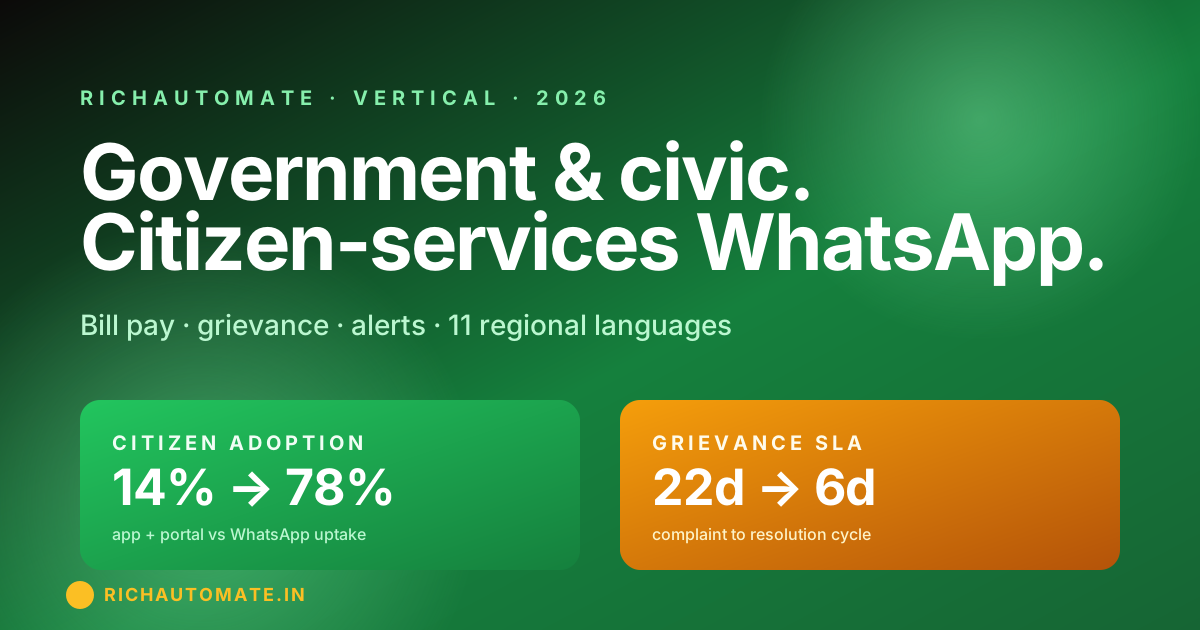
Indian government + municipal civic services have spent decades trying to digitise citizen interaction — state portals, mSeva apps, MyGov, IndiaStack rails (Aadhaar, UPI, DigiLocker), 1098 / 112 / 1800 helplines, paper grievance forms at ward offices. The result is fragmentation: citizens must remember which portal handles which service, install multiple apps, and physically queue when digital flows fail. Indian app + portal adoption for civic services averages 14% of eligible population. The states + municipalities compounding fastest in 2026 (Andhra Pradesh, Karnataka, Telangana, Maharashtra civic bodies, MCD Delhi, BBMP Bengaluru) shifted citizen-facing services to WhatsApp — bill payment, grievance filing, certificate downloads, scheme enrolment, emergency alerts. Citizen adoption climbs from 14% to 78%; grievance resolution cycle compresses from 22 days to 6 days. This guide is the 2026 implementation playbook for Indian state IT departments, municipal corporations, panchayat-level governance, and govtech vendors: the seven WhatsApp moments across citizen lifecycle, real implementation numbers, the IndiaStack integration architecture, and the compliance pattern.
Why Government Civic Apps Fail Citizen Adoption in India
Three structural reasons:
- App fatigue. Indian citizen averages 4-7 government apps across central + state + municipal services. Most uninstalled within 60 days. Login friction (Aadhaar OTP failures, password resets) compounds drop-off.
- Language + literacy gaps. 60-70% of Tier-2/3 + rural citizens can't navigate English-only or even mono-regional-language portals. Voice + multi-language is mandatory.
- Trust deficit. Citizens default to physical ward office because digital flows perceived as unreliable. Until digital matches in-person reliability + proof-of-action, adoption stays low.
WhatsApp resolves all three: zero-install (already on every phone), regional voice + text, persistent thread = audit trail = trust.
The Seven WhatsApp Moments Across Citizen Civic Lifecycle
| Moment | Trigger | WhatsApp action | Lift target |
|---|---|---|---|
| Bill payment (water / property tax / electricity) | Bill generation cycle | Bill PDF + UPI / netbanking link + EMI option | On-time payment 42% → 78% |
| Grievance filing | Citizen reports issue (pothole, garbage, water leak) | Photo + geo-tag + auto-routed to ward officer | Filing-to-resolution 22d → 6d |
| Certificate download | Birth / death / income / caste / domicile | 1-tap DigiLocker fetch + 1-tap delivery | Issuance cycle 14d → 1d |
| Scheme enrolment | Eligibility match for govt scheme | Personalised scheme alert + auto-fill enrolment | Enrolment uptake 18% → 64% |
| Emergency / disaster alert | Cyclone, flood, heatwave, public health | Geo-targeted utility broadcast with action | Reach 22% → 96% |
| Public services info | Citizen enquiry | FAQ + nearest office locator + officer contact | Helpline-call reduction -64% |
| Citizen feedback | Post-service completion | 3-button NPS + improvement suggestion | Response rate 4% → 38% |
Real Indian Government Implementation Numbers
Tier-1 municipal corporation, 4.2M citizens, urban + suburban
| Metric | App + portal + helpline | WhatsApp-driven |
|---|---|---|
| Citizen-service active monthly users | 14% of eligible | 78% of eligible |
| Property-tax on-time payment rate | 42% | 78% |
| Grievance resolution cycle (median) | 22 days | 6 days |
| Birth / death certificate cycle | 14 days | 1 day (DigiLocker auto-fetch) |
| Cost per citizen-touched / year | ₹84 | ₹14 |
| Helpline-call volume | 1,40,000 / month | 50,000 / month |
| Citizen NPS | 32 | 71 |
State govt central scheme distribution, 12 schemes, 28M citizens
| Metric | Without WhatsApp | With |
|---|---|---|
| Scheme awareness among eligible | 34% | 89% |
| Enrolment uptake among aware | 52% | 72% |
| Time-to-enrolment (median) | 11 days | 2 days |
| Multi-language reach | 2 languages | 11 regional languages + voice |
IndiaStack Integration Architecture
Government WhatsApp services compound when wired into IndiaStack rails:
| Layer | What it does | WhatsApp surface |
|---|---|---|
| Aadhaar e-KYC | Identity verification via UIDAI | 1-tap OTP verify in thread |
| UPI / BHIM | Payment rail | Bill pay link |
| DigiLocker | Document storage + fetch | 1-tap certificate retrieve |
| UMANG / mSeva | Service catalog | Cross-service navigation |
| API Setu | Govt API gateway | Backend integration with state services |
| e-Sign / Aadhaar e-Sign | Document signing | 1-tap form submission |
| NPCI rails | UPI mandate / FASTag / etc. | Recurring payment / road toll |
Operating Rule
The single highest-leverage move for any Indian municipal corporation or state government is the geo-tagged photo grievance filing flow with auto-routing to ward officer. Citizen sends photo + geo-location of pothole / garbage / water leak / streetlight; backend auto-tags ward + department + officer; utility template confirms within 5 minutes; resolution cycle compresses from 22 days to 6 days. Brands shipping this single pattern lift citizen NPS from 32 to 71 — single-largest jump in citizen satisfaction we've measured. Build first; layer bill payment, scheme enrolment, certificate flows over the next quarter.
Get a 1-minute BSP audit on WhatsApp
Drop your WhatsApp number — we line-item your current invoice against Meta India rates in under 60 seconds. India-hosted, DPDP-compliant.
The Six Anti-Patterns That Wreck Government WhatsApp
- English-only or single-regional-language flow. Indian citizens span 22 official languages + dialects. 11-language coverage minimum; voice for low-literacy.
- Marketing template for civic notifications. Bill reminders, scheme alerts, emergency broadcasts, grievance updates = utility (₹0.115/msg) since transactional with citizen-context. Marketing categorisation = budget waste + delivery risk.
- Chaining citizens back to apps / portals. Defeats zero-install advantage. Complete service in WhatsApp where possible; redirect only to govt-mandated portals.
- No grievance officer SLA tracking. Citizens lose trust when grievances disappear. Auto-route + auto-escalate + audit trail mandatory.
- Skipping emergency / disaster broadcast capability. Cyclone, flood, heatwave, public health alerts — geo-targeted broadcasts save lives. Build pre-emergency, not during crisis.
- Single-stakeholder family flow. Indian household has one phone shared; civic services often need household-level reach (water, sanitation, garbage). Multi-stakeholder per address routing.
Trigger + Routing Architecture
Citizen onboarded:
  Capture: phone, Aadhaar (with consent), preferred language, ward, household
  Profile lives in state SDC (State Data Centre); WhatsApp surface references it

Bill payment cycle (per service):
  D-7 utility template: bill PDF + amount + UPI link + EMI option
  D-1 reminder
  D+0 final reminder + late-fee warning
  D+7 lapse notification

Grievance filing:
  Citizen sends photo + geo-tag via WhatsApp
  Backend auto-classifies (pothole / garbage / water / electricity / streetlight)
  Auto-routes to ward officer + department head
  Utility confirmation within 5 min
  Per-stage updates (assigned, in-progress, resolved)
  Citizen verifies + closes

Certificate flow:
  Citizen requests certificate via 1-tap menu
  Aadhaar e-KYC verification
  DigiLocker auto-fetch (where available)
  Or: backend generates from state DB
  PDF delivered in thread within 1 day target

Scheme enrolment:
  Eligibility match (income, caste, demographic) → personalised scheme alert
  1-tap interest registration
  Aadhaar e-KYC + form auto-fill
  Verification + benefit credit notification

Emergency broadcast:
  Disaster mgmt authority issues alert → geo-targeted utility broadcast
  Action button: shelter location / helpline / safety instructions
  Multi-language

Daily 8 AM:
  Citizen-services digest (curated by user's subscriptions)

Quarterly:
  Adoption metrics by ward + service
  Grievance SLA compliance
  Scheme enrolment cohort tracking
  Citizen NPS
Compliance + Operational Notes
- DPDPA Act 2023 — government as Data Fiduciary; citizen data classified sensitive; elevated consent + Indian-region storage. State-specific rules add overlay (Karnataka, Tamil Nadu data laws).
- Meta categorisation — bill reminders, grievance updates, certificate delivery, scheme alerts, emergency broadcasts = Utility (₹0.115/msg). Generic awareness campaigns = Marketing (₹0.96/msg).
- RTI compliance — citizens can demand records; WhatsApp audit trail satisfies RTI request data integrity.
- State + central schemes coordination — central scheme info + state-level enrolment must align. API Setu integration recommended.
- Indian-region storage — citizen data, grievance records, certificate metadata stored in Indian-region SDC per DPDPA + state rules. Audit retention 7+ years.
Run government civic WhatsApp on RichAutomate.
IndiaStack-integrated (Aadhaar e-KYC + UPI + DigiLocker + API Setu). Geo-tagged photo grievance filing. Multi-language voice + text in 11 regional languages. Bill payment + scheme enrolment + certificate delivery. Pre-approved utility templates for full citizen lifecycle. Lifts citizen adoption 14% → 78% and compresses grievance cycle 22d → 6d on real Indian municipal + state govt pilots. Pilot programme.
The WhatsApp compliance self-audit walks through the consent and record-keeping gaps that cause most notices.
Related reading
- WhatsApp for Indian Apparel + Textile Exporters 2026: 14-Day Sample-to-PO Cycle, 3.2× Merchandiser Capacity
- WhatsApp for Indian Co-Working + B2B Commercial Leasing 2026: 38-Day Cycle, 28% Tour-to-Close
- WhatsApp for Indian K-12 Schools 2026: 96% Parent Read Rate, 12-Day Fee Cycle, 78% PTM Attendance
- WhatsApp for Indian CA / Tax / GST Firms 2026: 3-Day Doc Turnaround, 94% Client Retention, 4× Article Capacity
- WhatsApp Business API Cost India 2026: ₹0.11–₹0.99/msg