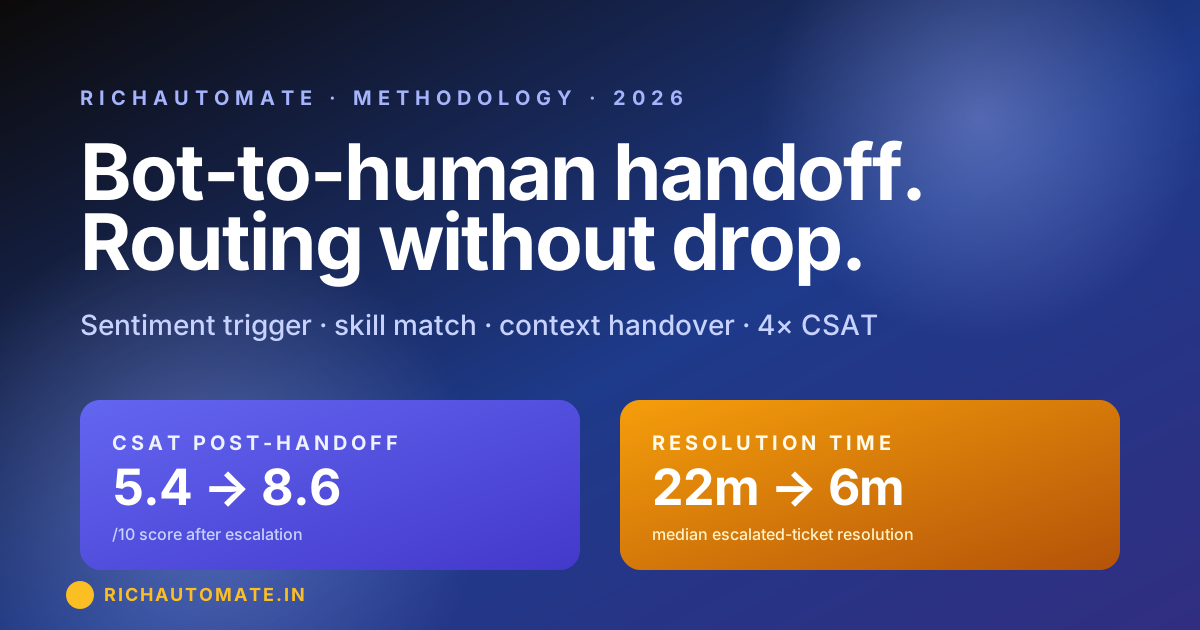
The hardest moment in any Indian D2C / SaaS WhatsApp customer service operation is not when the bot answers correctly — it's when the bot has to admit it can't and route the customer to a human agent without losing context, momentum, or trust. Most brands ship this badly: bot says "please contact support@" (customer drops), or hand-off creates a new ticket where the agent reads from scratch (customer repeats), or the agent receives the bot transcript but no escalation reason (CSAT collapses). Done well, bot-to-human handoff is one of the highest-ROI moments in the support stack — when escalation is timely, contextual, and skill-matched, post-handoff CSAT climbs from 5.4/10 to 8.6/10 and median escalated-ticket resolution drops from 22 min to 6 min. This guide is the 2026 implementation playbook for Indian brands running LLM bot + human agent hybrid: the seven escalation triggers, skill-routing matrix, context-handover schema, agent UI requirements, and the SLA + measurement framework.
Why Most Bot-to-Human Handoffs Fail
Three structural problems:
- Late escalation. Bot loops 4-7 times trying to resolve, customer frustration spikes, only THEN escalates. Customer sentiment already destroyed before human picks up.
- Lost context. Customer repeats their problem from scratch to the agent because escalation transcript isn't shown or isn't summarised. Indian customers especially: "I just told the bot all this, why are you asking again?"
- Wrong agent skill match. Refund query routed to sales agent; technical issue routed to billing rep. Adds another handoff cycle inside the human team. Mean time to resolution doubles.
The Seven Escalation Triggers That Should Auto-Handoff
| Trigger | Detection signal | Action |
|---|---|---|
| Sentiment negative + repeated | 2 consecutive messages classified angry / frustrated | Immediate handoff to human |
| LLM low-confidence | Function-call confidence below threshold (e.g., <0.6) | Bot says "Let me get a specialist" + handoff |
| Explicit request | Customer types "talk to human" / "agent" / "person" / "इंसान" | Honour immediately, no second guess |
| Out-of-scope intent | Bot intent classifier returns "unknown" or low-prob top-K | Handoff with "not sure I can help, getting human" |
| Refund / dispute / legal mention | Keyword + sentiment combo | Always escalate; never let bot commit |
| High-value customer | Customer LTV / VIP tier above threshold | Lower escalation threshold; bias to human |
| Loop detection | Same intent attempted 3+ times unsuccessfully | Handoff before customer abandons |
The Skill-Routing Matrix
| Customer issue category | Skill required | Routing tag |
|---|---|---|
| Order tracking / delivery | L1 ops | support_l1_ops |
| Refund / cancellation | L2 ops + financial authority | support_l2_finance |
| Product complaint / quality | L2 ops + product knowledge | support_l2_product |
| Technical issue (SaaS) | L2 technical | support_l2_technical |
| Billing / subscription | L2 finance | support_l2_finance |
| Sales enquiry / upgrade | Sales rep | sales_inbound |
| VIP / executive escalation | Senior CSM / manager | support_l3_csm |
| Legal / compliance | Compliance officer | compliance_review |
Context Handover Schema
Every escalation should include a structured payload to the agent UI containing:
- 3-line summary — LLM-generated TL;DR of the conversation so far. Agent reads in 5 seconds.
- Customer profile snapshot — name, phone, registered email, last 5 orders, lifetime value, language preference, sentiment trend.
- Escalation reason — which trigger fired (sentiment / low-confidence / explicit / etc.) and why.
- Recommended action — bot's best guess at what the customer wants + suggested response template.
- Full transcript — collapsible / scrollable; default-collapsed.
- Suggested macros — top-3 canned responses the agent can 1-tap send to acknowledge + buy time while reading context.
Real Indian D2C + SaaS Numbers
D2C, 80,000 active customers, 12,000 conversations/month with 22% escalation rate
| Metric | Cold handoff | Contextual handoff |
|---|---|---|
| Post-handoff CSAT | 5.4/10 | 8.6/10 |
| Customer-repeat-question rate | 72% | 14% |
| Median time-to-resolution after handoff | 22 min | 6 min |
| Agent-handle-time per ticket | 14 min | 4 min |
| Re-escalation rate (re-routing inside human team) | 34% | 6% |
| Cost per resolved ticket | ₹186 | ₹54 |
SaaS B2B, 3,200 customers, 1,800 conversations/month with 32% escalation rate
| Metric | Generic ticket queue | Skill-routed handoff |
|---|---|---|
| First-response time after escalation | 14 min | 2 min |
| Issue-to-resolution single-touch rate | 54% | 89% |
| Customer NPS impact | baseline | +22 points |
| CSM hours freed | — | 48 hours/month |
Operating Rule
The single highest-leverage move for any Indian brand running LLM bot + human agent hybrid is the 3-line LLM-generated TL;DR + customer profile snapshot + escalation reason in the agent UI. This single payload cuts customer-repeat-question rate from 72% to 14%, post-handoff CSAT from 5.4 to 8.6, and median resolution from 22 min to 6 min. Build the context-handover schema first; layer skill routing and SLA monitoring downstream. The cost-per-resolved-ticket drop alone (₹186 → ₹54) pays for the engineering inside one quarter.
Get a 1-minute BSP audit on WhatsApp
Drop your WhatsApp number — we line-item your current invoice against Meta India rates in under 60 seconds. India-hosted, DPDP-compliant.
The Six Anti-Patterns That Wreck Bot-to-Human Handoff
- Late escalation only after explicit request. By the time customer types "I want a human" sentiment is already at -0.6. Auto-detect frustration earlier and pre-empt.
- Cold handoff with full transcript dump. Agent reads 30 messages, customer waits 90 sec, then asks "so what's your name again?". Use 3-line LLM summary, not full transcript scroll.
- Single human queue for all issue types. Refund routed to sales rep, tech routed to billing. Skill-routing tags + per-skill agent pools cuts re-escalation 34% → 6%.
- No SLA on first-response post-handoff. Customer waits 8-15 min in "connecting you to an agent" limbo. Hard SLA: 90-second first response post-handoff.
- Agent UI without macros / suggested responses. Agent retypes "I see, let me check on this for you" 80 times a day. 1-tap macros buy time while reading context.
- Marketing template for handoff acknowledgement. Inside 24h customer-initiated session, all responses are free-form and free. No template needed; using one is wasteful.
Trigger + Routing Architecture
Conversation enters bot → LLM agent handles
Each turn:
  - sentiment classifier → score, history
  - intent classifier → top-K with confidence
  - keyword detector → refund, dispute, legal, "human", "agent", "इंसान"
  - loop detector → same intent attempted N times

Escalation gate fires if any:
  - sentiment_negative_streak >= 2
  - llm_confidence < 0.6 on 2 consecutive function-call attempts
  - explicit human request keyword detected
  - intent_classifier_top_prob < 0.4 (out-of-scope)
  - refund / dispute / legal keyword
  - customer_lifetime_value > tier_threshold AND any other signal
  - loop counter >= 3

On escalation:
  Generate 3-line LLM summary of conversation + recommended action
  Determine skill_tag from issue category classifier
  Route to agent pool matching skill_tag
  Push context payload to agent UI:
    - 3-line summary
    - customer profile snapshot
    - escalation reason
    - recommended action + macros
    - full transcript (collapsible)

Agent picks up:
  Acknowledge within 90 sec (SLA enforced)
  Use suggested macros to buy time while reading context
  Resolve OR re-escalate to higher tier with reason

Post-resolution:
  Auto-CSAT survey (1-5 scale + optional reason)
  Tag conversation outcome (resolved / unresolved / escalated)
  Feed back into:
    - bot training (where bot failed)
    - agent training (where handoff was suboptimal)
    - SLA dashboard

Quarterly review:
  Top 10 escalation reasons → fix in bot
  Top 5 re-escalation patterns → fix skill routing
  CSAT segments by skill → coaching priorities
SLA + Measurement Framework
| Metric | Target | Action if missed |
|---|---|---|
| First-response time post-handoff | ≤ 90 sec | Add agent capacity in shift |
| Customer-repeat-question rate | ≤ 18% | Improve LLM summary prompt |
| Re-escalation rate inside human team | ≤ 8% | Refine skill-routing matrix |
| Post-handoff CSAT | ≥ 8.0/10 | Coaching + macro-library refresh |
| Median time-to-resolution | ≤ 8 min | Process review per skill team |
| Agent handle time | ≤ 5 min | Macro coverage + UI improvements |
Compliance + Operational Notes
- DPDP Act 2023 — bot transcript + customer profile shared with agents counts as personal data processing; lawful basis (legitimate interest / contract performance) must be documented.
- LLM-generated summary auditability — log original transcript + LLM summary + agent action for 90-180 days; allows audit of LLM-introduced inaccuracies in escalation context.
- Multilingual handoff — match customer language to agent. Indian language code-switching common; agents tagged by language proficiency.
- Right to escalate — Indian consumer-protection norms increasingly require easy access to human support. Bot must not block / delay explicit human-request escalations.
- Indian-region storage — customer transcripts, agent notes, CSAT data stored in Indian region per DPDP Act.
Run bot-to-human handoff on RichAutomate.
7 escalation triggers pre-built. Skill-routing matrix configurable. 3-line LLM summary + customer profile snapshot + escalation reason payload to agent UI. 90-sec first-response SLA enforcement. Macro library + suggested responses for fast acknowledgement. Lifts post-handoff CSAT 5.4 → 8.6 and cuts cost-per-resolved-ticket ₹186 → ₹54 on real Indian D2C + SaaS pilots. 14-day trial.
To see what non-compliance would actually cost, the DPDP penalty calculator sizes the exposure against your contact volume.
New to WhatsApp automation? Start with the complete WhatsApp chatbot for business guide for the full picture, then come back to apply it here.
Handoff only helps if the bot answered at all — see why a flow never triggers in the first place.
\nRelated reading
- WhatsApp Business API foundations — the conversation and window mechanics your handoff logic sits on
- best WhatsApp API providers in India 2026 — compare shared-inbox and agent-routing features across BSPs
- RichAutomate pricing — team inbox plus chatbot automation plans that include human handoff
Handoff moves the chat to a person; it does not decide which person or how fast. That is policy, and it belongs in a written WhatsApp complaint escalation matrix so every grievance has one owner and one clock.