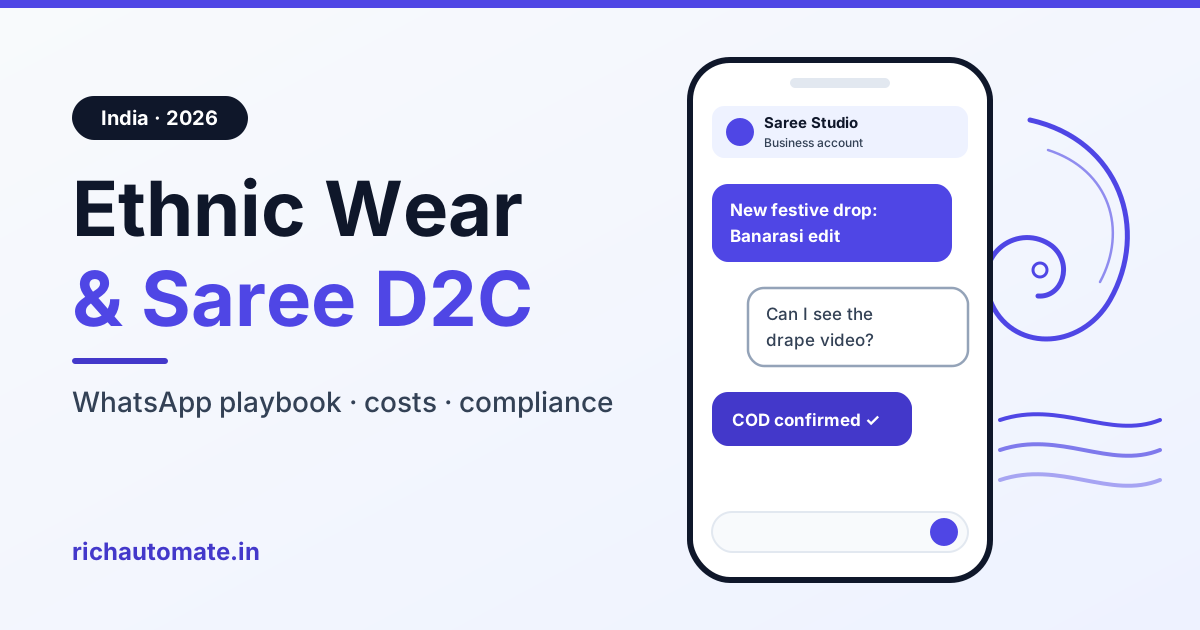
Indian ethnic-wear and saree D2C brands use the official WhatsApp Business API to launch festive and wedding collections to opted-in buyers, answer drape, fabric and blouse questions in chat, confirm COD orders and recover abandoned carts, with a chatbot handling repeat questions 24x7. On RichAutomate it costs ₹0 setup and ₹0 monthly on Client Pay (Meta's rate + ₹0.10 per message). Below: use cases, a festive calendar, compliance basics, cost arithmetic and a setup checklist.
This guide is for brands selling ethnic wear online under their own name: handloom labels, saree studios, and kurta, lehenga and festive-wear brands on a website, Shopify or Instagram. Selling in bulk to retailers? Read the guide to the best WhatsApp Business API for textile and saree wholesalers. Running one physical store? See WhatsApp for boutiques and clothing stores.
Why ethnic wear sells on WhatsApp
Ethnic wear is a high-consideration purchase. A buyer choosing a wedding silk saree wants to know how the fabric falls, whether the zari is real, whether the colour matches and whether the blouse will be stitched in time. Those are questions, and chat is built for questions.
In ethnic wear, the product photo starts the sale and the conversation closes it.
- Buyers want to see and ask before paying. A short drape video or a daylight close-up of the border answers more than a paragraph of copy.
- Demand comes in peaks. Diwali, Navratri, Durga Puja, Onam, Pongal, Karwa Chauth and the winter wedding season concentrate buying into windows where reply speed matters.
- Decisions are shared. A saree for a family function is often forwarded to a mother or sister before anyone pays, and a product card in WhatsApp travels to exactly those people.
A saree buyer who can ask about the fabric and see a drape video in chat is answering her own objections before checkout.
9 WhatsApp use cases for ethnic-wear D2C brands
Every message falls into a Meta category that sets its price. Marketing templates promote and need a recorded opt-in; utility templates update something the buyer started, such as an order; service messages are free-form replies inside the 24-hour window.
| Use case | Message type | What it does |
|---|---|---|
| Festive or wedding collection drop | Marketing | Sends a new edit to opted-in buyers as a catalog message or a carousel template of product cards, each with its own button. |
| Drape or try-on video on request | Service | A stylist or the chatbot replies with a drape video or daylight photos when a buyer asks. |
| Fabric and authenticity Q&A | Service | Answers fabric, weave, Silk Mark, handloom or GI questions using only claims the product genuinely qualifies for. |
| Blouse stitching, fall-pico and measurements | Service or utility | Captures blouse style, fall-pico choice and measurements through a WhatsApp Flow form or chatbot. |
| COD confirmation | Utility | Asks the buyer to confirm or cancel a cash-on-delivery order and check the address before dispatch, to cut RTO. |
| Abandoned cart recovery | Marketing | Reminds consented buyers about a saved cart in a short timed sequence. |
| Order and shipping updates | Utility | Confirms the order and shares dispatch, courier status and delivery exceptions in one thread. |
| Exchange, return and alteration requests | Service or utility | Collects order, reason and photos, then updates the buyer on status. |
| Back-in-stock alerts for sold-out weaves | Marketing | Notifies only buyers who asked to hear when a sold-out saree or colourway returns. |
Catalog, carousel and WhatsApp Flows
A WhatsApp catalog is a product list inside the chat that lets a buyer browse sarees, see price and add to cart without leaving WhatsApp. Single Product Messages show one hero piece; Multi Product Messages show a short curated edit. A carousel template is a marketing template showing several product cards side by side. Keep the catalog in sync with stock; catalog messages count as marketing, so they need opt-in.
A WhatsApp Flow is a structured form inside the chat, such as blouse measurements or an address correction, that returns clean data instead of free text. A chatbot handles simple questions and hands over to a stylist for advice.
COD confirmation and cart recovery
Return-to-origin (RTO) on cash-on-delivery orders is commonly cited at 20-30% of COD shipments for Indian D2C, though it varies by category and pin code. A COD confirmation is a utility message sent right after a cash order asking the buyer to confirm or cancel and to check the address. Use Confirm and Cancel buttons, collect address edits through a WhatsApp Flow, send one polite reminder if there is no reply, and keep any prepaid-discount nudge in a separate message, because promotional wording inside a utility template risks Meta re-categorising it as marketing.
A COD order is only an order once the buyer has confirmed it.
Cart reminders are marketing templates and need recorded consent. A workable sequence is three messages at roughly 45 minutes, 24 hours and 72 hours: no discount in the first, objections (delivery time, returns, COD or payment options) in the second, and a time-boxed incentive only in the third. Re-check order status before every send and keep a holdout group. Treat 8-15% of messaged carts recovered as a planning range, not a promise.
Festive and wedding season calendar playbook
Festive campaigns are won in the weeks before the festival, not on the day. Review queues slow in the fourth quarter, so submit festive templates about six weeks before Diwali, cap marketing at about one send per recipient per day, send in daytime on festival days and prepare regional-language variants. The Diwali 2026 WhatsApp marketing playbook has the day-by-day sequence.
| Window | What to send | Category |
|---|---|---|
| Before the festive season | Get templates approved, sync the catalog, clean the opt-in list, keep order updates flowing | Utility |
| Onam | Regional edit in a regional-language template, drape videos on request | Marketing; service for replies |
| Navratri and Durga Puja | Festive drops as carousel or catalog messages, quick answers on delivery dates | Marketing; service for replies |
| Karwa Chauth | Festive and ready-to-wear sarees with a clear blouse-stitching cut-off | Marketing; utility for stitching updates |
| Run-up to Diwali | Collection drop, early access for engaged buyers, one reminder, COD confirmation on every cash order | Marketing and utility |
| Winter wedding season | Bridal and wedding-guest edits families can forward, measurement capture, alteration slots | Marketing; service for fittings |
| Pongal | Regional silk and cotton edit in a regional-language template | Marketing |
| After each peak | Exchange and alteration updates, restock alerts to buyers who asked | Utility; marketing for restock |
Authenticity, labelling and compliance
This is general information, not legal advice. Confirm anything you rely on with your CA or compliance advisor.
Authenticity is a claim you have to be able to prove, not a word you add to a caption.
- GI tags exist for several Indian sarees and weaves, including Kanchipuram silk, Banarasi brocades and sarees, Chanderi, Paithani and Pochampally Ikat. Claim it only where the product genuinely qualifies, after checking the GI Registry listing.
- Silk Mark is a quality-assurance label for pure natural silk, run by the Silk Mark Organisation of India under the Central Silk Board (Ministry of Textiles). Your chatbot's "is this pure silk?" answer should match what the product can show.
- The India Handloom Brand and the Handloom Mark identify handwoven products. Say "handloom" only where it is true.
- Legal Metrology (Packaged Commodities) Rules require declarations such as manufacturer, net quantity, MRP and country of origin on pre-packaged goods sold online; fibre-content labelling also applies.
- Consumer Protection (E-Commerce) Rules, 2020 expect clear price, return, refund and grievance details and no misleading descriptions; chatbot answers should match your published policy.
- Digital Personal Data Protection Act, 2023 expects consent and use of data only for the stated purpose. Keep an opt-in record per WhatsApp contact (timestamp, page, exact wording) that you can query, and let a STOP reply suppress all campaigns.
Opt-in is not a formality; it is the record that lets you message the buyer at all.
Get a 1-minute BSP audit on WhatsApp
Drop your WhatsApp number — we line-item your current invoice against Meta India rates in under 60 seconds. India-hosted, DPDP-compliant.
Price your festive drop around the ₹2,500 line
After the GST rate rationalisation effective 22 September 2025, garments priced up to ₹2,500 per piece are taxed at 5% and those above at 18%. That line can shape festive pricing and how you bundle a saree with a stitched blouse. Whether your sarees, unstitched suits or blouse pieces fall under the garment rule or a fabric HSN code is a classification question, so confirm the current slab and your HSN code with your CA.
What WhatsApp costs an ethnic-wear brand
Meta's India rates used on this site are ₹0.8631 per delivered marketing message and ₹0.115 per delivered utility or authentication message, as reported by BSPs. From 1 October 2026, Meta charges for WhatsApp service messages (your free-form replies inside the 24-hour customer service window) and for utility templates sent inside that window, both billed per delivered message at the utility rate of ₹0.115 plus 18% GST. BSPs report that the first 1,000 service messages per business phone number each month stay free, though Meta's own pages do not yet state it. Meta revises rates; confirm the live rate card.
RichAutomate charges ₹0 setup and ₹0 monthly on usage-only billing:
- Client Pay: Meta bills your account directly at its rate, plus a ₹0.10 per message platform fee. Marketing = ₹0.9631, utility = ₹0.215.
- SaaS Pay: all-in ₹1.50 per marketing and ₹0.50 per utility message.
A festive month, marketing-heavy (60% marketing) vs utility-heavy (20% marketing), excluding GST and service replies:
- 5,000, marketing-heavy (3,000 + 2,000 utility): Client Pay ₹2,889.30 + ₹430 = ₹3,319.30; SaaS Pay ₹4,500 + ₹1,000 = ₹5,500.
- 5,000, utility-heavy (1,000 + 4,000): Client Pay ₹963.10 + ₹860 = ₹1,823.10; SaaS Pay ₹1,500 + ₹2,000 = ₹3,500.
- 20,000, marketing-heavy (12,000 + 8,000): Client Pay ₹11,557.20 + ₹1,720 = ₹13,277.20; SaaS Pay ₹18,000 + ₹4,000 = ₹22,000.
- 20,000, utility-heavy (4,000 + 16,000): Client Pay ₹3,852.40 + ₹3,440 = ₹7,292.40; SaaS Pay ₹6,000 + ₹8,000 = ₹14,000.
- 50,000, marketing-heavy (30,000 + 20,000): Client Pay ₹28,893 + ₹4,300 = ₹33,193; SaaS Pay ₹45,000 + ₹10,000 = ₹55,000.
- 50,000, utility-heavy (10,000 + 40,000): Client Pay ₹9,631 + ₹8,600 = ₹18,231; SaaS Pay ₹15,000 + ₹20,000 = ₹35,000.
Marketing volume drives the bill, so segmenting drops to engaged buyers saves most. Budget for service replies beyond the BSP-reported free allowance in peak season. Optional plans sit on top: Starter ₹499/mo, Pro ₹899/mo and White-label ₹1,199/mo. Compare them on the RichAutomate WhatsApp API pricing page and model your own mix in the WhatsApp Business API cost calculator.
Want to test it on your next edit first? Start a 14-day free trial + 100 free credits on RichAutomate and send your first approved template to opted-in buyers.
WhatsApp Business app vs API for an ethnic-wear brand
The free Business app suits a handful of chats a day; its limits show in festive peaks.
| Capability | WhatsApp Business app | WhatsApp Business API |
|---|---|---|
| Broadcast scale | Small broadcast lists that reach only people who saved your number | Approved templates to every opted-in buyer, segmented by interest or past orders |
| Chatbot | Basic greeting and away messages | Chatbot and flows answering fabric, blouse and returns questions 24x7, with handover |
| Shared inbox for stylists | A few linked devices, no assignment | Shared team inbox; several stylists on one number, chats assignable |
| Catalog | Basic catalog shared manually | Store-synced catalog sent as product messages and carousel templates |
| Integrations | None; orders handled by hand | Store events (order placed, abandoned checkout, COD flag) trigger messages via webhooks or API |
| Verified badge | Depends on Meta's own verification programmes | Can be requested after Meta Business verification; granted at Meta's discretion, never guaranteed |
RichAutomate's native Shopify and WooCommerce integrations are shipping soon; until then, order events connect via webhooks or the API, usually a developer hour or two.
Setup checklist for an ethnic-wear brand
- GST registration is required to go live on the WhatsApp Business API (you can explore on the trial first).
- Meta Business verification in Business Manager; catalog selling also needs a verified business.
- Number and display name: a number not active on the WhatsApp app, and a display name matching your brand.
- Opt-in capture: an unticked WhatsApp checkbox by the phone field on your site, Instagram lead forms and checkout, with timestamp, page and wording stored.
- Catalog sync: stock, price and images kept in step with your store.
- Template approval: drop, COD, order-update, cart and restock templates in the right category, submitted well before peaks. Meta decides approval; it is never guaranteed.
- Chatbot FAQ for fabric care, blouse stitching and fall-pico, delivery times and returns.
- Team inbox for stylists and support, with handover rules for drape-video and custom-order requests.
Mistakes to avoid
- Bulk blasting non-opted contacts. Blocks and reports can lower your quality rating and limit sends in peak season; no platform can promise a number will never be restricted.
- Unverified GI or pure-silk claims. Never call a saree GI-tagged, Silk Mark certified or handloom unless it genuinely is.
- Colour-inaccurate images. Filtered photos drive returns; send daylight photos when asked.
- No COD confirmation. Shipping cash orders unconfirmed leaves RTO to chance.
- Festive promos sent too late. Last-week templates risk slow review.
Drops, drape videos, blouse measurements, COD confirmations and cart recovery can all run from one number at ₹0 setup and ₹0 monthly. Create your RichAutomate account with a 14-day free trial and 100 free credits before the next festive window opens.
Frequently asked questions
How can a saree business use WhatsApp to sell online?
Use the official WhatsApp Business API to send festive and wedding drops to opted-in buyers, share a synced catalog, answer drape, fabric and blouse questions, send drape videos on request, confirm cash-on-delivery orders and recover abandoned carts. A chatbot handles repeat questions 24x7 and hands over to a stylist when needed.
How much does WhatsApp marketing cost for an ethnic wear brand in India?
Meta's India rate is about Rs 0.8631 per delivered marketing message and Rs 0.115 per utility message, as reported by BSPs; Meta revises rates, so confirm the live rate card. RichAutomate Client Pay adds Rs 0.10 per message with Rs 0 setup and Rs 0 monthly, so 5,000 messages in a marketing-heavy festive month cost about Rs 3,319 before GST. SaaS Pay is all-in Rs 1.50 per marketing and Rs 0.50 per utility message.
Can I sell sarees directly inside WhatsApp?
Yes. A WhatsApp catalog lets buyers browse sarees, see prices and add to a cart without leaving the chat, and you can send single products, curated edits or carousel templates. It needs a verified Meta business and a catalog synced with stock, and catalog messages count as marketing, so send them only to opted-in buyers.
Do I need GST registration to use the WhatsApp Business API?
You can try RichAutomate on the 14-day free trial with 100 free credits, but GST registration is required to go live. You also need Meta Business verification, a number not active on the WhatsApp app and approved templates.
Can I say my saree is pure silk or GI-tagged in WhatsApp messages?
Only if it genuinely is. GI tags exist for weaves such as Kanchipuram silk, Banarasi, Chanderi, Paithani and Pochampally Ikat, Silk Mark covers pure natural silk and the Handloom Mark identifies handwoven products. Check the GI Registry listing and your actual certification first, since misleading descriptions can breach consumer-protection rules. This is general information, not legal advice.