Every admission season, an Indian college or university runs the same painful gauntlet. Thousands of prospective students fill an enquiry form, download a prospectus or message on the official number — and a thin admissions cell tries to call them all back before a rival institution does. A parent in a tier-2 town wants to know the fee structure, the hostel situation and the placement record before the application deadline. An applicant who started the form abandoned it halfway. A confirmed student needs the document checklist, the fee-payment link and the orientation date. Most of this conversation is already happening on WhatsApp — but on personal staff numbers, with no structure, no follow-up, and every lost enquiry quietly becoming a seat that goes unfilled. The institutions that win the admissions race in 2026 are the ones that turn that chaos into a system: instant enquiry capture, automated counselling, application nudges, fee reminders and student-lifecycle communication, all on the official WhatsApp Business API. This is the buyer's guide to choosing the best WhatsApp Business API for a college, university or higher-education institution in India in 2026: what actually matters for admissions and student comms, the lifecycle it has to carry, and how to pick a platform that does not tax an education budget. Treat every regulatory and fee specific below as "verify as of 2026," treat every figure as illustrative, and treat none of this as legal, regulatory or financial advice.
Why admissions is a WhatsApp problem. A college admission is a high-consideration, deadline-driven decision made by an anxious student and an even more anxious parent. They want answers — fees, courses, eligibility, placements, hostel, scholarships — fast, in their language, and on the channel they already use, which is WhatsApp. A missed reply means the applicant enrols elsewhere; a slow counselling response means a half-filled form is abandoned; a forgotten fee-deadline nudge means a confirmed seat lapses. WhatsApp — opened within minutes, read far more than email — is where an institution captures the enquiry, answers the parent, nudges the application forward, reminds about the fee deadline, and stays in touch through the student's entire journey, provided every message is consent-based and honest. None of this is a promise of admissions outcomes, and quality and compliance depend on your own messaging behaviour. Verify UGC, AICTE, NAAC and fee-regulation specifics as of 2026.
What "best" actually means for a college or university
The "best WhatsApp Business API" for a higher-education institution is not the one with the most features or the loudest brand — it is the one that fits the specific shape of an admissions-and-student-lifecycle communication problem: enquiry-heavy in season, deadline-driven, parent-sensitive and built on a multi-year relationship with the student. Before comparing logos, get clear on the criteria that actually decide outcomes for this vertical. The table below is the buyer's checklist — weigh each against your own admissions cell and student body as of 2026.
| What to evaluate | Why it matters for an institution | What good looks like |
|---|---|---|
| High-volume enquiry capture | Admission season floods the cell; every uncaptured lead is an unfilled seat | Instant capture from website, ads and QR with auto-reply, no enquiry left waiting |
| Automated counselling & FAQ | Fees, courses, eligibility, placements, hostel are asked thousands of times | A chatbot that answers the predictable questions and routes the rest to a counsellor |
| Application & fee-deadline nudges | Abandoned forms and lapsed fee deadlines lose confirmed seats | Scheduled, opted-in reminders for application steps and fee-payment windows |
| Parent + student communication | Parents drive the decision and need reassurance | Segmentation and language options for student vs parent audiences |
| Transparent, low pricing | Education budgets are tight and scrutinised; a per-seat SaaS fee is hard to justify | ₹0 platform fee, pay only per message and Meta's conversation charge |
| Whole student lifecycle | The relationship runs from enquiry to alumni, not just admission | Onboarding, exam/result updates, fee reminders and alumni comms on one line |
The reframe most admissions heads eventually make: the platform is not the product — the admissions-and-engagement engine it lets you run is. An institution that picks on price-per-message alone, but cannot capture every enquiry or nudge an abandoned application, has bought a cheaper way to leave seats unfilled. Pick for the journey, then optimise the cost.
The end-to-end admissions and student-lifecycle WhatsApp flow
Here is the full lifecycle a college or university can run over WhatsApp, from the first enquiry to the alumni relationship, mapped to the automation at each stage and the guardrail that keeps it honest and compliant. Treat the automation column as a reference pattern and verify regulatory and fee specifics as of 2026.
| Lifecycle stage | WhatsApp automation | Guardrail (verify 2026) |
|---|---|---|
| 1. Enquiry capture | Website form, click-to-WhatsApp ad or campus QR opens a chat; bot replies instantly and captures course interest, city and contact | Capture consent at first contact; honour opt-out |
| 2. Counselling & FAQ | Bot answers fees, courses, eligibility, placements, hostel and scholarship questions; routes complex cases to a human counsellor | Accurate, non-misleading claims; no guaranteed-admission or guaranteed-placement promises |
| 3. Application nudges | Reminders to complete the application, upload documents and book a counselling slot; recover abandoned forms | Opted-in nudges only; factual deadlines |
| 4. Offer & fee payment | Offer-letter notification, document checklist and secure fee-payment link with deadline reminders | Accurate fee and deadline info; secure payment; clear refund terms (verify regulation) |
| 5. Onboarding & orientation | Joining instructions, orientation schedule, hostel and ID details for confirmed students | Factual, timely operational messages |
| 6. In-programme comms | Exam timetables, result notifications, fee-instalment reminders, event and placement-drive alerts | Separate service vs marketing consent; minimise data |
| 7. Alumni & referral | Opted-in convocation, alumni-network and referral broadcasts | Consent-based broadcasts only; easy opt-out |
Notice the rhythm: WhatsApp carries a decision that is too high-stakes and too parent-sensitive for email to sustain, then keeps the student through exams, results, fees and into the alumni network — which is where an institution's real long-term value lives. For the schools-sector companion view see our best WhatsApp Business API for schools guide, and for entrance-coaching parent comms the best WhatsApp Business API for coaching institutes guide is a close neighbour.
The counselling thread: where admissions are won
The single highest-leverage part of an admission is the counselling moment: an anxious applicant and parent want clear, honest answers about fees, courses, eligibility, placements and hostel — and they want them now, before the deadline and before a rival institution answers first. An admissions cell that can respond instantly, in the parent's language, with accurate information and a smooth path to a human counsellor, looks like a serious, caring institution. One that takes two days to call back looks like a risk to a family making a major financial and life decision. WhatsApp's instant, conversational nature turns the counselling thread into something the institution can run at scale during peak season without drowning the cell — while keeping every claim honest and routing every genuine query to a human. Done well, the counselling thread is what converts an enquiry into a confirmed, fee-paid seat.
The counselling thread, in one principle. Treat admissions communication as fast, honest, consent-based counselling at scale, not a broadcast blast. Let the chatbot handle the predictable questions, route every real decision to a human counsellor, never promise guaranteed admission, placement or outcomes, state fees and deadlines accurately, and make opt-out trivially easy. The thread should feel like a responsive admissions office that respects an anxious family — never like a spam channel. Verify UGC, AICTE, NAAC, advertising-standards and fee-regulation rules as of 2026; this is not legal, regulatory or financial advice.
Get a 1-minute BSP audit on WhatsApp
Drop your WhatsApp number — we line-item your current invoice against Meta India rates in under 60 seconds. India-hosted, DPDP-compliant.
Per-seat SaaS vs a ₹0-platform model: the budget question
Education budgets are tight, scrutinised and seasonal — the admissions cell is busy for a few months and quieter the rest of the year. The WhatsApp platform an institution picks should not be a fixed monthly tax on every counsellor seat regardless of season. Most legacy BSPs charge a per-seat or tiered monthly platform fee on top of Meta's own per-conversation charge; a ₹0-platform model charges only for what you actually send. This comparison is directional — verify current pricing on each vendor as of 2026.
| Dimension | ₹0-platform model (RichAutomate) | Typical per-seat / tiered SaaS BSP |
|---|---|---|
| Platform / setup / monthly fee | ₹0 platform, ₹0 setup, ₹0 monthly | Monthly platform fee, often per seat or per tier |
| What you pay for | Only per message + Meta's conversation charge | Subscription + markup on conversations |
| Fit for seasonal admissions | Costs scale with sends; off-season costs little | You pay the subscription even out of season |
| Budget justification | Clear per-message line item against enrolments | Fixed fee harder to defend to a finance committee |
| Billing transparency | Client Pay: Meta bills you direct at Meta rates | Often a bundled markup you cannot see through |
The conclusion most institutions reach: for a seasonal, budget-scrutinised function like admissions, a model where the cost tracks messages sent — and drops in the off-season — is far easier to justify than a fixed monthly tax you pay whether the cell is flooded or idle. Run your own numbers on the WABA cost calculator and read the Client Pay vs SaaS Pay billing breakdown before committing.
The automation stack that runs it
The good news for an admissions team is that none of this needs custom engineering. The building blocks map onto a standard WhatsApp Business API automation stack: a website, ad and QR enquiry-capture flow that grabs course interest and contact instantly; a chatbot counsellor that answers fees, courses, eligibility, placements, hostel and scholarship questions and routes the rest; an application-nudge engine that recovers abandoned forms and reminds about document uploads and slots; an offer-and-fee layer with secure payment links and deadline reminders; an onboarding sequence for confirmed students; in-programme broadcasts for exam timetables, results, fee instalments and placement drives; and a human handoff the moment a family needs real counselling. For the campaign-design view, the WhatsApp drip campaigns guide and the best WhatsApp CRM for India comparison are useful companions. The discipline is to keep the chatbot scoped to information and logistics, route every real counselling decision to a human, and never promise admission or placement outcomes.
The economics: an illustrative admissions cohort
Criteria and architecture are the floor; the reason to run WhatsApp across the admissions and student lifecycle is faster enquiry response, more applications completed, fewer fee deadlines missed, and a student relationship that lasts from enquiry to alumni. Consider an illustrative institution running a mix of website enquiries, click-to-WhatsApp ad leads, education-fair contacts and campus walk-ins during peak admission season. Every figure below is illustrative — model your own on the calculator, and treat none of it as a guaranteed enrolment outcome.
| Metric (illustrative) | Without WhatsApp lifecycle | With WhatsApp lifecycle |
|---|---|---|
| Speed to first counselling reply | Hours to days; manual call-backs | Seconds; instant auto-reply, human follow-up |
| Applications completed | Lower; forms abandoned, no nudges | Higher; abandoned forms recovered |
| Fee deadlines missed | More; no reminders | Fewer; opted-in deadline reminders |
| Off-season comms cost | Fixed SaaS fee regardless | Low; cost tracks actual sends |
| WhatsApp messaging cost | ₹0 | Utility reminders at the cheapest tier |
The asymmetry is the argument: counselling replies, application nudges, fee reminders, exam and result updates are largely utility-category conversations — the cheapest tier — and they directly reduce the most expensive failures in an admissions cycle, namely slow replies that send the applicant to a rival, abandoned applications, and lapsed fee deadlines that empty a confirmed seat. A handful of extra filled seats a season dwarf the messaging bill. Run your own figures on the WhatsApp Business API cost guide before committing.
Build the admissions lifecycle on RichAutomate
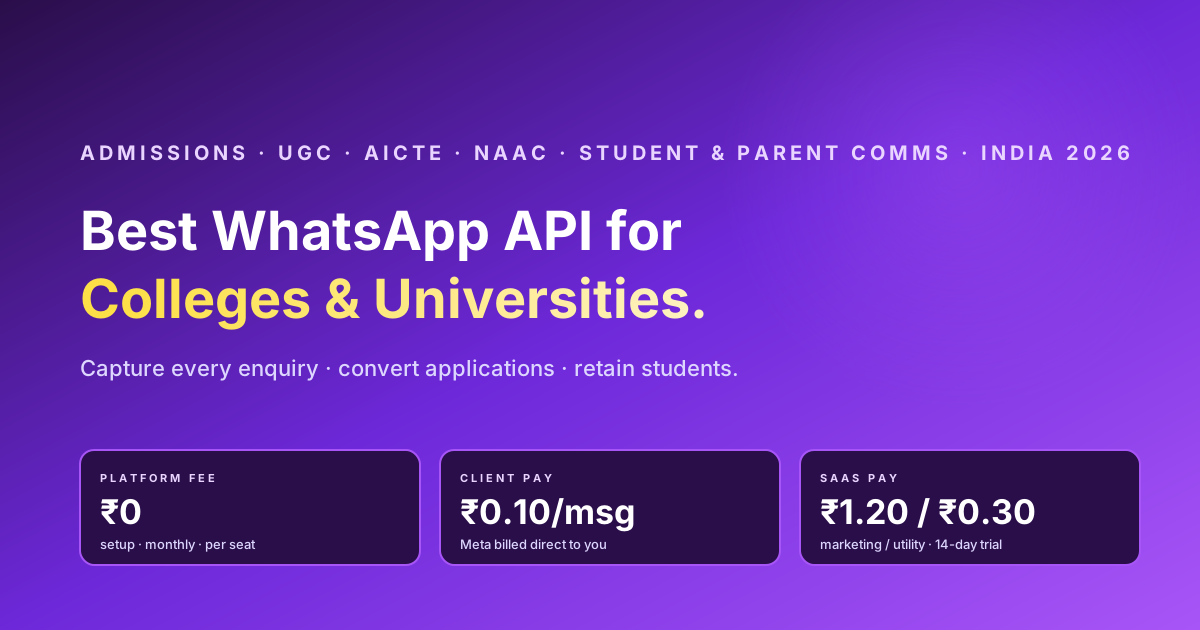
You can stand up the entire admissions-and-student communication layer — instant enquiry capture from website, ads and campus QR, a chatbot counsellor on fees, courses, eligibility and placements, application and document nudges that recover abandoned forms, offer-letter and secure fee-payment flows with deadline reminders, onboarding and orientation sequences, in-programme exam, result and fee-instalment broadcasts, and an opted-in alumni and referral engine — without engineering lift, while your SIS and admissions team stay the source of truth. RichAutomate charges ₹0 platform fee, ₹0 setup, ₹0 monthly. On Client Pay you pay only ₹0.10 per message plus Meta's own per-conversation charge billed to you directly by Meta at Meta's rates; on SaaS Pay it is an all-in ₹1.20 per marketing conversation and ₹0.30 per utility conversation — and counselling replies, application nudges, fee and exam reminders are utility conversations, the cheaper category. There is a 14-day free trial with 100 credits, so you can measure the response-speed and application-completion improvement before committing. Keep WhatsApp as the conversation layer, keep your student-information system as the source of truth, never promise guaranteed admission or placement, and verify UGC, AICTE, NAAC, advertising-standards and DPDP data rules as of 2026. See the full pricing page for details.
To see what non-compliance would actually cost, the DPDP penalty calculator sizes the exposure against your contact volume.
Stop losing seats to a slow reply
A college or university does not have to let high-intent enquiries leak away because the counsellor called back two days late, the application was abandoned, or the fee deadline passed unremarked. From the instant website, ad or QR capture, through the chatbot counsellor, the application and document nudges, the offer and secure fee payment, the onboarding and orientation, the in-programme exam and result updates, and the opted-in alumni relationship — WhatsApp can be the one continuous student thread, while your admissions team and SIS stay the source of truth. On illustrative numbers that means faster counselling, more applications completed and fewer lapsed fee deadlines, for a messaging bill that is a rounding error against the value of a filled seat. RichAutomate's pricing stays flat through all of it: ₹0 platform fee, ₹0 setup, ₹0 monthly — Client Pay at ₹0.10 per message with Meta conversation charges billed direct by Meta, or SaaS Pay at ₹1.20 marketing / ₹0.30 utility all-in. Start the 14-day free trial with 100 credits, WhatsApp us at 918160311319, or book a 30-minute walkthrough at https://calendly.com/inrichdaddy/30min. (All cohort, response-time and application figures here are illustrative — model your own on the calculator — no enrolment outcome is guaranteed, and UGC, AICTE, NAAC, advertising-standards and fee rules change; verify the current position as of 2026. This is operational guidance, not legal, regulatory or financial advice.)
Start your 14-day free trial → · See full pricing · Read the schools guide
Related: Best WhatsApp API for Study Abroad Consultants in India 2026 — the enquiry-to-departure workflow an overseas-education consultancy runs on WhatsApp: consent capture, counselling booking, SOP and document collection, deadline reminders and offer/visa-stage updates.